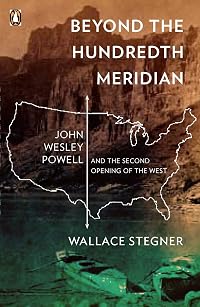
Beyond the Hundredth Meridian: John Wesley Powell and the Second Opening of the West
by Wallace Stegner
On This Page
Description
Pulitzer Prize winner Wallace Stegner recounts the remarkable career of Major John Wesley Powell, the distinguished ethnologist and geologist who explored the Colorado River, the Grand Canyon, and the homeland of the Southwest Indian tribes. This classic work is a penetrating and insightful study of the Powell's career, from the beginning of the Powell Survey, in which Powell and his men famously became the first to descend the Colorado River, to his eventual ouster from the Geological show more Survey. In masterful prose, Stegner details the expedition, as well as the philosophies and ideas that drove Powell. show lessTags
Recommendations













Member Reviews
Beautiful, thoughtful, and sweeping. More than I could take in. My first Stegner book, and it frankly impressed me with the depth of his story, the liveliness of his characters, and his applications to modern society.
I thought this would be the story of how Powell explored the southwest U.S. That is certainly a wild story, but less than half the book. It covers 30 years of Powells career: frontier upstart, unlikely explorer, lobbyist, celebrated scientist, political gamesman, bureaucratic father figure. Years ago vaguely remember hearing that later in the East Powell became an unpopular voice of caution that western water could not support large scale settlement. The last chapters tell how he ruffled feathers and established water and show more land policies that shaped western politics, land use, and conservationism. Stegner wrote in the 1950s with the limitations of a man in that day, and his applications are still relevant today. But I wonder if the west will hold strong for responsible resource management against the politics of growth and short-term prosperity. The pattern of seasonal widespread wildfires and dropping reservoir water levels is worrying, and I wonder if a modern-day Powell could even prevail on better judgement. show less
I thought this would be the story of how Powell explored the southwest U.S. That is certainly a wild story, but less than half the book. It covers 30 years of Powells career: frontier upstart, unlikely explorer, lobbyist, celebrated scientist, political gamesman, bureaucratic father figure. Years ago vaguely remember hearing that later in the East Powell became an unpopular voice of caution that western water could not support large scale settlement. The last chapters tell how he ruffled feathers and established water and show more land policies that shaped western politics, land use, and conservationism. Stegner wrote in the 1950s with the limitations of a man in that day, and his applications are still relevant today. But I wonder if the west will hold strong for responsible resource management against the politics of growth and short-term prosperity. The pattern of seasonal widespread wildfires and dropping reservoir water levels is worrying, and I wonder if a modern-day Powell could even prevail on better judgement. show less
A superb book about the latter half of the 19th century in the American West w/ J.W. Powell as the chief protagonist. Literate and provocative....where are these writers today? As I read this I was simultaneously reading/scanning First Through the Grand Canyon by Michael Ghiglieri. Working at the Grand Canyon, I've been told by countless people how poor Stegner's book is and some of those comment on how great Ghiglieri's book is. They are absolutely, completely, and totally bonkers. I've since found out that most of them know or are friends of Ghiglieri. That is certainly the only way he could have gotten the reviews he got and placed on the cover.
Anyway, to cut it short, Stegner knows how to write, does not feel the need to use a book show more as a means of starting/creating a vendetta against someone he doesn't like, and is considerably more balanced and literate in his approach. A great book by Stegner and worthy of the accolades. Grand Canyon people do not read.... show less
Anyway, to cut it short, Stegner knows how to write, does not feel the need to use a book show more as a means of starting/creating a vendetta against someone he doesn't like, and is considerably more balanced and literate in his approach. A great book by Stegner and worthy of the accolades. Grand Canyon people do not read.... show less
I bought this book during our first trip to the Southwest. Before this trip I had not thought too much about the West; it's there and it's big, that's about the extent of my perception.
Stegner's book, now over 60 years since publication, is a worthy read on several counts. First, the writing is terrific. I had not read any works by Stegner, known for mainly his western fiction, but this writer is one of the most skilled in literature; I will read more of his works. Second, the book uses John Wesley Powell and his career as an exposition of the West, particularly its geology and climate. Powell isn't too much a major figure in our history and he deserves the recognition that Stegner gives him. His exciting passage down the Colorado River show more is what he is most known for in the popular mind, but it was his career in Washington as head of the Bureau of Ethnology and of the US Geodetic Survey that is most remarkable. Powell understood in an amazingly foresighted way the real issues facing the settlement and long-term use of the West. ("West" in this context is mainly the Colorado plateau.) Much fantastical thinking of the region existed in the mid and latter 19th century -- that it was a place where small-scale homestead farming without effort or toil was to be achieved. Powell knew that the key characteristic of the region is its aridity. The annual rainfall could not support farming or grazing without careful manipulation of the water resources from rivers and streams. He saw that unplanned development, especially under the control of speculating and greedy land conglomerates, would only bring ruin. His "Grand Plan" for cooperation among the users of the region's resources ran into the opposition of powerful forces that portrayed his aims as counter to the American notion of free-wheeling unrestrained exploitation. He never completely countered these checks on his vision, but many of his ideas finally took root in land use policy in the 20th century. The interplay of the politics, lobbying, economic motivation, science, bureaucracy, and more in Powell's time is strikingly (and depressingly) similar to the forces that govern today's political dynamics.
Also of great interest is Powell's scholarly work on the Native American population of the West. At the time of overt warfare between the US government and the native tribes of the West, Powell carried out a scientific study of the diverse elements of native culture, almost at the last moment when this was still possible. His contributions in the field preserve a view of native life that would have otherwise been lost.
Powell was a major force the the opening of the West between the plains and the Pacific coast. Stegner's book is an excellent way to learn about this remarkable man and deepen insights into this unique area of our country. show less
Stegner's book, now over 60 years since publication, is a worthy read on several counts. First, the writing is terrific. I had not read any works by Stegner, known for mainly his western fiction, but this writer is one of the most skilled in literature; I will read more of his works. Second, the book uses John Wesley Powell and his career as an exposition of the West, particularly its geology and climate. Powell isn't too much a major figure in our history and he deserves the recognition that Stegner gives him. His exciting passage down the Colorado River show more is what he is most known for in the popular mind, but it was his career in Washington as head of the Bureau of Ethnology and of the US Geodetic Survey that is most remarkable. Powell understood in an amazingly foresighted way the real issues facing the settlement and long-term use of the West. ("West" in this context is mainly the Colorado plateau.) Much fantastical thinking of the region existed in the mid and latter 19th century -- that it was a place where small-scale homestead farming without effort or toil was to be achieved. Powell knew that the key characteristic of the region is its aridity. The annual rainfall could not support farming or grazing without careful manipulation of the water resources from rivers and streams. He saw that unplanned development, especially under the control of speculating and greedy land conglomerates, would only bring ruin. His "Grand Plan" for cooperation among the users of the region's resources ran into the opposition of powerful forces that portrayed his aims as counter to the American notion of free-wheeling unrestrained exploitation. He never completely countered these checks on his vision, but many of his ideas finally took root in land use policy in the 20th century. The interplay of the politics, lobbying, economic motivation, science, bureaucracy, and more in Powell's time is strikingly (and depressingly) similar to the forces that govern today's political dynamics.
Also of great interest is Powell's scholarly work on the Native American population of the West. At the time of overt warfare between the US government and the native tribes of the West, Powell carried out a scientific study of the diverse elements of native culture, almost at the last moment when this was still possible. His contributions in the field preserve a view of native life that would have otherwise been lost.
Powell was a major force the the opening of the West between the plains and the Pacific coast. Stegner's book is an excellent way to learn about this remarkable man and deepen insights into this unique area of our country. show less
A very thorough study of John Wesley Powell's life in public service, beginning with his expeditions to explore the rivers of the canyon lands through to his directorship of the Bureau of Ethnology and the U.S. Geological Survey. A significant part of the book focused on the political battles waged against Powell's vision for a cooperative settlement of the arid west in regards to water usage and rights, battles which are still being fought today. This was much drier than I expected (sorry for the pun) but here and there Stegner's masterful turn of phrase came through.
This book, originally published 1954, comes across to me as a bit old fashioned in its approach - yet the recounting of the Powell party's journey down the rivers and rapids, through the Grand Canyon, is most stirring. Danger, hardship and the elements are met with determination and grit.
This book was my introduction to Stegner and it hooked me on all his writing. It is essentially a biography of John Wesley Powell, a man primarily known for his exploration of the Colorado River. His river trips have an action-adventure feel, whereas his latter carreer explores the problems of aridity in the far west and how misguided federal ploicy has created the problems (tensions between water availability and land use) that still dog this section of the country today. Powell was an autodidactic scientist whose insights were profound, but largely ignored.
No Westerner can say he understands the West until he has read this book about John Wesley Powell. I'm afraid water problems of the past will pale compared to those in the future, brought on not so much by climate change, but by ignoring the lessons Powell tried to teach us about the arid West.
Members
- Recently Added By
Lists

Non-Fiction Worth Reading
1,025 works; 264 members
Author Information

94+ Works 20,897 Members
In 1972, Wallace Earle Stegner won a Pulitzer Prize for Angle of Repose (1971), a novel about a wheelchair-bound man's recreation of his New England grandmother's experience in a late nineteenth-century frontier town. Stegner was born on February 18, 1909 in Lake Mills, Iowa. He was an American novelist, short story writer, environmentalist, and show more historian; he has been called "The Dean of Western Writers". He also won the US National Book Award in 1977 for The Spectator Bird. Stegner grew up in Great Falls, Montana; Salt Lake City, Utah; and in the village of Eastend, Saskatchewan, which he wrote about in his autobiography Wolf Willow. Stegner taught at the University of Wisconsin and Harvard University. Eventually he settled at Stanford University, where he initiated the creative writing program. His students included Wendell Berry, and Sandra Day O'Connor. The Stegner Fellowship program at Stanford University is a two-year creative writing fellowship. The house Stegner lived in from age 7 to 12 in Eastend, Saskatchewan, Canada, was restored by the Eastend Arts Council in 1990 and established as a Residence for Artists; the Wallace Stegner Grant For The Arts offers a grant of $500 and free residency at the house for the month of October for published Canadian writers. Stegner died in Santa Fe, New Mexico, on April 13, 1993, from a car accident on March 28, 1993. (Bowker Author Biography) show less
All Editions
Some Editions
Awards and Honors
Awards
Distinctions
Common Knowledge
- Original publication date
- 1954
- People/Characters
- John Wesley Powell; Clover Adams; Henry Adams; Samuel Adams (Captain); Alexander Agassiz
- Important places
- USA; Grand Canyon, Arizona, USA
- Dedication
- For Bernard De Voto
- First words
- On July 4, 1868, about the time when Henry Adams was turning back toward New York to face a new and sharply altered America after ten years of study and diplomacy in the service of the old, two men who would have been worth h... (show all)is attention as a historian were going about their business on the western edge of the Great Plains.
- Quotations
- The things I want to know are in books; my best friend is a man who‘ll git me a book I ain‘t read.
- Abe Lincoln - Last words
- (Click to show. Warning: May contain spoilers.)But from the river bluffs where we have symbolically planted him, looking over the West that was his province, he can perhaps contemplate the truly vortical, corkscrew path of human motion and with some confidence wait for the future to catch up with him.
- Blurbers
- Doig, Ivan
Classifications
Statistics
- Members
- 919
- Popularity
- 29,264
- Reviews
- 14
- Rating
- (3.99)
- Languages
- English, Russian
- Media
- Paper, Audiobook, Ebook
- ISBNs
- 15
- ASINs
- 20