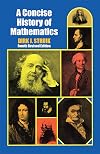
A Concise History of Mathematics: Fourth Revised Edition (Dover Books on Mathematics)
by Dirk J. Struik
On This Page
Description
This compact, well-written history - first published in 1948, and now in its fourth revised edition - describes the main trends in the development of all fields of mathematics from the first available records to the middle of the 20th century. Students, researchers, historians, specialists - in short, everyone with an interest in mathematics - will find it engrossing and stimulating. Beginning with the ancient Near East, the author traces the ideas and techniques developed in Egypt, show more Babylonia, China, and Arabia, looking into such manuscripts as the Egyptian Papyrus Rhind, the Ten Classics of China, and the Siddhantas of India. He considers Greek and Roman developments from their beginnings in Ionian rationalism to the fall of Constantinople; covers medieval European ideas and Renaissance trends; analyzes 17th- and 18th-century contributions; and offers an illuminating exposition of 19th century concepts. Every important figure in mathematical history is dealt with - Euclid, Archimedes, Diophantus, Omar Khayyam, Boethius, Fermat, Pascal, Newton, Leibniz, Fourier, Gauss, Riemann, Cantor, and many others. For this latest edition, Dr. Struik has both revised and updated the existing text, and also added a new chapter on the mathematics of the first half of the 20th century. Concise coverage is given to set theory, the influence of relativity and quantum theory, tensor calculus, the Lebesgue integral, the calculus of variations, and other important ideas and concepts. The book concludes with the beginnings of the computer era and the seminal work of von Neumann, Turing, Wiener, and others. show lessTags
Recommendations























Member Reviews
This volume delivers on its promise: an efficient, digestible history of mathematics up to (but excluding) the 20th century. The focus is unsurprisingly on the Western world. Although there are efforts (expanded in this 1967 revised edition) to take non-European mathematics into account in the sections on ancient and medieval periods, there is no recognition of any accomplishments outside of Europe in the modern era.
Since the book is rather short, it is prudently supported with a considerable bibliographic apparatus. A general bibliography constitutes the bulk of the introduction, and a more topical bibliography is appended to each of the eight chronological chapters. A full index of names helps make the volume useful for reference.
I show more have not had any formal study of mathematics since my undergraduate days, although I like to challenge myself periodically by reading math books that exceed my training. This one actually qualifies. Although it is primarily a history book, it constantly alludes to mathematical topics far in advance of what an accomplished college freshman calculus student is likely to have encountered. Even so, the book remained intelligible to me for the most part.
Author Struik goes some way toward offering ideas about how social and political circumstances impacted the development of mathematical ideas and techniques. He also remarks historical parallels in particular schools and periods of activity. The prose is fairly dry, but an effort is made to communicate the personalities of key mathematicians.
This read has sufficiently stoked my mathematical enthusiasm that I will be reading some actual math texts quite soon. show less
Since the book is rather short, it is prudently supported with a considerable bibliographic apparatus. A general bibliography constitutes the bulk of the introduction, and a more topical bibliography is appended to each of the eight chronological chapters. A full index of names helps make the volume useful for reference.
I show more have not had any formal study of mathematics since my undergraduate days, although I like to challenge myself periodically by reading math books that exceed my training. This one actually qualifies. Although it is primarily a history book, it constantly alludes to mathematical topics far in advance of what an accomplished college freshman calculus student is likely to have encountered. Even so, the book remained intelligible to me for the most part.
Author Struik goes some way toward offering ideas about how social and political circumstances impacted the development of mathematical ideas and techniques. He also remarks historical parallels in particular schools and periods of activity. The prose is fairly dry, but an effort is made to communicate the personalities of key mathematicians.
This read has sufficiently stoked my mathematical enthusiasm that I will be reading some actual math texts quite soon. show less
Indeholder "Indledning", "1. Begyndelsen", "2. Det gamle Orienten", "3. Grækenland", "4. Orienten efter det græske samfunds forfald", "5. Begyndelsen i Vesteuropa", "6. Det syttende århundrede", "7. Det attende århundrede", "8. Det nittende århundrede", "Personregister".
Glimrende matematikhistorie som var med til at vække og vedligeholde min interesse for matematik. Specielt nogle af de uendelige rækkeudviklinger for pi har jeg brugt en del tid på. Dirk J. Struik var professor i matematik på M.I.T. = Massachusetts Institute of Technology.
Glimrende matematikhistorie som var med til at vække og vedligeholde min interesse for matematik. Specielt nogle af de uendelige rækkeudviklinger for pi har jeg brugt en del tid på. Dirk J. Struik var professor i matematik på M.I.T. = Massachusetts Institute of Technology.
Oct 1, 2016 (Edited)Danish
Indeholder "Introduction", "The Beginnings", "The Ancient Orient", "Greece", "The Orient after the Decline of Greek Society", "The Beginnings in Western Europe", "The Seventeenth Century", "The Eighteenth Century", "The Nineteenth Century", "Index".
Illustreret med 49 portrætter og tekster. Dirk J. Struik var professor i matematik på M.I.T. = Massachusetts Institute of Technology.
Illustreret med 49 portrætter og tekster. Dirk J. Struik var professor i matematik på M.I.T. = Massachusetts Institute of Technology.
Oct 1, 2016Danish
Ratings
Members
- Recently Added By
Author Information

20+ Works 659 Members
Series
Belongs to Publisher Series
Common Knowledge
- Original title
- Concise history of mathematics
- Original publication date
- 1948
Classifications
Statistics
- Members
- 349
- Popularity
- 90,740
- Reviews
- 3
- Rating
- (3.25)
- Languages
- 8 — Danish, Dutch, English, German, Greek, Russian, Serbian, Swedish
- Media
- Paper, Ebook
- ISBNs
- 13
- UPCs
- 1
- ASINs
- 6