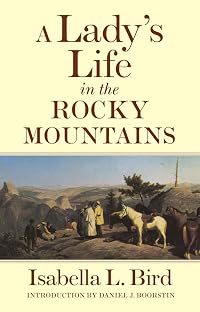
A Lady's Life in the Rocky Mountains
by Isabella L. Bird
On This Page
Description
From sickly child to pioneering Victorian explorer, Isabella Bird defied convention. After back surgery in 1850 and the recommendation of life in the open air, she finally looked her malaise and her pain in the eye and set off across the world completely alone. In Colorado she covered 800 miles on horseback, climbing mountains, wrangling cattle, sleeping in snow and finding herself drawn to a violent, one-eyed outlaw with a soft spot for poetry, known as 'Mountain Jim'. With the writing show more skills to match her spirit of adventure, she documented her journey in these letters to her sister, which were published as a collection in 1879. She was a true trailblazer - a Victorian woman of 4'11" with debilitating pain who chose to blow open life's limits. show lessTags
Recommendations
















Member Reviews
Written as letters to her sister back in England, the epistolary memoir of horse-riding and cabin dwelling in the late 19th Century American west is a fascinating time capsule. Here, widely separated, rugged individuals exist as islands of self-reliance with an unexpectedly active intellectual life. Recitations and attempts at scholarly papers happen around the fire as much as tales of brigands and lost cattle. Bird also finds herself a minor player in the opening act of the tragedy of noble and flawed "Mountain Jim". Also, it seems her hours or solo riding through frozen landscapes seems to border on masochism. However, it seems fitting to her as complaints about others seem to be directly proportional to the number of people she is show more amidst. show less
Isabella Bird was a middle-aged Victorian-era Englishwoman who apparently hadn’t read the middle-aged Victorian-era Englishwoman manual and thus traveled all over the world alone. And rode astride (except when somebody might be watching). Her book narrates her adventures in the Colorado Rockies in 1872-73. Interestingly, she doesn’t give a particular reason why she stopped over in Colorado (she was on her way back from a trip to Hawaii, and she doesn’t volunteer why she was there, either). At any rate, she did quite well for herself while here; rounded up cattle for an Estes Park rancher, engaged in a very discrete flirtation with the one-eyed desperado Rocky Mountain Jim (“desperado” is her word; about half the male show more population of Colorado is “desperados”, which, given the year was 1872, probably wasn’t far wrong), and became the first woman to ascend Long’s Peak (in October, at that). Sometimes you wonder if Isabella was totally clueless, incredibly lucky, or just gifted with the sublime self-confidence of a Proper Englishwoman. I favor the last. Her writing is almost modern seeming – she gives credit to the scenery but eschews the paroxysms of overblown language that flow from the quills of other Victorian travel writers, and has just enough of a sense of humor to provoke a grin now and then. For Coloradans, the best parts are probably her descriptions of the towns she passes through – Fort Collins is “altogether revolting” and has “less bugs but more flies” than Greeley; Longmont (“Longmount” to Ms. Bird) is “as uninviting as Fort Collins” and Boulder is “hideous”. (Denver, at least, has “good shops and fair hotels” and is sufficiently tamed that “shootings are as rare as in Liverpool”). To be fair to Ms. Bird, Coloradans seemed to be rather prejudiced against Englishwomen, but generally came around when Ms. Bird demonstrated her willingness to pitch in and wash dishes, cook, and herd livestock. I think I’d like to hear more of Ms. Bird; she continued her travels to Japan, Malaya, the Punjab, Kurdistan, Persia, China, and Canada. A pleasant and quick read. show less
In what started as letters to her sister Isabella Bird paints vivid pictures of a very young Colorado as she travels from the Sandwich Islands to Estes Park, Colorado. Because the trip to the Hawaiian islands is so fresh in Bird's mind, she can't help but make interesting comparisons between the tropical island and the wild western plains. She even wears the same clothes in both climates. As with Bird's other adventures, her courage and tenacity shine through her prose. Most memorable for me was the fact Bird would don a long skirt and ride polite side saddle in the company of men but alone she would wear pants and ride western style. Comfort, not propriety, was her ultimate goal.
It's rare that I read Westerns due to the genre being one of the wrongest things that ever wronged in the history of United States' literature. Another one is the holiday being celebrated today by the US Federal Government, a day that my ongoing reads of [Genesis (Memory of Fire, #1)] and [Almanac of the Dead] has thrown into piercing scrutiny. This work was the odd one out in the group in the brutal sense of the word, something I knew would be the case when I started out but didn't deter me due to, frankly, the shock I felt at learning that an English woman rode hundreds of miles in the Northwestern United States in 1873 and lived to not only tell, but write the tale. Her story is one where her deed proves her more a feminist than her show more word, a word that is horribly imperialist and the reason why I find more worth in a single work of fiction by an actual citizen than a hundred nonfiction pieces by tourists, but with a bag of salt these letters render the concept of the "fairer sex" null and void. It's compromised, but unlike reading something written by a white man during the same time period, this piece cuts through some of the bullshit by the sheer fact of existing.
It helps that she's a decent prose stylist, along with the fact that for a while at the beginning, she's traveling through the area I grew up in. California is not one that crops up often in the literature I read, and when it does it is most often Los Angeles that graces the pages, a city I have my share of memories in but in no way compares to remembrance of the Bay Area. Reveler in imagery that I am, it is different when another agrees with the oddities, annoyances, and beauty that I have encountered in my daily life in and around San Francisco, a concordance that only becomes more precious when separated by almost 150 years. In other words, it made me nostalgic, but that happens rarely enough that I can afford to indulge.
Judgmental she was, but not enough to forbear having a sense of humor. This and a firm (white) head on her shoulders helped her immensely through snow storms, bears, near starvation, a useless poet with a bottomless stomach, and a particularly infamous desperado called "Mountain Jim" who Bird had the most interesting time with because she thought he was really hot. She danced around the pronouncement like any white woman did at the time, but that's how it was.
This is her in her last letter following up on her viewing the wife doing all the work in various settlements she stayed at as completely normal. How she would describe her own commitment to travel that would in the future venture far beyond shores both European and United States, I cannot say. However, she did write it down for those of us who need a "Look! If she could do it almost 150 years ago, so can I," every so often, so that's of merit.
A bit of humor for the road. show less
I pass hastily over the early part of the journey, the crossing the bay in a fog as chill as November, the number of "lunch baskets," which gave the car the look of conveying a great picnic party, the last view of the Pacific, on which I had looked for nearly a year, the fierce sunshine and brilliant sky inland, the look of long rainlessness, which one may not call drought, the valleys with sides crimson with the poison oak, the dusty vineyards, with great purple clusters thick among the leaves, and between the vines great dusty melons lying on the dusty earth.
It helps that she's a decent prose stylist, along with the fact that for a while at the beginning, she's traveling through the area I grew up in. California is not one that crops up often in the literature I read, and when it does it is most often Los Angeles that graces the pages, a city I have my share of memories in but in no way compares to remembrance of the Bay Area. Reveler in imagery that I am, it is different when another agrees with the oddities, annoyances, and beauty that I have encountered in my daily life in and around San Francisco, a concordance that only becomes more precious when separated by almost 150 years. In other words, it made me nostalgic, but that happens rarely enough that I can afford to indulge.
In traveling there is nothing like dissecting people's statements, which are usually colored by their estimate of the powers or likings of the person spoken to, making all reasonable inquiries, and then pertinaciously but quietly carrying out one's own plans.
Judgmental she was, but not enough to forbear having a sense of humor. This and a firm (white) head on her shoulders helped her immensely through snow storms, bears, near starvation, a useless poet with a bottomless stomach, and a particularly infamous desperado called "Mountain Jim" who Bird had the most interesting time with because she thought he was really hot. She danced around the pronouncement like any white woman did at the time, but that's how it was.
I have seen a great deal of the roughest class of men both on sea and land during the last two years, and the more important I think the "mission" of every quiet, refined, self-respecting woman—the more mistaken I think those who would forfeit it by noisy self-assertion, masculinity, or fastness.
This is her in her last letter following up on her viewing the wife doing all the work in various settlements she stayed at as completely normal. How she would describe her own commitment to travel that would in the future venture far beyond shores both European and United States, I cannot say. However, she did write it down for those of us who need a "Look! If she could do it almost 150 years ago, so can I," every so often, so that's of merit.
Birdie slipped so alarmingly that I got off and walked, but then neither of us could keep our feet, and in the darkness she seemed so likely to fall upon me, that I took out of my pack the man's socks which had been given me at Perry's Park, and drew them on over her fore-feet—an expedient which for a time succeeded admirably, and which I commend to all travelers similarly circumstanced.
A bit of humor for the road. show less
My reading for a visit to Colorado was A Lady's Life in the Rocky Mountains, a collection of letters written during a trip in 1873 to Colorado by a remarkable solo world-traveling Englishwoman, Isabella L. Bird. I recommend it to anyone living in the region as both a first-hand account of the early settlements in the state and intimate descriptions of the hard-working and at times desperate people who built them, and rapturous descriptions of the beauty and rigors of the surroundings.
This book is available from Project Gutenberg and well worth reading if only to admire the tenacity and courage of the author. Do note that PG offers other books on her travels, to Hawaii,Tibet, Japan, Persia, Kurdistan. Not most peoples' idea of proper show more behavior for a Victorian lady. show less
This book is available from Project Gutenberg and well worth reading if only to admire the tenacity and courage of the author. Do note that PG offers other books on her travels, to Hawaii,Tibet, Japan, Persia, Kurdistan. Not most peoples' idea of proper show more behavior for a Victorian lady. show less
Her views on race are despicable, but probably common for a woman of her time. She also doesn't seem to enjoy or respect the women around her. I don't know why I hoped for better, but it was interesting to read as a travelogue best-seller for the late 1800s. I am astonished at all she managed to survive -- really, I would think falling through the ice in below freezing weather repeatedly with no break to warm up would finish a person off, but it's certainly a thrilling narrative, of bracing hardships and unchinked cabins. Why didn't they chink the cabins? I would think that would be a basic sort of move, but I guess if you move to Colorado for consumption, it might make sense to stay in an airy cabin rather than a smoky one. Anyway, I show more found the litany of cold/snow/blizzard/ riding over unbroken terrain a lot to believe, but I enjoyed the rhapsodizing over the scenery, and was mostly able to ignore the clear Christian propaganda throughout the book. I didn't enjoy it enough to pick up another of her works, and I shudder to imagine what she might say about Native Hawaiians or Thai or Japanese people when traveling in their countries. I wanted to know more about Mountain Jim, but it appears her account of him is the main documentation that has made it to the internet.
Advanced listening copy provided by Libro.fm show less
Advanced listening copy provided by Libro.fm show less
Isabella Bird was an inveterate traveller, naturalist, and writer. This might not be an unusual description for women today but Bird was all of these things in the mid-nineteenth century, a time when women's lives were far more constrained than they are today. She chronicled many of her travels in letters home to her sister before they were published in collections.
This particular collection of letters details Bird's long journeying through the Rocky Mountains, into the heart of the land, often unaccompanied, only choosing her routes based on her preference of the moment and always willing to deviate from the plan. She wrote beautiful descirptions of a time and place much changed today, appreciating the remote wildness she found on many show more of her tramps. In addition to her natural writings, she also turned her eye on the people who inhabited these lonely, majestic places as well and her character depictions are delightful. She has captured the character of the folks who chose to eke out a living homesteading in the shadows and valleys of these majestic mountains, capturing the fortitude, the sometime lawlessness, the hospitality, and the suspicions of her hosts and acquaintances.
Make no mistake that this is a modern day account. It is very much rooted in its time and it takes a little adjustment to Bird's language and writing to get into the book. But once in the story, the reader will happily accompany her on her meanderings, oftentimes in awe of her determination. The writing flowed clearly and smoothly along and I'll probably try searching out more of her straightforward and appealing travelogues. I may not have to suffer the discomforts she did in traveling but the romanticism of her journey, even when she encounters difficulties, is unbeaten. show less
This particular collection of letters details Bird's long journeying through the Rocky Mountains, into the heart of the land, often unaccompanied, only choosing her routes based on her preference of the moment and always willing to deviate from the plan. She wrote beautiful descirptions of a time and place much changed today, appreciating the remote wildness she found on many show more of her tramps. In addition to her natural writings, she also turned her eye on the people who inhabited these lonely, majestic places as well and her character depictions are delightful. She has captured the character of the folks who chose to eke out a living homesteading in the shadows and valleys of these majestic mountains, capturing the fortitude, the sometime lawlessness, the hospitality, and the suspicions of her hosts and acquaintances.
Make no mistake that this is a modern day account. It is very much rooted in its time and it takes a little adjustment to Bird's language and writing to get into the book. But once in the story, the reader will happily accompany her on her meanderings, oftentimes in awe of her determination. The writing flowed clearly and smoothly along and I'll probably try searching out more of her straightforward and appealing travelogues. I may not have to suffer the discomforts she did in traveling but the romanticism of her journey, even when she encounters difficulties, is unbeaten. show less
Members
- Recently Added By
Lists

500 Great Books by Women
507 works; 60 members

Geography and Travel from The Book-Lover
291 works; 1 member

Club Read's Recommended Nonfiction Written by Women
618 works; 30 members
Talk Discussions
Past Discussions
Folio Archives 330: A Lady’s Life in the Rocky Mountains by Isabella Bird 1988 in Folio Society Devotees (July 2023)
Author Information

All Editions
Some Editions
Awards and Honors
Series
Belongs to Publisher Series
Work Relationships
Is contained in
Is abridged in
Has as a reference guide/companion
Common Knowledge
- Original publication date
- 1879
- People/Characters
- Isabella Bird Bishop; "Rocky Mountain Jim" Nugent
- Important places
- Rocky Mountains, USA; Estes Park, Colorado, USA; USA; Colorado, USA
- Dedication
- To my sister, to whom these letters were originally written, they are now affectionately dedicated.
- First words
- I have found a dream of beauty at which one might look all one's life and sigh.
[Introduction, B&N edition] Like the glorious after glow so often described in A Lady's Life in the Rocky Mountains, Isabella Bird's impassioned travelogue continues to delight us long after its initial publicatio... (show all)n in 1879.
[Note to the Second Edition] For the benefit of other lady travellers, I wish to explain that my "Hawaiian riding dress" is the "American Lady's Mountain Dress," a half-fitting jacket, a skirt reaching to the ankles, and ful... (show all)l Turkish trousers gathered into frills falling over the boots,--a thoroughly serviceable and feminine costume for mountaineering and other rough travelling, as in the Alps of any other part of the world.
[Note to the Third Edition] In consequence of the unobserved omission of a date to my letters having been pointed out to me, I take this opportunity of stating that I travelled in Colorado in the autumn and early winter of 1... (show all)873, on my way to England from the Sandwich Islands. - Last words
- (Click to show. Warning: May contain spoilers.)A drive of several hours over the Plains brought us to Greeley, and a few hours later, in the far blue distance, the Rocky Mountains, and all that they enclose, went down below the prairie sea.
(Click to show. Warning: May contain spoilers.)[Introduction, B&N edition] More than just a classic travelogue, Isabella Bird's A Lady's Life in the Rocky Mountains speaks across generations, emboldening women to explore their own paths of life.
Classifications
Statistics
- Members
- 1,016
- Popularity
- 25,639
- Reviews
- 21
- Rating
- (4.07)
- Languages
- 5 — English, French, German, Italian, Japanese
- Media
- Paper, Audiobook, Ebook
- ISBNs
- 79
- UPCs
- 1
- ASINs
- 28