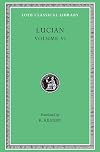
Works
by Lucian
On This Page
Description
Collected here are all of Lucian's major works. This includes his satires, dialogues, apologias, essays, and proto-novels. Lucian's sharp wit and searing criticisms are heightened by his exacting and eloquent style. He could move effortlessly from the bawdy to the supremely sophisticated, touching on all strata of the ancient intellect. His extensive traveling across Europe further influenced and developed his writing. Lucian's eccentric prose pieces tell of interplanetary war, alien show more encounters, and space travel. Consequently Lucian is considered the first science fiction novelist. Yet Lucian remains most lauded for his pointed satires, mocking authoritative tyrants and intellectual trends. In "The Works of Lucian of Samosata" we see Lucian in all of his talents and colors, offering insight into the classical mind. show lessTags
Recommendations
















Member Reviews
Okay, so it's taken a while to finish this. I had a free e-book version and, boy, does that show. It's even more evident in the glossary in the back where all the entries are in all-caps and the scanner thingie just can't deal with capitals that have diacritical marks. But that's neither here nor there. Meh, you get what you pay for.
Not sure why I started it in the first place, but probably after Natalie Haynes banged on about him. And then, a lot of it was slow going. I was on the look-out for the first evidence of science fiction (call it fantasy, but it does involve going to the moon ... and the sun for that matter), the faux Jesus character (which was more about the gullibility Lucian attributed to Christians of his time), and the show more earliest version of The Sorcerer's Apprentice. Well, that last one is perfectly valid.
On the one hand, Lucian despised hypocritical philosophers, but apparently liked a specific Cynic. He cheerfully avers the non-existence of the gods and then immediately (at least it is in this edition) writes a dialog of the gods complaining there are people down there saying they don't exist. Dialogs of the gods are one of his particular favorites.
Many of the pieces are dialogs, and like the plays of the Classical period (and modern radio programs) they contain stage directions in the dialog: "Why here's that man we were just talking about approaching us holding something in his hand" sort of thing. Were these meant to be performed? I supposed that he would read these aloud to his friends and later pass them around.
There is philosophy, imagination, and comedy in here. Some of it, though, takes some wading through. show less
Not sure why I started it in the first place, but probably after Natalie Haynes banged on about him. And then, a lot of it was slow going. I was on the look-out for the first evidence of science fiction (call it fantasy, but it does involve going to the moon ... and the sun for that matter), the faux Jesus character (which was more about the gullibility Lucian attributed to Christians of his time), and the show more earliest version of The Sorcerer's Apprentice. Well, that last one is perfectly valid.
On the one hand, Lucian despised hypocritical philosophers, but apparently liked a specific Cynic. He cheerfully avers the non-existence of the gods and then immediately (at least it is in this edition) writes a dialog of the gods complaining there are people down there saying they don't exist. Dialogs of the gods are one of his particular favorites.
Many of the pieces are dialogs, and like the plays of the Classical period (and modern radio programs) they contain stage directions in the dialog: "Why here's that man we were just talking about approaching us holding something in his hand" sort of thing. Were these meant to be performed? I supposed that he would read these aloud to his friends and later pass them around.
There is philosophy, imagination, and comedy in here. Some of it, though, takes some wading through. show less
The Fowler of the translation is the Fowler of [The King's English]. Lucian's works are primarily satires, including one of the first voyages to the moon, parodies of the Greek romance novels popular at the time, and many , many digs at professional philosophers, whom he regards as parasites and fakes. The tone is not modern, but it is comfortable and familiar, rather urbane. Lucian travelled around the Roman Empire, teaching, and giving readings ( of the satires in these volumes, among other things ). An interesting life at a fortunate period of the Roman Empire - it could be the basis for an fun novel.
Ratings
Members
- Recently Added By
Lists

How to Read a Book's Recommended Reading List
309 works; 10 members

Philip Ward's Lifetime Reading Plan
592 works; 22 members
Author Information

502+ Works 3,877 Members
Lucian, the wit and satirist, was a brilliant Greek writer in the time of the Roman Empire. He was born in Samosata, Syria. He traveled and lectured in Italy, Asia Minor, and Gaul; and in later life, held a government position in Egypt. Of nearly 80 works, the most important and characteristic are his essays written in dialogue form. "Dialogues of show more the Gods," which satirizes mythology; "Dialogues of the Dead," which are expositions of human vanity; and "The Sale of Lives," which satirizes various schools of philosophy. He is a good critical source for ancient art and for information about his literary contemporaries. "The True History," a nonsense fantasy and parody of adventure stories, influenced Rabelais, Swift 1), and Voltaire. (Bowker Author Biography) show less
Awards and Honors
Notable Lists
Common Knowledge
- Canonical title
- Works
Classifications
Statistics
- Members
- 176
- Popularity
- 185,382
- Reviews
- 2
- Rating
- (3.50)
- Languages
- 7 — Catalan, English, French, Greek (Ancient), Latin, Multiple languages, Spanish
- Media
- Paper, Ebook
- ISBNs
- 6
- ASINs
- 6