On This Page
Description
Fourteen-year-old Madeleine of Cambridge, England, struggling to cope with poverty and her mother's illness, and fifteen-year-old Elliot of the Kingdom of Cello in a parallel world where colors are villainous and his father is missing, begin exchanging notes through a crack between their worlds and find they can be of great help to each other.Tags
Recommendations




Member Reviews
A Corner of White isn't quite like anything else I've ever read...but I really, really liked it. Primarily a quirky nonsense fantasy---reminiscent of Roald Dahl, Lewis Carroll, and Catherynne M. Valente's Fairyland series---it also contains elements of a contemporary young adult novel, where the 14- and 15-year-old protagonists come to realize some uncomfortable truths about themselves in the context of their normal, everyday lives. The combination is fresh and fun and unexpectedly compelling, and I can't wait to read the next book in the series. ...Which will arrive rather sooner than later, I hope.
Madeleine lives with her mother in Cambridge, no longer as well off as she used to be now that they've run away from her father, and has an eccentric life as a homeschooled kid with friends Jack and Belle. Elliot lives in the Kingdom of Cello where colors don't just exist visually - they also attack. His dad is missing, presumed dead, or taken by a Purple and Elliot is determined to find him.
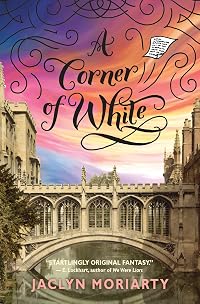
Over the course of the story, of course, their lives end up intertwining. The world-building was okay but not as fleshed out as I would like, as I had trouble imagining exactly what an attacking color would look like. Is it transparent? Opaque? Can it look humanoid or is each different? And my expectations were elevated both because I've really show more liked this author's books in the past and because one of the blurbs on the cover calls it "Startlingly original fantasy." Not sure I'd go that far - sure, things were interesting but... not that amazing. I also had a really hard time believing English homeschooling laws would allow the oddball version dreamed up by Madeleine's mother. All that aside, the story kept my attention and I enjoyed the characters and their interactions. The ending took me by surprise and I'm interested enough to look up the next book in the series. show less
Over the course of the story, of course, their lives end up intertwining. The world-building was okay but not as fleshed out as I would like, as I had trouble imagining exactly what an attacking color would look like. Is it transparent? Opaque? Can it look humanoid or is each different? And my expectations were elevated both because I've really show more liked this author's books in the past and because one of the blurbs on the cover calls it "Startlingly original fantasy." Not sure I'd go that far - sure, things were interesting but... not that amazing. I also had a really hard time believing English homeschooling laws would allow the oddball version dreamed up by Madeleine's mother. All that aside, the story kept my attention and I enjoyed the characters and their interactions. The ending took me by surprise and I'm interested enough to look up the next book in the series. show less
Okay, a year after I originally read this, I can't remember why I gave it 3 stars...
My 3 star rating is truly an "okay, I liked it, but not enough to a)reread it, b) buy a copy, and c) put it on my top 10 recommend list"
But, as time has gone on, this book has stuck with me and I find myself revisiting Madeleine and Elliot: their conversations, the lives they lead, the worlds they live in, their separate realities, and the point(s) at which they intersect.
When the second book arrived, I gobbled it up, breathlessly, adoringly, and now I want more.
So, accordingly, I must change my rating from a 3 star to a 5 star, because I will buy these books and I will reread them, and the more I read them, the more I find to love about the worlds and show more characters that Moriarty has created. show less
My 3 star rating is truly an "okay, I liked it, but not enough to a)reread it, b) buy a copy, and c) put it on my top 10 recommend list"
But, as time has gone on, this book has stuck with me and I find myself revisiting Madeleine and Elliot: their conversations, the lives they lead, the worlds they live in, their separate realities, and the point(s) at which they intersect.
When the second book arrived, I gobbled it up, breathlessly, adoringly, and now I want more.
So, accordingly, I must change my rating from a 3 star to a 5 star, because I will buy these books and I will reread them, and the more I read them, the more I find to love about the worlds and show more characters that Moriarty has created. show less
Fourteen year old Madeleine Tully lives with her eccentric mother (and her mother's sewing machine) in an attic in Cambridge, England, The World. She is convinced that her father will soon come looking for her and take her back to a life of luxury.
In the meantime, she is homeschooled with her friends Jack and Belle, learns about Byron and Isaac Newton, rides her bike around Cambridge, and leaves letters in a broken parking meter for Elliot.
Even though she thinks the world Elliot describes is one he made up.
Fifteen year old Elliot Baranski lives with his mother in Bonfire, the Farms, the Kingdom of Cello, a place where crops are failing, seasons roam erratically and Colours attack. Elliot believes his missing father was abducted by a show more Purple and is planing yet another attempt to find him.
In the meantime, he fixes things and hangs out with his friends and leaves letters for Madeleine in the TV sculpture a friend made.
Even though he knows it is illegal to fail to report a crack through to The World.
A Corner of White also includes extracts from a travel guide to Cello, and a newspaper column written by Cello's princesses. However, most of the narrative is third person, omniscient. It jumps backwards and forward between Madeleine and Elliot, and then between them and the people around them.
All this jumping seems random at first. As do the details of Madeleine and Elliot's lives, which are presented quite matter-of-factly, with explanations drifting slowly in.
What makes both these worlds feel real, however, is the characters - their convictions, their conversations and their relationships. That's where the heart of the book is.
A Corner of White is unusual, gorgeously written, whimsical and witty. A tale of growing up, friendship and dealing with absent fathers. Peppered with fascinating facts about history of science and the science of colours.
I thought it was lovely and was enjoying it enormously.
AND THEN! And then, unexpectedly, the pieces suddenly start falling together! I had thought I was seeing random glimpses into Elliot and Madeleine's respective worlds and then I discovered there was a bigger picture! A mystery!
This was incredibly exciting and satisfying and unexpected.
Dear Internet, when is the sequel coming? show less
In the meantime, she is homeschooled with her friends Jack and Belle, learns about Byron and Isaac Newton, rides her bike around Cambridge, and leaves letters in a broken parking meter for Elliot.
Even though she thinks the world Elliot describes is one he made up.
Fifteen year old Elliot Baranski lives with his mother in Bonfire, the Farms, the Kingdom of Cello, a place where crops are failing, seasons roam erratically and Colours attack. Elliot believes his missing father was abducted by a show more Purple and is planing yet another attempt to find him.
In the meantime, he fixes things and hangs out with his friends and leaves letters for Madeleine in the TV sculpture a friend made.
Even though he knows it is illegal to fail to report a crack through to The World.
A Corner of White also includes extracts from a travel guide to Cello, and a newspaper column written by Cello's princesses. However, most of the narrative is third person, omniscient. It jumps backwards and forward between Madeleine and Elliot, and then between them and the people around them.
All this jumping seems random at first. As do the details of Madeleine and Elliot's lives, which are presented quite matter-of-factly, with explanations drifting slowly in.
What makes both these worlds feel real, however, is the characters - their convictions, their conversations and their relationships. That's where the heart of the book is.
A Corner of White is unusual, gorgeously written, whimsical and witty. A tale of growing up, friendship and dealing with absent fathers. Peppered with fascinating facts about history of science and the science of colours.
I thought it was lovely and was enjoying it enormously.
AND THEN! And then, unexpectedly, the pieces suddenly start falling together! I had thought I was seeing random glimpses into Elliot and Madeleine's respective worlds and then I discovered there was a bigger picture! A mystery!
This was incredibly exciting and satisfying and unexpected.
Dear Internet, when is the sequel coming? show less
This was a wonderfully gentle fantasy story about two teens in parallel worlds passing letters to each other, one in a damaged parking meter and the other in a playground sculpture featuring a broken TV set. One world, known as The World, is as we know it. Madeleine has a group of friends who are homeschooled by a variety of different people. Her mother is a little wacky and becomes more wacky as the days progress. The other world, known as Cello, has a problem with color attacks. Some colors are more dangerous than others. Elliot is highly respected in his world but his father is missing and Elliot learns he is not the only missing person in Cello. Many of the letters that are passed are written to try and make the other person show more understand what color means to them. Each teen has a major personal problem and they are able to help each other.
I found that the story started a little slow but gradually became more and more interesting as more facts about Cello became known and I was very interested in understanding the color situation there. Teens and adults will love this story. show less
I found that the story started a little slow but gradually became more and more interesting as more facts about Cello became known and I was very interested in understanding the color situation there. Teens and adults will love this story. show less
I enjoyed the heck out of this book—Moriarty is a refreshingly original voice in YA fantasy literature.
For the first chapter or so, I was concerned about the level of whimsy, but light, quirky tone is balanced by a world that is grounded and complex. The story itself is quiet, yet exciting and well-told.
Recommended for Pratchett fans, aficionados of Pushing Daisies, and anyone who enjoys non-traditional fantasy fiction.
For the first chapter or so, I was concerned about the level of whimsy, but light, quirky tone is balanced by a world that is grounded and complex. The story itself is quiet, yet exciting and well-told.
Recommended for Pratchett fans, aficionados of Pushing Daisies, and anyone who enjoys non-traditional fantasy fiction.
This is a very odd book. Not odd bad at all just odd. This is a book filled with a strong narrative voice, a quirky cast, and no one but two rather unusual environments. Don’t get the sense that this is a disjointed literary ramble, though, because even unconnected things end up fitting better than you could have imagined.
The story opens with an excerpt from a travel guide, only it’s about the Kingdom of Cello, a fantastical place that clearly exists only in imagination. When the story begins with Madeleine transplanted from her life of glamour and riches to a small flat in Cambridge, England, with her rather strange mother, the connection to the travel guide is unclear. It’s the voice that keeps you reading. But Madeleine is only show more one of a large cast of point of view characters who move in and out of the center stage smoothly. Some of these characters are confined to our world while others live in Cello itself, a place not so imaginary after all though it retains its fantastical character with a vengeance, a place where people have odd talents and colors attack out of nowhere.
Connections between the two dimensions had existed in the past and are occasionally discovered (and destroyed) even now, after the plague crossed through with devastating effect. Elliot, of Cello, risks banishment and death when he discovers a note from the other world and begins a conversation with Madeleine that is instrumental in both of their growth, these two playing the main characters around whom the story revolves.
The conversation is odd because Madeleine doesn’t believe in Cello, but at the same time she’s studying Isaac Newton (she is part of a home school group and their assignment was to “become” an important person who went to Cambridge). She uses what she’s learning from Newton to respond to Elliot, blending interesting information into the narrative as well as showing how different their two worlds are.
I feel it’s hard to describe this book in any way that captures its essence. It plays with reality, science, relationships, and a sense of self. The playful, often random-seeming, voice tricks you into thinking it is fluff and easy to dismiss, but you find yourself returning for another glimpse and thinking about the characters and what they are going through at odd moments even when not reading.
Elliot and Madeleine are tied together by the loss of their fathers, Madeleine because she ran away and stayed away, and Elliot because a purple (one of those vicious colors) killed his uncle the same night his father disappeared. Seeking their fathers is a key part of the story, but not all of it by any means.
This is a complex story that works on many levels. It made me laugh at points, made me cry, and delighted me more than I could have imagined when I picked it up on NetGalley on a whim. I’m glad I spent this time with Madeleine, Elliot, Jack, Belle, and all the other characters in the book. I think you would be too. show less
The story opens with an excerpt from a travel guide, only it’s about the Kingdom of Cello, a fantastical place that clearly exists only in imagination. When the story begins with Madeleine transplanted from her life of glamour and riches to a small flat in Cambridge, England, with her rather strange mother, the connection to the travel guide is unclear. It’s the voice that keeps you reading. But Madeleine is only show more one of a large cast of point of view characters who move in and out of the center stage smoothly. Some of these characters are confined to our world while others live in Cello itself, a place not so imaginary after all though it retains its fantastical character with a vengeance, a place where people have odd talents and colors attack out of nowhere.
Connections between the two dimensions had existed in the past and are occasionally discovered (and destroyed) even now, after the plague crossed through with devastating effect. Elliot, of Cello, risks banishment and death when he discovers a note from the other world and begins a conversation with Madeleine that is instrumental in both of their growth, these two playing the main characters around whom the story revolves.
The conversation is odd because Madeleine doesn’t believe in Cello, but at the same time she’s studying Isaac Newton (she is part of a home school group and their assignment was to “become” an important person who went to Cambridge). She uses what she’s learning from Newton to respond to Elliot, blending interesting information into the narrative as well as showing how different their two worlds are.
I feel it’s hard to describe this book in any way that captures its essence. It plays with reality, science, relationships, and a sense of self. The playful, often random-seeming, voice tricks you into thinking it is fluff and easy to dismiss, but you find yourself returning for another glimpse and thinking about the characters and what they are going through at odd moments even when not reading.
Elliot and Madeleine are tied together by the loss of their fathers, Madeleine because she ran away and stayed away, and Elliot because a purple (one of those vicious colors) killed his uncle the same night his father disappeared. Seeking their fathers is a key part of the story, but not all of it by any means.
This is a complex story that works on many levels. It made me laugh at points, made me cry, and delighted me more than I could have imagined when I picked it up on NetGalley on a whim. I’m glad I spent this time with Madeleine, Elliot, Jack, Belle, and all the other characters in the book. I think you would be too. show less
Members
- Recently Added By
Lists

Red Dot 2014-2015 - Older Readers - Longlist
37 works; 4 members

Books Read in 2016
4,666 works; 199 members

Book Worlds We'd Like To Visit
322 works; 158 members
Author Information

19+ Works 5,808 Members
Jaclyn Moriarty is the prize-winning, best-selling author of novels for young adults and adults including Feeling Sorry for Celia and The Year of Secret Assignments. Jaclyn grew up in Sydney, lived in England, the US, and Canada, and now lives in Sydney again. She was born in 1968 in Perth and studied English and Law at the University of Sydney. show more She then completed a Masters in Law at Yale University and a PhD at Gonville Caius College, Cambridge. She worked asan entertainment an dmedia lawyer before becoming a full-time writer. The Asbury Brookfield Series is four novels that revolve around various student that attend the exclusive private school, Asbury High. Many of the students cross over into more than one novel. The series includes: Feeling Sorry for Celia, Finding Cassie Crazy, The Betrayal of Bindy Mackenzie, and Dreaming of Amelia. Her title The Cracks in the Kingdom won the Aurealis Award in 2014 for Young Adult Novel. It also won the Ethel Turner Prize for Young People¿s Literature. (Bowker Author Biography) show less
Some Editions
Awards and Honors
Awards
Distinctions
Series

Common Knowledge
- Canonical title
- A Corner of White
- Original publication date
- 2012
- People/Characters
- Madeleine Tully; Elliot Baranski
- Important places
- Cambridge, Cambridgeshire, England, UK; Bonfire, The Farms, Kingdom of Cello
- Epigraph
- From Memoir of Isaac Newton by John Conduitt, 1727
[Isaac Newton] received the famous problem which was intended to puzzle all the Mathematicians in Europe at 4 o'clock in the afternoon when he was very much t... (show all)ired with the business of the Mint where he had been employed all day, & yet he solved it before he went to bed that night. - Dedication
- To Charlie, with love
- First words
- FROM THE KINGDOM OF CELLO: AN ILLUSTRATED TRAVEL GUIDE, BY T.I. CANDLE
INTRODUCTION
The Kingdom of Cello (pronounced ‘Chello’) needs no introduction.
Madeleine Tully turned fourteen yesterday but today she did not turn anything. - Last words
- (Click to show. Warning: May contain spoilers.)She swung her bike around and rode back to fetch the letter.
Classifications
- Genres
- Fiction and Literature, Tween, Fantasy, Kids, Teen, Young Adult
- DDC/MDS
- 813.6 — Literature & rhetoric American literature in English American fiction in English 2000-
- LCC
- PZ7 .M826727 .C — Language and Literature Fiction and juvenile belles lettres Fiction and juvenile belles lettres Juvenile belles lettres
- BISAC
Statistics
- Members
- 526
- Popularity
- 57,133
- Reviews
- 49
- Rating
- (3.85)
- Languages
- English, Portuguese, Spanish
- Media
- Paper, Audiobook, Ebook
- ISBNs
- 16
- ASINs
- 5