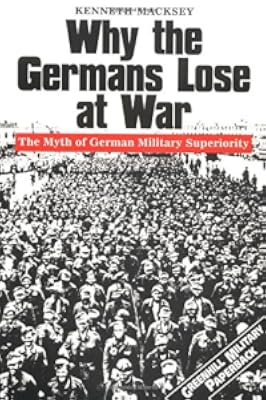
Why the Germans Lose at War : The Myth of German Military Superiority
by Kenneth Macksey
On This Page
Description
Focusing on the two World Wars, Kenneth Macksey examines the inherent flaws in the German military system and its generalship, highlighting the German military's tendency to underestimate the enemy and believe its own propaganda.Tags
Recommendations

























Member Reviews
If you go by the title, I guarantee you will be scratching your head and try to figure out are you reading a book that by accident got the cover with the title in question.
Book is not analysis on why Germans lose at war - this is story of highest level of command of German army (from around unification, through 1800's, WW1 and finally WW2) and the way high command saw itself as a true political body that should actually run the country (or at least act as king-maker).
High level of country's militarization and pretty elite status of the army was driven by the very location of Germany in Europe, ever so good neighborly relations in Europe (which is same for every country that shares its border with also-very-trigger-happy neighbors, show more different one every couple of hundred miles) and need to finish the war as fast as possible to avoid catastrophic attrition. This is what Germany was known for until WW1 - relatively localized wars with one or (at maximum) two opponents (in the same direction), with aim to finish it fast.
So, to sum the book up (because, again, to underline - proper title would be History of German High Command) is that Germans paid the price other great nations paid when they chewed more than they can swallow - Alexander the Great and the Napoleon to name the few. They started very carefully and after successes started to believe their own might and invincibility (very similar to current West that spent 20 years chasing insurgents on open ground and they believe they can confront peer-opponent in direct combat like that - right....). Driven by this superiority complex, Germans just over extended themselves, committed disgusting crimes (yes, German Army too, oh yes) and then found themselves crushed and ruthlessly hunted and decimated while retreating to their home country.
Only thing that is different here is that Germans used start of Cold War to create the myth of their professionalism and quality in battle, myth that was supported unfortunately by (further west) Western Allies because they needed something to act as a barrier against the USSR (even in form of barren fields decimated by nuclear weapons if need be - but even for this that same nation needs to be ready to die to the last man so give them a myth).
Did they have more capable, and adaptive senior and junior officers - definitely at the beginning. This was truly advantage over more strict and inflexible French and Russian command chains and even rather rigid British socially-controlled officer corps. But against US and (to a degree) Canadians, I dont think so - these were initiative driven armies from the start (which together with ANZAC they proved in WW1). And lets be honest - adaptability and capability is something that gets (unfortunately very bloody) learned in the field of the battle. After few bloody battles each surviving army unit grows and does not forget the lessons learned (which is something West is [shockingly!] becoming aware in the East Europe these days).
I gotta say I expected something more but then again it is obvious my expectations were unrealistic. Why? Because story of German Army is story of Napoleon, Alexander the Great, Gustav Adolphus - people who created great armies but then just went over the cliff because they could not control themselves.
German's myth survived only due to the better propaganda machine.
Interesting book. If you disregard the title very good history of German High Command.
Recommended. show less
Book is not analysis on why Germans lose at war - this is story of highest level of command of German army (from around unification, through 1800's, WW1 and finally WW2) and the way high command saw itself as a true political body that should actually run the country (or at least act as king-maker).
High level of country's militarization and pretty elite status of the army was driven by the very location of Germany in Europe, ever so good neighborly relations in Europe (which is same for every country that shares its border with also-very-trigger-happy neighbors, show more different one every couple of hundred miles) and need to finish the war as fast as possible to avoid catastrophic attrition. This is what Germany was known for until WW1 - relatively localized wars with one or (at maximum) two opponents (in the same direction), with aim to finish it fast.
So, to sum the book up (because, again, to underline - proper title would be History of German High Command) is that Germans paid the price other great nations paid when they chewed more than they can swallow - Alexander the Great and the Napoleon to name the few. They started very carefully and after successes started to believe their own might and invincibility (very similar to current West that spent 20 years chasing insurgents on open ground and they believe they can confront peer-opponent in direct combat like that - right....). Driven by this superiority complex, Germans just over extended themselves, committed disgusting crimes (yes, German Army too, oh yes) and then found themselves crushed and ruthlessly hunted and decimated while retreating to their home country.
Only thing that is different here is that Germans used start of Cold War to create the myth of their professionalism and quality in battle, myth that was supported unfortunately by (further west) Western Allies because they needed something to act as a barrier against the USSR (even in form of barren fields decimated by nuclear weapons if need be - but even for this that same nation needs to be ready to die to the last man so give them a myth).
Did they have more capable, and adaptive senior and junior officers - definitely at the beginning. This was truly advantage over more strict and inflexible French and Russian command chains and even rather rigid British socially-controlled officer corps. But against US and (to a degree) Canadians, I dont think so - these were initiative driven armies from the start (which together with ANZAC they proved in WW1). And lets be honest - adaptability and capability is something that gets (unfortunately very bloody) learned in the field of the battle. After few bloody battles each surviving army unit grows and does not forget the lessons learned (which is something West is [shockingly!] becoming aware in the East Europe these days).
I gotta say I expected something more but then again it is obvious my expectations were unrealistic. Why? Because story of German Army is story of Napoleon, Alexander the Great, Gustav Adolphus - people who created great armies but then just went over the cliff because they could not control themselves.
German's myth survived only due to the better propaganda machine.
Interesting book. If you disregard the title very good history of German High Command.
Recommended. show less
Jag visste det ju. Jag visste, visste, visste att om en bok heter Därför förlorar tyskarna i krig (med undertiteln myten om Tysklands militära överlägsenhet), så betyder det ju egentligen »Därför förlorade tyskarna andra världskriget«. Speciellt när omslaget är en enda jämrans karta över olika marschvägar i Europa för åren 1943-1945.
Jag vill ju inte läsa om det där eländet. Tyska generaler, blixtkrig, rysk gyttja och en domderande Führer: det är ju så förbannat tråkigt och genomtröskat att man undrar hur mycket till man orkar innan man börjar förneka hela kriget av ren protest.
Författaren Kenneth Macksey tycks känna en smula förpliktan från titeln, och han nämner kort såväl Tyska orden, Fredrik den show more store, Preussen under 1800-talet och första världskriget. Det är dock andra världskriget han egentligen vill skriva om, och när han väl kommer dit försvinner direkt alla ansatser att generalisera: det blir marscher och Hitlerdiktat och högmod och fall och en hel genomgång av alla kampanjer och tyska befälhavare, komplett med skriftliga omdömen och förklaringar hur man egentligen borde ha gjort. Det hela avslutas med sex sidor där han tycks komma ihåg den titel han satt, men dessa blir bara helt intetsägande snömos om överskattning och aggressivitet, med vag förankring i någon sorts idé om att allt beror på avsaknaden av naturliga hinder.
Det skulle möjligen fortfarande kunna ha varit en lika god bok som någon för just att skildra den tyska krigsinsatsen, men tyvärr har det uttjatade ämnet också råkat ut för en översättare som antingen är inkompetent eller överarbetad. Vissa stycken är bara läsbara genom att man kan se vad som stått i det engelska originalet. Det är en heltigenom onjutbar produkt, lämpad enbart för militärfanatiker i total avsaknad av stilkänsla. show less
Jag vill ju inte läsa om det där eländet. Tyska generaler, blixtkrig, rysk gyttja och en domderande Führer: det är ju så förbannat tråkigt och genomtröskat att man undrar hur mycket till man orkar innan man börjar förneka hela kriget av ren protest.
Författaren Kenneth Macksey tycks känna en smula förpliktan från titeln, och han nämner kort såväl Tyska orden, Fredrik den show more store, Preussen under 1800-talet och första världskriget. Det är dock andra världskriget han egentligen vill skriva om, och när han väl kommer dit försvinner direkt alla ansatser att generalisera: det blir marscher och Hitlerdiktat och högmod och fall och en hel genomgång av alla kampanjer och tyska befälhavare, komplett med skriftliga omdömen och förklaringar hur man egentligen borde ha gjort. Det hela avslutas med sex sidor där han tycks komma ihåg den titel han satt, men dessa blir bara helt intetsägande snömos om överskattning och aggressivitet, med vag förankring i någon sorts idé om att allt beror på avsaknaden av naturliga hinder.
Det skulle möjligen fortfarande kunna ha varit en lika god bok som någon för just att skildra den tyska krigsinsatsen, men tyvärr har det uttjatade ämnet också råkat ut för en översättare som antingen är inkompetent eller överarbetad. Vissa stycken är bara läsbara genom att man kan se vad som stått i det engelska originalet. Det är en heltigenom onjutbar produkt, lämpad enbart för militärfanatiker i total avsaknad av stilkänsla. show less
Mar 24, 2014Swedish
The myth of German military superiority.
Feb 3, 2015Dutch
Ratings
Members
- Recently Added By
Lists

All Things Germany
321 works; 4 members
Author Information

52+ Works 2,502 Members
Kenneth Macksey MC was commissioned into the Royal Tank Regiment during the Second World War and has enjoyed a long and successful career as a military historian
Some Editions
Common Knowledge
- Canonical title
- Why the Germans Lose at War : The Myth of German Military Superiority
- Original title
- From Triumph to Disaster
- Original publication date
- 1996
- Important places
- Germany
Classifications
- Genres
- History, Nonfiction, General Nonfiction
- DDC/MDS
- 355.3 — Society, government, & culture Public administration & military science The Military - Land, Air & Sea / Warfare Organization and personnel of military forces
- LCC
- UB210 .M22 — Military Science Military administration Military administration
- BISAC
Statistics
- Members
- 122
- Popularity
- 267,913
- Reviews
- 3
- Rating
- (3.41)
- Languages
- English, Swedish
- Media
- Paper
- ISBNs
- 7