
Bevin Alexander
Author of How Hitler Could Have Won World War II: The Fatal Errors That Led to Nazi Defeat
About the Author
Bevin Alexander is the author of five books on military history, & his battle studies of the Korean War, written during his decorated service as a combat historian, are stored in the National Archives. He lives in Bremo Bluff, Virginia. (Bowker Author Biography)
Image credit: Caston Studio
Works by Bevin Alexander
How Hitler Could Have Won World War II: The Fatal Errors That Led to Nazi Defeat (2000) 352 copies, 5 reviews
How Wars Are Won: The 13 Rules of War from Ancient Greece to the War on Terror (2002) 155 copies, 2 reviews
How the South Could Have Won the Civil War: The Fatal Errors That Led to Confederate Defeat (2007) 82 copies, 1 review
Inside the Nazi War Machine: How Three Generals Unleashed Hitler's Blitzkrieg Upon the World (2010) 81 copies, 2 reviews
Tagged
Common Knowledge
- Legal name
- Alexander, Bevin Ray
- Other names
- Aleksander, Bevin
- Birthdate
- 1928-02-17
- Gender
- male
- Education
- Northwestern University (MS)
The Citadel (AB) - Occupations
- military officer
military historian
reporter
editor - Organizations
- United States Army (Korean War)
United States Army Reserve
Richmond Times-Dispatch
Rural Virginia
University of Virginia, Charlottesville
Richmond Rotary Club (President, 1985-1986) (show all 11)
Kappa Tau Alpha
Sigma Delta Chi
Virginia Hotel and Motel Association
Virginia Commonwealth University
Longwood University - Awards and honors
- Chosen as one of the books that have most transformed Civil War scholarship, Civil War Book Review, for Lost Victories: The Military Genius of Stonewall Jackson
received Commendation Medal and three battle stars - Nationality
- USA
- Birthplace
- Gastonia, North Carolina, USA
- Associated Place (for map)
- North Carolina, USA
Members
Reviews
How Wars Are Won: The 13 Rules of War from Ancient Greece to the War on Terror (Missing Dust jacket) by Bevin Alexander
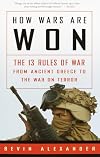
This is a book whose argument would be more effective had the author not apparently refocused his manuscript after September 11. Alexander, a journalist and writer of general audience works on military subjects, challenges the relevance and effectiveness of the "Western way of war" as articulated by, among others, Victor Davis Hanson and John Keegan. That model emphasizes intense, direct conflict focused on decisive battles whose outcomes are determined by relative loss rates. Alexander's show more "13 rules," in contrast, emphasize indirection: striking at weak spots, employing deception, paralyzing systems as opposed to killing men. Though the research bases of Alexander's case studies are uniformly thin, he does not seriously abuse his evidence. Most of the battles he cites in demonstration of a particular "rule" more or less support the argument. Cannae, for example, is an appropriate example of a battle of encirclement. Yet Alexander (How Hitler Could Have Won World War II) also seeks to connect his "rules of war" directly to the contemporary "war on terror." In this case, the drastic asymmetries between the adversaries make the relationships to historic battles fought by more similar forces difficult to establish. Alexander usually winds up postulating a connection rather than demonstrating it. The link, for example, between operational-level "cauldron battles" like those fought in Russia in 1941, and the tactics employed by the U.S. in Afghanistan against the Taliban, is at best tenuous, if not entirely inferential. Alexander's case should not be dismissed, but is best approached with intellectual caution. As the U.S. prepares for war, look for interest in this title to be high. (Review 2002 - https://www.publishersweekly.com/9780609610398)
EXAMPLES: Feign retreat: Pretend defeat, fake a retreat, then ambush the enemy while being pursued. Used to devastating effect by the North Vietnamese against U.S. forces during the Vietnam War.
• Strike at enemy weakness: Avoid the enemy’s strength entirely by refusing to fight pitched battles, a method that has run alongside conventional war from the earliest days of human conflict. Brilliantly applied by Mao Zedong to defeat the Chinese Nationalists.
• Defend, then attack: Gain possession of a superior weapon or tactical system, induce the enemy to launch a fruitless attack, then go on the offensive. Employed repeatedly against the Goths by the Eastern Roman general Belisarius to reclaim vast stretches of the Roman Empire. show less
EXAMPLES: Feign retreat: Pretend defeat, fake a retreat, then ambush the enemy while being pursued. Used to devastating effect by the North Vietnamese against U.S. forces during the Vietnam War.
• Strike at enemy weakness: Avoid the enemy’s strength entirely by refusing to fight pitched battles, a method that has run alongside conventional war from the earliest days of human conflict. Brilliantly applied by Mao Zedong to defeat the Chinese Nationalists.
• Defend, then attack: Gain possession of a superior weapon or tactical system, induce the enemy to launch a fruitless attack, then go on the offensive. Employed repeatedly against the Goths by the Eastern Roman general Belisarius to reclaim vast stretches of the Roman Empire. show less

In keeping with some of what the other reviewers have thought, this should be read less as a counterfactual and more as a brief overview account of various battles where sometimes is taken at the start of each section to explain why this was important to the Nazi War Machine, and what mistakes were made with regards to what could’ve been an overall strategy. Obviously at this remove it is difficult to understand and to contemplate what Nazi war aims were particularly, given the long reach show more of history. However, these sections which I think will be what most people who buy this book for, are far too short. They add some small amount of spice to another otherwise relatively pedestrian yet fairly accurate depiction of various battles across the course of the western and North African theatre. There is some look at the Eastern front but predominantly this is a discussion about western war aims and how the Nazis could’ve changed things around. Had they been slightly more insightful. This isn’t the book that I think you want when you buy it because I think the title is misleading. Having said that I enjoyed it immensely in places and was not bored whilst reading it. show less
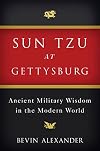
Mr. Alexander's clearly and simply explains how Sun Tzu's approach to warfare was successfully applied or tragically ignored in several battles that shaped America's destiny. The United States is fortunate that Stonewall Jackson was killed during the civil war and Lee ignored Longstreet .

My reactions after reading this book in 2000.
I really only see two flaws in this book.
First, I think Alexander down plays Russian involvement and assistance in the North Korean. This is primarily a political history from the partition of Korea between Russian and U.S. forces to the final armistice, though he mentions the battles of Heartbreak and Bloody Ridge – Pork Chop Hill is not even mentioned, he considers the war done – in a political sense and strategic sense – in June 1951 show more when both sides entrenched and began a war of position. Of course, thousands died after than on both sides but to little effect since the lines at that time were close to the 38th parallel – the starting place of the war.
Second, Alexander doesn’t really explain the intelligence failures that caused MacArthur to underestimate the strength of Chinese forces in Korea and misread their intentions. Alexander covers Inchon showing that it was a surprisingly obvious move that no one could see except Douglas MacArthur and makes a gruding admission that was brilliant. He does defend MacArthur by saying that Inchon’s success was not luck but the result of careful planning.
But he takes MacArthur to task for clearly being publically insubordinate to President Truman and rightly points out that, yes, Korea was a case of Communist aggression but fighting it would divert resources (soldiers and the goodwill of America’s European allies) from opposing Soviet aggression in Europe – probably rightly deemed as being more in America’s strategic interests. The goodwill of France and Europe and the U.N. (who supported America’s decision to defend Korea and placed forces, combat and non-combat,under U.S. command) would have evaporated if America would have carried the war to Chinese soil or used nukes on China. It galls, but, given the realities of the situation (the political environment, the necessity to keep a U.N. coalition, America’s military and last, but, by no means least, the abilities of the Chinese military) Korea had to be a limited war.
Indeed, Alexander says that WWII created an unrealistic American attitude that wars should end in total victory. He doesn’t define that, exactly, but, if he means occupying an enemy’s home and dictating terms from a position of overwhelming strength then few wars, except the Civil War and World War II and, perhaps, the Mexican War, can be depicted as ending that way.)
He says the Korean conflict was mismanaged. MacArthur’s military superiors and the Truman administration should have noted the signs of MacArthur’s of intending to unify all of Korea after Inchon. They partially went along with his idea because they hadn’t formed a plan what to do after Inchon’s success. (Alexander points out that MacArthur’s brilliance at Inchon was marred by the odd decision to move forces north in a bizarre criss-cross – forces in eastern Korea were to move to the north-western border with the Yalu river and western forces were loaded on boats and landed at Winsan on the east.) The failure was in not following the original notion of simply driving North Korea forces out of South Korea.
Alexander puts up a convincing argument that China didn’t come up with the idea of North Korea invading South Korea since it interfered with their plans to invade Taiwan. It was after the invasion of South Korea that U.S. pledged to protect Taiwan and patrolled the Formosa Strait. For their part, the Chinese also made a fatal mistake on Dec. 21, 1950 when they rejected a cease fire thinking they could force the withdrawal of all UN troops from Korea. A de-militarized zone would have the 38th parallel as a southern boundary, no new troops would have been introduced, and prisoners of war would be exchanged) . This miscalculation cost a lot of lives since the lines ultimately ended up to be close to the lines at this time.
Alexander doesn’t give a lot of low-level detail in describing various battles except when they’re famous or involves noted individual exploits (i.e, medal winners). He does show the weakness (and, at times, surprising skill and tenacity) of American troops quickly jerked out of their (primarily) Japanese postings and whisked to the battle front where their poor physical conditioning and training also showed. (He also shows the Republic of Korea soldiers as frequently not up to the task. Partly, that was a cultural fear of the Chinese. However, American officers found them adequate soldiers if well-led and well-trained.)
The Chosin disaster is covered as well as the battles of Unsan and Taejon. Alexander speaks of the excellent physical conditioning of the Chinese troops whose favorite tactic was to pin American troops down with frontal assaults and sweep around their flanks. This worked well in Korea since the heavily motorized UN forces relied on narrow, rare roads easily blocked. The Chinese forces were highly mobile possessing no artillery, usually, bigger than a mortar and carried everything on their backs. However, this limited their mobility, and they couldn’t exploit breakthroughs well and frequently had to stop to consolidate. American forces – while the war was in its mobile phase – found the best tactic was to hold positions against typically night assaults and pound the Chinese in the day with their overwhelming air and artillery superiority.
Alexander speaks at length about arguments over prisoner exchanges prolonged the word, pointlessly in geopolitical terms, for over two years from its de-facto end when both sides entrenched. The dispute largely hinged on whether all captured North Koreans and Chinese had to be, as required by the Geneva Convention, repatriated. Truman didn’t want to forcibly return anyone to a Communist country – some of the soldiers had been Chinese Nationalists or no lovers of North Korea. Alexander talks about the prison riots amongst the Communist POWs – instigated by infiltrator/organizers deliberately allowing themselves to be captured by the UN. The bizarre case of the badly handled prison riot of Koje in May 1952 is covered and the justified demotion of camp commander General Francis T. Dodd.
Alexander also covers the ungrateful actions of South Korean President (and despot) Syngman Rhee who tried to blackmail his way into continuing the fighting if he was not given final say over armistice terms. Eventually, America bluffed and said they would withdraw all troops unless he signed off on the agreement. He did but America pledged to protect South Korea’s sovereignty.
Most of the book is drawn from secondary sources though Blevin quotes one of his works – on captured Chinese weapons, I believe. However, Alexander does use his personal experience in the Korean War as a lieutenant in the Army’s Historical Detachment Unit (at least, I assume it’s personal memory) to comment on Korea’s distinctive smells (Korean cabbage on the breath of Korean girls protected their virtue and human feces as fertilizer). He also comments that R&R in Japan probably, despite soldierly boasts, consisted mostly of sleep. He notes that soldiers after found Japanese girls, with their non-western sexual morality, cleanliness, and limited English, more appealing than the many American women then working in occupied Japan; perhaps, he speculates their lack of English made them seem more sympathetic to the soldiers' plight and stories of Korea.
At the time I read the book, there had been talk of No Gun Ri (nowhere mentioned here), I found it interesting to see Alexander noting several friendly fire episodes in the opening months of the war including both American and South Koreans knowingly blowing up bridges with civilians on them. show less
I really only see two flaws in this book.
First, I think Alexander down plays Russian involvement and assistance in the North Korean. This is primarily a political history from the partition of Korea between Russian and U.S. forces to the final armistice, though he mentions the battles of Heartbreak and Bloody Ridge – Pork Chop Hill is not even mentioned, he considers the war done – in a political sense and strategic sense – in June 1951 show more when both sides entrenched and began a war of position. Of course, thousands died after than on both sides but to little effect since the lines at that time were close to the 38th parallel – the starting place of the war.
Second, Alexander doesn’t really explain the intelligence failures that caused MacArthur to underestimate the strength of Chinese forces in Korea and misread their intentions. Alexander covers Inchon showing that it was a surprisingly obvious move that no one could see except Douglas MacArthur and makes a gruding admission that was brilliant. He does defend MacArthur by saying that Inchon’s success was not luck but the result of careful planning.
But he takes MacArthur to task for clearly being publically insubordinate to President Truman and rightly points out that, yes, Korea was a case of Communist aggression but fighting it would divert resources (soldiers and the goodwill of America’s European allies) from opposing Soviet aggression in Europe – probably rightly deemed as being more in America’s strategic interests. The goodwill of France and Europe and the U.N. (who supported America’s decision to defend Korea and placed forces, combat and non-combat,under U.S. command) would have evaporated if America would have carried the war to Chinese soil or used nukes on China. It galls, but, given the realities of the situation (the political environment, the necessity to keep a U.N. coalition, America’s military and last, but, by no means least, the abilities of the Chinese military) Korea had to be a limited war.
Indeed, Alexander says that WWII created an unrealistic American attitude that wars should end in total victory. He doesn’t define that, exactly, but, if he means occupying an enemy’s home and dictating terms from a position of overwhelming strength then few wars, except the Civil War and World War II and, perhaps, the Mexican War, can be depicted as ending that way.)
He says the Korean conflict was mismanaged. MacArthur’s military superiors and the Truman administration should have noted the signs of MacArthur’s of intending to unify all of Korea after Inchon. They partially went along with his idea because they hadn’t formed a plan what to do after Inchon’s success. (Alexander points out that MacArthur’s brilliance at Inchon was marred by the odd decision to move forces north in a bizarre criss-cross – forces in eastern Korea were to move to the north-western border with the Yalu river and western forces were loaded on boats and landed at Winsan on the east.) The failure was in not following the original notion of simply driving North Korea forces out of South Korea.
Alexander puts up a convincing argument that China didn’t come up with the idea of North Korea invading South Korea since it interfered with their plans to invade Taiwan. It was after the invasion of South Korea that U.S. pledged to protect Taiwan and patrolled the Formosa Strait. For their part, the Chinese also made a fatal mistake on Dec. 21, 1950 when they rejected a cease fire thinking they could force the withdrawal of all UN troops from Korea. A de-militarized zone would have the 38th parallel as a southern boundary, no new troops would have been introduced, and prisoners of war would be exchanged) . This miscalculation cost a lot of lives since the lines ultimately ended up to be close to the lines at this time.
Alexander doesn’t give a lot of low-level detail in describing various battles except when they’re famous or involves noted individual exploits (i.e, medal winners). He does show the weakness (and, at times, surprising skill and tenacity) of American troops quickly jerked out of their (primarily) Japanese postings and whisked to the battle front where their poor physical conditioning and training also showed. (He also shows the Republic of Korea soldiers as frequently not up to the task. Partly, that was a cultural fear of the Chinese. However, American officers found them adequate soldiers if well-led and well-trained.)
The Chosin disaster is covered as well as the battles of Unsan and Taejon. Alexander speaks of the excellent physical conditioning of the Chinese troops whose favorite tactic was to pin American troops down with frontal assaults and sweep around their flanks. This worked well in Korea since the heavily motorized UN forces relied on narrow, rare roads easily blocked. The Chinese forces were highly mobile possessing no artillery, usually, bigger than a mortar and carried everything on their backs. However, this limited their mobility, and they couldn’t exploit breakthroughs well and frequently had to stop to consolidate. American forces – while the war was in its mobile phase – found the best tactic was to hold positions against typically night assaults and pound the Chinese in the day with their overwhelming air and artillery superiority.
Alexander speaks at length about arguments over prisoner exchanges prolonged the word, pointlessly in geopolitical terms, for over two years from its de-facto end when both sides entrenched. The dispute largely hinged on whether all captured North Koreans and Chinese had to be, as required by the Geneva Convention, repatriated. Truman didn’t want to forcibly return anyone to a Communist country – some of the soldiers had been Chinese Nationalists or no lovers of North Korea. Alexander talks about the prison riots amongst the Communist POWs – instigated by infiltrator/organizers deliberately allowing themselves to be captured by the UN. The bizarre case of the badly handled prison riot of Koje in May 1952 is covered and the justified demotion of camp commander General Francis T. Dodd.
Alexander also covers the ungrateful actions of South Korean President (and despot) Syngman Rhee who tried to blackmail his way into continuing the fighting if he was not given final say over armistice terms. Eventually, America bluffed and said they would withdraw all troops unless he signed off on the agreement. He did but America pledged to protect South Korea’s sovereignty.
Most of the book is drawn from secondary sources though Blevin quotes one of his works – on captured Chinese weapons, I believe. However, Alexander does use his personal experience in the Korean War as a lieutenant in the Army’s Historical Detachment Unit (at least, I assume it’s personal memory) to comment on Korea’s distinctive smells (Korean cabbage on the breath of Korean girls protected their virtue and human feces as fertilizer). He also comments that R&R in Japan probably, despite soldierly boasts, consisted mostly of sleep. He notes that soldiers after found Japanese girls, with their non-western sexual morality, cleanliness, and limited English, more appealing than the many American women then working in occupied Japan; perhaps, he speculates their lack of English made them seem more sympathetic to the soldiers' plight and stories of Korea.
At the time I read the book, there had been talk of No Gun Ri (nowhere mentioned here), I found it interesting to see Alexander noting several friendly fire episodes in the opening months of the war including both American and South Koreans knowingly blowing up bridges with civilians on them. show less
You May Also Like


Statistics
- Works
- 18
- Members
- 1,500
- Popularity
- #17,133
- Rating
- 3.5
- Reviews
- 20
- ISBNs
- 66
- Languages
- 4