
Douglas Southall Freeman (1886–1953)
Author of Lee
About the Author
Image credit: Findagrave.com
Series
Works by Douglas Southall Freeman
Lee's Lieutenants: A Study In Command, Volume 1, Manassas to Malvern Hill (1942) 352 copies, 2 reviews
Lee's Lieutenants: A Study in Command, Volume 2, Cedar Mountain to Chancellorville (1943) 301 copies, 2 reviews
The South to Posterity: An Introduction to the Writing of Confederate History (1983) 57 copies, 1 review
Lee's Dispatches: Unpublished Letters of General Robert E. Lee, C.S.A., to Jefferson Davis and the War Department of the Confederate States of America, 1862-65 (1994) — Editor — 57 copies
George Washington, a biography, volume 6: Patriot and President 1784 - 1793 (1954) 28 copies, 1 review
R.E.Lee 4 copies
George Washington-6 Volume Set ~ Young Washington, Planter and Patriot, Leader of the Revolution, Victory With the Help (1948) 3 copies
Graduation exercises 2 copies
The Cornerstones of Stratford. Address at the Dedication of Stratford, October 12, 1935, by the Robert E. Lee Memorial Foundation (1935) 2 copies
Lee at Appomattox 1 copy
The educator 1 copy
When War Came To Richmond 1 copy
Emilio Maraini 1 copy
Associated Works
Lee, Grant and Sherman: A Study in Leadership in the 1864-65 Campaign (2000) — Introduction, some editions — 29 copies, 1 review
High Moment: Stories of Supreme Crises in the Lives of Great Men — Contributor — 2 copies
Tagged
Common Knowledge
- Legal name
- Freeman, Douglas Southall
- Birthdate
- 1886-05-16
- Date of death
- 1953-06-13
- Gender
- male
- Education
- University of Richmond (AB|1904)
Johns Hopkins University (Ph.D|1908)
Washington and Lee University - Occupations
- editor
journalist
historian
teacher
biographer - Organizations
- The Richmond News Leader
Richmond Times-Dispatch - Awards and honors
- Pulitzer Prize for Biography or Autobiography (1935)
Pulitzer Prize for Biography or Autobiography (1958)
American Academy of Arts and Letters (Literature ∙ 1937) - Cause of death
- heart attack
- Nationality
- USA
- Birthplace
- Lynchburg, Virginia, USA
- Places of residence
- Richmond, Virginia, USA
Lynchburg, Virginia, USA
Petersburg, Virginia, USA - Place of death
- Richmond, Virginia, USA
- Burial location
- Hollywood Cemetery, Richmond, Virginia, USA
- Map Location
- Virginia, USA
Members
Reviews
Lee's Lieutenants: A Study in Command, Vol. 2 - Cedar Mountain to Chancellorsville by Douglas Southall Freeman
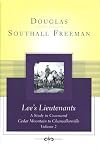
Whenever I read Douglas Southall Freeman's books my senses come alive. In my mind's eye, I can see the battlefields and the courage of young soldiers. I can hear the cannons volleying across enemy lines; the men yelling their battle cries. I can smell gunpowder, blood and mud. The campaigns from Cedar Mountain to Chancellorsville took place between 1862 and 1863. I can feel the pounding of the horse artillery's hooves. I swear I can taste the victories and losses as Freeman describes every show more detail. Like Freeman's first volume, Manassas to Mulvern Hill, Cedar Mountain to Chancellorsville is a minute by minute, battle by battle recounting of the Civil War. Every detail is well researched and described; using military papers, scrapbooks, memoirs, letters and official correspondence, court martial orders, and diaries and journals. A great deal of the narrative relies on Thomas Jonathan "Stonewall" Jackson's journals and official papers. As an aside, one of the most difficult passages to read was the death of "Stonewall" Jackson after his amputation. He had just become a new father and was well respected by his troops. his death was a blow to Robert E. Lee's armies. show less
Lee's Lieutenants: A Study in Command, Vol. 1 - Manassas to Malvern Hill by Douglas Southall Freeman
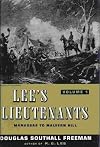
Freeman opens the first volume of Lee's Lieutenants by explaining why and how he started the study in command of the Civil War. He offers suggestions as to why other authors wrote the books they did on the same subject and how his is different. His version is a well-researched biography of major and minor personalities which includes a photograph portrait, a paragraph outlining the military success of each soldier, as well as an interesting fact, such as birthdays, birth places, who had a show more sense of humor, who had a lisp, who needed alcohol for motivation, and who had haunting eyes (and speaking of haunting eyes, I think "Stonewall" Jackson had beautiful eyes and I found Daniel Harvey Hill most attractive). Freeman used a myriad of sources, including journals, letters and previously published interviews. From these sources, he is able to provide minute by minute descriptions of each battle; of each mission.
One of the most fascinating details of Lee's Lieutenants was the stark contrast between the assumption of a situation at Headquarters and what was actually happening on the battlefield. Glory seeking exaggerations abounded. Who could take credit for the success at Manassas is a good example. What was so sad is that despite the lack of communication, both Headquarters and the battlefield thought that the battle at Manassas would decide and end the war. show less
One of the most fascinating details of Lee's Lieutenants was the stark contrast between the assumption of a situation at Headquarters and what was actually happening on the battlefield. Glory seeking exaggerations abounded. Who could take credit for the success at Manassas is a good example. What was so sad is that despite the lack of communication, both Headquarters and the battlefield thought that the battle at Manassas would decide and end the war. show less
I can recognize this book as a pillar of Civil War history, while also recognizing that the historiography has moved past it, and while the collection of primary source accounts are vital, in terms of research questions, writing style, and place in a larger academic debate, Lee's Lieutenants is obsolete and painful.
Freeman makes a close study of the campaigns of the Army of Northern Virginia in terms of the leading subordinates of Robert E Lee (he had previously written a massive biography show more of Lee). My dissatisfaction comes from my inability to get a good feel for the period, for why these commanders acted as they did in moment. The section that I read covered the crucial transformation from a mob into a semi-professional army, and I still have little sense of how 'old Army' veterans interacted with political appointees, the energy of ambitious young men, or the masses of common soldiers. The battles of the Civil War were a fascinating last gasp for when the physical courage and strength of a commander could make a decisive difference, for when information moved at the speed of horse messenger and battalions at a quick march, but I have little sense of how generals decided to deploy and attack. Confederate commanders seem to spend as much time sniping at each other in dispatches as they fighting the Federals. I have rarely read so many words and learned so little.
Part of this may come down to political differences. Freeman clearly idolized the Confederate generals. He grew up down the street from General Jubal Early, and his father was a Confederate veteran. I think we should be honest about the causes and consequences and call the war 'The Slavers Rebellion', and remember the Confederates as such, if at all. Freeman thought they should be memorialized, and their crimes covered up. I could forgive an opposing point of view, if it had something interesting to say. For example, I really enjoyed Guderian's memoirs, and Nazis murdered almost all my relatives who stayed behind in Poland. show less
Freeman makes a close study of the campaigns of the Army of Northern Virginia in terms of the leading subordinates of Robert E Lee (he had previously written a massive biography show more of Lee). My dissatisfaction comes from my inability to get a good feel for the period, for why these commanders acted as they did in moment. The section that I read covered the crucial transformation from a mob into a semi-professional army, and I still have little sense of how 'old Army' veterans interacted with political appointees, the energy of ambitious young men, or the masses of common soldiers. The battles of the Civil War were a fascinating last gasp for when the physical courage and strength of a commander could make a decisive difference, for when information moved at the speed of horse messenger and battalions at a quick march, but I have little sense of how generals decided to deploy and attack. Confederate commanders seem to spend as much time sniping at each other in dispatches as they fighting the Federals. I have rarely read so many words and learned so little.
Part of this may come down to political differences. Freeman clearly idolized the Confederate generals. He grew up down the street from General Jubal Early, and his father was a Confederate veteran. I think we should be honest about the causes and consequences and call the war 'The Slavers Rebellion', and remember the Confederates as such, if at all. Freeman thought they should be memorialized, and their crimes covered up. I could forgive an opposing point of view, if it had something interesting to say. For example, I really enjoyed Guderian's memoirs, and Nazis murdered almost all my relatives who stayed behind in Poland. show less
The third and final installment of Lee's Lieutenant's opens in June of 1863, nearly 162 years ago. The civil war is nearly over. Lee's right-hand man, Stonewall Jackson has died. Losing Jackson was a tremendous blow for General Lee. Longstreet was his only subordinate with similar military experience. I have to wonder if Longstreet resented the comparison. Many think the loss at Gettysburg, in simplified terms, can be blamed on the absence of Stonewall Jackson. His death prevented cavalry show more efficiency and amplified the poor management of artillery. Ammunition was in short supply by the time they got to Gettysburg.
For what Freeman could not possibly glean from diaries and first-hand accounts, he speculated and said "this is surely how it happened." But speaking of the letters and diaries, the missives varied in intimacy. Some soldiers when they wrote home did not want their loved ones to worry about them so they kept details vague. Others were extremely honest about their harrowing experiences in battle. show less
For what Freeman could not possibly glean from diaries and first-hand accounts, he speculated and said "this is surely how it happened." But speaking of the letters and diaries, the missives varied in intimacy. Some soldiers when they wrote home did not want their loved ones to worry about them so they kept details vague. Others were extremely honest about their harrowing experiences in battle. show less
Lists
Awards


You May Also Like


Associated Authors
Statistics
- Works
- 47
- Also by
- 8
- Members
- 3,765
- Popularity
- #6,733
- Rating
- 4.2
- Reviews
- 33
- ISBNs
- 57
- Favorited
- 9