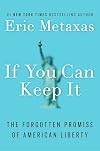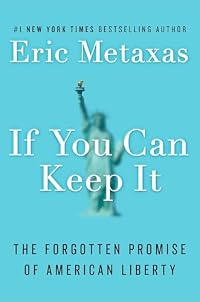
If You Can Keep It: The Forgotten Promise of American Liberty
by Eric Metaxas
On This Page
Description
Eric Metaxas offers a thrilling review of America's uniqueness, and a sobering reminder that America's greatness cannot continue unless people truly understand what their founding fathers meant for them to be. The book includes a stirring call-to-action for every American to understand the ideals behind the 'noble experiment in ordered liberty' that is America. It also paints a vivid picture of the tremendous fragility of that experiment and explains why that fragility has been dangerously show more forgotten - and in doing so it lays out our own responsibility to live those ideals and carry on those freedoms. Metaxas believes America is not a nation bounded by ethnic identity or geography, but rather by a radical and unprecedented idea, based upon liberty and freedom. show lessTags
Recommendations













Member Reviews
In If You Can Keep It, conservative commentator and author Eric Metaxas offered his take on the American experiment. Part alarm, part gratitude, part sermon, the book reflects his instinct as a cultural revivalist who's writings attempt to rekindle national memory. His message was clear: republics do not fall from force; they fall from moral drift. He called the nation to remember its founding virtues and recover the character he believed made freedom possible.
What was once timely now reads as a nostalgic scaffolding—a sentimental structure trying to support an increasingly complex republic. The questions Metaxas asks are real. The solutions he offers are not.
A Republic of Virtue? or Structure?
The central thesis of the book rests on show more what Metaxas calls the “Golden Triangle of Freedom”: that freedom depends on virtue, virtue depends on faith, and freedom, in turn, protects faith. It’s a clean model, rhetorically satisfying, and delivered with the clarity of a sermon. He casts the Founders not merely as political innovators but as moral visionaries whose personal character is the key to understanding the system they built.
But here he commits a common inversion—treating virtue as the cause of a republic’s durability rather than one of its aspirational effects. The Founders, well aware of human frailty, did not trust enduring liberty to private piety. They built institutions designed to constrain power, balance incentives, and resist the inevitable decline of public virtue. Their genius was not in imagining a population of saints, but in anticipating the failings of ordinary people and engineering a system to contain those failings.
Metaxas reverses that equation. In doing so, he presents character as the engine of political stability rather than acknowledging that structure exists precisely because human character is inconsistent.
Ten Years On
The decade since its publication has not been kind to his assumptions. Our current challenges (epistemic breakdown, institutional decay, tribalized incentives, etc.) are not failures of remembrance or reverence. They are systemic failures. They reveal where the design of our institutions no longer matches the complexity of our environment.
Metaxas leans on hope and memory as a solution. But hope is not a mechanism and memory is not infrastructure. A republic does not endure because its citizens feel virtuous; it endures because its systems are engineered to remain functional even when people behave poorly. That is the difference between inspiration and architecture.
Where Metaxas calls for moral seriousness and renewed faith, a modern, rational strategist would call for epistemic discipline, incentive alignment, and institutional restraint. One approach aims at the heart. The other guards the machinery.
Framing, Drift, Agency, and Aspiration
Metaxas builds his argument on theological premises. He treats faith not simply as a personal compass but as a civic necessity. He implies a republic cannot endure without a shared metaphysical commitment. That’s not a minor detail. It narrows the moral foundation of liberty to his specific Christian worldview, implying that reason alone is insufficient to preserve freedom.
A republic built on reason can accommodate faith; a republic built on faith cannot demand reason. Metaxas never addresses that tension. He assumes virtue flows downward: from belief to behavior to civic flourishing. The Founders, by contrast, created a republic where structure flows upward: from individual agency to legal restraint to national stability.
To frame liberty as a byproduct of belief is to mistake the mystical for the architectural. Republics are not sustained by the private motivations of the governed; they are sustained by systems that make good governance possible even when those motivations falter.
However, Metaxas does accurately capture the emotional appeal of moral revival. He speaks to a widespread longing for coherence, for civic purpose, for a society that once felt more aligned. But this longing is not a strategy. It’s what remains when architecture fails.
A free society should aspire to moral seriousness. But it cannot depend on it. Leaders in a rational republic must operate from clarity, engineered restraint, and idealized virtue. Metaxas focuses on nostalgia. He invites readers to be better people. But that invitation is not a substitute for a system designed to protect liberty when people inevitably are not.
Key Takeaways
Final Take
This is a sincere and well-intentioned book. It reminds us that freedom is rare, hard-won, and easily lost. But sincerity is not structure, and Metaxas offers moral exhortation in a moment that demands institutional engineering. He evokes what Americans should cherish without fully confronting how to preserve it when the virtues he prizes are absent.
The book deserves to be read as a window into a particular strain of American civic imagination. But for those interested in how republics actually endure, it is important to remember that the future of liberty does not rest on memory or faith alone. It rests on understanding the machinery of freedom—and designing it to withstand the worst in us. show less
What was once timely now reads as a nostalgic scaffolding—a sentimental structure trying to support an increasingly complex republic. The questions Metaxas asks are real. The solutions he offers are not.
A Republic of Virtue? or Structure?
The central thesis of the book rests on show more what Metaxas calls the “Golden Triangle of Freedom”: that freedom depends on virtue, virtue depends on faith, and freedom, in turn, protects faith. It’s a clean model, rhetorically satisfying, and delivered with the clarity of a sermon. He casts the Founders not merely as political innovators but as moral visionaries whose personal character is the key to understanding the system they built.
But here he commits a common inversion—treating virtue as the cause of a republic’s durability rather than one of its aspirational effects. The Founders, well aware of human frailty, did not trust enduring liberty to private piety. They built institutions designed to constrain power, balance incentives, and resist the inevitable decline of public virtue. Their genius was not in imagining a population of saints, but in anticipating the failings of ordinary people and engineering a system to contain those failings.
Metaxas reverses that equation. In doing so, he presents character as the engine of political stability rather than acknowledging that structure exists precisely because human character is inconsistent.
Ten Years On
The decade since its publication has not been kind to his assumptions. Our current challenges (epistemic breakdown, institutional decay, tribalized incentives, etc.) are not failures of remembrance or reverence. They are systemic failures. They reveal where the design of our institutions no longer matches the complexity of our environment.
Metaxas leans on hope and memory as a solution. But hope is not a mechanism and memory is not infrastructure. A republic does not endure because its citizens feel virtuous; it endures because its systems are engineered to remain functional even when people behave poorly. That is the difference between inspiration and architecture.
Where Metaxas calls for moral seriousness and renewed faith, a modern, rational strategist would call for epistemic discipline, incentive alignment, and institutional restraint. One approach aims at the heart. The other guards the machinery.
Framing, Drift, Agency, and Aspiration
Metaxas builds his argument on theological premises. He treats faith not simply as a personal compass but as a civic necessity. He implies a republic cannot endure without a shared metaphysical commitment. That’s not a minor detail. It narrows the moral foundation of liberty to his specific Christian worldview, implying that reason alone is insufficient to preserve freedom.
A republic built on reason can accommodate faith; a republic built on faith cannot demand reason. Metaxas never addresses that tension. He assumes virtue flows downward: from belief to behavior to civic flourishing. The Founders, by contrast, created a republic where structure flows upward: from individual agency to legal restraint to national stability.
To frame liberty as a byproduct of belief is to mistake the mystical for the architectural. Republics are not sustained by the private motivations of the governed; they are sustained by systems that make good governance possible even when those motivations falter.
However, Metaxas does accurately capture the emotional appeal of moral revival. He speaks to a widespread longing for coherence, for civic purpose, for a society that once felt more aligned. But this longing is not a strategy. It’s what remains when architecture fails.
A free society should aspire to moral seriousness. But it cannot depend on it. Leaders in a rational republic must operate from clarity, engineered restraint, and idealized virtue. Metaxas focuses on nostalgia. He invites readers to be better people. But that invitation is not a substitute for a system designed to protect liberty when people inevitably are not.
Key Takeaways
- Liberty endures through structure, not sentiment.
- Virtue may inspire, but institutions are what endure.
- A republic built on reason can protect faith; the reverse is not guaranteed.
- Character is cultivated, not assumed—and systems must hold when it fails.
- Renewal begins with clarity, not yearning. Engineering, not nostalgia, keeps a republic intact.
Final Take
This is a sincere and well-intentioned book. It reminds us that freedom is rare, hard-won, and easily lost. But sincerity is not structure, and Metaxas offers moral exhortation in a moment that demands institutional engineering. He evokes what Americans should cherish without fully confronting how to preserve it when the virtues he prizes are absent.
The book deserves to be read as a window into a particular strain of American civic imagination. But for those interested in how republics actually endure, it is important to remember that the future of liberty does not rest on memory or faith alone. It rests on understanding the machinery of freedom—and designing it to withstand the worst in us. show less
The title of this book is stolen from Benjamin Franklin when asked if we were founding a monarchy or a republic. With his classic quick wit, he responded, "A republic... if you can keep it."
This book, by a radio talk show host, comprises a series of lecture-type chapters that admonishes patriotism instead of carelessness towards America. It contains many anecdotes which are interesting, such as that of Nathan Hale's, "I regret only that I have but one life to give for my country."
It lacks a central argument beyond the obvious patriotism. Maybe I haven't experienced that anti-patriotism of the Northeast, but Metaxas' pleadings seem somewhat obvious. He doesn't really raise the conversation that highly beyond the obvious observation that show more we are killing each other with partisanship. Instead of exploring that topic in depth, he just sermonizes about one's country in a very superficial manner.
I like Metaxas' other works on Bonhoeffer and Luther. Despite the entertaining stories, this work lacks a fundamental central idea. I'd take a pass on this one. show less
This book, by a radio talk show host, comprises a series of lecture-type chapters that admonishes patriotism instead of carelessness towards America. It contains many anecdotes which are interesting, such as that of Nathan Hale's, "I regret only that I have but one life to give for my country."
It lacks a central argument beyond the obvious patriotism. Maybe I haven't experienced that anti-patriotism of the Northeast, but Metaxas' pleadings seem somewhat obvious. He doesn't really raise the conversation that highly beyond the obvious observation that show more we are killing each other with partisanship. Instead of exploring that topic in depth, he just sermonizes about one's country in a very superficial manner.
I like Metaxas' other works on Bonhoeffer and Luther. Despite the entertaining stories, this work lacks a fundamental central idea. I'd take a pass on this one. show less
This book eloquently reminds us of what our country has been and gives hope that we, as a people, could regain and practice the ideals that once characterized America. There is more than a little religiosity, but it remains a sound piece of encouragement in these or any other times, as demonstrated by the variety of sources quoted. You won't be sorry that you read this one.
Won in a Goodreads Giveaway.
Won in a Goodreads Giveaway.
If You Can Keep It
The Forgotten Promise Of American Liberty
(Eric Metaxas) (2016)
.
Dr James McHenry (a Maryland delegate) reports that as Benjamin Franklin emerged from Independence Hall at the close of the Constitutional Convention in 1787, a certain Mrs Powell of Philadelphia asked, “Well Doctor, what have we got, a republic or a monarchy?”.
Mr. Franklin replied, “A republic, madam – if you can keep it.”
----
I read and reread sections, underlined, highlighted and am determined to bring this forward for discussion with friends.
Eric Metaxas enables us to understand, more fully, what the founders intended for America.
Explaining Os Guinness' concept of "The Golden Triangle of Freedom" was both basic and profound.
"Freedom requires show more virtue; virtue requires faith; and faith requires freedom. If any of these three legs of the triangle is removed, the whole structure ceases to exist."
An in-depth look at each of the legs follows.
Please understand that the material in this book is much more expansive and thought provoking than I'm able to express here.
This is definitely a book I recommend you read and take seriously.
A quote from Eric Metaxas
"I still hope that perhaps those of us who call ourselves Americans might come to understand these vital ideas, to remember them again and to know what it means to be an American."
"It's time to reconnect to that idea before America loses the very foundation for what made it exceptional in the first place."
(publishers note)
4.5 ★ show less
The Forgotten Promise Of American Liberty
(Eric Metaxas) (2016)
.
Dr James McHenry (a Maryland delegate) reports that as Benjamin Franklin emerged from Independence Hall at the close of the Constitutional Convention in 1787, a certain Mrs Powell of Philadelphia asked, “Well Doctor, what have we got, a republic or a monarchy?”.
Mr. Franklin replied, “A republic, madam – if you can keep it.”
----
I read and reread sections, underlined, highlighted and am determined to bring this forward for discussion with friends.
Eric Metaxas enables us to understand, more fully, what the founders intended for America.
Explaining Os Guinness' concept of "The Golden Triangle of Freedom" was both basic and profound.
"Freedom requires show more virtue; virtue requires faith; and faith requires freedom. If any of these three legs of the triangle is removed, the whole structure ceases to exist."
An in-depth look at each of the legs follows.
Please understand that the material in this book is much more expansive and thought provoking than I'm able to express here.
This is definitely a book I recommend you read and take seriously.
A quote from Eric Metaxas
"I still hope that perhaps those of us who call ourselves Americans might come to understand these vital ideas, to remember them again and to know what it means to be an American."
"It's time to reconnect to that idea before America loses the very foundation for what made it exceptional in the first place."
(publishers note)
4.5 ★ show less
I read on avg at least a couple books every week, and some are obviously better than others. This is expected but for the most part I enjoy parts of most of them. This is the worst book I have read in a very long time. The author seems incompetent his historic reach is too far to be taken as non-fiction. Horrible!!!
Absolutely horrible and borderline fiction.
Absolutely horrible and borderline fiction.
Members
- Recently Added By
Author Information

73+ Works 14,978 Members
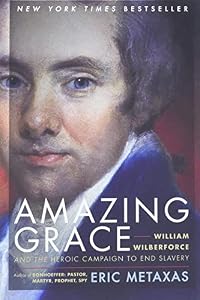
Eric Metaxas was born in New York City in 1963, and grew up in Danbury, Connecticut. He graduated from Yale University, where he edited the Yale Record, America's oldest college humor magazine. He has written several biographies, including Amazing Grace: William Wilberforce and the Heroic Campaign to End Slavery and the New York Times bestseller, show more Bonhoeffer: Pastor, Martyr, Prophet. His latest book is entitled, If You Can Keep It: The Forgotten Promise of American Liberty. He has also written over 30 children's books, including It's Time to Sleep, My Love and Squanto and the Miracle of Thanksgiving. (Bowker Author Biography) show less
Classifications
- Genres
- Politics and Government, Nonfiction, General Nonfiction, History
- DDC/MDS
- 323.440973 — Social sciences Political science Civil and political rights The state and the individual Liberty
- LCC
- JC585 .M566 — Political Science Political theory Political theory. The state. Theories of the state Purpose, functions, and relations of the state
- BISAC
Statistics
- Members
- 438
- Popularity
- 69,512
- Reviews
- 7
- Rating
- (3.83)
- Languages
- English
- Media
- Paper, Audiobook, Ebook
- ISBNs
- 6
- ASINs
- 2