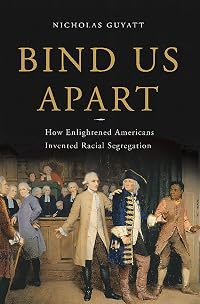
Bind Us Apart: How Enlightened Americans Invented Racial Segregation
by Nicholas Guyatt
92 Members (3.33)
On This Page
Description
"Why did the Founding Fathers fail to include blacks and Indians in their cherished proposition that "all men are created equal"? Racism is the usual answer. Yet Nicholas Guyatt argues in Bind Us Apart that white liberals from the founding to the Civil War were not confident racists, but tortured reformers conscious of the damage that racism would do to the nation. Many tried to build a multiracial America in the early nineteenth century, but ultimately adopted the belief that non-whites show more should create their own republics elsewhere: in an Indian state in the West, or a colony for free blacks in Liberia. Herein lie the origins of "separate but equal." Essential reading for anyone hoping to understand today's racial tensions, Bind Us Apart reveals why racial justice in the United States continues to be an elusive goal: despite our best efforts, we have never been able to imagine a fully inclusive, multiracial society."-- ""All men are created equal" is America's most cherished proposition. But for more than a century after Thomas Jefferson wrote those words, the Founding Fathers and their successors failed to extend the promise of the Declaration of Independence to blacks and Indians. Why? We take refuge in the notion that white people at the time were the prisoners of racist ideas and that we today are more enlightened. In this popular view, the history of America demonstrates how racist beliefs have been slowly discarded, with later generations realizing the dream of liberty and equality. But as Nick Guyatt argues in Bind Us Apart, white Americans from the founding to the Civil War were not confident racists who blithely condemned blacks and Indians to inferior status. Instead, they were confused and tortured souls, and often remarkably conscious of the damage that racism might do to the nation's future. They looked for ways to reconcile their principles and their prejudices, and sometimes succeeded: in the first decades of the United States, blacks went to the polls alongside whites in some northern states, and federal officials promoted intermarriage between Indians and frontier settlers in the hope that racial divisions would disappear in the West"-- show lessTags
Recommendations


Member Reviews
Members
- Recently Added By
Lists

List of Removed Books from Nimitz Library
353 works; 1 member
Author Information

8 Works 351 Members
Nicholas Guyatt is Assistant Professor of History at Simon Fraser University, Van-couver, British Columbia. He has studied at Cambridge University (B.A., M. Phil.) and Princeton University (Ph.D.). This is his first academic monograph, but his fourth book; a work on apocalyptic Christianity will also be published in 2007. He has written about show more American history for the London Review of Books and the Nation. show less
Classifications
- Genres
- Nonfiction, Anthropology, History, General Nonfiction, Biography & Memoir
- DDC/MDS
- 305.800973 — Society, government, & culture Social sciences, sociology & anthropology Social group - Age, Gender, Ethnicity Ethnic and national groups standard subdivisions / Ethnic and national groups with ethnic origins from more than one continent, of European descent standard subdivisions Biography And History North America United States
- LCC
- E184 .A1 .G985 — History of the United States United States Elements in the population Afro-Americans
- BISAC
Statistics
- Members
- 92
- Popularity
- 353,464
- Rating
- (3.33)
- Languages
- English
- Media
- Paper, Ebook
- ISBNs
- 4
- ASINs
- 2