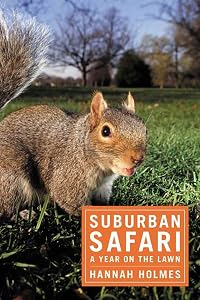
Suburban Safari: A Year on the Lawn
by Hannah Holmes
On This Page
Description
More than 550 square miles of new lawns unfold each year in the U.S. alone. Although new research shows that these lawns aren't nearly as "unnatural" as ecologists once thought, no one has offered an accessible exploration of this novel habitat--until now. Equipped with a lawn chair and her infectious curiosity, science writer Holmes spends a year on her lawn hoping to discover exactly what's going on out there. Under her examination, the lawn teems with life, populated by a bewilderment of show more birds, a mess of mammals, and a range of plants that record the history of this little piece of ground. As the seasons progress, she guides us through this bustling community, inviting over biologists, ecologists, botanists, entomologists, and energy experts to further unveil the complexities of life in the 'burbs.--From publisher description. show lessTags
Recommendations






Member Recommendations
Member Reviews
It is really a fascinating exploration of the nature in our backyards. The author does thorough research and provides plenty of scientific information on everything from the natural history of her region, to the many animals and plants who reside on her patch of land, to the environmental impact of her home and lifestyle. But she also provides enough subjective comments to remind the reader that she is basically just a homeowner and nature lover with her own preferences and quirks. She doesn't have any qualms about feeding her favorite animals and has minimal qualms about kill-trapping the mice in her house, but she does have an appreciation for all the flora and fauna and their amazing evolution and adaptability.
I have found it to be show more difficult to get in-depth information about "everyday" creatures that is still accessible to lay readers. For example, one of my favorite songbirds is the mockingbird. I have searched high and low for a book about these guys but there appears to be only one title on Amazon. A typical bird reference gives only sketchy information about each species. So I appreciated Holmes's deeper investigation into the lives of our familiary backyard neighbors, from crows to caterpillars.
In addition, one of the most fascinating sections to me was the discussion of the backyard trees. I am constantly amazed at the things we learn about plants. They are supposedly not self-aware, and they are fixed in place, but they seem to have some pretty complex ways of "communicating," defending themselves, and adapting.
Another favorite thing I learned from this book is that I have been a trend-setter without realizing it. Apparently a new fashion is to have "Freedom Lawns" or "Darwin lawns," in which the landowner avoids planting seed, fertilizing, or weeding and just allows the species who are fittest to take over the yard. My husband and I have been doing this for years and I thought we were just lazy! (Our yard always looks like the "before" picture in a before-and-after ad for a lawn service. Who knew we were on the cutting edge?)
Overall, this is a wonderful examination of one backyard that can provide information for anyone who is interested in nature and the environment. show less
I have found it to be show more difficult to get in-depth information about "everyday" creatures that is still accessible to lay readers. For example, one of my favorite songbirds is the mockingbird. I have searched high and low for a book about these guys but there appears to be only one title on Amazon. A typical bird reference gives only sketchy information about each species. So I appreciated Holmes's deeper investigation into the lives of our familiary backyard neighbors, from crows to caterpillars.
In addition, one of the most fascinating sections to me was the discussion of the backyard trees. I am constantly amazed at the things we learn about plants. They are supposedly not self-aware, and they are fixed in place, but they seem to have some pretty complex ways of "communicating," defending themselves, and adapting.
Another favorite thing I learned from this book is that I have been a trend-setter without realizing it. Apparently a new fashion is to have "Freedom Lawns" or "Darwin lawns," in which the landowner avoids planting seed, fertilizing, or weeding and just allows the species who are fittest to take over the yard. My husband and I have been doing this for years and I thought we were just lazy! (Our yard always looks like the "before" picture in a before-and-after ad for a lawn service. Who knew we were on the cutting edge?)
Overall, this is a wonderful examination of one backyard that can provide information for anyone who is interested in nature and the environment. show less
I found this quite a fun book to read. Perhaps that was mostly because I felt comforted to realize that someone beside myself takes the time to very closely look at all creatures and plants that inhabiting her yard - and even her house! The author worries about such things as her carbon footprint, invasive species, and sufficient food for the animals that visit her yard.
There are parts of this book which are quite funny as the time when the aithor tried to eliminate a wasp nest and all but eliminated herself! Other parts are a bit sad, as the time when her chipmunk failed to return at all after having developed a long-standing relationship based on seeds.
For those who appreciate nature at its simplest and best, I'd recommend this book. show more It's very sweet. show less
There are parts of this book which are quite funny as the time when the aithor tried to eliminate a wasp nest and all but eliminated herself! Other parts are a bit sad, as the time when her chipmunk failed to return at all after having developed a long-standing relationship based on seeds.
For those who appreciate nature at its simplest and best, I'd recommend this book. show more It's very sweet. show less
Science and travel writer Holmes turns her attention to her own backyard in this exploration of the ecosystems all around us everyday. She spends a year investigating every aspect of her own personal suburban ecosystem, from turning over stones to spot the ants all the way to naming and half-way taming a chipmunk. Along the way, she brings in soil scientists, entomologists, and other experts to join her in examining the life under her feet. Her scientific musings often shade into more philosophical ones as she examines humanity’s place in the ecosystem and the many ways our presence changes—or does not change—the existence of the species living among us. She also examines the historical and cultural history of the lawn as a show more feature of the modern landscape and launches some well-aimed environmental-activism volleys. In the end, readers will be left with a whole new appreciation of the great depth and richness of the life that surrounds us every day, but of which most people are barely aware. show less
Revelations from a year spent inspecting the doings of nature in the author's own backyard, and around her house. It starts off with observations on the behavior of birds, squirrels and bugs, then moves into analysis of her soil composition, location of groundwater, how trees deal with pests, the conflict between native and invasive species, what all the critters do to survive winter, etc etc. She called in specialists to give her more information about all sortsof things from the number of mosquito species to the lie of geological bedrock under her sod, to the energy-efficiency of her house. As the book progresses, she starts to wander farther afield than just her own yard, discussing deer in the neighborhood and the history of lawns, show more even traveling to other states to see how other people do things in their yards. I found all the facts Holmes shared fascinating.The book is packed with stuff I never dreamed off, all teeming around anyone's yard if they care to take a closer look. Engaging and intriguing. It even made me laugh a few times.
from the Dogear Diary show less
from the Dogear Diary show less
As the subtitle says, a year on the lawn in suburban Portland ME. Organized by season, with chapters focused on and digressing from a family of crows, an opportunistic chipmunk, the miniature world of bugs, chemical communication of trees. Anecdotal and entertaining, with a serious side of ecology and climate change, and bits of information from science studies scattered throughout. One takeaway: the Freedom Lawn.
(read 19 May 2012)
(read 19 May 2012)
I read this when it was new, and I really enjoyed it. Holmes has a nice eye, and a lovely turn of phrase.
I bought this book ages ago (Back in 2005 when it first came out!) read the first half, than forgot about. I finally came back to it, and I am glad I did. For a book about nature in 2005, the science seemed up to speed. I suspect there are more studies on this topic, but I think she hit all the big topics.
The author's writing style is easy to read. As always, I suspect that a specialist will find fault with it, but for the general person, it is the perfect amount of detail.
This is a fun informational read, leaving me happy in my laziness about cutting the grass only when it gets too long :)
The author's writing style is easy to read. As always, I suspect that a specialist will find fault with it, but for the general person, it is the perfect amount of detail.
This is a fun informational read, leaving me happy in my laziness about cutting the grass only when it gets too long :)
Members
- Recently Added By
Author Information

8 Works 884 Members
Hannah Holmes is a science and natural history writer whose work has been widely published, appearing in the Los Angeles Times Magazine, the New York Times Magazine, Outside, Sierra, National Geographic Traveler, and Escape. Her broadcast work has been featured on "Living on Earth" and Discovery Channel Online's "Science Live."
Common Knowledge
- Dedication
- In memory of Cheeky
- First words
- I grew up in a clan that disdained suburbs and cities. We were country folk.
- Quotations
- One of the reasons the songbird population is crashing is that North America is being converted into Wal-marts and White-Crowned Sparrow Estates.
- Last words
- (Click to show. Warning: May contain spoilers.)Strange family, indeed. But my family. Mine to cherish, and mine to take care of, to the best of my ability.
- Blurbers
- McKibben, Bill; Roach, Mary; Sullivan, Robert; Montgomery, Sy; Stoller, Debbie
Classifications
- Genres
- Science & Nature, Nonfiction, General Nonfiction
- DDC/MDS
- 591.75609741 — Natural sciences & mathematics Animals Animal Physiology Animal ecology, animals characteristic of specific environments Ecology of miscellaneous environments Urban ecology History, geographic treatment, biography
- LCC
- QL181 .H65 — Science Zoology Zoology General
- BISAC
Statistics
- Members
- 251
- Popularity
- 129,363
- Reviews
- 13
- Rating
- (3.77)
- Languages
- English
- Media
- Paper, Ebook
- ISBNs
- 4
- ASINs
- 2