The Comfort of Crows: A Backyard Year
by Margaret Renkl
On This Page
Description
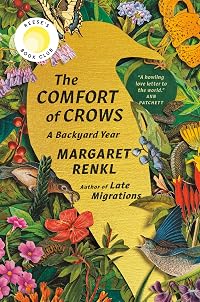
"In The Comfort of Crows, Margaret Renkl presents a literary devotional: fifty-two chapters that follow the creatures and plants in her backyard over the course of a year. As we move through the seasons -- from a crow spied on New Year's Day, its resourcefulness and sense of community setting a theme for the year, to the lingering bluebirds of December, revisiting the nest box they used in spring -- what develops is a portrait of joy and grief: joy in the ongoing pleasures of the natural show more world, and grief over winters that end too soon and songbirds that grow fewer and fewer. Along the way, we also glimpse the changing rhythms of a human life. Grown children, unexpectedly home during the pandemic, prepare to depart once more. Birdsong and night-blooming flowers evoke generations past. The city and the country where Renkl raised her family transform a little more with each passing day. And the natural world, now in visible flux, requires every ounce of hope and commitment from the author--and from us. For, as Renkl writes, 'radiant things are bursting forth in the darkest places, in the smallest nooks and deepest cracks of the hidden world.' With fifty-two original color artworks by the author's brother, Billy Renkl, The Comfort of Crows is a lovely and deeply moving book from a cherished observer of the natural world." -- show lessTags
Recommendations





Member Recommendations
Member Reviews
I loved the experience of reading Margaret Renkl's "The Comfort of Crows." The book is a collection of short essays structured around the passing of a year. It carries with it the feeling of a journey through nature and time with frequent stops as suddenly you come upon a deep insight lying there in the path, or an idea you want to mull over, consider again and again, before moving on. The essays are structured like a devotional, stepping through the year and pausing in each one to observe closely, be surprised, delight in something, or feel a grief.
Throughout, Renkl challenges herself to do better as a steward of the natural world in her backyard, and invites you in to share those experiences of tending to some creature, or failing to show more save it, or feeling amazed as life's complexity reveals itself. The world, and its mysteries and joy and grief, all in a back yard, or right out the window, or in a trip to another well-loved house.
This is a book that invites re-reading, in whole or in snippets. The language is precise and rich, and the observations are sharp. The vision, even in these small places, is wide.
Thanks to #netgalley and #Spiegel&Grau for the ARC. show less
Throughout, Renkl challenges herself to do better as a steward of the natural world in her backyard, and invites you in to share those experiences of tending to some creature, or failing to show more save it, or feeling amazed as life's complexity reveals itself. The world, and its mysteries and joy and grief, all in a back yard, or right out the window, or in a trip to another well-loved house.
This is a book that invites re-reading, in whole or in snippets. The language is precise and rich, and the observations are sharp. The vision, even in these small places, is wide.
Thanks to #netgalley and #Spiegel&Grau for the ARC. show less
I can’t emphasize strongly enough that this is a beautiful book. The artwork by Billy Renkl is stunning and worth the price of admission alone. The writing is also beautiful, but the spectre of climate change and mass extinctions hangs over it like a pall.
Renkl strives to find a balance between hope and despair, sorrow and joy, as in this lovely passage:
But—and maybe it’s just my frame of show more mind—sorrow seems most often to win out:
Since I read this for an “urban nature” reading challenge, I should point out that, strictly speaking, it’s at best about suburban nature, supplemented by woods, nature preserves, and an isolated cabin on the Cumberland Plateau. As she writes in the acknowledgments, “In making this account of a backyard year, I have hewed to an expansive definition of yard, including not just my own half acre but also the trails at Radnor Lake State Natural Area, Warner Parks, and Nashville’s extensive greenway system.”
I should probably clarify that this is a beautiful book, with gorgeous writing that is well worth reading, despite the darkness.
Renkl strives to find a balance between hope and despair, sorrow and joy, as in this lovely passage:
“Even now, with the natural world in so much trouble—even now, with the patterns of my daily life changing in ways I don’t always welcome or understand—radiant things are bursting forth in the darkest places, in the smallest nooks and deepest cracks of the hidden world. I mean to keep looking every single day until I find them.”
But—and maybe it’s just my frame of show more mind—sorrow seems most often to win out:
“Instead of fighting it so hard, maybe I should be honest, tell myself the brutal truth: This is the world as it is. This is what we’ve made of it, and there is no going back. This is the best the living world will ever be, and that’s only if we can stop the worst from coming.”
“The night sky is full of stars best seen from a dark place. I try to remember that, too.”
Since I read this for an “urban nature” reading challenge, I should point out that, strictly speaking, it’s at best about suburban nature, supplemented by woods, nature preserves, and an isolated cabin on the Cumberland Plateau. As she writes in the acknowledgments, “In making this account of a backyard year, I have hewed to an expansive definition of yard, including not just my own half acre but also the trails at Radnor Lake State Natural Area, Warner Parks, and Nashville’s extensive greenway system.”
I should probably clarify that this is a beautiful book, with gorgeous writing that is well worth reading, despite the darkness.
“In normal years, October is a month for open windows in Middle Tennessee. For cool, damp mornings. For colored leaves that quake in the wind before letting go and lifting away. For afternoon shadows so poignant they fill me with a longing I can’t even name.”show less
The way Renkl weaves the seasonal events of her yard, the transformation of her neighborhood over the decades, and her transition from young mother to an empty nester is poignant and lovely. She doesn't look away from the problems of today's world, but rather chooses to be mindful of ways she can help fellow living things within her sphere of influence. Her brother's artwork is a wonderful accompaniment to her meditations. Well worth the read.
Nearly forty hears have passed since I was in college, and I find myself thinking of the undergraduates who plod through the landscape that welcomed me at their age, a landscape so altered as to bewilder me when I visit. In years to come, will they remember with nostalgia what must seem even now like a magnificent chorus of birdsong pouring down from the trees? Are we all, generation upon generation, destined to mourn what seems in this moment impossibly abundant but is already far on its way to being gone?
Apocalyptic stories always get the apocalypse wrong. The tragedy is not the failed world's barren ugliness. The tragedy is its clinging beauty even as it fails. Until the very last cricket falls silent, the beauty-besotted will find show more a reason to love the world.
This book is beautiful and inspiring and depressing. It deserves to be read the way it was written, as a devotional with the weekly entries coinciding with the seasons, starting at Winter Solstice. It seems like such a perfect fit for my neighbor that I plan to gift her a copy at the end of this year. (Unfortunately, my library copy needs to be passed on to the next person on the hold list. It was a little unsettling to read about summer in Tennessee surrounded by snow and freezing temperatures.)
Margaret Renkle may not be for everyone. For example, if [b:Animal, Vegetable, Miracle: A Year of Food Life|40725379|Animal, Vegetable, Miracle A Year of Food Life|Barbara Kingsolver|https://i.gr-assets.com/images/S/compressed.photo.goodreads.com/books/1530799548l/40725379._SY75_.jpg|1582285] is not your jam, you should probably skip this one. Like Barbara Kingsolver, Renkle is a liberal writer who clearly feels superior to those who don't live the same way she does. She rails against her neighbors who use pesticides and herbicides, pull out native plants and plant grass, etc. I completely agree with her, but her holier-than-thou attitude might rub some the wrong way.
But...her prose is a thing of beauty:
Stop and consider the deep hollows of the persimmon's bark, the way the tree has carved its own skin into neat rectangles of sturdy protection. See how the lacy lichens have found purchase in the channels, sharing space in the hollows. Tree and lichen belong to one another. Neither is causing the other any harm.
And:
The purple-tinged stalks pop out of the ground with their foliage tightly furled, but very soon the leaves will open up like a teenager who has learned she's beautiful, like a lonely person finally loved. The striped leaves are all you notice at first, the perfect embodiment of springtime: cool and green and growing. Then, in a day or two, the white flowers appear, dainty and delicate, miniature bells nodding toward the damp soil on purple stems, nearly hidden under the showy leaves.
The accompanying artwork by her brother (Billy Renkl) is also lovely. show less
Apocalyptic stories always get the apocalypse wrong. The tragedy is not the failed world's barren ugliness. The tragedy is its clinging beauty even as it fails. Until the very last cricket falls silent, the beauty-besotted will find show more a reason to love the world.
This book is beautiful and inspiring and depressing. It deserves to be read the way it was written, as a devotional with the weekly entries coinciding with the seasons, starting at Winter Solstice. It seems like such a perfect fit for my neighbor that I plan to gift her a copy at the end of this year. (Unfortunately, my library copy needs to be passed on to the next person on the hold list. It was a little unsettling to read about summer in Tennessee surrounded by snow and freezing temperatures.)
Margaret Renkle may not be for everyone. For example, if [b:Animal, Vegetable, Miracle: A Year of Food Life|40725379|Animal, Vegetable, Miracle A Year of Food Life|Barbara Kingsolver|https://i.gr-assets.com/images/S/compressed.photo.goodreads.com/books/1530799548l/40725379._SY75_.jpg|1582285] is not your jam, you should probably skip this one. Like Barbara Kingsolver, Renkle is a liberal writer who clearly feels superior to those who don't live the same way she does. She rails against her neighbors who use pesticides and herbicides, pull out native plants and plant grass, etc. I completely agree with her, but her holier-than-thou attitude might rub some the wrong way.
But...her prose is a thing of beauty:
Stop and consider the deep hollows of the persimmon's bark, the way the tree has carved its own skin into neat rectangles of sturdy protection. See how the lacy lichens have found purchase in the channels, sharing space in the hollows. Tree and lichen belong to one another. Neither is causing the other any harm.
And:
The purple-tinged stalks pop out of the ground with their foliage tightly furled, but very soon the leaves will open up like a teenager who has learned she's beautiful, like a lonely person finally loved. The striped leaves are all you notice at first, the perfect embodiment of springtime: cool and green and growing. Then, in a day or two, the white flowers appear, dainty and delicate, miniature bells nodding toward the damp soil on purple stems, nearly hidden under the showy leaves.
The accompanying artwork by her brother (Billy Renkl) is also lovely. show less
This is the author's account of a "backyard year" that actually spanned a few years, with chapters themed after the seasons. I could empathize a lot with the author's experience of the joys and sorrows
of living and trying to keep things alive in a world seemingly in a death spiral. I loved how she emphasized death and rebirth, creating a book that was at times heartbreaking and others hilarious. Chock full of metaphors and quotes for tree-huggers and bird watchers of the world. I know a book is good when I'm sad it's over, but I feel like a lot of what she shared in it will persist as long as my memory.
of living and trying to keep things alive in a world seemingly in a death spiral. I loved how she emphasized death and rebirth, creating a book that was at times heartbreaking and others hilarious. Chock full of metaphors and quotes for tree-huggers and bird watchers of the world. I know a book is good when I'm sad it's over, but I feel like a lot of what she shared in it will persist as long as my memory.
This will no doubt be the best book I read this year, and it is only February. Renkl's writing is gorgeous. Her perceptions of things make me jealous that I don't seem capable of perceiving things her way. I think I teared up on every page of this book. What she wrote about, the feeling she put into it, her sincerity, her loving, caring nature, all of that just swept me along. I read this book in one day. I thought it was magnificent.
“According to birding tradition, the first bird you see on the first day of the new year sets the tone for your next twelve months.”
“The world will always be beautiful to those who look for beauty.”
“To follow politics these days is to court bewilderment, denial, complete despair. Too often I feel I am living in a country I no longer recognize, a country determined to imperil every principle that I hold dear...Immersing myself in the natural world of my own backyard.”
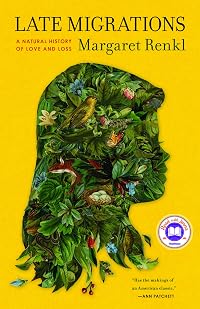
I loved Renkl’s essay collection Late Migrations and was looking forward to her latest, The Comfort of Crows. It did not disappoint. Told in 52 chapters, it follows her thoughts and observations, as she studies the birds and the plant life in her backyard. Her show more first bird of that year was a crow. She writes beautifully and touches on many things like climate change and habitat loss. You will not have to be a birder to enjoy this lovely book. show less
“The world will always be beautiful to those who look for beauty.”
“To follow politics these days is to court bewilderment, denial, complete despair. Too often I feel I am living in a country I no longer recognize, a country determined to imperil every principle that I hold dear...Immersing myself in the natural world of my own backyard.”
I loved Renkl’s essay collection Late Migrations and was looking forward to her latest, The Comfort of Crows. It did not disappoint. Told in 52 chapters, it follows her thoughts and observations, as she studies the birds and the plant life in her backyard. Her show more first bird of that year was a crow. She writes beautifully and touches on many things like climate change and habitat loss. You will not have to be a birder to enjoy this lovely book. show less
Members
- Recently Added By
Lists

Books With the Most Memorable Titles
478 works; 158 members

Bitter Southerner Summer Reading Roundup
198 works; 8 members

Top Five Books of 2024
795 works; 264 members

Favorite Books 2024
25 works; 1 member

Reese Witherspoon Book Club
100 works; 4 members

Reese's Book Club
122 works; 2 members
Author Information

7 Works 1,279 Members
Some Editions
Awards and Honors
Awards
Distinctions
Reese's Book Club (2024-09 – 2024)
Common Knowledge
- Original publication date
- 2023
- Important places
- Birmingham, Alabama, USA; Nashville, Tennessee, USA
- Epigraph
- "Nature" is what
we see--
The Hill--the
Afternoon--
Squirrel--Eclipse
--the Bumble bee
...
--EMILY DICKINSON
To pay attention,
this is our endless
and proper work.
--MARY OLIVER - Dedication
- For my children, who give me faith in the future
- First words
- Stop and look at the tangled rootlets of the poison ivy vine climbing the locust tree.
- Quotations
- According to birding tradition, the first bird you see on the first day of the new year sets the tone for your next twelve months. One year, the first bird I saw was a downy woodpecker, or possibly a hairy woodpecker--the two... (show all) species look virtually identical, particularly to a person who spies her first bird of the new year before she has had her first coffee of the new year. Because I couldn't sort it out in the instant before the woodpecker got spooked and flew away, my theme bird that year was neither species of woodpecker. Instead it was a robin, the second bird I saw that morning. As the robin stood on the edge of the birdbath, watching me as I watched it, I found myself wondering if birds play a New Year's game called "First Human." (p. 5)
Always I find more answers in a forest than I find in my own hot attic of a mind. Scientists have made studies of the walking brain, and the results are dumbfounding. Given a test that measures creativity, college students si... (show all)tting at a table produced unremarkable results. But when scientists put them on a treadmill, or sent them for a walk around campus, their brains lit up like the night sky. The students who walked produced 60 percent more original ideas than the students who were sitting. (p. 162) - Last words
- (Click to show. Warning: May contain spoilers.)I am far from feeling any confidence in the future, but when I look at the busy tableau before me, something flutters inside--something that feels just a little bit like hope.
- Original language
- English US
Classifications
Statistics
- Members
- 557
- Popularity
- 53,165
- Reviews
- 25
- Rating
- (4.24)
- Languages
- English
- Media
- Paper, Audiobook, Ebook
- ISBNs
- 4
- ASINs
- 3