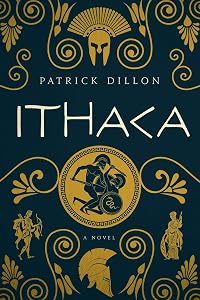
Ithaca: A Novel of Homer's Odyssey
by Patrick Dillon
On This Page
Description
"In the tumultuous aftermath of the Trojan War, a young man battles to save his home and his inheritance. Setting out to find his father, he ends up discovering himself." --Tags
Recommendations


























Member Reviews
Imagine a boy reaching the age of sixteen, never having met his father but having heard the most incredible stories of his heroism in battle, strength, daring, leadership, and cleverness. The boy is certain he shares none of these qualities, except, perhaps, the last.
But cleverness alone won’t protect his mother, who’s besieged by oafish, ambitious suitors she can’t get rid of, and who eat up whatever wealth the father left behind when he went to war–the boy’s inheritance. The only hope the son can cling to, and it’s not much, is that his father will, no, must return and put things right. But that hope competes against anger at the father’s irresponsibility and selfishness for staying away so long. And when an old friend show more passes through, he lets drop a remark like a lightning bolt: Your father’s a liar.
This is the premise to Dillon’s inventive, gripping take on Odysseus’ return to Ithaca following the Trojan War, except that the key figure here is Telemachus, the son. At once a coming-of-age story and a narrative about martial charisma, Ithaca asks, What is the measure of a man?
Fighting is the way of Telemachus’s world, but he’s never learned how; Odysseus wasn’t there to teach him. To be sure, the warriors who plague his mother and drive her deeper and deeper within herself give their calling a poor reputation. They’re vain, pompous, rude, and coarse, abusive to their subordinates (or those whom they’d like to make subordinate), and, if they perceive a slight, will kill by way of answer. Naturally, young Telemachus hates and mistrusts them, and would never want to be like them:
But he also fears them and hates his powerlessness, and he worries what will happen to his mother and himself should these quarrelsome guests ever put aside their rivalries to act in concert. Reluctantly, he leaves Ithaca to search for Odysseus, and his first stop is Pylos, where old Nestor rules, his father’s good friend and comrade-in-arms.
Nestor has no news, but he wants to help. He sends his daughter, Polycaste, a girl of Telemachus’s age, to guide the boy to Sparta and its king, Menelaus, the victor of the Trojan War. His ships range all over Greek and foreign waters, so if anyone knows what happened to Odysseus, Menelaus will.
The journey entails much more than a visit to a powerful lord, however, and Dillon turns his skill and insight toward a main theme of the novel: how the ability to fight defines masculinity and sexual power. In a switch, Polycaste is the warrior, whereas Telemachus hardly knows how to hold a sword. (Wouldn’t it have to be that way, or Nestor would never have put them together?) The author portrays Menelaus as a braggart and a bore, but he’s also a miserable soul who possesses everything in the world except happiness. It’s a terrific characterization.
The narrative shifts into Odysseus’s frame, as he lodges with a Phoenician trader and his wife, recovering until he’s fit to make the final voyage to Ithaca. Again, Dillon explores the sexual power theme, as he shows the trader’s daughter, Nausicaa, drooling over the shipwrecked hero. But the others react very differently, and though they feel the draw of Odysseus’s words when he tells of his travels and wars, they privately reserve judgment.
Is it possible that he’s lying about details or even entire exploits, an uncertainty that goes back to the question that plagues Telemachus? And even if what Odysseus says is true, do his adventures always suggest cleverness and a deft hand, or do greed, bungling, and poor seamanship play a part?
Ithaca is a fascinating tale, even–especially–if you’ve read the Odyssey or know the myth. show less
But cleverness alone won’t protect his mother, who’s besieged by oafish, ambitious suitors she can’t get rid of, and who eat up whatever wealth the father left behind when he went to war–the boy’s inheritance. The only hope the son can cling to, and it’s not much, is that his father will, no, must return and put things right. But that hope competes against anger at the father’s irresponsibility and selfishness for staying away so long. And when an old friend show more passes through, he lets drop a remark like a lightning bolt: Your father’s a liar.
This is the premise to Dillon’s inventive, gripping take on Odysseus’ return to Ithaca following the Trojan War, except that the key figure here is Telemachus, the son. At once a coming-of-age story and a narrative about martial charisma, Ithaca asks, What is the measure of a man?
Fighting is the way of Telemachus’s world, but he’s never learned how; Odysseus wasn’t there to teach him. To be sure, the warriors who plague his mother and drive her deeper and deeper within herself give their calling a poor reputation. They’re vain, pompous, rude, and coarse, abusive to their subordinates (or those whom they’d like to make subordinate), and, if they perceive a slight, will kill by way of answer. Naturally, young Telemachus hates and mistrusts them, and would never want to be like them:
But he also fears them and hates his powerlessness, and he worries what will happen to his mother and himself should these quarrelsome guests ever put aside their rivalries to act in concert. Reluctantly, he leaves Ithaca to search for Odysseus, and his first stop is Pylos, where old Nestor rules, his father’s good friend and comrade-in-arms.
Nestor has no news, but he wants to help. He sends his daughter, Polycaste, a girl of Telemachus’s age, to guide the boy to Sparta and its king, Menelaus, the victor of the Trojan War. His ships range all over Greek and foreign waters, so if anyone knows what happened to Odysseus, Menelaus will.
The journey entails much more than a visit to a powerful lord, however, and Dillon turns his skill and insight toward a main theme of the novel: how the ability to fight defines masculinity and sexual power. In a switch, Polycaste is the warrior, whereas Telemachus hardly knows how to hold a sword. (Wouldn’t it have to be that way, or Nestor would never have put them together?) The author portrays Menelaus as a braggart and a bore, but he’s also a miserable soul who possesses everything in the world except happiness. It’s a terrific characterization.
The narrative shifts into Odysseus’s frame, as he lodges with a Phoenician trader and his wife, recovering until he’s fit to make the final voyage to Ithaca. Again, Dillon explores the sexual power theme, as he shows the trader’s daughter, Nausicaa, drooling over the shipwrecked hero. But the others react very differently, and though they feel the draw of Odysseus’s words when he tells of his travels and wars, they privately reserve judgment.
Is it possible that he’s lying about details or even entire exploits, an uncertainty that goes back to the question that plagues Telemachus? And even if what Odysseus says is true, do his adventures always suggest cleverness and a deft hand, or do greed, bungling, and poor seamanship play a part?
Ithaca is a fascinating tale, even–especially–if you’ve read the Odyssey or know the myth. show less
Ratings
Members
- Recently Added By
Lists

Western & Northern Europe
60 works; 1 member

The wanderings of Odysseus
61 works; 6 members
Author Information
14 Works 899 Members
Patrick Dillon is executive producer of Stamen Design, a San Francisco-based data visualization studio. He was formerly the executive editor of California magazine and the editor in chief of Forbes ASAP. He lives in San Francisco, California. Carl M. Cannon is the executive editor of politicsDaily.com and the coauthor of Regan's Disciple: George show more W. Bush's Troubled Quest for a Presidential Legacy. He lives in Arlington, Virginia. show less
Classifications
Statistics
- Members
- 58
- Popularity
- 528,761
- Reviews
- 1
- Rating
- (3.78)
- Languages
- English
- Media
- Paper, Audiobook, Ebook
- ISBNs
- 7
- ASINs
- 2