On This Page
Description
Inspector Jules Maigret travels from grimy bars to luxury hotels as he traces the true identity of Pietr the Latvian.Tags
Recommendations













































Member Reviews
My first Maigret and the first Maigret.
It was interesting to see many of the existentialist themes with which Simenon grapples in his other work here in a procedural format. While the noir genre does deal with anxieties about identity and gender, in Simenon's hands noir is a cultural critique of all of these anxieties brought to a head between the two World Wars.
In Maigret and the Enigmatic Lett, Maigret faces the brick wall most detective face: circumstantial evidence. While he tries to amass concrete evidence against Pietr Lett, a known criminal on paper but whose life is too clean to place him under arrest, Simenon personalizes Maigret: we see his penchant for cigar smoking and standing too close to stoves for warmth; we see him show more using his physical body as part of the questioning process; we see him caring for his colleagues and yet also worried that this somehow shows a crack in the veneer of his masculinity. I imagine these are all traits Simenon uses to further make Maigret a real personage to readers in the rest of the Maigret books.
While trying to collect information, Maigret faces a case of mixed, doubled, and uncertain identities; this is something Simenon spends a lot of time on—and he even does this in his non-Maigret books, at least from those that I've read—for the way identity is shattered and destabilized in this specific time period in France. Simenon's strength as a writer of detective fiction/police procedurals speaks to his talent evident elsewhere with regard to pacing, an insistence on alienating the reader to underscore the characters—states of alienation, and a deft manipulation of a fictional personal crisis into an metacommentary of a very real national one. show less
It was interesting to see many of the existentialist themes with which Simenon grapples in his other work here in a procedural format. While the noir genre does deal with anxieties about identity and gender, in Simenon's hands noir is a cultural critique of all of these anxieties brought to a head between the two World Wars.
In Maigret and the Enigmatic Lett, Maigret faces the brick wall most detective face: circumstantial evidence. While he tries to amass concrete evidence against Pietr Lett, a known criminal on paper but whose life is too clean to place him under arrest, Simenon personalizes Maigret: we see his penchant for cigar smoking and standing too close to stoves for warmth; we see him show more using his physical body as part of the questioning process; we see him caring for his colleagues and yet also worried that this somehow shows a crack in the veneer of his masculinity. I imagine these are all traits Simenon uses to further make Maigret a real personage to readers in the rest of the Maigret books.
While trying to collect information, Maigret faces a case of mixed, doubled, and uncertain identities; this is something Simenon spends a lot of time on—and he even does this in his non-Maigret books, at least from those that I've read—for the way identity is shattered and destabilized in this specific time period in France. Simenon's strength as a writer of detective fiction/police procedurals speaks to his talent evident elsewhere with regard to pacing, an insistence on alienating the reader to underscore the characters—states of alienation, and a deft manipulation of a fictional personal crisis into an metacommentary of a very real national one. show less
The simple task of intercepting international criminal Pietr the Latvian at the Paris train station becomes far less simple when Pietr debarks the train, leaving behind him a dead man who looks just like him. Inspector Maigret will need all his imperturbable skill to thread his way through Paris’s swankiest nightclubs and its most wretched ghettos, if he hopes to stay alive long enough to discover the truth of Pietr the Latvian.
I didn’t know such a thing as French noir existed, and it’s delightful. The writing is not always poetry, or so gleefully hardboiled as American noir could be; but the archetype of the relentless police inspector on the track of his prey is excellently fulfilled in Maigret. This story skillfully evokes a show more Parisian atmosphere of days gone by, when American millionaires wore top hats to dinner and police inspectors got through their days and nights on a trail of chain-smoked pipe ash. show less
I didn’t know such a thing as French noir existed, and it’s delightful. The writing is not always poetry, or so gleefully hardboiled as American noir could be; but the archetype of the relentless police inspector on the track of his prey is excellently fulfilled in Maigret. This story skillfully evokes a show more Parisian atmosphere of days gone by, when American millionaires wore top hats to dinner and police inspectors got through their days and nights on a trail of chain-smoked pipe ash. show less
There are 75 Inspector Maigret books by Simenon! This is the first.
I had to read it. Maigret is a classic character. He really does carry the story. It’s interesting to think about how Simenon created a character that could keep our (and his) attention and interest for 75 books.
Maigret is subtly remarkable. He’s a large, imposing character, and his presence seems to be his superpower. When he confronts a perp or a witness, they talk. They may not tell the truth, but they talk. And Maigret learns almost as much from the lies as he would from the truth. Sometimes maybe more.
Just about everybody in the story is guilty of something. And, in Maigret's presence, that makes them vulnerable. They talk. Maybe they don't speak the truth, but show more their deflections point to what they are trying to deflect from. Maigret's superpower.
Saying much at all about the plot of the story would be a spoiler. I’ll keep it to a minimum because it really is the experience of Maigret the character that makes the book. The plot almost qualifies as a book length MacGuffin.
The notorious Pietr the Latvian has been on the move, and that’s never good. There has to be purpose to his travels, and to his arrival in Paris. He appears to be involved in some sort of scheme with visiting American businessman, Mortimer-Levingston.
But Pietr also seems to have been murdered! A body that for all the world looks to be Pietr was found onboard a Paris-bound train. We skip past that body, but it lurks in the background, as Maigret continues to follow Pietr’s trail and contacts throughout Paris, and as he hatches whatever he is hatching with Mortimer-Levingston.
As Maigret follows the trail, he’s gradually putting together the big picture — why Pietr is in Paris, what his plan is, and whose body was on the train. I’ll stop there. It’s engrossing, and it’s clever enough that I certainly didn’t know what Maigret knew, and he wasn’t telling.
Don’t worry, there’s a long reveal running through the final chapters, and if you didn’t figure it out, I think it probably reads better for the revelation. The long reveal, spoken by one of the characters to Maigret, is honest, no deflection finally. There's even dignity in it.
Like I said though, the story is Maigret, and the experience of reading is an experience of Maigret. The plot develops Maigret, rather than Maigret supporting the plot. That’s going to make for a good 75 books. show less
I had to read it. Maigret is a classic character. He really does carry the story. It’s interesting to think about how Simenon created a character that could keep our (and his) attention and interest for 75 books.
Maigret is subtly remarkable. He’s a large, imposing character, and his presence seems to be his superpower. When he confronts a perp or a witness, they talk. They may not tell the truth, but they talk. And Maigret learns almost as much from the lies as he would from the truth. Sometimes maybe more.
Just about everybody in the story is guilty of something. And, in Maigret's presence, that makes them vulnerable. They talk. Maybe they don't speak the truth, but show more their deflections point to what they are trying to deflect from. Maigret's superpower.
Saying much at all about the plot of the story would be a spoiler. I’ll keep it to a minimum because it really is the experience of Maigret the character that makes the book. The plot almost qualifies as a book length MacGuffin.
The notorious Pietr the Latvian has been on the move, and that’s never good. There has to be purpose to his travels, and to his arrival in Paris. He appears to be involved in some sort of scheme with visiting American businessman, Mortimer-Levingston.
But Pietr also seems to have been murdered! A body that for all the world looks to be Pietr was found onboard a Paris-bound train. We skip past that body, but it lurks in the background, as Maigret continues to follow Pietr’s trail and contacts throughout Paris, and as he hatches whatever he is hatching with Mortimer-Levingston.
As Maigret follows the trail, he’s gradually putting together the big picture — why Pietr is in Paris, what his plan is, and whose body was on the train. I’ll stop there. It’s engrossing, and it’s clever enough that I certainly didn’t know what Maigret knew, and he wasn’t telling.
Don’t worry, there’s a long reveal running through the final chapters, and if you didn’t figure it out, I think it probably reads better for the revelation. The long reveal, spoken by one of the characters to Maigret, is honest, no deflection finally. There's even dignity in it.
Like I said though, the story is Maigret, and the experience of reading is an experience of Maigret. The plot develops Maigret, rather than Maigret supporting the plot. That’s going to make for a good 75 books. show less
Georges Simenon’s creation, Chief Inspector Maigret, differs considerably from your average Golden Age detective from across the Channel or across the Pond.
Also published under the title of Maigret and the Enigmatic Lett and The Strange Case of Peter the Lett, this introduction to Maigret reveals a closed-mouth, almost taciturn man, large and infinitely patient and persistent. Police are tracking a cocky criminal mastermind with the eponymous nickname, Pietr the Latvian, but, when following this dashingly well-dressed man onto a train, Maigret sees him leave the train, but a perfect double, dressed as a common factory worker, is found dead in the train’s washroom. Who is the dead man? And who was the man who left the train? And who show more is to blame?
Maigret’s debut tale isn’t for those who crave non-stop action and grow frustrated with French existentialist musings; however, for those who find that a soupçon of Sartre provides a piquant flavor to one’s roman noir, Pietr the Latvian may be just your French bill of fare. show less
Also published under the title of Maigret and the Enigmatic Lett and The Strange Case of Peter the Lett, this introduction to Maigret reveals a closed-mouth, almost taciturn man, large and infinitely patient and persistent. Police are tracking a cocky criminal mastermind with the eponymous nickname, Pietr the Latvian, but, when following this dashingly well-dressed man onto a train, Maigret sees him leave the train, but a perfect double, dressed as a common factory worker, is found dead in the train’s washroom. Who is the dead man? And who was the man who left the train? And who show more is to blame?
Maigret’s debut tale isn’t for those who crave non-stop action and grow frustrated with French existentialist musings; however, for those who find that a soupçon of Sartre provides a piquant flavor to one’s roman noir, Pietr the Latvian may be just your French bill of fare. show less
Should it have been Peeter the Estonian?
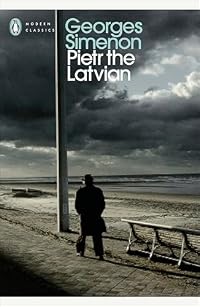
Review of the Penguin Classics paperback (2013) of a new translation by David Bellos from the French language original "Pietr-le-Letton" (Serialized 1930/Published 1931)
Although Chief Inspector Maigret's chase during Pietr the Latvian regularly refers to the title suspect as the leader of an international criminal "Latvian gang", the character himself is gradually revealed to be of Estonian origin. This is likely a minor issue for most readers, but since I'm of Estonian heritage it was a source of extra interest to me.
This 1st Maigret investigation is full of regular twists and cliffhanger chapter endings, probably characteristic of its serialized origins. Maigret himself is constantly frustrated show more and is even shockingly wounded during the hunt. He persists in cornering his quarry which produces yet another final surprising twist.
The details about the Korp! Ugala university student fraternity in Tartu, Estonia were particularly interesting to read and made me wonder where Simenon came across this sort of information.
See photograph at https://content.magnumphotos.com/wp-content/uploads/2018/11/cortex/par165093-tea...
Original photograph by Harry Gruyaert, used as a cropped image for the cover of the new Penguin Classics edition of "Pietr the Latvian." Image sourced from Magnum Photos.
I've now read several of the early Maigret novellas in the past few weeks and they continue to impress with how different they are not only from each other but also from other "Golden Age of Crime" novels of that interwar era. What is even more impressive is that the first dozen were all published in 1931 as if he wrote one every month. Perhaps it is not that surprising from an author who wrote over 500 books in his lifetime, but it still an eyeopener.
In an exception to the other books in the series, this is Maigret #1 in the both the Penguin Classics series of new translations (2013-2019) of the Inspector Maigret novels and short stories, and also Maigret #1 in the previous standard listing.
Trivia and Links
* Name redacted in order to conceal a key plot twist.
Pietr the Latvian, under its original French title Pietr-le-Letton, was adapted for French television in 1972, as part of the TV series Les enquêtes du commissaire Maigret (The Investigations of Commissioner Maigret) (1967-1990) with Jean Richard as Inspector Maigret.
There is an article about the Penguin Classics re-translations of the Inspector Maigret novels at Maigret, the Enduring Appeal of the Parisian Sleuth by Paddy Kehoe, RTE, August 17, 2019. show less
Review of the Penguin Classics paperback (2013) of a new translation by David Bellos from the French language original "Pietr-le-Letton" (Serialized 1930/Published 1931)
Although Chief Inspector Maigret's chase during Pietr the Latvian regularly refers to the title suspect as the leader of an international criminal "Latvian gang", the character himself is gradually revealed to be of Estonian origin. This is likely a minor issue for most readers, but since I'm of Estonian heritage it was a source of extra interest to me.
This 1st Maigret investigation is full of regular twists and cliffhanger chapter endings, probably characteristic of its serialized origins. Maigret himself is constantly frustrated show more and is even shockingly wounded during the hunt. He persists in cornering his quarry which produces yet another final surprising twist.
The details about the Korp! Ugala university student fraternity in Tartu, Estonia were particularly interesting to read and made me wonder where Simenon came across this sort of information.
... an individual by the name of __*, born Pskov, Russian Empire, of Estonian nationality, unemployed, residing at ... - an excerpt from Pietr the Latvian
Clearly visible in the middle of the table was a slate with the legend: Ugala Club, Tartu
Students have clubs of that kind in universities all over the world. One young man, however, was separate from the others. He was standing in front of the display without his cap. His shaved head made his face stand out. Unlike most of the others, in lounge suits, this young man was wearing a dinner jacket - a little awkwardly, as it was still too big for his shoulders. Over his white waistcoat he wore a white sash, as if he'd been made Knight Commander of something. It was the sash of office of the captain of the club. - an excerpt from Pietr the Latvian
... Captain of the Ugala Fraternity, became an important person, and he was taken seriously by people of substance. He didn't yet have a hair on his lip, but he was already being talked about as a potential leader of Free Estonia. - an excerpt from Pietr the Latvian
See photograph at https://content.magnumphotos.com/wp-content/uploads/2018/11/cortex/par165093-tea...
Original photograph by Harry Gruyaert, used as a cropped image for the cover of the new Penguin Classics edition of "Pietr the Latvian." Image sourced from Magnum Photos.
I've now read several of the early Maigret novellas in the past few weeks and they continue to impress with how different they are not only from each other but also from other "Golden Age of Crime" novels of that interwar era. What is even more impressive is that the first dozen were all published in 1931 as if he wrote one every month. Perhaps it is not that surprising from an author who wrote over 500 books in his lifetime, but it still an eyeopener.
In an exception to the other books in the series, this is Maigret #1 in the both the Penguin Classics series of new translations (2013-2019) of the Inspector Maigret novels and short stories, and also Maigret #1 in the previous standard listing.
Trivia and Links
* Name redacted in order to conceal a key plot twist.
Pietr the Latvian, under its original French title Pietr-le-Letton, was adapted for French television in 1972, as part of the TV series Les enquêtes du commissaire Maigret (The Investigations of Commissioner Maigret) (1967-1990) with Jean Richard as Inspector Maigret.
There is an article about the Penguin Classics re-translations of the Inspector Maigret novels at Maigret, the Enduring Appeal of the Parisian Sleuth by Paddy Kehoe, RTE, August 17, 2019. show less
The first Inspector Maigret book is tense from start to finish as the Inspector tries to trap a slippery international criminal, who has walked away scot free after previous arrests, and who has just arrived in Paris for a meeting with an American industrialist. The plot is pretty well done, but the most impressive parts are the descriptions of the grand hotel, where much of the action takes place, another, very seedy hotel, and the streets, piers, and bars where the story also plays out. AND--of course--the Inspector himself who fortified by a few beers and other assorted beverages shows the tenacity of a bulldog in staying on the case despite some rather serious issues. Just read it! The translation reads very well, and like most show more French noir, it is not too long, barely a novel really. Highly recommended. show less
After reading a number of Maigret novels I was curious to read the first one that Simenon wrote, which was Pietr-le-letton. According to my [Tout Maigret] omnibus, it was not the first of his detective novels that was published, it was one of the eight published in 1931, but this one was written in 1929. It is the first of a long series and people do like to start from the beginning: 1,151 members of LT own the book and there are 57 reviews.
In this stirring tale there are three murders, one being a policeman. Maigret himself is shot, but refuses to stop his hunt for the killers. He is described as a large powerful man and it is his dogged pursuit and solitary stake-outs that are the key to solving the mystery of Pietr-le-letton. The show more action takes place in tempest like conditions and Jules Maigret is soaked by rain water, by sea water and his own blood. He travels to the seaside port of Fécamp and prowls around the Jewish quarter, all fairly grim in the appalling weather. This is a far cry from later novels that I have read, where Maigret barely leaves his house or the prefecture. In this early incarnation he loves his wood stove that is the centre piece of his office and his pipe is rarely out of his mouth. He is a keen observer of peoples actions and reactions and his interviewing technique is already honed to a fine art. He is already drinking copiously, but horror of horrors we learn that he does not like champagne.
Of course it is fascinating to read a crime novel from the early 1930's when detective work and communications were so different; Maigret relied on people to run errands for him and to deliver messages. The train was used for long journeys and so the pace of detective work was carried out in accordance with train timetables. It was easier for detectives to cut corners, to pressure witnesses and to work on their own and all of this suited Maigret. This early novel has plenty of action and some good dialogue and reflects the suspicion of strangers from Germany and Eastern Europe. The mystery is well wrapped up: 4 stars and onto the next one. show less
In this stirring tale there are three murders, one being a policeman. Maigret himself is shot, but refuses to stop his hunt for the killers. He is described as a large powerful man and it is his dogged pursuit and solitary stake-outs that are the key to solving the mystery of Pietr-le-letton. The show more action takes place in tempest like conditions and Jules Maigret is soaked by rain water, by sea water and his own blood. He travels to the seaside port of Fécamp and prowls around the Jewish quarter, all fairly grim in the appalling weather. This is a far cry from later novels that I have read, where Maigret barely leaves his house or the prefecture. In this early incarnation he loves his wood stove that is the centre piece of his office and his pipe is rarely out of his mouth. He is a keen observer of peoples actions and reactions and his interviewing technique is already honed to a fine art. He is already drinking copiously, but horror of horrors we learn that he does not like champagne.
Of course it is fascinating to read a crime novel from the early 1930's when detective work and communications were so different; Maigret relied on people to run errands for him and to deliver messages. The train was used for long journeys and so the pace of detective work was carried out in accordance with train timetables. It was easier for detectives to cut corners, to pressure witnesses and to work on their own and all of this suited Maigret. This early novel has plenty of action and some good dialogue and reflects the suspicion of strangers from Germany and Eastern Europe. The mystery is well wrapped up: 4 stars and onto the next one. show less
Members
- Recently Added By
Lists

Le Monde - Les 100 livres du siècle
121 works; 25 members

Books Read in 2016
4,666 works; 197 members

Books Read in 2022
5,164 works; 113 members

Favorite Books in Translation
320 works; 133 members
Author Information

1,320+ Works 62,782 Members
The prolific Belgian-born writer Georges Simenon produced hundreds of fictional works under his own name and 17 pseudonyms, in addition to more than 70 books about Inspector Maigret, long "the favorite sleuth of highbrow detective-story readers" (SR). More than 50 "Simenons" have been made into films. In addition to his mystery stories, he wrote show more what he called "hard" books, the serious psychological novels numbering well over 100. The autobiographical Pedigree, set in his native town of Liege, is perhaps his finest work. The publication of Simenon's intimate memoirs also attracted considerable attention. Simenon himself once said that he would never write a "great novel." Yet Gide called him "a great novelist, perhaps the greatest and truest novelist we have in French literature today," and Thornton Wilder (see Vol. 1) found that Simenon's narrative gift extends "to the tips of his fingers." The following are some of Simenon's novels, exclusive of the Maigret detective stories, that are in print. (Bowker Author Biography) Georges Simenon was born on February 13, 1903 in Liege, Belgium. He wrote more than 200 fiction works under 16 different pseudonyms. His first book, The Case of Peter the Lent led to 80 more of the like including the main character, Inspector Maigret. He published over 400 books that were translated into 50 different languages and sold by the millions. He also wrote psychological novels, including The Man Who Watched the Train Go By. He died on September 4, 1989 in Lausanne. (Bowker Author Biography) show less
Some Editions
Awards and Honors
Series

Belongs to Publisher Series
Work Relationships
Is contained in
Was inspired by
Common Knowledge
- Canonical title
- Pietr the Latvian
- Original title
- Pietr-le-Letton
- Alternate titles
- Maigret And The Enigmatic Lett; The Case of Peter the Lett; The Strange Case of Peter the Lett
- Original publication date
- 1930 (serial) (serial); 1931-05 (book) (book); 1933 (in English) (in English)
- People/Characters
- Jules Maigret; Pietr the Latvian; Mr Mortimer-Levingston; Mrs Mortimer-Levingston; Berthe Swaan; Joseph Torrence (show all 14); Fyodor Yurevich; Anna Gorskin; José Latourie; Olaf Swaan; Oswald Oppenheim; Pepito Moretto; Hans Johannson; Louise Maigret
- Important places
- Paris, Île-de-France, France; Fécamp, Seine-Maritime, Normandy, France; 36 Quai des Orfèvres, Paris, Île-de-France, France
- Related movies
- Maigret (1970 | IMDb); Maigret (1960 | IMDb); Les enquêtes du commissaire Maigret (1967 | IMDb)
- First words
- Interpol to Sûreté, Paris:
Xuvust Cracovie vimontra m ghks triv psot uv Pietr-le-Letton Breme vs tyz btolem.
Detective Chief Inspector Maigret of the Flying Squad raised his eyes. - Last words
- (Click to show. Warning: May contain spoilers.)In Pskov, an old woman in national costume, the flaps of her bonnet pulled down over her cheeks, would now be on the way to church, her sledge gliding over the snow while a drunken coachman lashed at a pony which trotted jerkily, like a clockwork toy.
(Click to show. Warning: May contain spoilers.)In Pskov, an old lady in a folk hat that came down over both cheeks must have been on her way to church in a sled behind a drunken coachman whipping a pony trotting across the snow like a mechanical toy. - Original language
- French
- Disambiguation notice
- In the French original, Pietr-le-Letton (1931).
Variously published in English as:
(i) The Strange Case of Peter the Lett (1933) (trans. Anthony Abbot);
(ii) "The Case of Peter the ... (show all)Lett," (trans. Anthony Abbot) in Inspector Maigret Investigates (1933);
(iii) Maigret and the Enigmatic Lett (1963), and in Maigret Meets a Milord (1983) (trans. Daphne Woodward) and;
(iv) Pietr the Latvian (2013) (trans. David Bellos).
Classifications
Statistics
- Members
- 1,397
- Popularity
- 16,867
- Reviews
- 71
- Rating
- (3.41)
- Languages
- 14 — Catalan, Czech, Danish, Dutch, English, Finnish, French, German, Italian, Norwegian (Bokmål), Farsi/Persian, Portuguese, Romanian, Spanish
- Media
- Paper, Audiobook, Ebook
- ISBNs
- 46
- ASINs
- 36