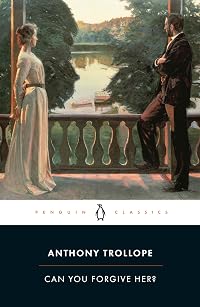
On This Page
Description
A woman forced to choose between two suitors is one of the world's oldest dilemmas. In the skilled hands of Anthony Trollope, this conundrum becomes an engrossing examination of the subtle family tics and preferences that can influence love relationships and marriage decisions. The novel follows three women as they puzzle through the choices that will determine the course of their lives..
Tags
Recommendations















Member Recommendations
Member Reviews
I started this book based on a number of reviews on Trollope--people said he was much more grounded than Dickens, much more sympathetic and understanding than prim, demanding George Eliot...all in all rather worldly. Perhaps I picked the wrong book to start with--this book kicks off the "Palliser" sextet of novels, detailing the machinations of a group of people concerned with the British government. Trollope thought that government service was just the BEST thing a Britisher could do, and I think he himself ran (and lost) for office. So there's a sort of fascination/admiration for political figures running through ALL his novels.
This volume, however, concerns itself with one Alice Vavasor, the woman mentioned in the title. Feeling show more rather proto-feminist, she throws over the kind, yet rather dull country gentleman John Grey (she's engaged to him). She does so after taking a trip to Switzerland with her cousins Kate and George. She used to be engaged to George, but broke it off for rather murky reasons, but it hints that he was a bit angry and gruff. Kate, however, is bent towards hooking the two up. After some subtle manipulation by Kate, Alice returns to London and breaks up with John Grey. She tells John that it has nothing to do with him or anyone else; "It's not you, it's me." Well, that's not quite true--more like "It's not you, it's me. And George." . That was a little irritating. Especially when she agrees to become marry George, who is endeavoring to run for a seat in Parliament, which ain't cheap. Did I mention Alice is quite well-endowed? (With a fortune, that is--the best sort of endowment to most Victorians).
She is pestered by a great deal of people to change her mind, and refuses to do so. But she also refuses to discuss the matter at all, threatening to leave the room or similar bratty behavior. It's certainly no one else's business, and when she gave it to a couple old biddies I was thrilled, but at other times she was really getting obnoxious about it.
I have to say that I consider Alice to be a failure as a character. I always cringe when a review presumes to know the intentions of an author, but it seems terribly likely that Trollope was in favor of Alice, that he wanted us to respect her for her willpower and ability to stand up for herself. But he overdoes it, and eventually he can only characterize her by what she ISN'T, by what she WON'T do. She spurns John Grey, comes to shudder at the touch of George, refuses to discuss her relations with her father or grandfather. She came to remind me, in fact, of Middlemarch's Dorothea Brooke, another high-minded, humourless young woman. But Dorothea does grow, and in time the reader comes to understand and pity her, especially in the shade of horrid Casaubon. Alice, even at her wedding to John Grey (it's a Victorian novel, happy endings were more common then), feels like she doesn't deserve her happiness. Whine whine. I wished she'd gone and thrown herself off the Swiss waterfall at the beginning of the novel and saved us all the trouble of attending to her high-mindedness.
There's also a subplot about Kate, who goes with a rich widow, Mrs. Greenow, to the seaside. Mrs. Greenow quickly becomes the target of two rather different men, one a well-to-do farmer, the other a spendthrift. I really liked this part--it was quite comic, and the two men would fight over all these ridiculous trifles, like who got to open the wine at a picnic, because whoever did so would be complimented on said wine. I would much rather have spent the entire book amongst these people. Again, though, none of them are very likeable, but at least they're lively and there's lots of maneuvering and social scheming, which Trollope is quite talented at. This part alone adds a star to the book. It reminded me a bit of Barchester Towers, which is another Trollope story about well-to-do, middle-class Englishmen (and women) fighting and scheming with a sort of bourgeois glee.
There's also ANOTHER subplot: this one concerns aspiring Prime Minister Lord Plantagenet Palliser and his "smile-until-you're-numb-inside" wife Glencora. They are badly suited for each other...actually they ended up married because the man Glencora loved, Burgo Fitzgerald, would have run through all her money and left them both penniless. He wasn't trying to hide the fact, though, and is a not-unlikeable character.
I had really mixed feelings about this book. Maybe Dickens spoiled me and made me used to more excitement--Trollope mocked his (occasionally) syrupy drama by calling him Mr. Popular Sentiment--but I enjoy Thackeray, and he's not bouncing up and down like Dickens. Trollope is just...there's no one for the reader to lock on to, no one to identify with or root for. Big deal you might say--look at the stories of Evelyn Waugh, or any number of satirical authors. In those cases though, the writer creates such a fracas that it doesn't matter that everyone's an ass--it's so damn entertaining you just come along for the ride. In Trollopeland, conversely, if they're not bores, they're unlikeable. Maybe I'm just cranky and short-tempered, though. The book resolves into a fairly happy ending, and Alice Vavasor does change somewhat, but damn, it's not a short book.
There was a wonderful section involving a fox hunt, which Trollope did wonderfully. And the book wasn't boring, it was just a sort of lusterless gossip, like the kind of gossip you might hear your grandmother whisper to you about her various acquaintances. It's amusing and passes the time, but once you kiss grandma goodbye, the stories quickly melt into a puddle and go right down the drain.
And while I do think that Trollope is more understanding than Eliot--Eliot would have sent Alice off to supervise the building of poorhouses in Limehouse or something, singing secular hymns all the way--Eliot has a dry sense of humor that manages to alleviate her horrible Victorian earnestness. Though I find her stuff pretty unreadable, excepting Middlemarch. Both Trollope and Eliot were widely read, so I fail to understand how they neglected to incorporate the lessons of Jane Austen into their work: just because a character goes against the grain, or is feisty, or meddlesome, or anything besides a stereotypical female character of the time, doesn't mean they have to be a burden that the reader must carry through to the end of the book. Actually, I have a vague feeling George Eliot didn't really like Jane Austen, either. And then what about the Brontes? They manage to handle female characters in a supple, independent fashion while giving us their sympathy all the while. Hell, even Becky Sharp was (at the very LEAST) entertaining. show less
This volume, however, concerns itself with one Alice Vavasor, the woman mentioned in the title. Feeling show more rather proto-feminist, she throws over the kind, yet rather dull country gentleman John Grey (she's engaged to him). She does so after taking a trip to Switzerland with her cousins Kate and George. She used to be engaged to George, but broke it off for rather murky reasons, but it hints that he was a bit angry and gruff. Kate, however, is bent towards hooking the two up. After some subtle manipulation by Kate, Alice returns to London and breaks up with John Grey. She tells John that it has nothing to do with him or anyone else; "It's not you, it's me." Well, that's not quite true--more like "It's not you, it's me. And George." . That was a little irritating. Especially when she agrees to become marry George, who is endeavoring to run for a seat in Parliament, which ain't cheap. Did I mention Alice is quite well-endowed? (With a fortune, that is--the best sort of endowment to most Victorians).
She is pestered by a great deal of people to change her mind, and refuses to do so. But she also refuses to discuss the matter at all, threatening to leave the room or similar bratty behavior. It's certainly no one else's business, and when she gave it to a couple old biddies I was thrilled, but at other times she was really getting obnoxious about it.
I have to say that I consider Alice to be a failure as a character. I always cringe when a review presumes to know the intentions of an author, but it seems terribly likely that Trollope was in favor of Alice, that he wanted us to respect her for her willpower and ability to stand up for herself. But he overdoes it, and eventually he can only characterize her by what she ISN'T, by what she WON'T do. She spurns John Grey, comes to shudder at the touch of George, refuses to discuss her relations with her father or grandfather. She came to remind me, in fact, of Middlemarch's Dorothea Brooke, another high-minded, humourless young woman. But Dorothea does grow, and in time the reader comes to understand and pity her, especially in the shade of horrid Casaubon. Alice, even at her wedding to John Grey (it's a Victorian novel, happy endings were more common then), feels like she doesn't deserve her happiness. Whine whine. I wished she'd gone and thrown herself off the Swiss waterfall at the beginning of the novel and saved us all the trouble of attending to her high-mindedness.
There's also a subplot about Kate, who goes with a rich widow, Mrs. Greenow, to the seaside. Mrs. Greenow quickly becomes the target of two rather different men, one a well-to-do farmer, the other a spendthrift. I really liked this part--it was quite comic, and the two men would fight over all these ridiculous trifles, like who got to open the wine at a picnic, because whoever did so would be complimented on said wine. I would much rather have spent the entire book amongst these people. Again, though, none of them are very likeable, but at least they're lively and there's lots of maneuvering and social scheming, which Trollope is quite talented at. This part alone adds a star to the book. It reminded me a bit of Barchester Towers, which is another Trollope story about well-to-do, middle-class Englishmen (and women) fighting and scheming with a sort of bourgeois glee.
There's also ANOTHER subplot: this one concerns aspiring Prime Minister Lord Plantagenet Palliser and his "smile-until-you're-numb-inside" wife Glencora. They are badly suited for each other...actually they ended up married because the man Glencora loved, Burgo Fitzgerald, would have run through all her money and left them both penniless. He wasn't trying to hide the fact, though, and is a not-unlikeable character.
I had really mixed feelings about this book. Maybe Dickens spoiled me and made me used to more excitement--Trollope mocked his (occasionally) syrupy drama by calling him Mr. Popular Sentiment--but I enjoy Thackeray, and he's not bouncing up and down like Dickens. Trollope is just...there's no one for the reader to lock on to, no one to identify with or root for. Big deal you might say--look at the stories of Evelyn Waugh, or any number of satirical authors. In those cases though, the writer creates such a fracas that it doesn't matter that everyone's an ass--it's so damn entertaining you just come along for the ride. In Trollopeland, conversely, if they're not bores, they're unlikeable. Maybe I'm just cranky and short-tempered, though. The book resolves into a fairly happy ending, and Alice Vavasor does change somewhat, but damn, it's not a short book.
There was a wonderful section involving a fox hunt, which Trollope did wonderfully. And the book wasn't boring, it was just a sort of lusterless gossip, like the kind of gossip you might hear your grandmother whisper to you about her various acquaintances. It's amusing and passes the time, but once you kiss grandma goodbye, the stories quickly melt into a puddle and go right down the drain.
And while I do think that Trollope is more understanding than Eliot--Eliot would have sent Alice off to supervise the building of poorhouses in Limehouse or something, singing secular hymns all the way--Eliot has a dry sense of humor that manages to alleviate her horrible Victorian earnestness. Though I find her stuff pretty unreadable, excepting Middlemarch. Both Trollope and Eliot were widely read, so I fail to understand how they neglected to incorporate the lessons of Jane Austen into their work: just because a character goes against the grain, or is feisty, or meddlesome, or anything besides a stereotypical female character of the time, doesn't mean they have to be a burden that the reader must carry through to the end of the book. Actually, I have a vague feeling George Eliot didn't really like Jane Austen, either. And then what about the Brontes? They manage to handle female characters in a supple, independent fashion while giving us their sympathy all the while. Hell, even Becky Sharp was (at the very LEAST) entertaining. show less
It’s been a year since I finished Anthony Trollope’s Chronicles of Barsetshire, and it was such a joy to return to his depiction of Victorian England in The Pallisers. In Can You Forgive Her?, Trollope shows the good, bad, and ugly of marriage through three different situations. Young Alice Vavasor, egged on by her cousin Kate, breaks off her engagement to John Grey in favor of Kate’s brother George. Lady Glencora “Cora” Palliser was recently forced by her family to break off a relationship with handsome, dashing Burgo Fitzgerald, to marry the prosperous and ambitious Plantagenet Palliser. Her comfortable lifestyle can’t make up for a dull and so far childless relationship. Finally, the widow Arabella Greenow toys with two show more different suitors and provides comic relief in the novel.
Alice’s reputation is sorely damaged, yet she remains oblivious to this and insists on providing financial support to George as he runs for parliament, even though they are not yet married, the sums are significant, and he proves himself to be a cad of the highest order. John Grey, meanwhile, is never far away and continues to have feelings for Alice. Cora finds solace in friendship with Alice as her husband largely ignores her and enlists others to keep Cora in check as he focuses on his work.
In an unusual move for the time, the story is told almost entirely from a female perspective. The women are strong characters with money and opinions of their own. However, Trollope cannot envision a world free from Victorian conventions, so naturally the only successful outcomes involve marriage. Still, I can forgive Trollope for being a product of his time, and I can forgive the eponymous heroines whose actions, both scandalous and annoying, made for a very good story. show less
Alice’s reputation is sorely damaged, yet she remains oblivious to this and insists on providing financial support to George as he runs for parliament, even though they are not yet married, the sums are significant, and he proves himself to be a cad of the highest order. John Grey, meanwhile, is never far away and continues to have feelings for Alice. Cora finds solace in friendship with Alice as her husband largely ignores her and enlists others to keep Cora in check as he focuses on his work.
In an unusual move for the time, the story is told almost entirely from a female perspective. The women are strong characters with money and opinions of their own. However, Trollope cannot envision a world free from Victorian conventions, so naturally the only successful outcomes involve marriage. Still, I can forgive Trollope for being a product of his time, and I can forgive the eponymous heroines whose actions, both scandalous and annoying, made for a very good story. show less
After a three and a half year hiatus, I’ve returned to Trollope and I am so glad I did. I read the Barsetshire series shortly after joining LT. I don’t think I had even heard of Trollope before becoming active here, but I fell in love with his writing immediately. [Can You Forgive Her?] is the first book in Trollope’s Palliser series. I had a little trepidation about reading the Palliser novels because I have heard that they get a bit bogged down in British politics of the day. This may be a problem for me in subsequent novels in the series, but this one had very little politics, and it was all very easy to comprehend as it mainly had to do with the ambitions of the characters rather than actual political theories or maneuverings. show more
At the heart of the novel is the character Alice Vavasor. She is an otherwise steady and wise young woman having problems deciding on a husband. As the novel opens she is engaged to the smart, handsome, steady, and slightly boring John Grey. In her past, she had a short engagement to her wild and interesting cousin, George Vavasor. His behavior resulted in her breaking off the engagement. George’s sister, Kate, still hopes to reunite her brother and Alice and they go on a trip to Europe together with John Grey’s blessing. Long story short, Alice decides to break off her engagement with John Grey to the horror of all of her relations. The novel explores her subsequent decisions and moral dilemmas and her actions are the reason for the title, [Can You Forgive Her?]. To resolve the novel, the reader waits to see if her friends can forgive her, John Grey can forgive her, the reader can forgive her, and most importantly, can Alice forgive herself?
All of this moralizing and the mood changes of Alice could have gotten old, except that of course Trollope has several other story lines going on. In fact, there are two other love triangles. My favorite character, Lady Glencora, is struggling to reconcile herself to a marriage with rising political star, Plantagenet Palliser. She is still in love with a handsome but penniless man named Burgo Fitzgerald, but her family convinced her to bring her enormous wealth to a more “deserving” husband, Palliser. She and Alice become friends and their lives intertwine. Added to this is the more humorous and light love triangle between Kate and Alice’s older Aunt Greenow. She is recently widowed and wealthy. She has two suitors vying for her hand in marriage.
I love Trollope’s writing. He writes fantastic female characters that are more than just caricatures or love interests. I also absolutely love his authorial commentary. I love knowing what he thinks about the characters he has created and the subtle foreshadowing he does. I’m really excited about continuing the series! show less
At the heart of the novel is the character Alice Vavasor. She is an otherwise steady and wise young woman having problems deciding on a husband. As the novel opens she is engaged to the smart, handsome, steady, and slightly boring John Grey. In her past, she had a short engagement to her wild and interesting cousin, George Vavasor. His behavior resulted in her breaking off the engagement. George’s sister, Kate, still hopes to reunite her brother and Alice and they go on a trip to Europe together with John Grey’s blessing. Long story short, Alice decides to break off her engagement with John Grey to the horror of all of her relations. The novel explores her subsequent decisions and moral dilemmas and her actions are the reason for the title, [Can You Forgive Her?]. To resolve the novel, the reader waits to see if her friends can forgive her, John Grey can forgive her, the reader can forgive her, and most importantly, can Alice forgive herself?
All of this moralizing and the mood changes of Alice could have gotten old, except that of course Trollope has several other story lines going on. In fact, there are two other love triangles. My favorite character, Lady Glencora, is struggling to reconcile herself to a marriage with rising political star, Plantagenet Palliser. She is still in love with a handsome but penniless man named Burgo Fitzgerald, but her family convinced her to bring her enormous wealth to a more “deserving” husband, Palliser. She and Alice become friends and their lives intertwine. Added to this is the more humorous and light love triangle between Kate and Alice’s older Aunt Greenow. She is recently widowed and wealthy. She has two suitors vying for her hand in marriage.
I love Trollope’s writing. He writes fantastic female characters that are more than just caricatures or love interests. I also absolutely love his authorial commentary. I love knowing what he thinks about the characters he has created and the subtle foreshadowing he does. I’m really excited about continuing the series! show less
We've all seen people who can't make up their minds - who waffle back and forth on a decision, but Alice Vavasor takes waffling to a new level. And her waffling isn't about what hat to wear today, but what man to marry. Alice, having been engaged to her cousin George, breaks off the engagement when George goes through a wild period and becomes engaged to a responsible and steady country gentleman, John Grey. But worried that being the wife of a country gentleman might be too staid and boring, Alice breaks off this engagement. There is much more waffling (the book is 848 pages after all) as well as some entertaining descriptions of political elections at that time - some things never change - before the book finally comes to a close. At show more the end of the story, the question is posed to the reader Can You Forgive Her?. Of course all of the characters forgive Alice as she and _____ (no spoiler here!) live happily ever after. I'm not sure if I would have forgiven her flip flopping, but her indecisiveness made for an entertaining and interesting story. show less
It seems that everyone but Alice Vavasor can forgive Alice for waffling over her engagements. (Except for her cousin George, but by the end of the book readers won't care what George thinks about anything!) But can the reader forgive her? Or is it Lady Glencora we're supposed to forgive? Or perhaps even Mrs. Greenow? All three women face similar circumstances. Each must decide which of two men to accept. Will they follow their hearts or their heads? Will they accept or reject advice? Will any choice lead to happiness, or is it just a matter of choosing the lesser of two evils?
I couldn't help comparing Alice to both Anne Elliot in Jane Austen's Persuasion and Lily Dale in Trollope's The Small House at Allington. Both Anne and Alice are show more motherless with fathers who have largely abdicated their parental responsibilities. Anne follows the guidance of a family friend in deciding whether to accept or reject a suitor, while Alice refuses to be guided by any but her own inclinations. Neither course of action works out well for these women. Alice is better suited for Lily Dale's life than is Lily Dale. She has money of her own and would not be a burden to other family members if she chose not to marry.
Aunt Greenow, recently widowed by a much older wealthy husband, provides comic relief. While she is the master of every situation and everyone does her bidding, she manages to make people think it's their idea to do what she wants them to do. The suspense for the reader is not in what might happen, but in how it will unfold.
Lady Glencora is my favorite of the three women. She may not know much about politics, but she understands people and she isn't easily fooled. My affinity for Lady Glencora is probably proof that I wouldn't have been cut out to be a society wife in Victorian England either.
I read this years ago but remembered very little of it. I was probably too young to appreciate it the first time around. Now I'm eagerly looking forward to discovering the pleasures ahead in the remaining books in the Palliser series. show less
I couldn't help comparing Alice to both Anne Elliot in Jane Austen's Persuasion and Lily Dale in Trollope's The Small House at Allington. Both Anne and Alice are show more motherless with fathers who have largely abdicated their parental responsibilities. Anne follows the guidance of a family friend in deciding whether to accept or reject a suitor, while Alice refuses to be guided by any but her own inclinations. Neither course of action works out well for these women. Alice is better suited for Lily Dale's life than is Lily Dale. She has money of her own and would not be a burden to other family members if she chose not to marry.
Aunt Greenow, recently widowed by a much older wealthy husband, provides comic relief. While she is the master of every situation and everyone does her bidding, she manages to make people think it's their idea to do what she wants them to do. The suspense for the reader is not in what might happen, but in how it will unfold.
Lady Glencora is my favorite of the three women. She may not know much about politics, but she understands people and she isn't easily fooled. My affinity for Lady Glencora is probably proof that I wouldn't have been cut out to be a society wife in Victorian England either.
I read this years ago but remembered very little of it. I was probably too young to appreciate it the first time around. Now I'm eagerly looking forward to discovering the pleasures ahead in the remaining books in the Palliser series. show less
I perhaps didn't wait long enough after finishing Phineas Finn before starting Can You Forgive Her?, so I was maybe "Trolloped Out", because it took me quite a while to get into this book. I limped along each evening, falling asleep after 10 or 15 pages for the first 150 to 200 pages, until it finally picked up for me.
I continue to be amazed at Trollope's enlightened attitude toward his female characters, his awareness of the rights they give up by marrying, his willingness to recognize their intellect.
I did note that I was very interested in Lady Glencora's story, which figures prominently in this book. She appears as a minor character in Phineas Finn, and had I been more aware of her back story, I might have enjoyed her more.
Good show more quote:
"I do not know that she was at all points a lady, but had Fate so willed it she would have been a thorough gentleman." show less
I continue to be amazed at Trollope's enlightened attitude toward his female characters, his awareness of the rights they give up by marrying, his willingness to recognize their intellect.
I did note that I was very interested in Lady Glencora's story, which figures prominently in this book. She appears as a minor character in Phineas Finn, and had I been more aware of her back story, I might have enjoyed her more.
Good show more quote:
"I do not know that she was at all points a lady, but had Fate so willed it she would have been a thorough gentleman." show less
I sometimes wonder - not terribly seriously - if the whole academic industry which has formed itself around Trollope has done this as a face saving exercise to justify the time investment for this brilliant, compelling series of novels (I mean the Pallister sequence), which have never gained the same ‘serious’ reputation as Dickens, Balzac, Dostoevsky. And make no mistake, one can testify seriously to the intellectual merits of the books - only those that are going on outdated critical reputation ever seem to argue they are lightweights - but there still seems a bit of view that by reading them one is somehow taking a less virtuous course than even say some of La Comédie humaine, or Les Rougon-Macquart which they most closely show more resemble.
I worried about this sort of thing a lot when younger. But coming to the first book in the series I now positively revel in his narrative genius, authorial voice, acute characterisation and humour. It is a page turner in the best sense of the phrase and even in its roots were in a less than successful play - melodrama would be an accurate description - (just read some of the appalling blank verse from the ‘The Noble Jilt’ quoted by Stephen Wall in his Introduction!) what Trollope eventually did with that material is genuinely inspired. show less
I worried about this sort of thing a lot when younger. But coming to the first book in the series I now positively revel in his narrative genius, authorial voice, acute characterisation and humour. It is a page turner in the best sense of the phrase and even in its roots were in a less than successful play - melodrama would be an accurate description - (just read some of the appalling blank verse from the ‘The Noble Jilt’ quoted by Stephen Wall in his Introduction!) what Trollope eventually did with that material is genuinely inspired. show less
Members
- Recently Added By
Lists

Favourite 19th century fiction
257 works; 60 members

Top Five Books of 2013
1,562 works; 721 members

Fiction Featuring Cranky, Eccentric Old Folks
80 works; 35 members

Read the book and saw the movie
1,170 works; 195 members

Best Political Fiction
92 works; 12 members

Books Set in Great Britain
191 works; 13 members

Folio Society
831 works; 49 members

19th Century
190 works; 16 members

Global Reads: Books Set in the United Kingdom and Ireland
109 works; 5 members

Top Five Books of 2015
811 works; 241 members
Out of Copyright
244 works; 14 members

Love Triangles in Literature
108 works; 15 members
Victorian Period
113 works; 10 members

1860s
25 works; 4 members
Books Read in 2016
4,666 works; 199 members

Europe
205 works; 6 members

Books Read in 2022
5,226 works; 115 members

infjsarah's wishlist
408 works; 2 members

Tagged 19th Century
104 works; 7 members

Books With Complete Sentence Titles
502 works; 17 members

Works Referenced in The League of Extraordinary Gentlemen
122 works; 6 members

Books Read in 2024
4,727 works; 128 members

Classics you know you should have read but probably haven't
421 works; 409 members
Talk Discussions
Past Discussions
Group read: Can You Forgive Her? by Anthony Trollope in 75 Books Challenge for 2013 (September 2017)
1815: Anthony Trollope - Palliser series I: Can You Forgive Her? in Literary Centennials (March 2015)
Author Information

344+ Works 50,608 Members
Anthony Trollope was born in London, England on April 24, 1815. In 1834, he became a junior clerk in the General Post Office, London. In 1841, he became a deputy postal surveyor in Banagher, Ireland. He was sent on many postal missions ending up as a surveyor general in the post office outside of London. His first novel, The Macdermots of show more Ballycloran, was published in 1847. His other works included Castle Richmond, The Last Chronicle of Barset, Lady Anna, The Two Heroines of Plumplington, and The Noble Jilt. He died after suffering from a paralytic stroke on December 6, 1882. (Bowker Author Biography) show less
Some Editions
Series

Belongs to Publisher Series
Work Relationships
Is contained in
The Palliser Novels, Volume One, Including: Can You Forgive Her? Phineas Finn and the Eustace Diamonds by Anthony Trollope
The Palliser Novels: The Duke's Children, Phineas Redux, The Eustace Diamonds, Phineas Finn, Can You Forgive Her? 5 vol set by Anthony Trollope
Contains
Has the adaptation
Is abridged in
Common Knowledge
- Canonical title
- Can You Forgive Her?
- Original title
- Can You Forgive Her?
- Original publication date
- 1865
- People/Characters
- Alice Vavasor; George Vavasor; Kate Vavasor; John Vavasor; Lady Glencora Palliser; Plantagenet Palliser (show all 14); John Grey; Burgo Fitzgerald; Mrs Arabella Greenow; Samuel Cheeseacre; Captain Bellfield; Mr Bott; Lady Margaret Midlothian; Lady Monk
- Important places
- Matching Priory, Yorkshire, England, UK (fictional); Vavasor Hall, Cumbria, England, UK; Basel, Basel-Stadt, Switzerland; Baden-Baden, Baden-Württemberg, Germany; London, England, UK; Great Yarmouth, Norfolk, England, UK
- First words
- Whether or no, she, whom you are to forgive, if you can, did or did not belong to the Upper Ten Thousand of this our English world, I am not prepared to say with any strength of affirmation.
- Quotations
- She wanted the little daily assurance of her supremacy in the man's feelings, the constant touch of love, half accidental half contrived, the passing glance of the eye telling perhaps of some little joke understood only betwe... (show all)en them two rather than of love, the softness of an occasional kiss given here and there when chance might bring them together, some half-pretended interest in her little doings, a nod, a wink, a shake of the head, or even a pout. It should have been given to her to feed upon such food as this daily, and then she would have forgotten Burgo Fitzgerald.
It's a very fine theory, that of women being able to get along without men as well as with them; but, like other fine theories, it will be found very troublesome by those who first put it in practice. Gloved hands, petticoats... (show all), feminine softness, and the general homage paid to beauty, all stand in the way of success. These things may perhaps some day be got rid of, and possibly with advantage; but while young ladies are still encumbered with them a male companion will always be found to be a comfort. - Last words
- (Click to show. Warning: May contain spoilers.)But as they have all forgiven her, including even Lady Midlothian herself, I hope that they who have followed her story to its close will not be less generous.
- Original language
- English
Classifications
Statistics
- Members
- 2,591
- Popularity
- 7,327
- Reviews
- 65
- Rating
- (4.02)
- Languages
- 5 — Czech, English, Finnish, French, Italian
- Media
- Paper, Audiobook, Ebook
- ISBNs
- 118
- UPCs
- 3
- ASINs
- 65