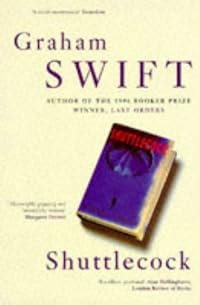
Shuttlecock
by Graham Swift
On This Page
Description
Prentis, the narrator of this nightmarish novel, catalogs "dead crimes" for a branch of the London Police Department and suspects that he is going crazy. His files keep vanishing. His boss subjects him to cryptic taunts. His family despises him. And as Prentis desperately tries to hold on to the scraps of his sanity, he uncovers a conspiracy of blackmail and betrayal that extends from his department and into the buried past of his father, a war hero code-named "Shuttlecock"--and, lately, a show more resident of a hospital for the insane. show lessTags
Recommendations
























Member Recommendations
by denni
Member Reviews
Taut, paranoid and thrillingly strange. Prentis, the first person narrator, begins the book as a petty tyrant at home, who has difficulties at work, and a difficult relationship with his father, a war hero who is now committed to a mental institution in a state of perpetual silence. Part of the strangeness of the book is that the narrator remains likeable and fascinating even as he describes himself as a despicable person. Gradually, he comes to some self-knowledge, although his father's history and mental condition still remain a mystery at the end. Perhaps the conceit that this is being written as it happens, rather than after the fact, doesn't come off, because the the opening is clearly written with the self-knowledge which he show more really only gains towards the end of the book. But then, one of the main questions of the book is the reliability of history, memory, and "facts." show less
Shuttlecock is kind of schizophrenic -- part mystery, part spy novel, part family drama. I don't think any of those aspects of it were done perfectly, but the mixing of them was interesting. The main character Prentis, is despicable, especially at the beginning; in fact, none of the characters are especially likable though some you do feel sorry for. The look at life, family, and people is very honest though, if sometimes brutally so.
Swift's writing unfortunately reminds me of Ishiguro's (I'm not fan of Ishiguro's writing at all), but it isn't bad-- just not my personal taste. I would have liked to see some of the threads pulled a bit more and finalized, though I think Swift is making a point by specifically NOT doing this. I also show more would label this as a "guy book." For a quick multi-facted read with memorable characters this is a good choice, but given Swift's reputation and awards it was a bit of let-down for me. show less
Swift's writing unfortunately reminds me of Ishiguro's (I'm not fan of Ishiguro's writing at all), but it isn't bad-- just not my personal taste. I would have liked to see some of the threads pulled a bit more and finalized, though I think Swift is making a point by specifically NOT doing this. I also show more would label this as a "guy book." For a quick multi-facted read with memorable characters this is a good choice, but given Swift's reputation and awards it was a bit of let-down for me. show less
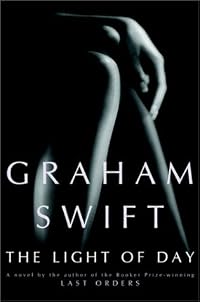
A curious little number, better than The Light of Day, but not quite up to Waterland and Last Orders. Odious (and deliciously probably unreliable) narrator, but his boss Quinn's an interesting character. The father, who is in a psychiatric hospital (and visited, summoning up for the reader the mother's visit to her daughter in Last Orders) is great to meet through his book which itself becomes a main character. Not called Swift for nothing, he might have written this nearly as fast as I read it, but he's a clever, clever writer, so the unfinished strands are left as questions. I'd recommend it as a quick read.
A bit of a strange one this. The novel is essentially made up of two different tales that sort of converge at the end. Set when the book was written (80's) it follows the life of Prentis.
Prentis is a married father of two boys, he works as an office bound investigator of past crimes. The story is written in the first person allowing us to learn his disturbed thought and reasoning behind the treatment of his family. Prentis comes across as extremely unlikable and paranoid. He is convinced that an ongoing investigation he is being asked to look into, involves him and his father and as he digs deeper and deeper (at the expense of his deteriorating home life) the more paranoid he becomes. Disillusioned with his lot in life he tries to show more force respect from his children and wife but only succeeds in alienating himself further.
The second tale relates to his father who is currently in a nursing home, and not been able to speak for number of months due to a mental trauma. When a young man he was employed as a secret agent during the war and known under the code name 'Shuttlecock', captured as a prisoner of war he later recounts his experiences in a published autobiography. Prentis becomes fascinated with this book and tries to find the answer for his fathers condition within the pages, reading and rereading them.
I don't know why, and it's not something I can easily pinpoint but I just did not enjoy the novel, often as a reader I myself felt left out of plot (in particular following the case where suspects were only referred to as letters). I found the narrative too disjointed and struggled to maintain interest. I can see why other readers have awarded the book 5 stars and I am sure that it has a lot more to offer than I was able to take from it. But, to be honest, it captivated me so little that I just couldn't be bothered trying to find it. show less
Prentis is a married father of two boys, he works as an office bound investigator of past crimes. The story is written in the first person allowing us to learn his disturbed thought and reasoning behind the treatment of his family. Prentis comes across as extremely unlikable and paranoid. He is convinced that an ongoing investigation he is being asked to look into, involves him and his father and as he digs deeper and deeper (at the expense of his deteriorating home life) the more paranoid he becomes. Disillusioned with his lot in life he tries to show more force respect from his children and wife but only succeeds in alienating himself further.
The second tale relates to his father who is currently in a nursing home, and not been able to speak for number of months due to a mental trauma. When a young man he was employed as a secret agent during the war and known under the code name 'Shuttlecock', captured as a prisoner of war he later recounts his experiences in a published autobiography. Prentis becomes fascinated with this book and tries to find the answer for his fathers condition within the pages, reading and rereading them.
I don't know why, and it's not something I can easily pinpoint but I just did not enjoy the novel, often as a reader I myself felt left out of plot (in particular following the case where suspects were only referred to as letters). I found the narrative too disjointed and struggled to maintain interest. I can see why other readers have awarded the book 5 stars and I am sure that it has a lot more to offer than I was able to take from it. But, to be honest, it captivated me so little that I just couldn't be bothered trying to find it. show less
Ratings
Members
- Recently Added By
Published Reviews
Still his most autobiographical work, it deals with Prentis, a petty-minded police clerk whose father, incarcerated in a mental institution in a state of catatonia, was a war hero and author of the boys' own spy memoir that gives the book its title. Again, the lives are muted, though the book brilliantly portrays the generational pressures of unrealistic expectation and ends with something of show more a Swiftean happy ending as Prentis gains a more realistic view of his father's achievements: "The connections between Prentis's professional and personal lives are delineated with great skill," concluded Punch magazine, "and the quality of writing is consistently high. The result is one that should appeal equally to readers of 'straight' novels and readers of thrillers." show less
added by KayCliff
Author Information

21+ Works 10,727 Members
British novelist Graham Swift was born in London on May 4, 1949. He attended Cambridge University and York University. Swift has written five novels, including Waterland. (Bowker Author Biography) Novelist Graham Swift was born in London, England on May 4, 1949. He attended Cambridge University where he received a B.A. in 1970, and an M.A. in show more 1975. He also attended York University from 1970-73. He taught English part time at several London Colleges between the years 1974 to1983. Swift's fiction tends to touch upon the subject of World War II as well as exploring the larger subject of history. "Waterland" established Swift's reputation and was made into a major film. He also wrote "Last Orders" and his novels have won a variety of prestigious literary awards and have been widely translated. Swift was an avid fisherman and co-edited an anthology of fishing in literature. (Bowker Author Biography) show less
Awards and Honors
Awards
Series
Belongs to Publisher Series
Common Knowledge
- Canonical title*
- Vederbal
- Original title
- Shuttlecock
- Alternate titles*
- Vederbal : een psychologische thriller
- Original publication date
- 1981
- First words
- Today I remembered my hamster: my pet hamster, Sammy, a gift for my tenth birthday.
- Quotations
- "How much of a book is in the words and how much is behind or in between the lines?'
Do other fathers have this terror over the breakfast table, when they realize their sons are growing up to be smarter than them? - Original language*
- Engels
*Some information comes from Common Knowledge in other languages. Click "Edit" for more information.
Classifications
Statistics
- Members
- 343
- Popularity
- 91,728
- Reviews
- 4
- Rating
- (3.46)
- Languages
- 5 — Dutch, English, Finnish, German, Spanish
- Media
- Paper, Audiobook, Ebook
- ISBNs
- 25
- ASINs
- 4