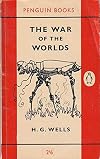
The Invisible Man / The War of the Worlds
by H. G. Wells
On This Page
Description
H.G. Wells barely revised The Invisible Man once it was published, adding only an epilogue. But the opening statement of that epilogue--So ends the strange and evil experiment of the Invisible Man--has posed challenges to scholars. How to understand it? Does it speak strictly to the scientific elements of the novel? Or is it a part of the work's political underpinnings? The 1897 New York first edition (the first edition to incorporate the epilogue) is used here as the basis for the show more exhaustive annotations and other critical apparatus of the world's foremost Wellsian scholar. The introduction examines in great detail the novel's position in the Wellsian canon and sets the major themes in context with the literary conventions used in his other works, particularly the scientific romances. show lessTags
Recommendations



















Member Reviews
I thought I was already familiar with these stories because they’ve been so influential in science fiction and I’ve seen references all over the place. But there was a lot that surprised me! For instance, did you know they were written in the 1890’s? Seriously! Fleeing from Martian invaders in horse drawn carriges.
War of the Worlds is my favorite of the two. I love the way the war ends, and the theological implications. The Invisible Man was a good read too.
The War of the Worlds:
The story itself is probably familiar enough to most people, but for the sake of clarity, here is a brief summary:
Ten cylinders are sent from Mars to Earth and all land in England. When these cylinders finally open, the public is shocked and bewildered. Grotesque aliens from Mars are inside of them. At first no one is scared, because with the difference in gravitational force on Earth compared to Mars, the creatures can barely move. After they complete construction of their tripods and bring those mechanical beasts out, however, all hell breaks loose. Mars is growing colder and colder and is no longer habitable for the Martians, so they intend to wipe out humans and set up camp on old Earth. What follows is the show more flight of one man in search of safety and his wife that was separated from him in the chaos. I won’t specify what happens in the end, but it is not hard to guess.
It goes without saying that The War of the Worlds is dated. Clearly little if any of it is applicable in the light of modern discoveries. It is interesting, however, to see how Wells draws on the scientific zeitgeist of the times he was writing in. He references the channels and rifts that run through Mars, the possible ill effects of microorganisms and bacteria, the gravitational differences that would come into play when a creature from space steps onto the soil of a different world, and the heat-ray prefigures the modern laser in an obvious way. There are numerous other (better) examples, but these are off the top of my head after finishing the book some days ago.
A problem some people might have with the book is reconciling the setting in time and space with the subject matter. It is a little far fetched and just weird to have merciless aliens with their heat-rays and tripods attacking the people of England in the 1800’s (as a side note, why would all ten cylinders be sent to England alone when the creatures of Mars were planning world domination? That just seems ridiculous.) as they ride around in their horse-drawn carriages. Personally, I think the stark clash between these two things makes for a much more unique and entertaining atmosphere overall.
Other problems include the fact that characters are not especially well developed, but this is in a way beside the point since the focus of the book is the events themselves, and since the chaotic turmoil of world disaster would most likely feature a breakdown in human personality even on the most basic level. Despite this problem with character, Wells weaves through the events beautifully, often poetically to a certain extent.
My overall thoughts:
This was not one of the best books I’ve ever read. It had its merits, but what I think it really comes down to is that I missed it. I should have read this book when I was a kid. It might have even worked for me in high school. But reading The War of the Worlds at this point in my life is unfortunately too late. I still enjoyed it, but it is one of those books that is best appreciated by a younger mind. I thoroughly enjoyed reading it as a precursor to the more current science fiction that I love, and I think this book clearly displays its relevance in the development of the genre. I do not know if I will ever read this again, and as I said, sadly, I missed it by several years, but I do think I liked this book as much as I possibly could have given that, and I would not hesitate to recommend it, especially to someone with a love for science fiction and its roots. Finished 10/26/09 show less
The story itself is probably familiar enough to most people, but for the sake of clarity, here is a brief summary:
Ten cylinders are sent from Mars to Earth and all land in England. When these cylinders finally open, the public is shocked and bewildered. Grotesque aliens from Mars are inside of them. At first no one is scared, because with the difference in gravitational force on Earth compared to Mars, the creatures can barely move. After they complete construction of their tripods and bring those mechanical beasts out, however, all hell breaks loose. Mars is growing colder and colder and is no longer habitable for the Martians, so they intend to wipe out humans and set up camp on old Earth. What follows is the show more flight of one man in search of safety and his wife that was separated from him in the chaos. I won’t specify what happens in the end, but it is not hard to guess.
It goes without saying that The War of the Worlds is dated. Clearly little if any of it is applicable in the light of modern discoveries. It is interesting, however, to see how Wells draws on the scientific zeitgeist of the times he was writing in. He references the channels and rifts that run through Mars, the possible ill effects of microorganisms and bacteria, the gravitational differences that would come into play when a creature from space steps onto the soil of a different world, and the heat-ray prefigures the modern laser in an obvious way. There are numerous other (better) examples, but these are off the top of my head after finishing the book some days ago.
A problem some people might have with the book is reconciling the setting in time and space with the subject matter. It is a little far fetched and just weird to have merciless aliens with their heat-rays and tripods attacking the people of England in the 1800’s (as a side note, why would all ten cylinders be sent to England alone when the creatures of Mars were planning world domination? That just seems ridiculous.) as they ride around in their horse-drawn carriages. Personally, I think the stark clash between these two things makes for a much more unique and entertaining atmosphere overall.
Other problems include the fact that characters are not especially well developed, but this is in a way beside the point since the focus of the book is the events themselves, and since the chaotic turmoil of world disaster would most likely feature a breakdown in human personality even on the most basic level. Despite this problem with character, Wells weaves through the events beautifully, often poetically to a certain extent.
My overall thoughts:
This was not one of the best books I’ve ever read. It had its merits, but what I think it really comes down to is that I missed it. I should have read this book when I was a kid. It might have even worked for me in high school. But reading The War of the Worlds at this point in my life is unfortunately too late. I still enjoyed it, but it is one of those books that is best appreciated by a younger mind. I thoroughly enjoyed reading it as a precursor to the more current science fiction that I love, and I think this book clearly displays its relevance in the development of the genre. I do not know if I will ever read this again, and as I said, sadly, I missed it by several years, but I do think I liked this book as much as I possibly could have given that, and I would not hesitate to recommend it, especially to someone with a love for science fiction and its roots. Finished 10/26/09 show less
Ratings
Members
- Recently Added By
Author Information

1,552+ Works 108,778 Members
H. G. Wells was born in Bromley, England on September 21, 1866. After a limited education, he was apprenticed to a draper, but soon found he wanted something more out of life. He read widely and got a position as a student assistant in a secondary school, eventually winning a scholarship to the Royal College of Science in South Kensington, where show more he studied biology. He graduated from London University in 1888 and became a science teacher. He also wrote for magazines. When his stories began to sell, he left teaching to write full time. He became an author best known for science fiction novels and comic novels. His science fiction novels include The Time Machine, The War of the Worlds, The Wonderful Visit, The Island of Doctor Moreau, The Invisible Man, The First Men in the Moon, and The Food of the Gods. His comic novels include Love and Mr. Lewisham, Kipps: The Story of a Simple Soul, The History of Mr. Polly, and Tono-Bungay. He also wrote several short story collections including The Stolen Bacillus, The Plattner Story, and Tales of Space and Time. He died on August 13, 1946 at the age of 79. (Bowker Author Biography) show less
Work Relationships
Common Knowledge
- Canonical title
- The Invisible Man / The War of the Worlds
- Original publication date
- 1962
- Related movies
- The Invisible Man (1958 | IMDb); The War of the Worlds (1953 | IMDb)
- Disambiguation notice
- This omnibus of THE INVISIBLE MAN and THE WAR OF THE WORLDS should not be combined with either individual work. Thank you.
Classifications
Statistics
- Members
- 188
- Popularity
- 174,110
- Reviews
- 3
- Rating
- (3.67)
- Languages
- Czech, English, Romanian
- Media
- Paper, Audiobook
- ISBNs
- 9
- ASINs
- 13