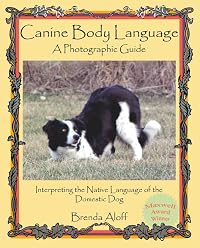
Canine Body Language: A Photographic Guide Interpreting the Native Language of the Domestic Dog
by Brenda Aloff
On This Page
Description
Your dog is talking. Are you listening? More important are you WATCHING? Dogs are attempting to communicate with humans as well as other dogs all the time.Tags
Recommendations






































Member Reviews
So, I had to send this back. Library and their rigid rules about due dates and such. Maybe I'll get it again. Maybe I won't. But I should do this book some justice.
It was really quite interesting. You'd think it might be dated, that there might be something revolutionary that's happened in the dog world since 2005, but you'd probably be wrong. People really aren't that great at advancing understanding of animal behavior. Aloff's contribution to understanding was to take a ton of pictures, and use a bunch of pictures from owner and trainer friends, for a very wide compilation of some of the subtleties in dog expression and what they seem to mean.
Each aspect or subtlety of behavior has a bit of written explanation and is then followed by show more three or four pictures. So this book is very much a visual dictionary, with perhaps a small paragraph accompanying each picture. It isn't really meant to be sit down and read through, the way one might read through Patricia McConnell's interesting dog-related books (such as The Other End of the Leash), but it is kind of hard to stop. It's a bit like looking at a friend's family album--do I recognize this expression? Have I seen my dog do this?
I've been living with dogs my entire life (except the three years in the college dorms) and as an adult, have had dogs from puppies, both 'rescued' and breeders, as well as well as an adopted older dog. I've consulted private trainers, attended dog training classes, and read a fair number of books, and have to say that this seemed to be a solid, well-done resource, as well as consistent with what you'll see from better quality sources.
Though this photographs are just one moment in time, Aloff does a nice job of pointing out the other small cues that help the humans understand the message the body is conveying. There's a particularly interesting sequence where her dogs and a friend's dogs are jockeying for space around the friend. How many times have the people interpreted that as "wanting to be near" their favorite people? Which it is, but there's also a hierarchy of status being played out, and that's the sort of thing that can get a group into trouble if you confuse the language of anxious status-seeking with regular human-attention-seeking. Aloff also points out how socially adept dogs might send calming signals to each other to show disinterest or calm the situation. It's super-interesting.
My largest concern would probably be photographic quality: I think Aloff mentioned she had been collecting some of these for years, and it shows in the reproduction quality. Needless to say, they are all black-and-white (cost), but I think in one or two of the fuzzy ones, the impact has been lost. A minor complaint would be that frequently the photos are of the same group of dogs, and so I didn't feel like I saw the range of expressions on a range of breeds, if that makes sense. Lots of terrier and medium-sized sporting and herding dogs, I think.
Still, I'd check it out again. Even after all this time, there's more we can learn about our best friends. show less
It was really quite interesting. You'd think it might be dated, that there might be something revolutionary that's happened in the dog world since 2005, but you'd probably be wrong. People really aren't that great at advancing understanding of animal behavior. Aloff's contribution to understanding was to take a ton of pictures, and use a bunch of pictures from owner and trainer friends, for a very wide compilation of some of the subtleties in dog expression and what they seem to mean.
Each aspect or subtlety of behavior has a bit of written explanation and is then followed by show more three or four pictures. So this book is very much a visual dictionary, with perhaps a small paragraph accompanying each picture. It isn't really meant to be sit down and read through, the way one might read through Patricia McConnell's interesting dog-related books (such as The Other End of the Leash), but it is kind of hard to stop. It's a bit like looking at a friend's family album--do I recognize this expression? Have I seen my dog do this?
I've been living with dogs my entire life (except the three years in the college dorms) and as an adult, have had dogs from puppies, both 'rescued' and breeders, as well as well as an adopted older dog. I've consulted private trainers, attended dog training classes, and read a fair number of books, and have to say that this seemed to be a solid, well-done resource, as well as consistent with what you'll see from better quality sources.
Though this photographs are just one moment in time, Aloff does a nice job of pointing out the other small cues that help the humans understand the message the body is conveying. There's a particularly interesting sequence where her dogs and a friend's dogs are jockeying for space around the friend. How many times have the people interpreted that as "wanting to be near" their favorite people? Which it is, but there's also a hierarchy of status being played out, and that's the sort of thing that can get a group into trouble if you confuse the language of anxious status-seeking with regular human-attention-seeking. Aloff also points out how socially adept dogs might send calming signals to each other to show disinterest or calm the situation. It's super-interesting.
My largest concern would probably be photographic quality: I think Aloff mentioned she had been collecting some of these for years, and it shows in the reproduction quality. Needless to say, they are all black-and-white (cost), but I think in one or two of the fuzzy ones, the impact has been lost. A minor complaint would be that frequently the photos are of the same group of dogs, and so I didn't feel like I saw the range of expressions on a range of breeds, if that makes sense. Lots of terrier and medium-sized sporting and herding dogs, I think.
Still, I'd check it out again. Even after all this time, there's more we can learn about our best friends. show less
What an excellent resource. When I grabbed this, I wasn’t sure if I would just page through or give it a thorough read. I’m glad I decided to go through it carefully from start to finish. Aloff’s photo essays wonderfully depict her instruction on canine body language. There’s a lot of repetition, which I found helpful for fixing this information in my brain, and the photos really help. There’s even a quiz at the end. She has a memorable, often humorous way of describing dog behavior. A couple of my favorites were when she described a dog in a photo as just wanting the other dog to “go be bizarre somewhere else,” and when she described the more intrusive, impolite version of butt-sniffing as a “Proctology Exam.”
She show more doesn’t go deeply into training philosophy or methodology, but the quality of her work in this book makes me want to explore other things she’s written.
I felt like I learned some new things, and I’ll be paying more attention and trying to apply what I learned to my own bizarre-acting dog. show less
She show more doesn’t go deeply into training philosophy or methodology, but the quality of her work in this book makes me want to explore other things she’s written.
I felt like I learned some new things, and I’ll be paying more attention and trying to apply what I learned to my own bizarre-acting dog. show less
Excellent, wonderful book about canine body language and the micro expressions used by dogs. I see many of these expressions at my job, and understand what the dogs are trying to say. I also learned more about how dogs diffuse tension, and when we should interfere, or let the dogs communicate on their own. Anyone who has multiple dogs in their household should buy this book; and anyone who works with or trains dogs MUST have this as part of their library. Brilliant.
Recommended in our therapy dog training classes with Dog B.O.N.E.S.
A bit dated; the picture quality is not high (all photos are black and white, some are blurry or low-contrast); and it could have used a thorough copy-edit. Nevertheless, there's valuable information here about dogs' body language.
A bit dated; the picture quality is not high (all photos are black and white, some are blurry or low-contrast); and it could have used a thorough copy-edit. Nevertheless, there's valuable information here about dogs' body language.
Lots and lots of good pictures. Very easy reading and it's very hard to put down once you start reading it.
sandy2233
sandy2233
Ratings
Members
- Recently Added By
Author Information
8 Works 322 Members
Common Knowledge
- Dedication
- This book is dedicated first to the dogs. All dogs. They are my teachers. Next to my incredible, dedicated and willing students. Thank you. Betty Owen, for always being there.
- First words
- You have probably noticed that your dog doesn't speak in sentences.
Classifications
Statistics
- Members
- 197
- Popularity
- 165,393
- Reviews
- 5
- Rating
- (4.45)
- Languages
- English
- Media
- Paper, Ebook
- ISBNs
- 2
- ASINs
- 3