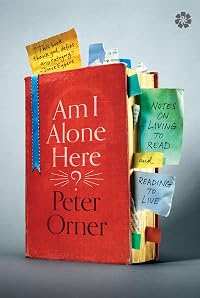
Am I Alone Here?: Notes on Living to Read and Reading to Live
by Peter Orner
On This Page
Description
"'Stories, both my own and those I've taken to heart, make up whoever it is that I've become,' Peter Orner writes in this collection of essays about reading, writing, and living. Orner reads and writes everywhere he finds himself: a hospital cafeteria, a coffee shop in Albania, or a crowded bus in Haiti. The result is 'a book of unlearned meditations that stumbles into memoir.' Among the many writers Orner addresses are Isaac Babel and Zora Neale Hurston, both of whom told their truths and show more were silenced; Franz Kafka, who professed loneliness but craved connection; Robert Walser, who spent the last twenty-three years of his life in a Swiss insane asylum, 'working" at being crazy; and Juan Rulfo, who practiced the difficult art of silence. Virginia Woolf, Eudora Welty, Yasunari Kawabata, Saul Bellow, Mavis Gallant, John Edgar Wideman, William Trevor, and Vc̀lav Havel make appearances, as well as the poet Herbert Morris about whom almost nothing is known. An elegy for an eccentric late father, and the end of a marriage, Am I Alone Here? is also a celebration of the possibility of renewal. At once personal and panoramic, this book will inspire readers to return to the essential stories of their own lives."--From publisher's description. show lessTags
Recommendations

Member Reviews
I am smitten with this book of funny, astute essays on reading. It is smart, personal, candid and it's indexed. With notes. How could anyone run out of good reading, said I with already 700 on my To-Read Shelf?
A curious, charming literary hybrid that combines autobiography, musings on the author's favorite writers, and meditations on the nature of storytelling. As if to underline its eccentricity, it includes hand-painted versions of the books that the author discusses. The author comes off throughout the book as a man obsessed, a compulsive reader who reads as soon as he wakes up, just before he goes to sleep, and most other times between. I'm a fairly consistent reader, but Orner is in another category altogether. The sort of people who's lives are wholly consumed by books may find a kindred spirit in the author.
As literary analysis, "Am I Alone Here," although it cites specific passages from specific works, favors big-picture analysis, show more which, in my opinion, makes it a better read. Orner wants to know what makes a story work, why we tell and write stories, how stories connect with our lives. His take on the story is holistic and not mechanical: he's open to surprise and innovation and is happy to leave some questions unresolved. This is a meditation on storytelling, not a writing guide, and it's probably better for it. As an autobiographer, Orner seems very much at peace with the fact that he's lived a somewhat unconventional, disjointed life that has been wholly consumed by books and writing. He discusses his large, colorful family, his troubled relationship with his late father, a marriage that didn't work out, time spent in late-nineties Prague, and his life as a husband and father. While Orner can be remarkably insightful about life and literature, to his credit, this isn't one of those memoirs that tries to convince the reader that the author has resolved his problems, learned some lessons, and moved on. While it's ending is frustratingly inconclusive, the book makes it clear that the author is still in the process of mourning his father, becoming a better writer, and finding his place in the world. Indeed, books seem to be one of the only constants in it, something that many fellow bibliophiles may appreciate.
As other reviewers have mentioned, many of the author discusses here are rather obscure, and while that makes "Am I Alone Here" a less immediately engaging read than it otherwise might have been, I also picked up a Kindle edition of Brohumil Hrabal's "Too Loud a Sloitude" for two dollars because it was mentioned here. He describes how, after he finished it in a Prague park, he felt so happy that he waved it around like a madman and believed that he'd had a genuinely religious experience. It's a story that's rather representative of "Am I Alone Here" as a whole and also one heck of a recommendation. Hardly the most linear book I've ever read, but "Am I Alone Here" is recommended to writers and hopeless bibliophiles alike. show less
As literary analysis, "Am I Alone Here," although it cites specific passages from specific works, favors big-picture analysis, show more which, in my opinion, makes it a better read. Orner wants to know what makes a story work, why we tell and write stories, how stories connect with our lives. His take on the story is holistic and not mechanical: he's open to surprise and innovation and is happy to leave some questions unresolved. This is a meditation on storytelling, not a writing guide, and it's probably better for it. As an autobiographer, Orner seems very much at peace with the fact that he's lived a somewhat unconventional, disjointed life that has been wholly consumed by books and writing. He discusses his large, colorful family, his troubled relationship with his late father, a marriage that didn't work out, time spent in late-nineties Prague, and his life as a husband and father. While Orner can be remarkably insightful about life and literature, to his credit, this isn't one of those memoirs that tries to convince the reader that the author has resolved his problems, learned some lessons, and moved on. While it's ending is frustratingly inconclusive, the book makes it clear that the author is still in the process of mourning his father, becoming a better writer, and finding his place in the world. Indeed, books seem to be one of the only constants in it, something that many fellow bibliophiles may appreciate.
As other reviewers have mentioned, many of the author discusses here are rather obscure, and while that makes "Am I Alone Here" a less immediately engaging read than it otherwise might have been, I also picked up a Kindle edition of Brohumil Hrabal's "Too Loud a Sloitude" for two dollars because it was mentioned here. He describes how, after he finished it in a Prague park, he felt so happy that he waved it around like a madman and believed that he'd had a genuinely religious experience. It's a story that's rather representative of "Am I Alone Here" as a whole and also one heck of a recommendation. Hardly the most linear book I've ever read, but "Am I Alone Here" is recommended to writers and hopeless bibliophiles alike. show less
I am smitten with this book of funny, astute essays on reading. It is smart, personal, candid and it's indexed. With notes. How could anyone run out of good reading, said I with already 700+ on my To-Read Shelf?
This wins the most unconventional memoir award, as it's described as "a book of unlearned meditations that stumbles into memoir.” (Say what?)
Mr. Orner, a professor, poses questions on literature and life and the reader is invited into this, at times, existential exploration. At first blush the book appears pedantic, but have courage readers, Am I Alone Here? is affecting on so many levels.
The author's true love is the short story, mixed with poetry and the occasional novel. Each chapter shows a rendering of the book cover, reviews the story (or poetry), gives background on the author (many of which were unknown to me) and then, how the story relates to Mr. Orner's own life.
Mr. Orner is a thinker -- a ponderer and as with many artists show more he struggles with the meaning of his life as it relates to his gift...and gifted he is. There's some staggeringly beautiful writing on display here.
On reading a book of poetry by an obscure poet:
"Books pursue us. I've always believed this. I dug Herbert Morris out of the free bin outside Dog Eared Books (San Francisco). What compelled me to stop that day? How can I express my gratitude to a poet who never sought it, who only wanted me to know his creations, not their creator? An how many others might be out there, somewhere, under all this noise, tell us things we need to hear?"
I must admit I skipped around while reading Am I Alone Here? and found some bits more interesting than others. The format is unusual which allows for picking and choosing chapters to suit. And the chapter titles -- so intriguing:
Euroda Welty, Badass; Shameless Impostors; Surviving the Lives We Have; My Father's Gloves; Night Train to Split: Unforgiveable
Don't you just want to see what they'll offer? My Father's Gloves is a tender tribute to his father and, unless you're a hard case, will bring tears to your eyes.
Sometimes heavy, often cynical, but always probing, and insightful-- Am I Alone Here offers plenty to think about long after you've finished. An as an added bonus, if you're like me, you'll come away with a whole new list of authors and poets to explore.
See more at http://www.bookbarmy.com show less
Mr. Orner, a professor, poses questions on literature and life and the reader is invited into this, at times, existential exploration. At first blush the book appears pedantic, but have courage readers, Am I Alone Here? is affecting on so many levels.
The author's true love is the short story, mixed with poetry and the occasional novel. Each chapter shows a rendering of the book cover, reviews the story (or poetry), gives background on the author (many of which were unknown to me) and then, how the story relates to Mr. Orner's own life.
Mr. Orner is a thinker -- a ponderer and as with many artists show more he struggles with the meaning of his life as it relates to his gift...and gifted he is. There's some staggeringly beautiful writing on display here.
On reading a book of poetry by an obscure poet:
"Books pursue us. I've always believed this. I dug Herbert Morris out of the free bin outside Dog Eared Books (San Francisco). What compelled me to stop that day? How can I express my gratitude to a poet who never sought it, who only wanted me to know his creations, not their creator? An how many others might be out there, somewhere, under all this noise, tell us things we need to hear?"
I must admit I skipped around while reading Am I Alone Here? and found some bits more interesting than others. The format is unusual which allows for picking and choosing chapters to suit. And the chapter titles -- so intriguing:
Euroda Welty, Badass; Shameless Impostors; Surviving the Lives We Have; My Father's Gloves; Night Train to Split: Unforgiveable
Don't you just want to see what they'll offer? My Father's Gloves is a tender tribute to his father and, unless you're a hard case, will bring tears to your eyes.
Sometimes heavy, often cynical, but always probing, and insightful-- Am I Alone Here offers plenty to think about long after you've finished. An as an added bonus, if you're like me, you'll come away with a whole new list of authors and poets to explore.
See more at http://www.bookbarmy.com show less
There are some books where the title is completely confusing and, at first glance, out of place...Steinbeck's OF MICE AND MEN comes to mind. This is not one of those books. What you see is what you get with Peter Orner's AM I ALONE HERE: NOTES ON LIVING TO READ AND READING TO LIVE.
The book gives readers glimpses into the author's life, and what books/authors have influenced him. It's a borrowed book that was never returned, and the author is ruminating about his relationship with the borrow-ee. It's a scene in the book that the author is currently reading, that brings up memories of a similar scene in Peter's life. It's two books that, at first glance might not seem similar, but upon reflection the author sees many parallels. By the end show more of the book, you may feel like you know something about Peter Orner...for better or worse. However, as is the case with most collections of essays, you may resonate with some of the pieces more than others.
For me, one of the most interesting pieces was "Eudora Welty, Badass". In it, Peter Orner talks about his love for Eudora Welty, and how he even made a pilgrimmage to her home (now a historic landmark) and inspecting her books. He also discovers a little-known story in her obscure, short story collection THE BRIDE OF THE INNISFALLEN called "The Burning". She primarily wrote about the American South, living her entire life in that area. In this particular story, she did not shy away from confronting the overt racism and other evils of slaveholders toward their slaves. In particular, the practice of white masters raping their female slaves is highlighted - within the context of post-Civil War reconstruction. Welty takes on complicated and complex issues that face herself and her fellow Southerners with clarity and sharpness. For Orner, that definitely makes her a badass, and puts this story in the realm of Toni Morrison, Edward P. Jones, and William Faulkner.
Most of the pieces feature at least one book that played a significant role in Peter Orner's life, but there are two essays which are obituaries he wrote after his father's death. His father features in many of the essays in AM I ALONE HERE as being a source of love, of fear, of confusion, and of example. One of the most unexpectedly moving essays is "My Father's Gloves", showing how an ordinary object to one person can be a metaphor and important artifact to another.
There are over 40 short essays here, each one around 5 pages long, which makes it perfect to read while waiting for an appointment, during a lunch break, or sitting on the toilet. In fact, the writing style is so unpretentious and full of humor, yet well-crafted and thoughtful that you don't even realize you're learning something, or feeling feelings, until the essay is over. This is the brilliance of Peter Orner's writing - it creeps up slowly and without flourish, then hits you over the head.
AM I ALONE HERE is a book that can be approached from many different ways, for different people. It's for readers and bibliophiles. It's for lovers of imperfect and complicated people and relationships. It's for memoir/essay enthusiasts. It's for humans. show less
The book gives readers glimpses into the author's life, and what books/authors have influenced him. It's a borrowed book that was never returned, and the author is ruminating about his relationship with the borrow-ee. It's a scene in the book that the author is currently reading, that brings up memories of a similar scene in Peter's life. It's two books that, at first glance might not seem similar, but upon reflection the author sees many parallels. By the end show more of the book, you may feel like you know something about Peter Orner...for better or worse. However, as is the case with most collections of essays, you may resonate with some of the pieces more than others.
For me, one of the most interesting pieces was "Eudora Welty, Badass". In it, Peter Orner talks about his love for Eudora Welty, and how he even made a pilgrimmage to her home (now a historic landmark) and inspecting her books. He also discovers a little-known story in her obscure, short story collection THE BRIDE OF THE INNISFALLEN called "The Burning". She primarily wrote about the American South, living her entire life in that area. In this particular story, she did not shy away from confronting the overt racism and other evils of slaveholders toward their slaves. In particular, the practice of white masters raping their female slaves is highlighted - within the context of post-Civil War reconstruction. Welty takes on complicated and complex issues that face herself and her fellow Southerners with clarity and sharpness. For Orner, that definitely makes her a badass, and puts this story in the realm of Toni Morrison, Edward P. Jones, and William Faulkner.
Most of the pieces feature at least one book that played a significant role in Peter Orner's life, but there are two essays which are obituaries he wrote after his father's death. His father features in many of the essays in AM I ALONE HERE as being a source of love, of fear, of confusion, and of example. One of the most unexpectedly moving essays is "My Father's Gloves", showing how an ordinary object to one person can be a metaphor and important artifact to another.
There are over 40 short essays here, each one around 5 pages long, which makes it perfect to read while waiting for an appointment, during a lunch break, or sitting on the toilet. In fact, the writing style is so unpretentious and full of humor, yet well-crafted and thoughtful that you don't even realize you're learning something, or feeling feelings, until the essay is over. This is the brilliance of Peter Orner's writing - it creeps up slowly and without flourish, then hits you over the head.
AM I ALONE HERE is a book that can be approached from many different ways, for different people. It's for readers and bibliophiles. It's for lovers of imperfect and complicated people and relationships. It's for memoir/essay enthusiasts. It's for humans. show less
 This review was written for LibraryThing Early Reviewers.
Part memoirs, part essay collection, and part reader's advisory; Am I Alone Here? didn't excite me when I picked it up but I found I couldn't put it back down. Admittedly, I have never read any of Orner's fiction but now I want to. Over 41 or so essays Orner explores writing and reading; his father's death and his daughter's birth using novels and stories as his meditative center. Each chapter/essay centers along a certain author or story, drawing themes to correlate with marriages, deaths, births, and loneliness. This category-defying memoir? essay collection? literary criticism? was a pleasure to read. Not only did I come away from this book with am appreciation for Orner's writing, but a long list of books to read.
This review was written for LibraryThing Early Reviewers.I loved this book though it will be hard for me to articulate just exactly why......I will, however, try. The book is very unconventional. Mr. Orner has a love of the short story and though there are a few novels mentioned within this memoir, there are far more short stories. The book is kind of a mix of, review of story, information about the author of the story and Peter Orner's life likened to the story. Not sure if that makes sense but it does make for some awesome reading. Mr. Orner has a dark side to his writing....he is a thinker, he ponders and as with many artists he struggles with the meaning of his life in relation to his gift....which is, most assuredly, on display in this book.
One may ask why we want to know about Mr. show more Orner's struggles but this book is about far more than that.....a reader, a writer. any lover of the written word will find nuggets of profundity in these pages. The book opened my eyes to all kinds of new reading opportunities...it also gave me clues as to how to look at past readings. The format is unusual which allows for contemplation. This book will poke and prod around in my head for a long time. The reading of "Am I Alone Here ?" will, most likely affect everything I read in the future.
I applaud Peter Orner for his willingness to share so much raw emotion....to relate it to the stories we read or write, and for his ability to do so in a way that is so engaging. I am so glad I had the opportunity to read this. Not sure if I would have picked it off the shelf . Having read and reviewed it, I find that I have so many people I would like to recommend it to. show less
One may ask why we want to know about Mr. show more Orner's struggles but this book is about far more than that.....a reader, a writer. any lover of the written word will find nuggets of profundity in these pages. The book opened my eyes to all kinds of new reading opportunities...it also gave me clues as to how to look at past readings. The format is unusual which allows for contemplation. This book will poke and prod around in my head for a long time. The reading of "Am I Alone Here ?" will, most likely affect everything I read in the future.
I applaud Peter Orner for his willingness to share so much raw emotion....to relate it to the stories we read or write, and for his ability to do so in a way that is so engaging. I am so glad I had the opportunity to read this. Not sure if I would have picked it off the shelf . Having read and reviewed it, I find that I have so many people I would like to recommend it to. show less
This review was written for LibraryThing Early Reviewers.Members
- Recently Added By
Lists

Books Read in 2016
4,666 works; 199 members

Books Read in 2018
4,360 works; 110 members

Five star books
1,767 works; 110 members

Best 21st Century Books (So Far)
670 works; 86 members

Non-Fiction Worth Reading
1,016 works; 262 members

Recommend the 20 best books you've read in the last five years
2,168 works; 606 members

Writers and Readers
11 works; 1 member
Author Information

24+ Works 1,197 Members
He was born in chicago in 1968. After graduating from the University of Michigan, he taught in a rural Catholic mission in Africa, received a law degree in Boston & practiced there as a juvenile public defender & then enrolled in the University of Iowa's Writer's Workshop. He lectured in law & English in Prague until joining the English department show more at Miami University in Ohio, where he now lives. (Bowker Author Biography) show less
Awards and Honors
Awards
Distinctions
Notable Lists
Common Knowledge
- First words
- Alone in the garage with all these books. -Notes for an Introduction
- Canonical DDC/MDS
- 814.6
- Canonical LCC
- PS3615.R58
Classifications
Statistics
- Members
- 228
- Popularity
- 142,924
- Reviews
- 17
- Rating
- (3.93)
- Languages
- English
- Media
- Paper, Ebook
- ISBNs
- 3
- ASINs
- 1