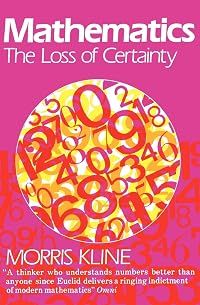
Mathematics: The Loss of Certainty
by Morris Kline
On This Page
Description
This work stresses the illogical manner in which mathematics has developed, the question of applied mathematics as against 'pure' mathematics, and the challenges to the consistency of mathematics' logical structure that have occurred in the twentieth century.Tags
Recommendations





Member Reviews
Personally, I was suspicious of this notion of a priori "knowledge" independent from any experience: mathematics, tautologies and deduction from "pure reason". (A posteriori knowledge depends on empirical evidence as in most fields of science and aspects of personal knowledge.) This convincing and well-researched book drawing on many cited sources has me now solid in camp of questioning mathematics a truth discovering technique as much as a concept generating process.
Of course, history is full of examples where mathematics has proved and been disproved.
....
....
However, many more mathematicians are pessimistic. Hermann Weyl, one of the greatest mathematicians of this century, said in 1944:
We find really it is an act of faith, a will to believe....
Many have instead taken an empirical approach.
I am fine with this "loss" of "certainty" and find comfort in placing mathematics along the greatest IMO human achievements like art.
Some summary:
...and finally from the great Karl Popper with a cheeky attitude:
Of course, history is full of examples where mathematics has proved and been disproved.
From the standpoint of the search for truths, it is noteworthy that Ptolemy, like Eudoxus, fully realized that his theory was just a convenient mathematical description which fit theshow more
observations and was not necessarily the true design of nature. For some planets he had a choice of alternative schemes and he chose the mathematically simpler one. Ptolemy says in Book XIII of his Almagest that in astronomy one ought to seek as simple a mathematical model as possible. But Ptolemy's mathematical model was received as the truth by the Christian world.
....
There are mathematicians who believe that the differing views on what can be accepted as sound mathematics will some day be reconciled. Prominent among these is a group of leading French mathematicians who write under the pseudonym of Nicholas Bourbaki...
....
Since the earliest times, all critical revisions of the principles of mathematics as a whole, or of any branch of it, have almost invariably followed periods of uncertainty, where contradictions did appear and had to be resolved.. There are now twenty-five centuries during which the mathematicians have had the practice of correcting their errors and thereby seeing their science enriched, not impoverished; this gives them the right to view the future with serenity.
However, many more mathematicians are pessimistic. Hermann Weyl, one of the greatest mathematicians of this century, said in 1944:
The question of the foundations and the ultimate meaning of mathematics remains open; we do not know in what direction it will find its final solution or even whether a final objective answer can be expected at all. "Mathematizing" may well be a creative activity of man, like language or music, of primary originality, whose historical decisions defy complete objective rationalization.
We find really it is an act of faith, a will to believe....
...in fact that these theorems use the axioms. However, they must be used to derive a large part of classical mathematics. In the second edition of his Principles (1937), Russell backtracked still more. He said that "The whole question of what are logical principles becomes to a very considerable extent arbitrary." The axioms of infinity and choice "can only be proved or disproved by empirical evidence." Nevertheless, he insisted that logic and mathematics are a unity.
However, the critics could not be stilled. In his Philosophy of Mathematics and Natural Science (1949), Hermann Weyl said the Principia based mathematics not on logic alone, but on a sort of logician's paradise, a universe endowed with an "ultimate furniture" of rather complex structure. Would any realistically-minded man dare say he believes in this transcendental world?... This complex structure taxes the strength of our faith hardly less than the doctrines of the early Fathers of the Church or of the Scholastic philosophers of the Middle Ages.
Many have instead taken an empirical approach.
The upshot of these views is that sound mathematics must be deter- mined not by any one foundation which may some day prove to be right. The "correctness" of mathematics must be judged by its applicability to the physical world. Mathematics is an empirical science much as Newtonian mechanics. It is correct only to the extent that it works and when it does not, it must be modified. It is not a priori knowledge even though it was so regarded for two thousand years. It is not absolute or unchangeable.
I am fine with this "loss" of "certainty" and find comfort in placing mathematics along the greatest IMO human achievements like art.
Weierstrass endorsed this thought with the words, "The true mathematician is a poet." And Ludwig Wittgenstein (1889-1951), a student of Russell and an authority in his own right, believed that the mathematician is an inventor not a discoverer...
...
As Weyl stated, mathematics is an activity of thought, not a body of exact knowledge. It is best viewed historically. The rational constructions and reconstructions of the foundations appear now only as a trav esty of the history.
The most extreme view was expressed by Karl Popper, a notable philosopher of science, in The Logic of Scientific Discovery. Mathematical reasoning is never verifiable but only falsifiable. Mathematical theorems are not guaranteed in any way. One may continue to use the existent theory in the absence of a better one, just as Newton's theory of mechanics was used for two hundred years before relativity, or as Euclidean geometry was before Riemannian geometry. But assurance of correctness is not attainable...
Some summary:
Arthur Stanley Eddington once said, "Proof is an idol before whom the mathematician tortures himself." Why should they continue to do so? We might well ask what mathematicians accomplish with their stress on reasoning if they no longer know that their subject is consistent and if, especially, they no longer agree on what correct proof is. Should they rather become indifferent to rigor, throw up their hands and say that mathematics as a soundly established body of knowledge is an illusion? Should they abandon deductive proof and resort merely to convincing, intuitively sound arguments? After all, the physical sciences use such arguments, and even where they use mathematics they are not too concerned with the mathematician's passion for rigor. Abandonment is not the advisable path. Anyone who has looked into the contributions of mathematics to human thought would not sacrifice the concept of proof.
...and finally from the great Karl Popper with a cheeky attitude:
To these gibes at proof we may add the words of a leading student of the logic of mathematics, Karl Popper: "There are three levels of understanding of a proof. The lowest is the pleasant feeling of having grasped the argument; the second is the ability to repeat it; and the third or top level is that of being able to refute it."show less
In spite of a fascinating subject--the way the once-monolithic field of Mathematics has splintered over the past two centuries into competing, contradictory factions--I had to give up on this book because of the poor writing. Any book that begins with the sentence "ANY CIVILIZATION WORTHY OF THE APPELLATION HAS SOUGHT TRUTHS" is already facing an extreme uphill battle with me (the ALL CAPS is there in the text. Really). It keeps going. Chapter 2 opens with " THE MAJESTIC GREEK CIVILIZATION WAS DESTROYED BY SEVERAL FORCES." Clearly Professor Kline would have benefitted from a few courses in Freshman Composition while teaching at NYU... this is the kind of classically bad writing you get from 17 year olds trying to say something important show more and not yet knowing how.
Kline could have benefited from taking a few Humanities courses, too. The introduction is a hysteria of blather about how nothing is certain any longer--ok, to whom is this news? Have we not been thinking about this problem at least since Galileo published Starry Messenger? Did Morris Kline never read Hamlet?
Ok, I feel slightly bad slamming the book of a deceased scholar who tried valiantly throughout his life to reform mathematics education. Maybe this is a book he knocked off when he was too busy in the real world to worry about his writing. show less
Kline could have benefited from taking a few Humanities courses, too. The introduction is a hysteria of blather about how nothing is certain any longer--ok, to whom is this news? Have we not been thinking about this problem at least since Galileo published Starry Messenger? Did Morris Kline never read Hamlet?
Ok, I feel slightly bad slamming the book of a deceased scholar who tried valiantly throughout his life to reform mathematics education. Maybe this is a book he knocked off when he was too busy in the real world to worry about his writing. show less
The chapters on historical development are great. Math is so often presented as a fait accompli, it's nice to be reminded that it has a messy, non-linear history, just like every other human endeavor. The latter chapters on the state of math research as Kline saw it in the late 70s were tedious.
Rather dry. Probably worth a second pass.
Ratings
Members
- Recently Added By
Published Reviews
ThingScore 35
"[H]is descriptions suffer from his extreme position as applied mathematician. . . . Kline's zeal obscures his perspective."
added by cpg
"Professor Kline does not deal honestly with his readers. He is a learned man and knows perfectly well that many mathematical ideas created in abstracto have found significant application in the real world. He chooses to ignore this fact, acknowledged by even the most fanatic opponents of mathematics. He does this to support an untenable dogma. One is reminded of the story of the court jester show more to Louis XIV: the latter had written a poem and asked the jester his opinion. 'Your majesty is capable of anything. Your majesty has set out to write doggerel and your majesty has succeeded.' On balance, such, alas, must be said of this book." show less
added by cpg
"I think three quarters of it is superb, and the other quarter is outrageous nonsense . . ."
added by cpg
Lists

HS Mathematics class library
79 works; 6 members
Author Information

31+ Works 3,095 Members
The late Morris Kline was Professor of Mathematics, Emeritus, at the Courant Institute of Mathematical Sciences, New York University, where he directed the Division of Electromagnetic Research for twenty years
Awards and Honors
Awards
Notable Lists
Series
Belongs to Publisher Series
Studio [Mondadori] (118)
Common Knowledge
- Canonical title
- Mathematics: The Loss of Certainty
- Original publication date
- 1980
- Epigraph
- The gods have not revealed all things from the beginning,
But men seek and so find out better in time.
Let us suppose these things are like the truth.
But surely no man knows or ever will know
The truth ab... (show all)out the gods and all I speak of.
For even if he happens to tell the perfect truth,
He does not know it, but appearance is fashioned over everything.
Xenophanes - Dedication
- To my wife Helen Mann Kline
- First words
- Preface — This book treats the fundamental changes that man has been forced to make in his understanding of the nature and role of mathematics.
- Last words
- (Click to show. Warning: May contain spoilers.)Madness, perhaps, but surely divine.
- Blurbers
- Barrett, William; Dionne, Roger; Quammen, David
Classifications
Statistics
- Members
- 436
- Popularity
- 70,521
- Reviews
- 5
- Rating
- (3.93)
- Languages
- 5 — Chinese, English, French, Italian, Spanish
- Media
- Paper
- ISBNs
- 8
- ASINs
- 2