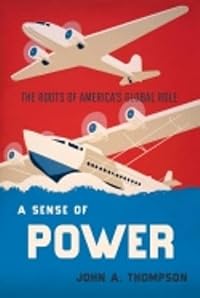
A Sense of Power: The Roots of America's Global Role
by John A. Thompson
On This Page
Description
Why has the United States assumed so extensive and costly a role in world affairs over the last hundred years? The two most common answers to this question are "because it could" and "because it had to." Neither answer will do, according to this challenging re-assessment of the way that America came to assume its global role. The country's vast economic resources gave it the capacity to exercise great influence abroad, but Americans were long reluctant to meet the costs of wielding that show more power. Neither the country's safety from foreign attack nor its economic well-being required the achievement of ambitious foreign policy objectives. A Sense of Power, John A. Thompson takes a long view of America's dramatic rise as a world power, from the late nineteenth century into the post-World War II era. How, and more importantly why, has America come to play such a dominant role in world affairs? There is, he argues, no simple answer. Thompson challenges conventional explanations of America's involvement in World War I and World War II, seeing neither the requirements of national security nor economic interests as determining. He shows how American leaders from Wilson to Truman developed an ever more capacious understanding of the national interest, and why by the 1940's most Americans came to support the price tag, in blood and treasure, attached to strenuous efforts to shape the world. The beliefs and emotions that led them to do so reflected distinctive aspects of U.S. culture, not least the strength of ties to Europe. Consciousness of the nation's unique power fostered feelings of responsibility, entitlement, and aspiration among the people and leaders of the United States. This original analysis challenges some widely held beliefs about the determinants of United States foreign policy and will bring new insight to contemporary debates about whether the nation should-or must-play so active a part in world politics. show lessTags
Recommendations




















Member Recommendations

Member Reviews
While this monograph initially looked interesting it delivered somewhat less than it seemed to promise. Thompson's take on U.S. foreign involvement and intervention is essentially that so many of these situations were really not justified by either matters of security or economic advancement, and that the justifications seem murky in retrospect. The essential conclusion is that the U.S. actually having the power by the end of the 1800s, allied with the cultural sense that the power should be used, and the experiences of the world wars, the way was clear for the use of power to maintain an international environment congenial for the United States. All this suggests that cultural considerations predominated; though the author suspects show more that the once the financial wherewithal is not there Washington will withdraw quite smartly. This being the case, unless your professor assigned this book to you, you'd be better off reading Walter McDougall's "Promised Land, Crusader State," even though it's a generation old at this point. show less
Ratings
Members
- Recently Added By
Author Information
3 Works 42 Members
Classifications
- Genres
- Politics and Government, Nonfiction, History, General Nonfiction
- DDC/MDS
- 327.73009 — Society, Government, and Culture Political science International Relations: Spies North America United States
- LCC
- E744 .T485 — History of the United States United States Twentieth century General Diplomatic history. Foreign and general
- BISAC
Statistics
- Members
- 19
- Popularity
- 1,277,211
- Reviews
- 1
- Rating
- (2.75)
- Languages
- English
- Media
- Paper, Ebook
- ISBNs
- 3