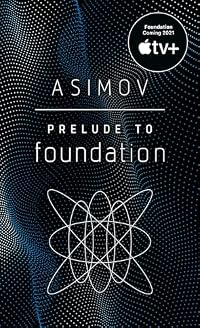
Prelude to Foundation
by Isaac Asimov
Foundation - Chronological (1), Foundation - Publication (6), Asimov's Universe (18)
On This Page
Description
In the year 12,020 G.E., Hari Seldon arrives in the domed city of Trantor and begins to develop his theory of psychohistory, which predicts the rise of a power greater than the Empire.Tags
Recommendations








Member Reviews
Well, wasn't this a dreadful little book?
It's been decades since I read any Asimov, but I remember him with fondness for the original Foundation trilogy I read in the late-70s, along with several of his other novels.
I do, however, have no recollection of his narrative style whatsoever. After finishing this travesty, that actually scares the shit out of me for considering the other nine books in this series.
Prelude to Foundation reads like it was written by a somewhat over-intelligent twelve-year-old who then handed it off to a university professor with absolutely no sense of humour to do final edits.
I've decided, at least for this book, that Asimov is the exact antithesis of both [a:Stephen R. Donaldson|12980|Stephen R. show more Donaldson|https://images.gr-assets.com/authors/1425823085p2/12980.jpg] and [a:Elmore Leonard|12940|Elmore Leonard|https://images.gr-assets.com/authors/1240015224p2/12940.jpg], for different things.
Where Donaldson loves to write pages and pages and pages of dialogue where characters are consistently frustrated because they need answers to questions--and Donaldson actually has them mull the precise questions over in their minds but never verbalize them--then become angry when they can't find the answers they seek, despite talking around the real question but somehow never getting to it. Asimov, on the other hand, just has the most bare bones, unnuanced conversations you'll ever read. There's no subtext, there's no ulterior motives, there's only straight, unvarnished, completely honest talk. If a character needs to ask something, he asks it, and the answer comes. If a character needs to argue, he busts out logic and the other side accepts that logical argument and moves on. It's awful.
Then there's Elmore Leonard, a man who built a career out of having characters speak and their speech sang with humanity. They sounded real, they sounded wonderful, they often spoke in circles, or buried their answers in sarcasm or venom. They rarely gave straight answers, always with some other angle they were playing, but by god, you could hear that talking in your head like the characters were in the room with you. Asimov, on the other hand, writes the driest, most uninspired, overly-logical, overly-factual dialogue you'll find this side of a first time author's unedited self-published book. It's awful.
There's no nuance. There's no blind alleys. There's no personality. There's no exploration of humanity or interpersonal relationships.
There's only facts. If Hari Seldon is in a bind and needs to find a way out of it, the very next person he'll meet is the precise one he needs to meet at that time.
Then there's the stunning differences in the various areas of the planet he explores. "We think hair is disgusting!" or "If I shave my mustache, I am eliminating my manhood!" Yes, they may have some parallels in the real world, but when speculating on humankind 20,000 years in the future, this is the best you could do?
And then, there's the theoretical point of the novel, where Hari Seldon gains the breakthrough that allows him to turn his theoretical psycho-historical projections into a practical application. It happens off-stage and is delivered in the most uninspiring, anti-climactic scene I may have ever read.
Look, Asimov was a brilliant man. But, for a guy with over 500 books under his belt, I expected a hell of a lot more talent with basic characters and dialogue here. This was absolutely, without a doubt, terrible, and it's this type of book that's held up as an example of why non-SF readers don't read the genre.
There's nothing to be found here. Move on. show less
It's been decades since I read any Asimov, but I remember him with fondness for the original Foundation trilogy I read in the late-70s, along with several of his other novels.
I do, however, have no recollection of his narrative style whatsoever. After finishing this travesty, that actually scares the shit out of me for considering the other nine books in this series.
Prelude to Foundation reads like it was written by a somewhat over-intelligent twelve-year-old who then handed it off to a university professor with absolutely no sense of humour to do final edits.
I've decided, at least for this book, that Asimov is the exact antithesis of both [a:Stephen R. Donaldson|12980|Stephen R. show more Donaldson|https://images.gr-assets.com/authors/1425823085p2/12980.jpg] and [a:Elmore Leonard|12940|Elmore Leonard|https://images.gr-assets.com/authors/1240015224p2/12940.jpg], for different things.
Where Donaldson loves to write pages and pages and pages of dialogue where characters are consistently frustrated because they need answers to questions--and Donaldson actually has them mull the precise questions over in their minds but never verbalize them--then become angry when they can't find the answers they seek, despite talking around the real question but somehow never getting to it. Asimov, on the other hand, just has the most bare bones, unnuanced conversations you'll ever read. There's no subtext, there's no ulterior motives, there's only straight, unvarnished, completely honest talk. If a character needs to ask something, he asks it, and the answer comes. If a character needs to argue, he busts out logic and the other side accepts that logical argument and moves on. It's awful.
Then there's Elmore Leonard, a man who built a career out of having characters speak and their speech sang with humanity. They sounded real, they sounded wonderful, they often spoke in circles, or buried their answers in sarcasm or venom. They rarely gave straight answers, always with some other angle they were playing, but by god, you could hear that talking in your head like the characters were in the room with you. Asimov, on the other hand, writes the driest, most uninspired, overly-logical, overly-factual dialogue you'll find this side of a first time author's unedited self-published book. It's awful.
There's no nuance. There's no blind alleys. There's no personality. There's no exploration of humanity or interpersonal relationships.
There's only facts. If Hari Seldon is in a bind and needs to find a way out of it, the very next person he'll meet is the precise one he needs to meet at that time.
Then there's the stunning differences in the various areas of the planet he explores. "We think hair is disgusting!" or "If I shave my mustache, I am eliminating my manhood!" Yes, they may have some parallels in the real world, but when speculating on humankind 20,000 years in the future, this is the best you could do?
And then, there's the theoretical point of the novel, where Hari Seldon gains the breakthrough that allows him to turn his theoretical psycho-historical projections into a practical application. It happens off-stage and is delivered in the most uninspiring, anti-climactic scene I may have ever read.
Look, Asimov was a brilliant man. But, for a guy with over 500 books under his belt, I expected a hell of a lot more talent with basic characters and dialogue here. This was absolutely, without a doubt, terrible, and it's this type of book that's held up as an example of why non-SF readers don't read the genre.
There's nothing to be found here. Move on. show less
Whew, what to make of this? I'm beginning to think I prefer Asimov's non-fiction. His fiction was ever a bit (or more than a bit) clunky, talky and static ... to be honest, the exalted status of the Foundation Trilogy in sf-dom always puzzled me a little, since -- while I enjoyed it, don't get me wrong -- I far preferred other series, even as a youngun ... James Blish's Cities in Flight, for example.
While I was reading this novel, a poor pun kept occurring to me: that Asimov's writing here didn't so much engender a "sense of wonder" (itself a much-maligned term) as a "sense of blunder" -- a kind of "oh, god, Isaac ... *really*?" This echoed with particular volume during the Mycogenian sequence ... where Hari Seldon and Dors Venabili show more encounter a Trantorian subculture where -- da da DUMMM -- hair is considered obscene. Golly. The future isn't so much unimaginable as just plain stupid.
It's kind of a commonplace to say that Asimov's writing improved as he aged, but in a way I disagree. I came away from this feeling like the freshness and ... eagerness? ... of the early work has been lost, and what's left is just slightly embarrassing. I remember that many years ago TV legend Norman Lear attempted a comeback with a new series (I can't remember the name) and, while on the surface he was doing the very same things that made his earlier work groundbreaking, funny and trenchant, the formula just didn't work any more and it failed with a clunk. There's a similar feeling here, for me at least.
(And It's somewhat creepier to take note of Asimov's leer-y attitude toward the female body here, since his status as sf-dom's "Man with a Hundred Hands" reputation has become more widely known. That made me sad)
Still, I kept reading. Why? I'm not sure. Uncle Isaac is so genial. I had fun. And the ending was a neat surprise, I thought. show less
While I was reading this novel, a poor pun kept occurring to me: that Asimov's writing here didn't so much engender a "sense of wonder" (itself a much-maligned term) as a "sense of blunder" -- a kind of "oh, god, Isaac ... *really*?" This echoed with particular volume during the Mycogenian sequence ... where Hari Seldon and Dors Venabili show more encounter a Trantorian subculture where -- da da DUMMM -- hair is considered obscene. Golly. The future isn't so much unimaginable as just plain stupid.
It's kind of a commonplace to say that Asimov's writing improved as he aged, but in a way I disagree. I came away from this feeling like the freshness and ... eagerness? ... of the early work has been lost, and what's left is just slightly embarrassing. I remember that many years ago TV legend Norman Lear attempted a comeback with a new series (I can't remember the name) and, while on the surface he was doing the very same things that made his earlier work groundbreaking, funny and trenchant, the formula just didn't work any more and it failed with a clunk. There's a similar feeling here, for me at least.
(And It's somewhat creepier to take note of Asimov's leer-y attitude toward the female body here, since his status as sf-dom's "Man with a Hundred Hands" reputation has become more widely known. That made me sad)
Still, I kept reading. Why? I'm not sure. Uncle Isaac is so genial. I had fun. And the ending was a neat surprise, I thought. show less
I've completely surrendered myself to this series. It's absolutely perfect for me, and I'm so happy to have read it a little bit later in life. As I get older, I start to think of future generations, humanity in general and, hopefully, try be a little less selfish.
As far as sci-fi adventuring goes, this is top notch. Asimov's writing got better as he got older, and even though there's little to no action, Hari Seldon and Dors visiting the various regions of Trantor and experiencing new cultures and dangers was fascinating. I can't believe the series is nearly over (I'm undecided if I will read the non-Asimov Foundation books), it will easily be right up there with my favorites when I'm done. Incredible callbacks to previous (future) show more books, the focus on a small cast, but a large scope feel just added another layer of enjoyment.
Hell, I love how the characters THINK. All the time. And they express their thoughts, often, and will discuss and debate with each other. Sometimes they'll change their minds when presented with a logical conclusion, other times they'll remain steadfast. It's that unpredictability, combined with a rational perspective, which endeared me to savor every page.
I may have a new favorite author. I'm not saying this book, or the Robots/Empire/Foundation series, is for everybody; it's got quite a few flaws, and I'm sure somebody will be happy to explain why it's not "good literature", but I couldn't care less. Love this series, loved this book. show less
As far as sci-fi adventuring goes, this is top notch. Asimov's writing got better as he got older, and even though there's little to no action, Hari Seldon and Dors visiting the various regions of Trantor and experiencing new cultures and dangers was fascinating. I can't believe the series is nearly over (I'm undecided if I will read the non-Asimov Foundation books), it will easily be right up there with my favorites when I'm done. Incredible callbacks to previous (future) show more books, the focus on a small cast, but a large scope feel just added another layer of enjoyment.
Hell, I love how the characters THINK. All the time. And they express their thoughts, often, and will discuss and debate with each other. Sometimes they'll change their minds when presented with a logical conclusion, other times they'll remain steadfast. It's that unpredictability, combined with a rational perspective, which endeared me to savor every page.
I may have a new favorite author. I'm not saying this book, or the Robots/Empire/Foundation series, is for everybody; it's got quite a few flaws, and I'm sure somebody will be happy to explain why it's not "good literature", but I couldn't care less. Love this series, loved this book. show less
Before Hari Seldon became the fearsome apostle of doom and the legendary founder of psychohistory, he was an idealistic 30-year-old with an interesting scientific theory. He only meant to start a hypothetical discussion among fellow mathematicians, but ended up seriously pondering its practical applicability.
Running for his life through various sectors of the imperial capital, Seldon tries to delve into the origin of an Empire rumoured to be on its last legs. After all a working science of psychohistory could be invaluable as a means of salvation.
I had initially meant to read this book to discuss the changes in TV series with my book club, but ended up barely grazing the subject. I am not sorry though, because the amount and quality of show more the world-building here is just amazing. Twice as long as the Foundation (i.e. the first book, not the series), this book gives the reader a much better understanding of the early signs of the Empire's collapse, by introducing a clever tactic of ingenious inventions left abandoned, due to lack of resources for mass production.
Set some 40 years before the start of the events of Foundation, we meet a much more naive and idealistic Hari Seldon, with a penchant for scientific flights of fancy and the occasional flirting session. I especially enjoyed seeing the clash between Seldon's scientific common sense, and Chetter Hummin's political one: both making excellent (if often contradictory) points.
The only thing that detracted from my enjoyment, was the protagonist's awkward attempt at flirting. I even suspected sarcasm initially, as Hari's sudden sleazy remarks felt rather out of character. It's funny how much I don't want to see romantic (sub)plots outside the genre anymore, when I could hardly picture a happy ending without it ten years ago.
Score: 4.8/5 stars
This was the book that made me fall in love with Asimov's stories, and now it's the book that brings back fond memories of the Robot series. I loved the clever Easter-Eggs that reference places and people from the 4 books, especially when Seldon tries to assess their accuracy.
==================
Review of book 3 (chronological order): Foundation
Review of book 4 (chronological order): Foundation and Empire
Review of book 5 (chronological order): Second Foundation show less
Running for his life through various sectors of the imperial capital, Seldon tries to delve into the origin of an Empire rumoured to be on its last legs. After all a working science of psychohistory could be invaluable as a means of salvation.
I had initially meant to read this book to discuss the changes in TV series with my book club, but ended up barely grazing the subject. I am not sorry though, because the amount and quality of show more the world-building here is just amazing. Twice as long as the Foundation (i.e. the first book, not the series), this book gives the reader a much better understanding of the early signs of the Empire's collapse, by introducing a clever tactic of ingenious inventions left abandoned, due to lack of resources for mass production.
Set some 40 years before the start of the events of Foundation, we meet a much more naive and idealistic Hari Seldon, with a penchant for scientific flights of fancy and the occasional flirting session. I especially enjoyed seeing the clash between Seldon's scientific common sense, and Chetter Hummin's political one: both making excellent (if often contradictory) points.
The only thing that detracted from my enjoyment, was the protagonist's awkward attempt at flirting. I even suspected sarcasm initially, as Hari's sudden sleazy remarks felt rather out of character. It's funny how much I don't want to see romantic (sub)plots outside the genre anymore, when I could hardly picture a happy ending without it ten years ago.
Score: 4.8/5 stars
This was the book that made me fall in love with Asimov's stories, and now it's the book that brings back fond memories of the Robot series. I loved the clever Easter-Eggs that reference places and people from the 4 books, especially when Seldon tries to assess their accuracy.
"The more valued and the more carefully preserved particular information is, the more long-lasting and accurate it may be.”
“The key word is ‘particular.’ What the Book may care to preserve may not be what you wish to have preserved and what a robot may remember best may be what you wish him to remember least.”
==================
Review of book 3 (chronological order): Foundation
Review of book 4 (chronological order): Foundation and Empire
Review of book 5 (chronological order): Second Foundation show less
Cleon looked frustrated. His lips tightened. 'And your paper, then? Is that what you call it, a paper? - Of what use is it?'
'It was merely a mathematical demonstration. It made a point of interest to mathematicians, but there was no thought in my mind of its being useful in any way.'
'I find that disgusting,' said Cleon, angrily.
Seldon shrugged slightly. More than ever, he knew that he should never have given the paper. What would become of him, if the Emperor took it into his head that he had been made to look a fool?
After five books telling the history of the Foundation, Asimov returns to the beginning, as Hari Seldon comes to Trantor to present a paper on psychohistory at a mathematical convention. He soon finds himself in trouble, as show more the emperor and others are concerned about the possibility that psychohistory could have practical applications.
Actually, I'm surprised that Hari Seldon survived long enough to develop a practical application of his idea. Although he is supposed to be keeping a low profile, he has the usual bull-headed approach of science fiction heroes (as in the some of the other Foundation books and "Shockwave Rider"). His lack of emotional intelligence means that he continually upsets his hosts and rubs them up the wrong way, and he keeps doing stupid things that get him noticed and into enough trouble that he has to be moved to another hiding place.
Although Hari Seldon irritated me a lot, the good thing about Asimov writing a prequel after the rest of the series, is that he could put in all sorts of subtle hints about the things that happen in the other books. And even though I guessed the twist, the ending still came as a surprise, as there was a second part to the twist that hadn't occurred to me at all. show less
'It was merely a mathematical demonstration. It made a point of interest to mathematicians, but there was no thought in my mind of its being useful in any way.'
'I find that disgusting,' said Cleon, angrily.
Seldon shrugged slightly. More than ever, he knew that he should never have given the paper. What would become of him, if the Emperor took it into his head that he had been made to look a fool?
After five books telling the history of the Foundation, Asimov returns to the beginning, as Hari Seldon comes to Trantor to present a paper on psychohistory at a mathematical convention. He soon finds himself in trouble, as show more the emperor and others are concerned about the possibility that psychohistory could have practical applications.
Actually, I'm surprised that Hari Seldon survived long enough to develop a practical application of his idea. Although he is supposed to be keeping a low profile, he has the usual bull-headed approach of science fiction heroes (as in the some of the other Foundation books and "Shockwave Rider"). His lack of emotional intelligence means that he continually upsets his hosts and rubs them up the wrong way, and he keeps doing stupid things that get him noticed and into enough trouble that he has to be moved to another hiding place.
Although Hari Seldon irritated me a lot, the good thing about Asimov writing a prequel after the rest of the series, is that he could put in all sorts of subtle hints about the things that happen in the other books. And even though I guessed the twist, the ending still came as a surprise, as there was a second part to the twist that hadn't occurred to me at all. show less
I read the original trilogy years ago, so long ago that I don't remember most of the details. So I decided to read the rest of them (including the originals when I get to them.)
I think Asimov's popularity rests on his ideas. And his ideas are interesting. The premise of these books is interesting. But his actual writing is average at best. And his characters don't go much deeper than the surface. There's very little interiority, just lots of dialogue-as-exposition. The book is largely plot-driven as Hari Seldon is chased all over the the planet Trantor, interacting with various subsets of society, most of which are thinly developed, stand-ins for current aspects of society as we know it. Fine--it's what Asimov is interested in, show more exploring ideas. But the actual experience of reading this novel isn't that enjoyable. It's just okay; I did enjoy thinking about his ideas, but how they are explored could have been more engaging. And the ending is literally deus ex machina. show less
I think Asimov's popularity rests on his ideas. And his ideas are interesting. The premise of these books is interesting. But his actual writing is average at best. And his characters don't go much deeper than the surface. There's very little interiority, just lots of dialogue-as-exposition. The book is largely plot-driven as Hari Seldon is chased all over the the planet Trantor, interacting with various subsets of society, most of which are thinly developed, stand-ins for current aspects of society as we know it. Fine--it's what Asimov is interested in, show more exploring ideas. But the actual experience of reading this novel isn't that enjoyable. It's just okay; I did enjoy thinking about his ideas, but how they are explored could have been more engaging. And the ending is literally deus ex machina. show less
The official start of the now six books that comprise the foundation series - it is also 8th in the 14 connected books that start with "The Complete Robot" and span through the Empire building, dissolution and final its re-establishment. A future history of the development of mankind over 100000s of years.
As a prelude written sometime after the initial works, this book very much relies uponthe reader having some idea of both the preceeding steps and the end of the series. The Foundation trilogy is perhaps one of Isaac Asimov's most famous stories. The basis is that a Galaxy wide empire has crumbled but before it completely dissolved into anarchy and chaos a mathmatician named Hari Seldon developed psycohistory - a means of predicting show more the agregate behavior of people. He foresaw the anarchy and laid plans to minimise the distruption and bring back the glory days as soon as possible. Of course in the time of the Foundation doing so, his actual life was far in the past and subject to myth.
Prelude to Foundation are excerts from his life, as he began the process of developing pyscohistory. Each chapter is preceded by a short exert of "Encylopedia Galactica" noting what details survived.
Hari presents his inability to make pyscohistory work to the emporer and his refusal to fudge the results to make Cleon look good. A chance encounter then sends Hari exploring the rest of the sectors in Trantor the imperial capitol. Each is beset with its own problems and its own characteristic defects. Hari runs into trouble each time and is moved on to another sector until the unsurprising conclusion is reached.
Asimov is an ideas science fiction writer. His characters are thin, his world building skills almost more so. The people in each sector are extreme contrasting stereotypes, with no redeeming features. there is no angst no confusion no dubious moarl quandries that make the real world exist. However the ideas are very good, and the conclusions based from them can't be faulted.
A light and entertaining edition to the series, worth reading as a fan, but not the ideal entry point - start with Foundation and come back to this later. An obvious note to the differences in writiing ages, the original books are about 1/3 the size of this. I'm note sure the extra words make it better. show less
As a prelude written sometime after the initial works, this book very much relies uponthe reader having some idea of both the preceeding steps and the end of the series. The Foundation trilogy is perhaps one of Isaac Asimov's most famous stories. The basis is that a Galaxy wide empire has crumbled but before it completely dissolved into anarchy and chaos a mathmatician named Hari Seldon developed psycohistory - a means of predicting show more the agregate behavior of people. He foresaw the anarchy and laid plans to minimise the distruption and bring back the glory days as soon as possible. Of course in the time of the Foundation doing so, his actual life was far in the past and subject to myth.
Prelude to Foundation are excerts from his life, as he began the process of developing pyscohistory. Each chapter is preceded by a short exert of "Encylopedia Galactica" noting what details survived.
Hari presents his inability to make pyscohistory work to the emporer and his refusal to fudge the results to make Cleon look good. A chance encounter then sends Hari exploring the rest of the sectors in Trantor the imperial capitol. Each is beset with its own problems and its own characteristic defects. Hari runs into trouble each time and is moved on to another sector until the unsurprising conclusion is reached.
Asimov is an ideas science fiction writer. His characters are thin, his world building skills almost more so. The people in each sector are extreme contrasting stereotypes, with no redeeming features. there is no angst no confusion no dubious moarl quandries that make the real world exist. However the ideas are very good, and the conclusions based from them can't be faulted.
A light and entertaining edition to the series, worth reading as a fan, but not the ideal entry point - start with Foundation and come back to this later. An obvious note to the differences in writiing ages, the original books are about 1/3 the size of this. I'm note sure the extra words make it better. show less
Members
- Recently Added By
Lists

One Book, Many Authors
441 works; 40 members

Unread books
1,063 works; 83 members

Books Read in 2015
3,298 works; 126 members
Books Read in 2016
4,666 works; 199 members

Books Read in 2019
4,052 works; 110 members

Books Read in 2012
815 works; 31 members

Wishlist
99 works; 1 member

Favorite Science Fiction
452 works; 215 members
Talk Discussions
Past Discussions
***Group Read: Asimov's Foundation Series in 75 Books Challenge for 2012 (March 2014)
Author Information

2,404+ Works 292,078 Members
Isaac Asimov was born in Petrovichi, Russia, on January 2, 1920. His family emigrated to the United States in 1923 and settled in Brooklyn, New York, where they owned and operated a candy store. Asimov became a naturalized U.S. citizen at the age of eight. As a youngster he discovered his talent for writing, producing his first original fiction at show more the age of eleven. He went on to become one of the world's most prolific writers, publishing nearly 500 books in his lifetime. Asimov was not only a writer; he also was a biochemist and an educator. He studied chemistry at Columbia University, earning a B.S., M.A. and Ph.D. In 1951, Asimov accepted a position as an instructor of biochemistry at Boston University's School of Medicine even though he had no practical experience in the field. His exceptional intelligence enabled him to master new systems rapidly, and he soon became a successful and distinguished professor at Columbia and even co-authored a biochemistry textbook within a few years. Asimov won numerous awards and honors for his books and stories, and he is considered to be a leading writer of the Golden Age of science fiction. While he did not invent science fiction, he helped to legitimize it by adding the narrative structure that had been missing from the traditional science fiction books of the period. He also introduced several innovative concepts, including the thematic concern for technological progress and its impact on humanity. Asimov is probably best known for his Foundation series, which includes Foundation, Foundation and Empire, and Second Foundation. In 1966, this trilogy won the Hugo award for best all-time science fiction series. In 1983, Asimov wrote an additional Foundation novel, Foundation's Edge, which won the Hugo for best novel of that year. Asimov also wrote a series of robot books that included I, Robot, and eventually he tied the two series together. He won three additional Hugos, including one awarded posthumously for the best non-fiction book of 1995, I. Asimov. "Nightfall" was chosen the best science fiction story of all time by the Science Fiction Writers of America. In 1979, Asimov wrote his autobiography, In Memory Yet Green. He continued writing until just a few years before his death from heart and kidney failure on April 6, 1992. (Bowker Author Biography) show less
Some Editions
Awards and Honors
Distinctions
Notable Lists
Series

Foundation - Chronological
8 works (1)

Foundation - Publication
7 works (6)

Asimov's Universe
14 works (18)
Belongs to Publisher Series
Work Relationships
Is contained in
Has as a teacher's guide
Common Knowledge
- Canonical title
- Prelude to Foundation
- Original title
- Prelude to Foundation (Foundation Series V) (Foundation Series V)
- Original publication date
- 1988-05
- People/Characters
- Hari Seldon; Cleon I; R. Daneel Olivaw; Dors Venabili; Eto Demerzel; Chester Hummin (show all 7); Chetter Hummin
- Important places
- Trantor; Trantor: Imperial Sector; Trantor: Streeling Sector; Trantor: Mycogene Sector; Trantor: Dahl Sector; Trantor: Wye Sector (show all 7); Aurora
- Dedication
- To Jennifer "Green Pencil" Brehl,
the best and hardest-working editor in the world. - First words
- CLEON I - The last Galactic Emperor of the Entun dynasty. (Chapter 1 Headnote)
Suppressing a small yawn, Cleon said, "Demerzel, have you by any chance ever heard of a man named Hari Seldon?"
Text:
Suppressing a small yawn, Cleon said, 'Demerzel, have you by any chance ever heard of a man named Hari Seldon?'
When I wrote "Foundation," which appeared in the May 1942 issue of Astounding Science Fiction, I had no idea that I had begun a series of stories that would eventually grow into six volumes and a total of 650,000 words... (show all) (so far). (Author's Note) - Quotations*
- Je suppose que les éléments de la population qui ont le moins de prise sur le monde naturel, matériel, sont les plus aptes à trouver le réconfort dans ce que vous appelez le surnaturalisme : les pauvres, les déshéritÃ... (show all)©s, les opprimés. Et dans la mesure où le surnaturel englobe la religion, ils peuvent être également plus religieux.
Pourquoi, se demanda-t-il, tant de gens passent-ils leur vie à éviter de trouver les réponses aux questions – et en premier lieu à éviter les questions ? N’y avait-il pourtant rien de plus excitant que de chercher de... (show all)s réponses ? - Last words
- (Click to show. Warning: May contain spoilers.)'Kiss me again, Hari. - Please.'
(Click to show. Warning: May contain spoilers.)Naturally, there's got to be some limit, for I don't expect to live forever, but I do intend to hang on as long as possible. (Author's Note) - Publisher's editor
- Brehl, Jennifer
- Original language
- English
- Canonical DDC/MDS
- 813.087625
*Some information comes from Common Knowledge in other languages. Click "Edit" for more information.
Classifications
- Genres
- Science Fiction, Fiction and Literature
- DDC/MDS
- 813.087625 — Literature & rhetoric American literature in English American fiction in English By type Genre fiction Adventure fiction Speculative fiction Science fiction Space opera
- LCC
- PS3551 .S5 .P7 — Language and Literature American literature American literature Individual authors 1961-
- BISAC
Statistics
- Members
- 9,371
- Popularity
- 1,118
- Reviews
- 106
- Rating
- (3.77)
- Languages
- 24 — Bulgarian, Catalan, Czech, Dutch, English, Estonian, Finnish, French, German, Greek, Hungarian, Italian, Japanese, Lithuanian, Norwegian, Polish, Portuguese, Romanian, Russian, Slovak, Spanish, Swedish, Turkish, Chinese, traditional
- Media
- Paper, Audiobook, Ebook
- ISBNs
- 89
- ASINs
- 49