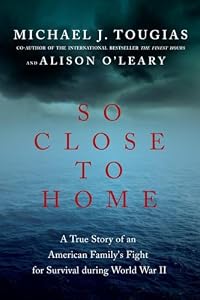
So Close to Home: A True Story of an American Family's Fight for Survival During World War II
by Michael J. Tougias, Alison O'Leary (Author)
On This Page
Description
"On May 19, 1942, a U-boat in the Gulf of Mexico stalked its prey fifty miles from New Orleans. Captained by twenty nine-year-old Iron Cross and King's Cross recipient Erich Wurdemann, the submarine set its sights on the freighter Heredia with sixty-two souls on board. Most aboard were merchant seamen, but there were also a handful of civilians, including the Downs family: Ray and Ina, and their two children, eight-year-old Sonny and eleven-year-old Lucille. Fast asleep in their berths, the show more Downs family had no idea that two torpedoes were heading their way. When the ship exploded, chaos ensued--and each family member had to find their own path to survival." -- show lessTags
Recommendations























Member Recommendations
Member Reviews
The severity of the German u-boat campaign on American ships in the Atlantic and Gulf of Mexico in the early days of World War II is often overlooked. Tougias and O'Leary tell that history through the story of the Downs family of Texas as they sail on the cargo ship Heredia from Costa Rica to New Orleans. The ship is destroyed by torpedoes on the May 19, 1942, and the Downs family are separated in the wreck, each having their own survival journey along with some members of the crew. It's a very gripping tale, but Tougias and O'Leary have a bigger story to tell based on the records of u-boat captains and the crews who were big heroes in Nazi Germany. This means that the Downs' story is broken up by long sections about the u-boat warfare show more in general and the experiences of their crew. Perhaps the Downs' story was too thin to make a book of its own, but the approach taken here makes the narrative very uneven. Nevertheless, it is an interesting glimpse into an overlooked period in American history. show less
A very well written and thoroughly researched historical account of The Heredia that was bombed and sunk by the Germans in the Gulf of Mexico during World War II that had civilians on board.
Mr. Tougias and Ms O'Leary detailed the military aspects and described all scenes so vividly that you could feel the cold and dampness and the fear all crew members and the Downs family was experiencing as they escaped from the wreckage.
You could actually put yourself with the survivors as they clung to a small makeshift raft, feared the sharks, suffered sun burn, craved water and food, and prayed for rescue boats to arrive.
The technical aspect was a bit too much for me to absorb, but the human element added in made for an excellent read. If you are show more a military buff, SO CLOSE TO HOME will be a book you will want to read.
The personal aspect of the survivors, and especially the Downs family held my interest.
I normally do not read non-fiction, but I am glad I read this book. It is an event in history that I knew nothing about. 4/5
This book was given to me free of charge and without compensation by the publisher in return for an honest review. show less
Mr. Tougias and Ms O'Leary detailed the military aspects and described all scenes so vividly that you could feel the cold and dampness and the fear all crew members and the Downs family was experiencing as they escaped from the wreckage.
You could actually put yourself with the survivors as they clung to a small makeshift raft, feared the sharks, suffered sun burn, craved water and food, and prayed for rescue boats to arrive.
The technical aspect was a bit too much for me to absorb, but the human element added in made for an excellent read. If you are show more a military buff, SO CLOSE TO HOME will be a book you will want to read.
The personal aspect of the survivors, and especially the Downs family held my interest.
I normally do not read non-fiction, but I am glad I read this book. It is an event in history that I knew nothing about. 4/5
This book was given to me free of charge and without compensation by the publisher in return for an honest review. show less
So Close to Home by Michael J. Tougias and Alison O'Leary is a riveting account of the amazing, providential survival and reunion of a family after the ship they are travelling on was torpedoed by a German submarine.
In 1942, the Downs Family, consisting of Ray and Ina Downs and two of their children, Lucille and Sonny Downs (their oldest son Terry was already in the U.S.), were making their way back to the United States from an eleven month stay in Columbia where Ray had taken a job with the United Fruit Company. They began their journey home on a ship called the Heredia.
Their trip home was drastically interrupted. The night before they were to land at New Orleans, two torpedoes hit the ship. The Downs' almost make it out onto the deck show more of this ship together but are separated by a lurch of the ship causing a surge of water to engulf them. Ray is washed back inside the ship, while Ina, Lucille and Sonny are swept to various places on the decks and in the water, all find themselves separated from the rest of their family.
Ray is reunited with Sonny after a short while, Lucille is helped by the Second Mate of the Heredia while Ina struggles to survive on her own. They all have encounters with sharks and suffer from long exposure to the elements. All of them have to deal with their fears for each other, wondering whether the rest of their family is still alive and they all try to keep their composure during their ordeal. Even little Sonny tries to be tough like his dad and succeeds in not breaking down. The Downs' family ends up happily reunited, all of them amazed and grateful that they survived.
Heavily intermixed with the story of the Downs family story are the accounts of several U-boat Captains and their crews, including that of the Captain of the U-boat that sank the Heredia. The authors interweave these accounts by jumping off many incidents in the Downs' story to lead into history and facts about German submarines, their crews and other ships they sank. I found it very interesting that, unlike the Japanese, many German Submarine Captains were kind and friendly to survivors of ships that they sank. The most amazing one is probably the account of the sinking of the ship called the Laconia which carried many civilians. The Captain of the U-boat who sunk her surfaced and took on many survivors, helped any injured, and ended up obtaining help from other German U-boats who also took on survivors and all of them towed several lifeboats in their wake and helped to repair lifeboats.
I'm going give a couple of negative comments here: First, I just want to note that book had some foul language, but it is easy enough to scribble out and to skip over (I've been reading it out-loud to some of my siblings). Sometimes I don't want to know what people said exactly the way it was said, even if it is actually history.
Second, I was saddened to find that, though Ray and Ina Downs' seemed to be professing Christians, they ended up divorcing later in life. If they hadn't been Christians I wouldn't have thought much of it. But they were professing Christians, and as such they could have shown the kind of unconditional love toward each other that God showed toward them. That was not a good example of a Christian marriage, that they loved each other conditionally rather than unconditionally. It is quite disheartening to think that they had the stamina to survive a ship's sinking, almost being drowned or eaten by sharks and yet they didn't have the stamina to choose to keep loving each other despite each other's flaws and keep their marriage covenant. Perhaps I am getting too preachy here, but that was just really sad to find out.
But all in all, I liked the book. It was a very fascinating account of the sinking of the Heredia with lots of background history and information interwoven throughout the book. It was very surprising to find how much German U-boat activity was happening in the Gulf of Mexico. I had no idea that U-boats came SO close to the U.S.! Looking at the map just inside the front cover of the book one can get a picture of just how close they got. Some U-boats even gave potential German saboteurs a lift to our shores! I learned quite a bit of extra World War II history.
Many thanks to the folks at Pegasus Books for sending me a free review copy of this book (My review did not have to be favorable)! show less
In 1942, the Downs Family, consisting of Ray and Ina Downs and two of their children, Lucille and Sonny Downs (their oldest son Terry was already in the U.S.), were making their way back to the United States from an eleven month stay in Columbia where Ray had taken a job with the United Fruit Company. They began their journey home on a ship called the Heredia.
Their trip home was drastically interrupted. The night before they were to land at New Orleans, two torpedoes hit the ship. The Downs' almost make it out onto the deck show more of this ship together but are separated by a lurch of the ship causing a surge of water to engulf them. Ray is washed back inside the ship, while Ina, Lucille and Sonny are swept to various places on the decks and in the water, all find themselves separated from the rest of their family.
Ray is reunited with Sonny after a short while, Lucille is helped by the Second Mate of the Heredia while Ina struggles to survive on her own. They all have encounters with sharks and suffer from long exposure to the elements. All of them have to deal with their fears for each other, wondering whether the rest of their family is still alive and they all try to keep their composure during their ordeal. Even little Sonny tries to be tough like his dad and succeeds in not breaking down. The Downs' family ends up happily reunited, all of them amazed and grateful that they survived.
Heavily intermixed with the story of the Downs family story are the accounts of several U-boat Captains and their crews, including that of the Captain of the U-boat that sank the Heredia. The authors interweave these accounts by jumping off many incidents in the Downs' story to lead into history and facts about German submarines, their crews and other ships they sank. I found it very interesting that, unlike the Japanese, many German Submarine Captains were kind and friendly to survivors of ships that they sank. The most amazing one is probably the account of the sinking of the ship called the Laconia which carried many civilians. The Captain of the U-boat who sunk her surfaced and took on many survivors, helped any injured, and ended up obtaining help from other German U-boats who also took on survivors and all of them towed several lifeboats in their wake and helped to repair lifeboats.
I'm going give a couple of negative comments here: First, I just want to note that book had some foul language, but it is easy enough to scribble out and to skip over (I've been reading it out-loud to some of my siblings). Sometimes I don't want to know what people said exactly the way it was said, even if it is actually history.
Second, I was saddened to find that, though Ray and Ina Downs' seemed to be professing Christians, they ended up divorcing later in life. If they hadn't been Christians I wouldn't have thought much of it. But they were professing Christians, and as such they could have shown the kind of unconditional love toward each other that God showed toward them. That was not a good example of a Christian marriage, that they loved each other conditionally rather than unconditionally. It is quite disheartening to think that they had the stamina to survive a ship's sinking, almost being drowned or eaten by sharks and yet they didn't have the stamina to choose to keep loving each other despite each other's flaws and keep their marriage covenant. Perhaps I am getting too preachy here, but that was just really sad to find out.
But all in all, I liked the book. It was a very fascinating account of the sinking of the Heredia with lots of background history and information interwoven throughout the book. It was very surprising to find how much German U-boat activity was happening in the Gulf of Mexico. I had no idea that U-boats came SO close to the U.S.! Looking at the map just inside the front cover of the book one can get a picture of just how close they got. Some U-boats even gave potential German saboteurs a lift to our shores! I learned quite a bit of extra World War II history.
Many thanks to the folks at Pegasus Books for sending me a free review copy of this book (My review did not have to be favorable)! show less
Ratings
Members
- Recently Added By
Author Information

55 Works 2,673 Members
Syndicated outdoor columnist and author Michael J. Tougias is one of New England's leading nature writers. He is the author and co-author of 14 books including River Days, New England Wild Places, Quabbin, Quiet Places of Massachusetts, Exploring the Hidden Charles, and King Philip's War. His columns appear in the Springfield Union News, Taunton show more Gazette, and Attleboro Sun Chronicle and he frequently contributes to Outdoor Life, Field and Stream, Fine Gardening, Flower and Garden, Yankee Travel, the Boston Globe, Farmer's Almanac, and Trout Magazine. Tougias is a popular speaker giving about 125 presentations a year. He lives in Franklin, Massachusetts. show less

Michael Tougias is a LibraryThing Author, an author who lists their personal library on LibraryThing.
Common Knowledge
- Original publication date
- 2016
- Important places
- Gulf of Mexico
- Important events
- World War II (1939 | 1945)
- Original language
- English
Classifications
Statistics
- Members
- 39
- Popularity
- 744,622
- Reviews
- 3
- Rating
- (3.90)
- Languages
- English
- Media
- Paper, Audiobook, Ebook
- ISBNs
- 8
- ASINs
- 1