On This Page
Description
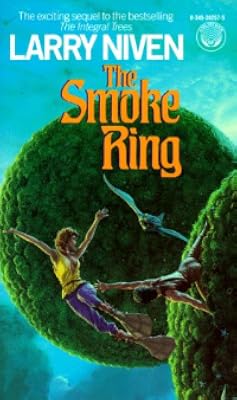
For a long time, the State used slower-than-light spacecraft to prepare star systems for colonization by Man. Normally the ramseeders traveled centuries-long circuits which began and ended at Earth. Normally the mixed crew of citizens and "corpsicle" convicts remained with their ship. Normally ultimate control of the mission was exercised by a built-in cyborg "adviser," the true despot of the tiny State microcosm that was the ship. But little happened normally when Discipline reached the show more double-star system of T3 and LeVoy's Star. There an immense doughnut-shaped gaseous envelope had formed around a neutron star-and a vast volume of that nearly-empty cloud was comfortably habitable to Man. Though it had very little usable land, the Smoke Ring had evolved a huge variety of free-fall life-forms, most of which were edible and all of which could fly. show lessTags
Recommendations




















Member Recommendations
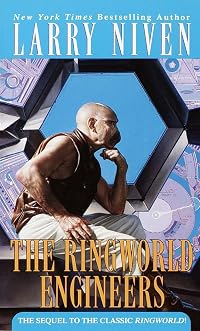
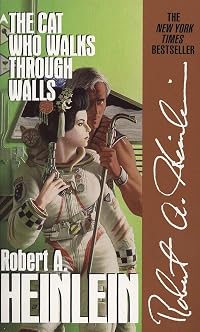
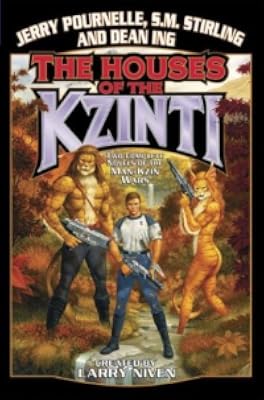
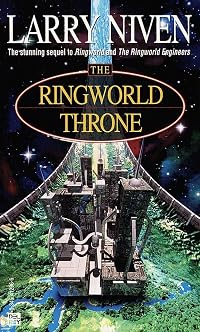
KingRat Sun and Suns (and the two other Virga books), like The Integral Trees (and The Smoke Ring) explores a weightless world made of air.
Member Reviews
I enjoyed it, but I'm the kind of girl who is a little bit miffed that the aliens on Star Trek only speak in Klingon (that the viewer can hear) when they're deliberately cursing or otherwise trying to talk in Klingon - and the "universal translator" makes them speak in English 100% of the time that it's not a plot point.
Which is to say, if you are the kind of person whose responses to "it looks like an integral sign" and "go feed the tree" are laced with frustration and annoyance ("I didn't take Calculus!"; "Just say what you mean instead of making up clever in-world sayings, geez!") then you might be kind of more annoyed than thrilled with this book.
Also, if you're more interested in epic fantasy type stuff - "we cross the world in show more order to get rid of this ring because we were fated to do so and then the ring is gotten rid of and the world is saved even if we ourselves can never go home" - the lack of a strong sense of fate/destiny, the fact that most of the time the characters are primarily focused on immediate survival, the lack of clearly articulated global themes, etc., will probably be aggravating.
Honestly, I'm also the kind of girl who goes for the epic fantasy stuff, which is the big reason this isn't a 5-star book for me. I liked it, and it was well-executed for what it is, but like looking at a piece of Op Art, there's just a bit of me that's left weirdly cold at the end anyhow. Not Niven's fault; if you are a hard sci-fi addict you should absolutely read this one and I strongly suspect you'll love it. If you're more of a generalist or have noticed some stuff up above that may annoy you, I suggest you go for one of Niven's later works, or cowritten novels, to get a taste of Niven that you'll really enjoy. show less
Which is to say, if you are the kind of person whose responses to "it looks like an integral sign" and "go feed the tree" are laced with frustration and annoyance ("I didn't take Calculus!"; "Just say what you mean instead of making up clever in-world sayings, geez!") then you might be kind of more annoyed than thrilled with this book.
Also, if you're more interested in epic fantasy type stuff - "we cross the world in show more order to get rid of this ring because we were fated to do so and then the ring is gotten rid of and the world is saved even if we ourselves can never go home" - the lack of a strong sense of fate/destiny, the fact that most of the time the characters are primarily focused on immediate survival, the lack of clearly articulated global themes, etc., will probably be aggravating.
Honestly, I'm also the kind of girl who goes for the epic fantasy stuff, which is the big reason this isn't a 5-star book for me. I liked it, and it was well-executed for what it is, but like looking at a piece of Op Art, there's just a bit of me that's left weirdly cold at the end anyhow. Not Niven's fault; if you are a hard sci-fi addict you should absolutely read this one and I strongly suspect you'll love it. If you're more of a generalist or have noticed some stuff up above that may annoy you, I suggest you go for one of Niven's later works, or cowritten novels, to get a taste of Niven that you'll really enjoy. show less
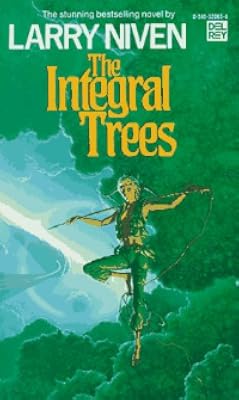
Larry Niven is most well known for his Ringworld series. Therein, he established his hard sci-fi credentials with his elaborate world-building, an artificially constructed ring around a star providing enough livable surface area equivalent to thousands of Earths. And true to form, this book's strength is its world-building. It posits a star system composed of a G-class star in orbit around a neutron star. Closer in, the neutron star has a doughnut-shaped ring of gas fed by a gas giant, whose atmosphere is slowly being stripped by said neutron star. Life exists here in the form of kilometers-long trees, shaped like integrals (You know: the kind from Calculus), inhabited by alien birds and insects. Free floating ponds (giant spheres of show more water) occasionally crash into the trees, providing life sustaining water.
An exploration vessel from Earth happened upon this system. The entire crew of the ship disembarked, telling the ship's AI that they wanted a close-up look. But they never returned, choosing to settle there instead rather than live under the oppressive Terran government, simply referred to as "the State." The story picks up 500 years later. The AI is annoyed but still has some measure of patience.
The descendants of these mutineers have split into tribes and live on separate trees or opposite ends of the same tree. They've adapted to these new low gravity conditions while technology has almost all but reverted to primitive means. And so does the culture! Back to patriarchy! Oh yay!
Niven's early work is guilty—as many sci-fi authors of his generation are—of being stuck with outdated attitudes about women. This early 80s story shows a modicum of progress, but still clings to the past. In one tribe, there's a group of women warriors who patrol and hunt, but it's because the other option is to just cook and make babies. One character joins this group because she was tired of being groped all the time. She wants to find some kind of middle ground, but can't find it in her tribe. Others in this group are hinted at being lesbians, and there's one man who's been granted the "courtesy" of joining as he's gay. In other tribes, women have multiple roles, and in one, a woman is a scientist-apprentice. But lest you think this tribe is progressive, they take slaves from other tribes. The men are forced into labor while the women do the cooking and laundry while occasionally serving as "comfort women."
Niven flits about with which character runs the narrative, so we get multiple POVs within the same chapter. Just as we get to know a character, the POV switches and that's that. We start with the AI, then Gavving, the teenager coming into manhood, and then he-man Clave takes over with his twin girlfriends (eyeroll). The character of Merrill was born without legs, but we never get her POV of things.
It was an entertaining read for the first 70 pages, but after that, the writing felt amateurish. It was like Niven put most of his effort into the world-building and the start of the story, but didn't have anything left to continue. With his editor complaining about a deadline (I have no idea. I'm just making this part up.), he had an event hijack the story, forcing the characters into a slave rescue plot.
While this book is listed as being in the same series as A World Out of Time, there's no connection to it other than a reference to the nefarious State. show less
An exploration vessel from Earth happened upon this system. The entire crew of the ship disembarked, telling the ship's AI that they wanted a close-up look. But they never returned, choosing to settle there instead rather than live under the oppressive Terran government, simply referred to as "the State." The story picks up 500 years later. The AI is annoyed but still has some measure of patience.
The descendants of these mutineers have split into tribes and live on separate trees or opposite ends of the same tree. They've adapted to these new low gravity conditions while technology has almost all but reverted to primitive means. And so does the culture! Back to patriarchy! Oh yay!
Niven's early work is guilty—as many sci-fi authors of his generation are—of being stuck with outdated attitudes about women. This early 80s story shows a modicum of progress, but still clings to the past. In one tribe, there's a group of women warriors who patrol and hunt, but it's because the other option is to just cook and make babies. One character joins this group because she was tired of being groped all the time. She wants to find some kind of middle ground, but can't find it in her tribe. Others in this group are hinted at being lesbians, and there's one man who's been granted the "courtesy" of joining as he's gay. In other tribes, women have multiple roles, and in one, a woman is a scientist-apprentice. But lest you think this tribe is progressive, they take slaves from other tribes. The men are forced into labor while the women do the cooking and laundry while occasionally serving as "comfort women."
Niven flits about with which character runs the narrative, so we get multiple POVs within the same chapter. Just as we get to know a character, the POV switches and that's that. We start with the AI, then Gavving, the teenager coming into manhood, and then he-man Clave takes over with his twin girlfriends (eyeroll). The character of Merrill was born without legs, but we never get her POV of things.
It was an entertaining read for the first 70 pages, but after that, the writing felt amateurish. It was like Niven put most of his effort into the world-building and the start of the story, but didn't have anything left to continue. With his editor complaining about a deadline (I have no idea. I'm just making this part up.), he had an event hijack the story, forcing the characters into a slave rescue plot.
While this book is listed as being in the same series as A World Out of Time, there's no connection to it other than a reference to the nefarious State. show less
Gavving was fourteen years old, as measured by passings of the sun behind Voy. He had never been above Quinn Tuft until now.
The trunk went straight up, straight out from Voy. It seemed to go out forever, a vast brown wall that narrowed to a cylinder, to a dark line with a gentle westward curve to it, to a point at infinity—and the point was tipped with green. The far tuft.
A cloud of brown-tinged green dropped away below him, spreading out into the main body of the tuft. Looking east, with the wind whipping his long hair forward, Gavving could see the branch emerging from its green sheath as a half-klomter of bare wood: a slender fin.
This is a hard science fiction book about humans living in the gas torus surrounding a neutron star, show more and the diagrams at the beginning of the book are a great help to the reader in visualising the setting. A decaying gas giant orbits the neutron star, creating the Smoke Ring, a region of the gas torus that has a high enough concentration of air, water and other chemicals to support life. Humans have only lived there for the past 500 years, but have adapted well to their new environments, although in most of the tribes it is only the Scientist who knows much about their space-faring past. The AI that controlled the ship they arrived in is still waiting outside the smoke ring, and worrying about what has become of the descendants of the crew.
The unique environment has both benefits and limitations for the people who live in the smoke ring, and it is no utopia. The original composition of the ship's crew has led some of the tribes to practise slavery, and in both cases where a woman is approached by a man with a view to marriage, she immediately finds herself someone she prefers and marries him the very same day, so it seems that refusing to marry someone just because you don't want to is unacceptable. Unlike the 'birds' and most other creatures that inhabit the smoke ring, the humans do not have wings so they cannot leave the trees to go hunting. and they now live in isolated groups, some in low-gravity environments on the tufts at the ends of huge trees, and others in free-fall amidst floating jungles of foliage. They eat leaves and fungus growing on the trees, grow some crops and catch passing 'birds' for meat, using harpoons and bows. The tree-dwellers have evolved to be much taller and thinner than standard humans, and the few people who are still born with the old body-shape are seen as dwarfs, while the jungle dweller are even more elongated due to living in free-fall.
As the story begins, things are going badly for the the Quinn Tuft tribe, as the Dalton-Quinn tree has been knocked out of the fertile central region of the smoke ring after passing too close to the planet Gold, and the Quinn Tuft tribe's Scientist believes that the tree is dying. A group of tribe members considered persona non grata by the tribe's Chairman is sent on an expedition along the tree in search of food and water and end up going much further than they ever expected.
I have read this book before, over 20 years ago, but although I remembered the unique setting, with the low gravity and the trees, I didn't remember the plot at all, although certain events rang faint bells with me during this re-read. I've ordered a copy of the sequel, and I hope it will be equally fascinating. show less
The trunk went straight up, straight out from Voy. It seemed to go out forever, a vast brown wall that narrowed to a cylinder, to a dark line with a gentle westward curve to it, to a point at infinity—and the point was tipped with green. The far tuft.
A cloud of brown-tinged green dropped away below him, spreading out into the main body of the tuft. Looking east, with the wind whipping his long hair forward, Gavving could see the branch emerging from its green sheath as a half-klomter of bare wood: a slender fin.
This is a hard science fiction book about humans living in the gas torus surrounding a neutron star, show more and the diagrams at the beginning of the book are a great help to the reader in visualising the setting. A decaying gas giant orbits the neutron star, creating the Smoke Ring, a region of the gas torus that has a high enough concentration of air, water and other chemicals to support life. Humans have only lived there for the past 500 years, but have adapted well to their new environments, although in most of the tribes it is only the Scientist who knows much about their space-faring past. The AI that controlled the ship they arrived in is still waiting outside the smoke ring, and worrying about what has become of the descendants of the crew.
The unique environment has both benefits and limitations for the people who live in the smoke ring, and it is no utopia. The original composition of the ship's crew has led some of the tribes to practise slavery, and in both cases where a woman is approached by a man with a view to marriage, she immediately finds herself someone she prefers and marries him the very same day, so it seems that refusing to marry someone just because you don't want to is unacceptable. Unlike the 'birds' and most other creatures that inhabit the smoke ring, the humans do not have wings so they cannot leave the trees to go hunting. and they now live in isolated groups, some in low-gravity environments on the tufts at the ends of huge trees, and others in free-fall amidst floating jungles of foliage. They eat leaves and fungus growing on the trees, grow some crops and catch passing 'birds' for meat, using harpoons and bows. The tree-dwellers have evolved to be much taller and thinner than standard humans, and the few people who are still born with the old body-shape are seen as dwarfs, while the jungle dweller are even more elongated due to living in free-fall.
As the story begins, things are going badly for the the Quinn Tuft tribe, as the Dalton-Quinn tree has been knocked out of the fertile central region of the smoke ring after passing too close to the planet Gold, and the Quinn Tuft tribe's Scientist believes that the tree is dying. A group of tribe members considered persona non grata by the tribe's Chairman is sent on an expedition along the tree in search of food and water and end up going much further than they ever expected.
I have read this book before, over 20 years ago, but although I remembered the unique setting, with the low gravity and the trees, I didn't remember the plot at all, although certain events rang faint bells with me during this re-read. I've ordered a copy of the sequel, and I hope it will be equally fascinating. show less
A couple of years ago, at my previous job, I was recommended 'The Integral trees' by Larry Niven. It took me forever to find this book in a shop, but when the huge book sale at work happened before Christmas last year, this was one of the books I picked up. I've read a few books by Niven, but all of them were Ringworld novels. This is a book in a different series (Smoke Ring or The State) and I didn't like it as much as I liked the Ringworld novels.
This is the story of the Quinn tribe, who inhabit an integral tree in the smoke ring around Voy. The smoke ring is a ring of breathable air around Voy where life is possible. Because there is no land, and thus no gravity, everything flies and floats, including the trees. Humans have 'landed' show more in this area 500 years earlier, and have adapted to life on the trees (by having extra long toes and more length for example). The Quinn tribe lives on a tree in the tuft that is dying. There is a draught, and because of that, there is not enough food. A hunting party is sent out to climb the tree towards the center to find food and water. This is the start of a huge adventure where they not only find and fight food, but also other humans, other trees. Besides that they also discover more about the history of the humans that came so many centuries ago and the technology they had.
I don't exactly know why this book didn't grip me as much as Niven's other books. Partly it is because it was a pretty linear adventure. A group sets out, and discovers all kinds of people and things, and they just keep going. Partly it is also because the involvement of the ship outside the Smoke Ring was so small. I saw later that there is a book before this one if you see it as part of "The State" series, so I will read that one soon to get more of the back story. All in all this was an enjoyable story, but not as good as I had expected, three out of five stars. show less
This is the story of the Quinn tribe, who inhabit an integral tree in the smoke ring around Voy. The smoke ring is a ring of breathable air around Voy where life is possible. Because there is no land, and thus no gravity, everything flies and floats, including the trees. Humans have 'landed' show more in this area 500 years earlier, and have adapted to life on the trees (by having extra long toes and more length for example). The Quinn tribe lives on a tree in the tuft that is dying. There is a draught, and because of that, there is not enough food. A hunting party is sent out to climb the tree towards the center to find food and water. This is the start of a huge adventure where they not only find and fight food, but also other humans, other trees. Besides that they also discover more about the history of the humans that came so many centuries ago and the technology they had.
I don't exactly know why this book didn't grip me as much as Niven's other books. Partly it is because it was a pretty linear adventure. A group sets out, and discovers all kinds of people and things, and they just keep going. Partly it is also because the involvement of the ship outside the Smoke Ring was so small. I saw later that there is a book before this one if you see it as part of "The State" series, so I will read that one soon to get more of the back story. All in all this was an enjoyable story, but not as good as I had expected, three out of five stars. show less
A fun little story about a world with without real gravity, just centripetal force holding people to objects as the object revolves. The story is solid - with an interesting premise, and interesting ecology. The enemy in the story seems a bit... tacked on. I liked that the story included both men and women as interesting characters, although generally, the story is male dominated. Also, some of the ugliness of this world was glossed over. Over all, a good story, with good characterization, set in a world not much explored.
Another masterpiece of inventing a new world from Niven. In a gaseous ring surrounding a neutron star there exists free fall life forms which provide all the comforts humans could want. So the crew of the star ship Discipline mutiny and flee the ship leaving behind only one sentient being. Sharls Davis Kendy is a cyborg and so he is able to wait five centuries to track down the mutineers' descendants.
The story here concerns the descendents of Earth travelers who, five hundred years earlier, chose to settle in an array of massive, free-floating trees that orbit a neutron star. During a particularly lean time, a small group is sent out to search for additional resources, and then an environmental disaster strikes...
By this point in their history, the tree people have lost most of their technology, and scientific knowledge is limited, so (like Anne McCaffrey's Pern novels) this is a science fiction adventure that feels a lot like fantasy most of the time. Still, there is plenty of hard science used to describe their strange environment and how it works, so it may satisfy both camps.
Characterization is not the novel's strong point. All show more of the characters are stereotypes - the bossy alpha male, the science guy, the cranky old guy, the inexperienced guy, the young girls with nice breasts... - and never move beyond that. I didn't care too much about any one of them. This is a book you read for the bigger concepts. Those ideas are interesting enough that I may read the sequel at some point. show less
By this point in their history, the tree people have lost most of their technology, and scientific knowledge is limited, so (like Anne McCaffrey's Pern novels) this is a science fiction adventure that feels a lot like fantasy most of the time. Still, there is plenty of hard science used to describe their strange environment and how it works, so it may satisfy both camps.
Characterization is not the novel's strong point. All show more of the characters are stereotypes - the bossy alpha male, the science guy, the cranky old guy, the inexperienced guy, the young girls with nice breasts... - and never move beyond that. I didn't care too much about any one of them. This is a book you read for the bigger concepts. Those ideas are interesting enough that I may read the sequel at some point. show less
Members
- Recently Added By
Lists

Locus Award for Best Novel/SF Novel
53 works; 6 members

Space Colonization
100 works; 26 members

Books Read in 2000
121 works; 4 members

Books Read in 2025
4,128 works; 98 members

Favorite Science Fiction
457 works; 223 members
Author Information

334+ Works 98,569 Members
Larry Niven received his B.A. in mathematics in 1962. His first novel, World of Ptavvs (1966), was a success and launched his career. Niven has won five Hugos and one Nebula award, testimony that his colleagues in the science fiction world respect his work. Perhaps Niven's most well-known creation is Ringworld, a distant planet that may be taken show more as a metaphor for Earth, as it was once great but has since fallen into decay. (Bowker Author Biography) show less
Some Editions
Awards and Honors
Awards
Series

Belongs to Publisher Series
Work Relationships
Is contained in
Common Knowledge
- Original publication date
- 1984-03; 1983
- People/Characters
- Sharls Davis Kendy
- Important places
- starship Discipline; Smoke Ring
- Dedication
- This book is dedicated to Robert Forward, for the stories he's sparked in me, for his help in working out the parameters of the Smoke Ring, and for his big, roomy mind.
- First words
- Prologue:
It was taking too long, much longer than he had expected.
Text:
Gavving could hear the rustling as his companions tunneled upward. - Quotations
- Wood snapped explosively, spattering Gavving with splinters as he leapt across the bucking, tearing bark. A million insects poured from a sudden black gap that must have reached a klomter into the heartwood. Gavving cried out... (show all) and waved his arms through the buzzing cloud, trying to clear enough air to breathe. The tree was everything that was, and the tree was ending. If he’d stopped to think, his fear would have frozen him fast. He held to the one thought: Get the meat and get out! The nose-arm legs tumbled loose within a cloud of burning coals. One haunch was in reach. Gavving caught a line to pull it free of the coals, then jumped to catch it against his shoulder. Hot grease burned his neck. He yelled and thrust himself away. Now what? He couldn’t think in this end-of-the-world roar. He doffed his backpack, tied it against the nose-arm leg, braced against the pack, and pushed himself into the sky. Clouds of insects and pulverized wood half hid the shuddering, thundering tree. Dagger-sized splinters flew past. Gavving braced one of his jet pods against the pack and twisted the tip. Seeds and cold gas blasted past him. The pod ripped itself free of his hands, spat seeds into the flesh of his face, and was gone. His hands shook. Beads of blood were pooling on his cheek and his neck. He dug out his remaining jet pod and tried again, his tongue between his teeth. This time the pod held steady until it had gone quiet. The world came apart. He watched it all while his terror changed to awe. Fiery wind swept past him and left him in the open sky. Two fireballs receded in and out, until the home tree had become two bits of fluff linked by an infinite line of smoke. Awesome! Nobody could hope to live through a bigger disaster. All of Quinn Tribe must be dead…the idea was really too big to grasp…all but Clave’s citizens, and they’d lost Jiovan too, and who was left? He looked about him. Nobody? A cluster of specks, far out. He’d used both his jet pods, and now he was lost in the sky. At least he wouldn’t starve…
- Last words
- (Click to show. Warning: May contain spoilers.)Prologue:
Kendy waited.
(Click to show. Warning: May contain spoilers.)Text:
Kendy waited. - Blurbers
- Pournelle, Jerry
- Original language
- English
Classifications
Statistics
- Members
- 2,424
- Popularity
- 8,101
- Reviews
- 31
- Rating
- (3.66)
- Languages
- 6 — Dutch, English, German, Greek, Italian, Spanish
- Media
- Paper, Audiobook, Ebook
- ISBNs
- 30
- ASINs
- 16