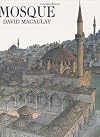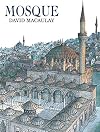
Mosque
by David Macaulay
On This Page
Description
An author and artist who has continually stripped away the mystique of architectural structures that have long fascinated modern people, David Macaulay here reveals the methods and materials used to design and construct a mosque in late-sixteenth-century Turkey. Through the fictional story and Macaulay's distinctive full-color illustrations, readers will learn not only how such monumental structures were built but also how they functioned in relation to the society they served.Tags
Recommendations











Member Reviews
This book is another Macaulay great this time chronicling 1580's mosque creation in the Ottoman Empire. The story uses a narrator to raise and address various engineering problems and both traditional and innovative solutions of the time. There is an emphasis on the prestige and political and economic motivations for the construction in addition to the religious and technical. The illustration is profound and gorgeous and gives a great sense of the mastery of geometry and space true to the skills of the historical artisans and architects who might have worked on such a place of worship, which speaks well of Macaulay’s research into the era and really cultivates an admiration for the genius of the people involved.
Macaulay describes the means by which a Mosque is funded, designed, sited, and then built in the 16th century. As with all of Macaulay's books, the text is accompanied by wonderful drawings. This one was a bit different from which others because a Mosque, unlike other Macaulay topics, is not so complex in its physical building. But it was wonderful to learn about all the different parts of a faith not particularly familiar to me.
From the award-winning author of The Way Things Work, a remarkable look at how a sixteenth-century mosque would have been built, in words and pictures.
“Gorgeously illustrated . . . Macaulay is renowned for spectacular children’s books with an architectural flavor . . . Mosque is a superbly illustrated and technically engrossing explanation of how a great Turkish mosque complex would be built in about 1600 . . . Frankly, I had no idea that I was interested in how mosques were put together, but I found the subject fascinating. And I learned how to make a brick and build a dome, and also a good deal about the economics of the Ottoman Empire and the role of the mosque in society. Macaulay’s mosque is fictional, but loosely based on show more those built around Istanbul (then Constantinople) in the late 16th century by Sinan, a great architect of the Ottoman Empire.” —The New York Times show less
“Gorgeously illustrated . . . Macaulay is renowned for spectacular children’s books with an architectural flavor . . . Mosque is a superbly illustrated and technically engrossing explanation of how a great Turkish mosque complex would be built in about 1600 . . . Frankly, I had no idea that I was interested in how mosques were put together, but I found the subject fascinating. And I learned how to make a brick and build a dome, and also a good deal about the economics of the Ottoman Empire and the role of the mosque in society. Macaulay’s mosque is fictional, but loosely based on show more those built around Istanbul (then Constantinople) in the late 16th century by Sinan, a great architect of the Ottoman Empire.” —The New York Times show less
David Macaulay's Mosque tells the story of a fictionalized mosque being constructed during the latter part of the Ottoman Empire. The book shines because it is not strictly dry historical information taken from encyclopedias or academic books; Macaulay manages to engage his young readers by providing the details of the mosque-building project and the people who were involved with its construction.
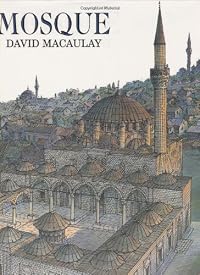
Macaulay's intricate illustrations definitely draw the reader in because of their complexity. There are large illustrations that depict the construction site from a bird's eye view. Macaulay uses these high-angle shots to show his readers that building a mosque was not comprised of building only one structure. Besides the mosque itself, the show more building plan included a turbe (a tomb), a medrese (a school), an imaret (a soup kitchen), a hamam (a public bath), and a cesme (a public fountain). in addition to these larger illustrations, there are small drawings of a process, such as making a brick out of sand and clay. These varied illustrations illuminate the story that Macaulay so clearly describes in the text of this book.
This would be a great book to give to readers interested in construction or buildings. Macaulay has written a number of books describing architectural edifices, so if this book prompted a response, there are many more like it. show less
Macaulay's intricate illustrations definitely draw the reader in because of their complexity. There are large illustrations that depict the construction site from a bird's eye view. Macaulay uses these high-angle shots to show his readers that building a mosque was not comprised of building only one structure. Besides the mosque itself, the show more building plan included a turbe (a tomb), a medrese (a school), an imaret (a soup kitchen), a hamam (a public bath), and a cesme (a public fountain). in addition to these larger illustrations, there are small drawings of a process, such as making a brick out of sand and clay. These varied illustrations illuminate the story that Macaulay so clearly describes in the text of this book.
This would be a great book to give to readers interested in construction or buildings. Macaulay has written a number of books describing architectural edifices, so if this book prompted a response, there are many more like it. show less
Macaulay walks the reader through the construction of a mosque in Istanbul from 1595-1600. The mosque in the book is fictional, but representative of mosques built by the architect Sinan at this same place and time.
Even though this Mosque in this story is fictional, this book gives a detailed explanation with accompanying pictures of how a Mosque complex of 7 buildings would have been built in the 1500s. It take the reader through every step in the process from selection of the site to the building of the domes to the completion of the project. Throughout the book, the author also explains the religious importance of each choice and design decisions.
Beautifully illustrated book about architecture and religion. It gives a positive view of the Islamic religion such as charity, one cannot bequeath their entire fortune to their family. It is a fictitous story about the building of a mosque but it is based on fact. The mosque in the story though fictional is based on the work of famous architect Sinan, who plays a character in the story. It is also a great introduction to architecture, mathematics, and physics which is important in building a structure that will withstand the force of earthquakes. The location of the story is Turkey which is an area prone to earthquakes.
Members
- Recently Added By
Lists

A Child's Book Tour of Turkey
27 works; 2 members

r/History Recommended Reading List
603 works; 12 members

The Story of the World: Activity Book Three: Early Modern Times
191 works; 3 members

Favorite Kids Science Books
129 works; 1 member
Author Information

73+ Works 30,245 Members
David Macaulay was born on December 2, 1946 in Lancashire, England, but moved to Bloomfield, New Jersey when he was 11. He received a bachelor's degree in architecture from the Rhode Island School of Design (RISD). Before becoming an author and illustrator, he worked as an interior designer, a junior high school teacher, and instructor of interior show more design at RISD from 1969 to 1973. His first book, Cathedral: The Story of Its Construction, was published in 1973. His other books include City, Castle, Pyramid, Mill, Underground, Mosque, The Way Things Work, Rome Antics, Shortcut,and How Machines Work. He has received numerous awards including a Caldecott Honor Medal in 1991 for Black and White and the Washington Children's Book Guild Award for a Body of Non-Fiction Work in 1977. He won the Royal Society young people¿s book prize for the best science books for children for his book How Machines Work. (Bowker Author Biography) show less
Awards and Honors
Awards
Distinctions
Common Knowledge
- Canonical title
- Mosque
- Original publication date
- 2003
- First words
- By the middle of the sixteenth century, the Ottomans had built the largest Muslim empire in the world.
- Original language
- English
Classifications
- Genres
- Nonfiction, Tween
- DDC/MDS
- 726.2 — Arts & recreation Architecture Buildings for religious and related purposes Mosques and minarets
- LCC
- NA4670 .M33 — Fine Arts 2599.5-2599.9 Architectural criticism Architecture Special classes of buildings Classed by use Public buildings Religious architecture
- BISAC
Statistics
- Members
- 779
- Popularity
- 35,672
- Reviews
- 17
- Rating
- (4.15)
- Languages
- Dutch, English, German, Turkish
- Media
- Paper, Ebook
- ISBNs
- 10
- UPCs
- 1
- ASINs
- 6