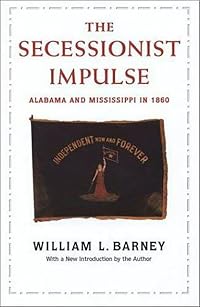
The secessionist impulse : Alabama and Mississippi in 1860
by William L. Barney
On This Page
Description
This is an outline of the economic crisis in the South based on the declining yields, increasing class stratification and higher slave prices. It supplies data on the property holdings and occupations of the elected representatives and finds the secessionists to be young, probably lawyers who were both ambitious and confident. Because the economic dislocation of the 1850s made people receptive to a rhetoric that emphasized conspiratorial abolitionists and almost paranoid fear of blacks and show more strangers, the politicians were able to persuade their constituents that a real crisis did exist and that secession was the only remedy. show lessTags
Recommendations






























Member Recommendations

Member Reviews
The Secessionist Impulse is a study of the politics of secession in the Deep South states of Alabama and Mississippi, leading up to the 1860 presidential election. Published back in 1974, the book has held its value much better than most works published as long ago. (It was reprinted in 2004.)
William Barney builds on the findings of another book, Crisis of Fear, Steven A. Channing's classic study of South Carolina in 1860. The Secessionist Impulse extends the analysis to Alabama and Mississippi, two states that were crucial to the "cotton aristocracy" in 1860, both for their prominence as cotton-producing slave states and for their leading position, with South Carolina, in the drive to secession.
Barney combed newspapers and political show more documents for the names of those Alabamians and Mississippians who were active in an 1860 presidential campaign or in the election of delegates to a state secession convention. He then used the 1860 census to determine each individual's age, occupation, birthplace, wealth, and slaveholding status. Patterns emerged.
Barney's study overturns the traditional view of pre-war southern politics, which held that large slaveholders along with rich merchants and bankers tended to be Whigs, while smaller slaveholders and the "yeomanry" backed the Democrats. In fact, wealth and the interests of large slaveholders dominated both parties. Barney found that the key determiner of whether a person supported secession in 1860 was not just wealth, but relative youth within the elite slaveholding class.
The pro-secession forces attracted "young wealth," especially in Alabama. In particular, young lawyer-planters, born in the Deep South and aspiring to acquire more land and slaves, were more likely than older planters and migrants from other states to plump for a John Breckinridge presidency, the expansion of slave territory, and ultimately, secession.
Barney's portrayal of the South's economy on the eve of war is somewhat dated (a mild critique of a book published around forty years ago!). Barney overemphasizes the admittedly commanding position of large planters in southern society, and he is perhaps too convinced of the absence of "a vigorous town life" in the Deep South. Still, his overall portrait of a "beleaguered" South devoted to the protection of slavery (not "state's rights") is convincing. Although southern politics used a rhetoric of white egalitarianism, the party system functioned to further the interests of large slaveholders and to usher ambitious, socially qualified men into the centers of power. Barney sums up, "The slave system was never questioned, only its standard-bearers at any given moment." In this analysis, 1860's sectional crisis of fear tended to advance the interests of, and to win its strongest support from, the most ambitious members of the Deep South planter elite. show less
William Barney builds on the findings of another book, Crisis of Fear, Steven A. Channing's classic study of South Carolina in 1860. The Secessionist Impulse extends the analysis to Alabama and Mississippi, two states that were crucial to the "cotton aristocracy" in 1860, both for their prominence as cotton-producing slave states and for their leading position, with South Carolina, in the drive to secession.
Barney combed newspapers and political show more documents for the names of those Alabamians and Mississippians who were active in an 1860 presidential campaign or in the election of delegates to a state secession convention. He then used the 1860 census to determine each individual's age, occupation, birthplace, wealth, and slaveholding status. Patterns emerged.
Barney's study overturns the traditional view of pre-war southern politics, which held that large slaveholders along with rich merchants and bankers tended to be Whigs, while smaller slaveholders and the "yeomanry" backed the Democrats. In fact, wealth and the interests of large slaveholders dominated both parties. Barney found that the key determiner of whether a person supported secession in 1860 was not just wealth, but relative youth within the elite slaveholding class.
The pro-secession forces attracted "young wealth," especially in Alabama. In particular, young lawyer-planters, born in the Deep South and aspiring to acquire more land and slaves, were more likely than older planters and migrants from other states to plump for a John Breckinridge presidency, the expansion of slave territory, and ultimately, secession.
Barney's portrayal of the South's economy on the eve of war is somewhat dated (a mild critique of a book published around forty years ago!). Barney overemphasizes the admittedly commanding position of large planters in southern society, and he is perhaps too convinced of the absence of "a vigorous town life" in the Deep South. Still, his overall portrait of a "beleaguered" South devoted to the protection of slavery (not "state's rights") is convincing. Although southern politics used a rhetoric of white egalitarianism, the party system functioned to further the interests of large slaveholders and to usher ambitious, socially qualified men into the centers of power. Barney sums up, "The slave system was never questioned, only its standard-bearers at any given moment." In this analysis, 1860's sectional crisis of fear tended to advance the interests of, and to win its strongest support from, the most ambitious members of the Deep South planter elite. show less
Ratings
Members
- Recently Added By
Author Information
14 Works 264 Members
William L. Barney is Professor of History at the University of North Carolina-Chapel Hill.
Series
Belongs to Publisher Series
Library of Alabama Classics (2004)
Common Knowledge
- Canonical title
- The secessionist impulse : Alabama and Mississippi in 1860
- Original publication date
- 1974
- Important places
- Alabama, USA; Mississippi, USA
- Important events
- Secession Crisis (1860 | 1861)
Classifications
Statistics
- Members
- 31
- Popularity
- 905,238
- Reviews
- 1
- Rating
- (4.00)
- Languages
- English
- Media
- Paper
- ISBNs
- 2