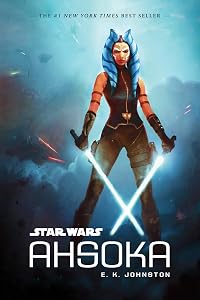
Ahsoka
by E. K. Johnston
Star Wars: Canon - publication order (18 BBY), Star Wars: Canon - chronological order (18 BBY, Imperial Era)
On This Page
Description
Science Fiction. Young Adult Fiction. Young Adult Literature. Fans have long wondered what happened to Ahsoka after she left the Jedi Order near the end of the Clone Wars, and before she re-appeared as the mysterious Rebel operative Fulcrum in Rebels. Finally, her story will begin to be told. Following her experiences with the Jedi and the devastation of Order 66, Ahsoka is unsure she can be part of a larger whole ever again. But her desire to fight the evils of the Empire and protect those show more who need it will lead her right to Bail Organa, and the Rebel Alliance. show lessTags
Recommendations



Member Reviews
This is my first Star Wars novel. I wasn't expecting much, but I was expecting more than this. The more I encounter Star Wars in print, the more I think it is a universe best left to film. There are lots of things that are not quite right about the Star Wars universe, from technology to economics to race relations, that get swept away by great cinematography and awesome music. In print, the reader has more time to think and pick at things.
This did provoke one realization on my part: Star Wars technology is basically Legos. In the original trilogy this isn't readily apparent. C3PO is full of confusing wires, there are piles of scrapped out robots here and there, one gets the impression that technology operates more like Junk Yard Wars. show more However, in the subsequent films, comics, and novels (at least this one) characters just mash parts together. Want a light sabre? Get a special sentient crystal, then mash some parts together. No special tools required.
There is a character who can build electronic locks that deliver electric shocks to intruders and is also a prodigy at building bombs, but can't make minor repairs to her agricultural drone. This seems like a locksmith who can't fix his lawnmower and doesn't quite compute for me.
Also, what's up with the Cantinas? Is that the primary entertainment outlet of technically advanced societies? They have faster than light travel, sentient robots, planet destroying weapons, and people with telepathy/telekinesis/clairvoyance, and a large proportion of characters spend their off hours in dingy bars with loud music?
And where are the bizarre alien intoxicants? I think an opportunity was missed here. Star Wars seems to assume that everyone can booze it up, but why would alcohol affect all of these diverse alien metabolisms in the same way? Why not toss in whatever intergalactic-chronic that fills Jabba's water pipe?
Why does anyone need the manual labor of organic creatures? A lot of the story here centers around and agricultural moon that is staffed by farm laborers who don't seem much different than California fruit pickers. they have machines to assist, but their hands seem essential to the task of harvesting. Is picking vegetables more difficult than interstellar travel? show less
This did provoke one realization on my part: Star Wars technology is basically Legos. In the original trilogy this isn't readily apparent. C3PO is full of confusing wires, there are piles of scrapped out robots here and there, one gets the impression that technology operates more like Junk Yard Wars. show more However, in the subsequent films, comics, and novels (at least this one) characters just mash parts together. Want a light sabre? Get a special sentient crystal, then mash some parts together. No special tools required.
There is a character who can build electronic locks that deliver electric shocks to intruders and is also a prodigy at building bombs, but can't make minor repairs to her agricultural drone. This seems like a locksmith who can't fix his lawnmower and doesn't quite compute for me.
Also, what's up with the Cantinas? Is that the primary entertainment outlet of technically advanced societies? They have faster than light travel, sentient robots, planet destroying weapons, and people with telepathy/telekinesis/clairvoyance, and a large proportion of characters spend their off hours in dingy bars with loud music?
And where are the bizarre alien intoxicants? I think an opportunity was missed here. Star Wars seems to assume that everyone can booze it up, but why would alcohol affect all of these diverse alien metabolisms in the same way? Why not toss in whatever intergalactic-chronic that fills Jabba's water pipe?
Why does anyone need the manual labor of organic creatures? A lot of the story here centers around and agricultural moon that is staffed by farm laborers who don't seem much different than California fruit pickers. they have machines to assist, but their hands seem essential to the task of harvesting. Is picking vegetables more difficult than interstellar travel? show less
In Star Wars Ahsoka, E.K. Johnston traces Ahsoka Tano's journey from former Padawan at the end of Star Wars: The Clone Wars to Fulcrum in Star Wars Rebels. Following Order 66 and the rise of the Empire, Ahsoka moved from place to place, lying low and coming to grips with the sudden void in the Force where she used to sense the Jedi. When Imperial forces arrive on a planet she's hiding on, she moves to an agricultural moon. Soon, the Empire shows up there and puts the local population to work farming a crop the Empire uses for nutritional supplements that also depletes the soil. Ahsoka tries to organize an insurgency, but things go wrong and, having demonstrated her powers, she has to flee. On the run, she realizes that it's her calling show more to work against the Empire, networks with Bail Organa, and leads the fledgling Rebellion back to the agricultural moon to face a Sith Inquisitor and rescue the locals.
Johnston fills in the gap in Ahsoka's background while showing how she became Fulcrum. The origin of Ahsoka's white lightsabers neatly fits into the Rebels-era theme of hope. Johnston does not fill in every gap in Ahsoka's timeline, but she gives enough to tell an entertaining story that leaves room for further exploration. Fans of the character and The Clone Wars will particularly enjoy the more introspective scenes, in which Ahsoka deals with the legacy of that war and what she lost. Johnston also uses short interludes to provide a look at what's going on in the larger galaxy, including Obi-Wan Kenobi's attempts to communicate with Qui-Gon Jinn's spirit. Like Claudia Gray and Greg Rucka before her, Johnston demonstrates how these YA Star Wars novels are on par with, if not superior to, the "adult" novels currently available. show less
Johnston fills in the gap in Ahsoka's background while showing how she became Fulcrum. The origin of Ahsoka's white lightsabers neatly fits into the Rebels-era theme of hope. Johnston does not fill in every gap in Ahsoka's timeline, but she gives enough to tell an entertaining story that leaves room for further exploration. Fans of the character and The Clone Wars will particularly enjoy the more introspective scenes, in which Ahsoka deals with the legacy of that war and what she lost. Johnston also uses short interludes to provide a look at what's going on in the larger galaxy, including Obi-Wan Kenobi's attempts to communicate with Qui-Gon Jinn's spirit. Like Claudia Gray and Greg Rucka before her, Johnston demonstrates how these YA Star Wars novels are on par with, if not superior to, the "adult" novels currently available. show less
Spring 2019 - audiobook;
This book was a heartbreaker and yet so well done, so well detailed, setting itself into that great wide gray divide of years from where Child!Ahsoka was last seen in the Clone Wars cartoon (walking away after the Jedi Order betrayed her) and first seen again as an adult in Star Wars: Rebels. The setting for this book is a short while after Order66 and the assumption and on the run life of 'the last jedi' alive, who has no clue what happened given when she left. It's heartbreaking and beautiful, but with very realistic repercussions, both for Ahsoka and those around her (both those who figure out what she is and those who don't).
I was very touched and this being my second EK Johnston book, I'm going to be here show more in her worlds for a long time to come. show less
This book was a heartbreaker and yet so well done, so well detailed, setting itself into that great wide gray divide of years from where Child!Ahsoka was last seen in the Clone Wars cartoon (walking away after the Jedi Order betrayed her) and first seen again as an adult in Star Wars: Rebels. The setting for this book is a short while after Order66 and the assumption and on the run life of 'the last jedi' alive, who has no clue what happened given when she left. It's heartbreaking and beautiful, but with very realistic repercussions, both for Ahsoka and those around her (both those who figure out what she is and those who don't).
I was very touched and this being my second EK Johnston book, I'm going to be here show more in her worlds for a long time to come. show less
If I were to attempt to rate this more objectively, I'd probably give it three stars, I think. But, for me personally, it rates four.
I'm assuming anyone interested in reading this is at least familiar with the movies, and thus things like what happens to the Jedi in episode 3. If not, there are one or two spoilers below. You've been warned.
I was a huge fan of the original trilogy (OT), though a little skeptical of putting cutesy spear-wielding teddy bears in episode 6, Return of the Jedi. (Side note, the episode numbering is in-universe chronological, not the real-world release order.)
However, I found the subsequent movies in the meh to shitty range. Except for episode 9, as the shittiness of episodes 7 and 8 had driven any desire to show more see it out of me. Just... bad dialogue, painfully bad humor, inexplicable character behavior. Anyhow... not a Stars Wars movie series review. And in any event, I still love the SW universe and mythology.
When the Star Wars: The Clone Wars series came out, I ignored it, though friends told me it was pretty good. Like many, I was just in it for the movies. I've read the novelization of Empire, and four of the early non-canon books. (For the uninitiated, a lot of the early books and at least one early series have been declared non-canonical in the wake of the creation of a coherent Star Wars cinematic universe.)
Finally, I took a leap of faith and started watching The Mandalorian. It still had some flaws, but they were the flaws of A New Hope and Empire, not the painful shit from the later films. And it was pretty damn good. I mean, really surprisingly good. Really, if someone came to you and said, "I want to make a million dollar [or whatever it cost] an episode show, about a mercenary and his little green, toddler, alien sidekick, oh, and you'll never see the mercenary's face because he always wears armor." You would laugh in their face. But, because it's SW and because Disney, for all its faults, does know how to make good shows, it works. And works well.
Anyhow, so with Mandalorian watched and my interest in SW rekindled, I decide to give Clone Wars a go. And it's pretty damn good too. Plus, it develops the universe and mythology a lot, explores many characters (Obi Wan, Yoda, Mace Windu, Anakin, Bail Organa, Padme), and introduces a few new ones, including Anakin's padawan, Ahsoka Tano. Ahsoka quickly became a fan favorite, got her own book (obviously), and has a limited series coming (next year, at a guess).
In the timeline of the movies, the series runs roughly from episode 2 through to the end of episode 3, but, being seven seasons long, adds a lot of detail to the period. It's also about 30 times better written.
So, now I feel like I can write a couple paragraphs about the book after writing a six-paragraph-long prelude. The Star Wars universe is a big, complicated thing.
I'll tell you right now, this is brain candy. It's a solid book. I didn't notice any glaring flaws in continuity or logical flow. As near as I can tell, this was Johnston's first SW novel (she subsequently wrote two others), and I can only wonder how much backstory a new writer in the SW universe has to wade through before they can actually write something that fits into the grand scheme of things. So, an A for presumed effort there. It helps that Ahsoka is fairly self-contained. It doesn't touch on too much outside of Ahsoka and the backwater planets she's on. And maybe that's typical for new SW authors so they don't have to spend three months reading backstory notes right off the bat. In fact, one of the story's principle tasks is to (re)connect her to what's going on (that being the start of the rebellion).
Ahsoka is popular for good reasons. First, she's one of the few major female characters. Though that hardly explains it, and it would be insulting to suggest that simply being female is what makes Ahsoka popular, both to the writers and to, well, most humans.
There is one big reason to be skeptical, at least without seeing the series. She begins the series as a sidekick (Anakin's), and so often the sidekick role gets botched terribly. Plus, she's the only major new character, which seems to enhance the botchability in these things. The writers, to their credit, did not make her annoying. She's not just there for comic relief or to do stupid shit to create plot points. She's a kid to be sure (maybe mid-to-late-teens at the start of the show), and does screw up at times to be sure, but she's learning -- and she does learn. She grows, she gains new responsibilities and independence. She leads trooper into battle. She has agency. And she's never sexualized.
Ahsoka the book extends this arc of Ahsoka the character into her becoming a full adult. She is one of the few Jedi to survive Order 66, but as she was away from the Jedi Temple, she does not know who else survived, only that she can no longer sense other Jedi through the Force. She is young, quite alone, quite sad, and constantly in fear of being discovered by Imperials.
As the Empire expands into the outer rim of the galaxy, Ahsoka skips from world to world, until she finally decides to stay and help the few hundred inhabitants of a moon about to have the resources wrung out of it by the Empire.
The plot is nothing intricate -- this is Star Wars after all. It took me just a couple dozen words to explain it. But the action is fast, you care about the characters, and you hate the bad guys. Sweetness for your cerebellum (don't come at me with your neuroanatomy).
Ahsoka's a bad ass -- she's a trained Jedi -- but not too bad ass. Her training is incomplete for one thing. And she just not as powerful as some of the more famous force wielders like Obi Wan, Luke, or Vader (to say nothing of Yoda or Palpatine). And she is as aware of these limitations as she is of her abilities. Years of fighting in the Clone Wars given her a lot of practical knowledge of strategy and tactics, as well as experience in tangling with other force-wielders. It makes for a satisfying story, especially when coupled with the strong reasons she has to keep her identity as a Force-wielder (to say nothing of as a mostly-Jedi) secret. And along the way, you do get to meet a couple old favorites to boot: R2-D2 and Bail Organa.
The audiobook is a delight. It's read by Ahsoka's voice actress, Ashley Eckstein, and comes complete with lightsaber and other sound effects, R2-D2 beeps, and various stirring bars of John Williams's SW score. Eckstein's a pro voice actress and you always know which character's speaking from the distinct voices she gives them.
Bottom line: If you're a disillusioned SW movie fan, or just never ventured beyond the films, give Clone Wars a shot and then read this. I sincerely doubt you'll be disappointed.
Though I have not watched it yet, as I understand it, Ahsoka's story continues in the Star Wars Rebels animated series, though she is not a regular in it, and after that, the eponymous, upcoming limited series. show less
I'm assuming anyone interested in reading this is at least familiar with the movies, and thus things like what happens to the Jedi in episode 3. If not, there are one or two spoilers below. You've been warned.
I was a huge fan of the original trilogy (OT), though a little skeptical of putting cutesy spear-wielding teddy bears in episode 6, Return of the Jedi. (Side note, the episode numbering is in-universe chronological, not the real-world release order.)
However, I found the subsequent movies in the meh to shitty range. Except for episode 9, as the shittiness of episodes 7 and 8 had driven any desire to show more see it out of me. Just... bad dialogue, painfully bad humor, inexplicable character behavior. Anyhow... not a Stars Wars movie series review. And in any event, I still love the SW universe and mythology.
When the Star Wars: The Clone Wars series came out, I ignored it, though friends told me it was pretty good. Like many, I was just in it for the movies. I've read the novelization of Empire, and four of the early non-canon books. (For the uninitiated, a lot of the early books and at least one early series have been declared non-canonical in the wake of the creation of a coherent Star Wars cinematic universe.)
Finally, I took a leap of faith and started watching The Mandalorian. It still had some flaws, but they were the flaws of A New Hope and Empire, not the painful shit from the later films. And it was pretty damn good. I mean, really surprisingly good. Really, if someone came to you and said, "I want to make a million dollar [or whatever it cost] an episode show, about a mercenary and his little green, toddler, alien sidekick, oh, and you'll never see the mercenary's face because he always wears armor." You would laugh in their face. But, because it's SW and because Disney, for all its faults, does know how to make good shows, it works. And works well.
Anyhow, so with Mandalorian watched and my interest in SW rekindled, I decide to give Clone Wars a go. And it's pretty damn good too. Plus, it develops the universe and mythology a lot, explores many characters (Obi Wan, Yoda, Mace Windu, Anakin, Bail Organa, Padme), and introduces a few new ones, including Anakin's padawan, Ahsoka Tano. Ahsoka quickly became a fan favorite, got her own book (obviously), and has a limited series coming (next year, at a guess).
In the timeline of the movies, the series runs roughly from episode 2 through to the end of episode 3, but, being seven seasons long, adds a lot of detail to the period. It's also about 30 times better written.
So, now I feel like I can write a couple paragraphs about the book after writing a six-paragraph-long prelude. The Star Wars universe is a big, complicated thing.
I'll tell you right now, this is brain candy. It's a solid book. I didn't notice any glaring flaws in continuity or logical flow. As near as I can tell, this was Johnston's first SW novel (she subsequently wrote two others), and I can only wonder how much backstory a new writer in the SW universe has to wade through before they can actually write something that fits into the grand scheme of things. So, an A for presumed effort there. It helps that Ahsoka is fairly self-contained. It doesn't touch on too much outside of Ahsoka and the backwater planets she's on. And maybe that's typical for new SW authors so they don't have to spend three months reading backstory notes right off the bat. In fact, one of the story's principle tasks is to (re)connect her to what's going on (that being the start of the rebellion).
Ahsoka is popular for good reasons. First, she's one of the few major female characters. Though that hardly explains it, and it would be insulting to suggest that simply being female is what makes Ahsoka popular, both to the writers and to, well, most humans.
There is one big reason to be skeptical, at least without seeing the series. She begins the series as a sidekick (Anakin's), and so often the sidekick role gets botched terribly. Plus, she's the only major new character, which seems to enhance the botchability in these things. The writers, to their credit, did not make her annoying. She's not just there for comic relief or to do stupid shit to create plot points. She's a kid to be sure (maybe mid-to-late-teens at the start of the show), and does screw up at times to be sure, but she's learning -- and she does learn. She grows, she gains new responsibilities and independence. She leads trooper into battle. She has agency. And she's never sexualized.
Ahsoka the book extends this arc of Ahsoka the character into her becoming a full adult. She is one of the few Jedi to survive Order 66, but as she was away from the Jedi Temple, she does not know who else survived, only that she can no longer sense other Jedi through the Force. She is young, quite alone, quite sad, and constantly in fear of being discovered by Imperials.
As the Empire expands into the outer rim of the galaxy, Ahsoka skips from world to world, until she finally decides to stay and help the few hundred inhabitants of a moon about to have the resources wrung out of it by the Empire.
The plot is nothing intricate -- this is Star Wars after all. It took me just a couple dozen words to explain it. But the action is fast, you care about the characters, and you hate the bad guys. Sweetness for your cerebellum (don't come at me with your neuroanatomy).
Ahsoka's a bad ass -- she's a trained Jedi -- but not too bad ass. Her training is incomplete for one thing. And she just not as powerful as some of the more famous force wielders like Obi Wan, Luke, or Vader (to say nothing of Yoda or Palpatine). And she is as aware of these limitations as she is of her abilities. Years of fighting in the Clone Wars given her a lot of practical knowledge of strategy and tactics, as well as experience in tangling with other force-wielders. It makes for a satisfying story, especially when coupled with the strong reasons she has to keep her identity as a Force-wielder (to say nothing of as a mostly-Jedi) secret. And along the way, you do get to meet a couple old favorites to boot: R2-D2 and Bail Organa.
The audiobook is a delight. It's read by Ahsoka's voice actress, Ashley Eckstein, and comes complete with lightsaber and other sound effects, R2-D2 beeps, and various stirring bars of John Williams's SW score. Eckstein's a pro voice actress and you always know which character's speaking from the distinct voices she gives them.
Bottom line: If you're a disillusioned SW movie fan, or just never ventured beyond the films, give Clone Wars a shot and then read this. I sincerely doubt you'll be disappointed.
Though I have not watched it yet, as I understand it, Ahsoka's story continues in the Star Wars Rebels animated series, though she is not a regular in it, and after that, the eponymous, upcoming limited series. show less
A nice story of Ahsoka Tano...
Author E.K. Johnston did a pretty good job with her novel 'Ahsoka'. It was clear and somewhat fast paced. I felt like it was written for everyone and not just the YA crowd. Kind of set between her leaving the Jedi Order in the Clone Wars and her appearance in Rebels this tale follows her to Raada, a small, out-of-the-way moon base where she is looking to make another "fresh" start. She befriends come in the local community she finds and immediately begins to affect change...and as we find out, that change brings attention, and not the good kind. As the story unfolds this is not the first time this has happened and she is somewhat ready. She does some thing that I was not ready for, she runs away and leaves show more the population grasping and struggling for all sorts of help.
What will she do now? Where will she go? How can she deal with all that is going on in the universe and in her world? All these are answered as the story unfolds and as a bonus we are given a some treats in the form of a couple appearances by some familiar individuals.
Ahsoka was a fun uncomplicated read and if you are a Star Wars fan I would definitely read it. 3.5 stars as this isn't Shakespeare, but it isn't trash either...it was nice. show less
Author E.K. Johnston did a pretty good job with her novel 'Ahsoka'. It was clear and somewhat fast paced. I felt like it was written for everyone and not just the YA crowd. Kind of set between her leaving the Jedi Order in the Clone Wars and her appearance in Rebels this tale follows her to Raada, a small, out-of-the-way moon base where she is looking to make another "fresh" start. She befriends come in the local community she finds and immediately begins to affect change...and as we find out, that change brings attention, and not the good kind. As the story unfolds this is not the first time this has happened and she is somewhat ready. She does some thing that I was not ready for, she runs away and leaves show more the population grasping and struggling for all sorts of help.
What will she do now? Where will she go? How can she deal with all that is going on in the universe and in her world? All these are answered as the story unfolds and as a bonus we are given a some treats in the form of a couple appearances by some familiar individuals.
Ahsoka was a fun uncomplicated read and if you are a Star Wars fan I would definitely read it. 3.5 stars as this isn't Shakespeare, but it isn't trash either...it was nice. show less
After losing everything, Ahsoka feels lost and starts to wander the outer-rim in hiding. Along the way she meets people and forms friendships, but doesn't quite know where her place in the galaxy is. Eventually she realizes that her calling is to help people and to bring people together to fight the Empire.
This book takes place immediately after Episode III and references characters from the TV shows Clone Wars and Star Wars Rebels. If you have not seen that series, or know nothing about the Star Wars prequels, this book will be a little confusing. Overall I enjoyed it.
This book takes place immediately after Episode III and references characters from the TV shows Clone Wars and Star Wars Rebels. If you have not seen that series, or know nothing about the Star Wars prequels, this book will be a little confusing. Overall I enjoyed it.
Mmm! 4.5! Now I have to find out more about these damn Clone Wars, not to mention Rebels. But let a character live! Let her BE QUEER! Oh, a head resting on her shoulder at the end doesn’t cut it, Disney, you scaredy straights. Anyway, the book is one of the better SW DEU books - Ahsoka is quite an interesting character, powerful and vulnerable at once, not knowing the one thing that she really should know about the Empire.
Members
- Recently Added By
Lists

Books Read in 2021
5,361 works; 114 members

Star Wars Canon Reading List
204 works; 1 member

Kindle Fantasy/Science Fiction Re-Read
151 works; 1 member
Author Information

19+ Works 6,331 Members
E. K. Johnston is a Canadian author and a forensic archeologist. Her books include The Story of Owen, Prairie Fire, A Thousand Nights, Spindle, That Inevitable Victorian Thing, and Exit, Pursued By a Bear. (Bowker Author Biography)
Some Editions
Awards and Honors
Notable Lists
Series


Common Knowledge
- Canonical title
- Ahsoka
- Original publication date
- 2016-10-11
- People/Characters
- Ahsoka Tano; Kaeden Larte; Bail Organa
- Important places
- Raada
- Related movies
- Star Wars: The Clone Wars (2008 | IMDb)
- First words
- Mandalore burned.
- Original language
- English
Classifications
- Genres
- Fiction and Literature, Science Fiction, Teen, Young Adult
- DDC/MDS
- 813.6 — Literature & rhetoric American literature in English American fiction in English 2000-
- LCC
- PZ7 .J64052 .A — Language and Literature Fiction and juvenile belles lettres Fiction and juvenile belles lettres Juvenile belles lettres
- BISAC
Statistics
- Members
- 1,408
- Popularity
- 16,795
- Reviews
- 28
- Rating
- (3.84)
- Languages
- 7 — Czech, English, French, German, Italian, Polish, Spanish
- Media
- Paper, Audiobook, Ebook
- ISBNs
- 25
- ASINs
- 5