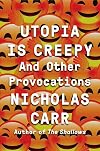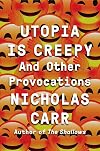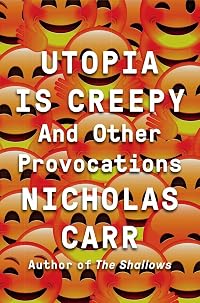
Utopia Is Creepy and Other Provocations
by Nicholas Carr
On This Page
Description
"A freewheeling, sharp-shooting indictment of our tech-besotted culture by the Pulitzer Prize finalist. Over the past dozen years, Nicholas Carr has made his name as an agenda-setting writer on our complicated relationship with technology. Gathering posts from his blog Rough Type as well as seminal pieces published in The Atlantic, the MIT Technology Review, and the Wall Street Journal, he now provides an alternative history of the digital age, chronicling its roller-coaster crazes and show more crashes (remember MySpace or Second Life?). Ground-breaking essays such as 'Is Google Making Us Stupid?' and 'Life, Liberty, and the Pursuit of Privacy' dissect the logic behind Silicon Valley's 'liberation mythology, ' laying bare how technology has both enriched and imprisoned us--sometimes at the same time. A forward-looking new essay rounds out the collection. With searching assessments of topics from the future of work and play to free choice and the fate of reading, Carr once again challenges us to see our world anew"--Provided by publisher. show lessTags
Recommendations






Member Reviews
(Reprinted from the Chicago Center for Literature and Photography [cclapcenter.com]. I am the original author of this essay, as well as the owner of CCLaP; it is not being reprinted illegally.)
To be clear, I would've loved to have read a book of insightful, thought-provoking essays about how everything we assume about the internet is in fact wrong, as Nicholas Carr promises with his new book, Utopia is Creepy and Other Provocations; so what a profound shame, then, that what this book actually consists of is a bunch of reprints of three-page blog posts from Carr's website, a whopping 95 of them in less than 350 pages, giving us the same kind of puerile, surface-level-only look at issues that he claims is what's ruining the internet in show more general these days. That's an entirely avoidable situation in this case, which is what makes this such a particular tragedy; for the Pulitzer-nominated Carr is obviously a smart guy, former executive editor of the Harvard Business Review and a regular contributor to places like The New York Times and Wired, and I suspect he could've delivered a really intelligent book if he had just spent a year actually writing one from scratch, one that slowly and methodically builds up his arguments over the course of tens of thousands of words and a coherent single book-long outline. Instead, though, he's delivered what's essentially a series of 21st-century two-minute Andy Rooney elderly rants with no real point and certainly no solutions being offered -- "Wikipedia sure is full of mistakes, amirightfolks? 'Blog' sure is a funny name, amirightfolks? Second Life sure was overhyped, amirightfolks? AMIRIGHT FOLKS, AMIRIGHT AMIRIGHT??!!" -- thus ironically being exactly guilty himself of what he's complaining about in this book, how the internet has turned all of us into short-attention-span ADD morons who no longer possess the mental skills to follow a rational and extensively plotted argument. A book that would've already been a profoundly disappointing read on its own, it becomes even doubly so by this self-defeating, cloud-yelling aspect of its writing style; and instead of it being merely a book I don't recommend reading, today I am actively suggesting to stay far away from it, if for no other reason so to discourage publishers to continuing to offer up this kind of treacly pablum as proper intellectual fare.
Out of 10: 2.3 show less
To be clear, I would've loved to have read a book of insightful, thought-provoking essays about how everything we assume about the internet is in fact wrong, as Nicholas Carr promises with his new book, Utopia is Creepy and Other Provocations; so what a profound shame, then, that what this book actually consists of is a bunch of reprints of three-page blog posts from Carr's website, a whopping 95 of them in less than 350 pages, giving us the same kind of puerile, surface-level-only look at issues that he claims is what's ruining the internet in show more general these days. That's an entirely avoidable situation in this case, which is what makes this such a particular tragedy; for the Pulitzer-nominated Carr is obviously a smart guy, former executive editor of the Harvard Business Review and a regular contributor to places like The New York Times and Wired, and I suspect he could've delivered a really intelligent book if he had just spent a year actually writing one from scratch, one that slowly and methodically builds up his arguments over the course of tens of thousands of words and a coherent single book-long outline. Instead, though, he's delivered what's essentially a series of 21st-century two-minute Andy Rooney elderly rants with no real point and certainly no solutions being offered -- "Wikipedia sure is full of mistakes, amirightfolks? 'Blog' sure is a funny name, amirightfolks? Second Life sure was overhyped, amirightfolks? AMIRIGHT FOLKS, AMIRIGHT AMIRIGHT??!!" -- thus ironically being exactly guilty himself of what he's complaining about in this book, how the internet has turned all of us into short-attention-span ADD morons who no longer possess the mental skills to follow a rational and extensively plotted argument. A book that would've already been a profoundly disappointing read on its own, it becomes even doubly so by this self-defeating, cloud-yelling aspect of its writing style; and instead of it being merely a book I don't recommend reading, today I am actively suggesting to stay far away from it, if for no other reason so to discourage publishers to continuing to offer up this kind of treacly pablum as proper intellectual fare.
Out of 10: 2.3 show less
It's a blog post collection from the early 00s. For those of us who were there 3000 years ago you'll be struck by thoughts like "oh yeah MySpace existed" or "Second Life was a thing". But there's no deep insight on display here, it's exactly as shallow and surface level as he himself complains about in The Shallows: What the Internet Is Doing to Our Brains - or even in blog posts contained in this book.
This could have been elevated somewhat if Carr returned to comment upon his own blog thoughts, maybe reflect on how things actually turned out, what was prescient and what was laughably gullible regarding the future of technology. But he doesn't. Blog post books were a scourge for a while and seemingly existed just to fulfil some show more contractual obligation to publishers. Much like you wouldn't want to see a podcast (a rare holdout from this age) transcript in book form, blog posts aren't elevated by the book format. show less
This could have been elevated somewhat if Carr returned to comment upon his own blog thoughts, maybe reflect on how things actually turned out, what was prescient and what was laughably gullible regarding the future of technology. But he doesn't. Blog post books were a scourge for a while and seemingly existed just to fulfil some show more contractual obligation to publishers. Much like you wouldn't want to see a podcast (a rare holdout from this age) transcript in book form, blog posts aren't elevated by the book format. show less
Ratings
Members
- Recently Added By
Lists

Books Read in 2017
4,249 works; 130 members
Author Information

12+ Works 5,384 Members
Common Knowledge
- Canonical title
- Utopia Is Creepy and Other Provocations
Classifications
Statistics
- Members
- 135
- Popularity
- 238,605
- Reviews
- 3
- Rating
- (3.50)
- Languages
- English, Spanish
- Media
- Paper, Ebook
- ISBNs
- 7
- ASINs
- 1