
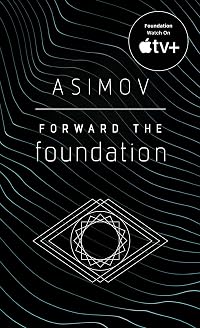
Forward the Foundation
by Isaac Asimov
Foundation - Chronological (2), Foundation - Publication (7), Asimov's Universe (19)
On This Page
Description
The second of two prequel novels in Isaac Asimov’s classic science-fiction masterpiece, the Foundation seriesTHE EPIC SAGA THAT INSPIRED THE APPLE TV+ SERIES FOUNDATION
As Hari Seldon struggles to perfect his revolutionary theory of psychohistory and ensure a place for humanity among the stars, the great Galactic Empire totters on the brink of apocalyptic collapse. Caught in the maelstrom are Seldon and all he holds dear, pawns in the struggle for dominance. Whoever can control Seldon show more will control psychohistory—and with it the future of the Galaxy.
Among those seeking to turn psychohistory into the greatest weapon known to man are a populist political demagogue, the weak-willed Emperor Cleon I, and a ruthless militaristic general. In his last act of service to humankind, Hari Seldon must somehow save his life’s work from their grasp as he searches for its true heirs—a search that begins with his own granddaughter and the dream of a new Foundation. show less
Tags
Recommendations



Member Recommendations
Member Reviews
Forward the Foundation is the second prequel to the Foundation Trilogy, yet the seventh and last book written in the series, literally right before Asimov’s death decades after he wrote the original trilogy. And I think it’s genius. Let me provide some perspective. I had heard of the Foundation trilogy for some time, of course, but when I finally read it, I was unimpressed. In fact, I thought the first two books were so poorly written, that the man clearly showed he had no clue of basic grammatical concepts, such as transitions, and writing devices, such as plot and character development. And his dialogue was atrocious! Since then, I’ve read a lot of Asimov, including many of his later works and have concluded that he grew and show more matured as a writer. He learned how to use transitions. He learned a little bit about plot and character development. He never did learn how to write dialogue that wasn’t wooden, stilted, overly formal, inauthentic, and just plain stupid, but no one’s perfect. When I picked up his fourth book, I loved it. Thought it was brilliant. So I bought the “last one,” the fifth, and hated it because of the nonstop sniping and bitching between two of the characters on every page of the book. I didn’t even finish it.
So it was with some trepidation that I picked up the first prequel a few weeks ago, the sixth book, Prelude to Foundation, where we meet Hari Seldon and his companions and learn about the beginnings of psychohistory and I was struck by how good it was. I loved it! And I thought the ending was spectacular. So I picked this book up, the seventh and last book – but the alleged “second” in the series – that is meant to be read last and just finished reading it a few days ago. I’m only now getting around to writing this review because I’ve had to let thoughts percolate for a few days.
Forward the Foundation covers a hell of a lot of ground and it has to if it wants to tie in with the first Foundation novel. Because of that, the book is divided into five parts, each concerned with a major character – and Hari – and each taking us one decade further in Hari’s life. These parts are of Eto Demerzel, Cleon I, Dors Venabili, Wanda Seldon, and an epilogue.
The first part of the book starts when Hari is turning 40 – 40! – and he and his colleague, Yugo Amaryl, are working to improve psychohistory so that one day it can help foretell future probabilities and create a second Galactic Empire after the fall of the Empire they currently live in. Demerzel is the emperor’s First Minister and a very interesting individual. We meet him in the previous novel and he turns out to be Hari’s champion. Unfortunately, there’s an opposition leader who’s gathering populist support in an effort to unseat him and take his position and Demerzel can see his days are numbered. Even as Demerzel defeats this challenger, saving his position, he gives it up by turning in his notice to the emperor and naming Hari as his successor, much to Hari’s horror. Demerzel then disappears.
The second part of the book has to deal with Hari at age 50 and as acting First Minister to the emperor. An early attempt is made on his life and Dors, his wife and protector, saves his life. She doesn’t have the most pleasant personality and is kind of a little too focused, but she’s extremely devoted. Meanwhile, Hari continues to devote time to the research and pursuit of psychohistory. During this time, it seems the empire is crumbling. Infrastructure is decaying, money is disappearing, fringe planets are fleeing the empire, rebellions are fomenting, and the opposition party from the first part still exists. Hari hears rumors of this and, rather stupidly, convinces his now grown son, Raych, to go to Wye to infiltrate and report back. What he doesn’t expect is for his son to be recognized and to be used as an assassin to kill Hari. At the section’s climactic end, two things happen. Raych raises his gun and points it at Hari, as does as second assassin, and a female undercover agent who Raych took as a lover blows the other assassin away, saving Hari’s life while Raych is overcome. However, shots are heard and elsewhere on the property, the emperor lies dead at the hands of the new chief gardener, who didn’t want his promotion. The empire is about to disintegrate.
In the next chapter, titled Dors, Hari and Yugo and a huge team of scientists and historians have made substantial progress in psychohistory. But Hari is getting old. He’s now 60 and feels it. The government is run by a military junta and things have fallen apart. Hari has landed back at the old university he used to teach at. Raych has married that agent and has had a young daughter, Wanda, now eight, and another small child. Wanda has had a bad dream just in time for a three day birthday party celebration thrown in Hari’s honor. She’s dreamed he’s going to die, be killed. She overhears two men talking about it. No one takes her seriously. Except for Dors. Who starts questioning people. And questions a new, young supergenius mathematician, who has been instrumental in bringing psychohistory along. She confronts him and he levels some accusations against her, and attempts to kill her, weakening her greatly before she somehow kills him first. She reaches Hari, tells him the story and dies in his arms. It’s tragic.
In the Wanda section, Hari is now 70. His friend, Yugo, has died at a young age from overwork. His friend Demerzel is no longer with him. Dors is dead. Psychohistory is in danger of dying out due to lack of funding. The empire is nearly dead. Crime and anarchy are everywhere. Hari is attacked multiple times. On one occasion, Raych saves him. On another, a young researcher named Palver saves him and becomes his bodyguard. Wanda is growing up and is obsessed with psychohistory. And it appears she has some interesting mental powers. These intrigue Hari. See, he has some ideas about something he calls a Foundation. Or rather, two Foundations. To save the galaxy. With Wanda’s help, they encounter more mentalists, including Palver, and these people form the foundation of the people who will become the Second Foundationers. But Raych and his family, minus Wanda, move to another planet, saying goodbye to Hari forever. Now Hari has been abandoned by virtually everyone he has ever cared for in his life at this stage in his life. He feels old and helpless. Yet he must plug on. However, by the end of this section, Wanda and Palver leave Hari too, to go in search of others like them, to form a Foundation for the future of psychohistory and the galaxy. Hari is now truly alone.
The epilogue is quite short, just a couple of pages. Hari is 81. He has recorded his holograms for the First Foundation crises he foresees. Psychohistory has done all it can do and he has too. Everyone has been taken from him. The last thing we see is his seeing his life’s work, Foundation, Dors! And he is found slumped dead over his desk. It’s so fucking sad, I literally cried. I know there’s hope in Wanda and the two Foundations, but this book was so bleak and so sad, and yet so essential to the creation of the Foundation Trilogy, it was impossible not to read and understand and engage. But, damn, was it depressing! But, well done. Well done. Of course, the big secret about Dors comes as no surprise to anyone, but that’s okay. And not only was it sad to see Raych and his family leave, but to find that he is killed in a rebellion on his new planet while his wife and youngest child are lost forever on a starship that is never found. Hari’s tragedies. He dedicates his whole life to psychohistory and his fellow man and loses everything in the process. It’s a fucking tragedy. As is the case with all Asimov books, I’m not sure this merits five stars, due in part to poor dialogue, at a minimum. But I think I can overlook that in this case. It was an excellent book. Five stars. Recommended, but not as the second prequel. Instead, read it as the seventh and last book of the Foundation series to gain the greatest understanding as to what’s going on. Most definitely recommended. show less
So it was with some trepidation that I picked up the first prequel a few weeks ago, the sixth book, Prelude to Foundation, where we meet Hari Seldon and his companions and learn about the beginnings of psychohistory and I was struck by how good it was. I loved it! And I thought the ending was spectacular. So I picked this book up, the seventh and last book – but the alleged “second” in the series – that is meant to be read last and just finished reading it a few days ago. I’m only now getting around to writing this review because I’ve had to let thoughts percolate for a few days.
Forward the Foundation covers a hell of a lot of ground and it has to if it wants to tie in with the first Foundation novel. Because of that, the book is divided into five parts, each concerned with a major character – and Hari – and each taking us one decade further in Hari’s life. These parts are of Eto Demerzel, Cleon I, Dors Venabili, Wanda Seldon, and an epilogue.
The first part of the book starts when Hari is turning 40 – 40! – and he and his colleague, Yugo Amaryl, are working to improve psychohistory so that one day it can help foretell future probabilities and create a second Galactic Empire after the fall of the Empire they currently live in. Demerzel is the emperor’s First Minister and a very interesting individual. We meet him in the previous novel and he turns out to be Hari’s champion. Unfortunately, there’s an opposition leader who’s gathering populist support in an effort to unseat him and take his position and Demerzel can see his days are numbered. Even as Demerzel defeats this challenger, saving his position, he gives it up by turning in his notice to the emperor and naming Hari as his successor, much to Hari’s horror. Demerzel then disappears.
The second part of the book has to deal with Hari at age 50 and as acting First Minister to the emperor. An early attempt is made on his life and Dors, his wife and protector, saves his life. She doesn’t have the most pleasant personality and is kind of a little too focused, but she’s extremely devoted. Meanwhile, Hari continues to devote time to the research and pursuit of psychohistory. During this time, it seems the empire is crumbling. Infrastructure is decaying, money is disappearing, fringe planets are fleeing the empire, rebellions are fomenting, and the opposition party from the first part still exists. Hari hears rumors of this and, rather stupidly, convinces his now grown son, Raych, to go to Wye to infiltrate and report back. What he doesn’t expect is for his son to be recognized and to be used as an assassin to kill Hari. At the section’s climactic end, two things happen. Raych raises his gun and points it at Hari, as does as second assassin, and a female undercover agent who Raych took as a lover blows the other assassin away, saving Hari’s life while Raych is overcome. However, shots are heard and elsewhere on the property, the emperor lies dead at the hands of the new chief gardener, who didn’t want his promotion. The empire is about to disintegrate.
In the next chapter, titled Dors, Hari and Yugo and a huge team of scientists and historians have made substantial progress in psychohistory. But Hari is getting old. He’s now 60 and feels it. The government is run by a military junta and things have fallen apart. Hari has landed back at the old university he used to teach at. Raych has married that agent and has had a young daughter, Wanda, now eight, and another small child. Wanda has had a bad dream just in time for a three day birthday party celebration thrown in Hari’s honor. She’s dreamed he’s going to die, be killed. She overhears two men talking about it. No one takes her seriously. Except for Dors. Who starts questioning people. And questions a new, young supergenius mathematician, who has been instrumental in bringing psychohistory along. She confronts him and he levels some accusations against her, and attempts to kill her, weakening her greatly before she somehow kills him first. She reaches Hari, tells him the story and dies in his arms. It’s tragic.
In the Wanda section, Hari is now 70. His friend, Yugo, has died at a young age from overwork. His friend Demerzel is no longer with him. Dors is dead. Psychohistory is in danger of dying out due to lack of funding. The empire is nearly dead. Crime and anarchy are everywhere. Hari is attacked multiple times. On one occasion, Raych saves him. On another, a young researcher named Palver saves him and becomes his bodyguard. Wanda is growing up and is obsessed with psychohistory. And it appears she has some interesting mental powers. These intrigue Hari. See, he has some ideas about something he calls a Foundation. Or rather, two Foundations. To save the galaxy. With Wanda’s help, they encounter more mentalists, including Palver, and these people form the foundation of the people who will become the Second Foundationers. But Raych and his family, minus Wanda, move to another planet, saying goodbye to Hari forever. Now Hari has been abandoned by virtually everyone he has ever cared for in his life at this stage in his life. He feels old and helpless. Yet he must plug on. However, by the end of this section, Wanda and Palver leave Hari too, to go in search of others like them, to form a Foundation for the future of psychohistory and the galaxy. Hari is now truly alone.
The epilogue is quite short, just a couple of pages. Hari is 81. He has recorded his holograms for the First Foundation crises he foresees. Psychohistory has done all it can do and he has too. Everyone has been taken from him. The last thing we see is his seeing his life’s work, Foundation, Dors! And he is found slumped dead over his desk. It’s so fucking sad, I literally cried. I know there’s hope in Wanda and the two Foundations, but this book was so bleak and so sad, and yet so essential to the creation of the Foundation Trilogy, it was impossible not to read and understand and engage. But, damn, was it depressing! But, well done. Well done. Of course, the big secret about Dors comes as no surprise to anyone, but that’s okay. And not only was it sad to see Raych and his family leave, but to find that he is killed in a rebellion on his new planet while his wife and youngest child are lost forever on a starship that is never found. Hari’s tragedies. He dedicates his whole life to psychohistory and his fellow man and loses everything in the process. It’s a fucking tragedy. As is the case with all Asimov books, I’m not sure this merits five stars, due in part to poor dialogue, at a minimum. But I think I can overlook that in this case. It was an excellent book. Five stars. Recommended, but not as the second prequel. Instead, read it as the seventh and last book of the Foundation series to gain the greatest understanding as to what’s going on. Most definitely recommended. show less
This is so not "a stunning testament to his creative genius" as purported by the hyperbolic cover copy.
Once again, and--even for all its faults--sadly, for the last time, Asimov subjects us to some interesting concepts, but delivers them with awful cardboard characters, dialogue that sounds like it came out of a textbook for logical thinking--seriously, count how many times a character gets into some sort of physical, emotional, or existential jam and then the logical arguments come out and all becomes well with the world again.
Overall, between average plotting, too many coincidences to count, transparent, one-dimensional characters, stiff dialogue, and essentially no character progressions or arcs aside from the "now he's fifty, now show more he's sixty" stuff, and far too much "as you know, Bob" info-dumps, it just shows that Asimov, while brilliant, was, at best, workmanlike in his actual writing talent...at least for this, his last novel and "a stunning testament to his creative genius." show less
Once again, and--even for all its faults--sadly, for the last time, Asimov subjects us to some interesting concepts, but delivers them with awful cardboard characters, dialogue that sounds like it came out of a textbook for logical thinking--seriously, count how many times a character gets into some sort of physical, emotional, or existential jam and then the logical arguments come out and all becomes well with the world again.
Overall, between average plotting, too many coincidences to count, transparent, one-dimensional characters, stiff dialogue, and essentially no character progressions or arcs aside from the "now he's fifty, now show more he's sixty" stuff, and far too much "as you know, Bob" info-dumps, it just shows that Asimov, while brilliant, was, at best, workmanlike in his actual writing talent...at least for this, his last novel and "a stunning testament to his creative genius." show less
It is hard to believe that my journey of reading all of Asimov's Robots/Empire/Foundation series is over. It took just over a year, although I got distracted with a few other books along the way, and it was one of the best reading experiences of my life.
Asimov's style just resonates with me. His focus on small cast, but big picture is unparalleled. So many pieces of fiction TRY to be epic, and so few succeed. Asimov succeeds, over and over again. While Forward the Foundation wasn't quite as good as some of his other works, I couldn't help but feel moved by the last few pages, as if Asimov was writing as Hari Seldon himself.
This will remain among my favorite series ever and am so pleased to have read them. I guarantee some will find show more them dull, or slow - there's not a ton of action, LOTS of talking and exposition, but all the sci-fi greatness that permeates these books is still thrilling to read decades after they were published. show less
Asimov's style just resonates with me. His focus on small cast, but big picture is unparalleled. So many pieces of fiction TRY to be epic, and so few succeed. Asimov succeeds, over and over again. While Forward the Foundation wasn't quite as good as some of his other works, I couldn't help but feel moved by the last few pages, as if Asimov was writing as Hari Seldon himself.
This will remain among my favorite series ever and am so pleased to have read them. I guarantee some will find show more them dull, or slow - there's not a ton of action, LOTS of talking and exposition, but all the sci-fi greatness that permeates these books is still thrilling to read decades after they were published. show less
This was the last Foundation novel Asimov wrote, and indeed it was published in 1993 posthumously by his widow, Janet Jeppson Asimov. Chronologically, it is the second of the prequel Foundation novels that he wrote in the last few years of his life, detailing the life of Hari Seldon and his attempts to develop psychohistory and establish his Foundations to mitigate the collapse of the Galactic Empire. It covers some 40 or more years of Seldon's life including his rather unlikely decade as First Minister of the Empire, and his increasingly frustrated attempts to keep his project going. As such it had for me at least an aura of sadness throughout, exacerbated by the sad demises of several of Seldon's loved ones. I couldn't help feeling show more that many of Seldon's attitudes as he aged mirrored those of the author. One aspect that irritates me slightly is the harping on about growing old at ages we don't normally regard as such ("Seldon's eyes twinkled in a face now lined by age, his sixty years given away as much by his wrinkles as much as by his white hair")! show less
A bit forced and pat in too many places, but then he was piecing together his Foundation canon. Still, it was more enjoyable than his earlier books, despite its shortcomings.
I thought it was good but not amazing. I didn't particularly like the return to the Foundation Trilogy-esque time skips. I much prefer a story to be isolated over a day or week like in Prelude to the Foundation. Seldon was better in this book and felt more like his incarnation in Foundation. Dors unfortunately felt too one-note and lost all her character from Prelude. Raych was good and his death was quite sad. Wanda wasn't really in it for long enough but it was cool that she's the first generation of the Second Foundation.
Aging feels to be the main theme of the book. Seldon gets older and older and everyone is dying while he's still alive. He's left alone in a deteriorating Empire and ultimately Wanda leaves in order to establish the show more Second Foundation. It's a rather touching ending that his last words aren't about psychohistory but his love for Dors. Ultimately it's revealed to me that what touches me most about this franchise of books I've been reading for over 2 years now is that it's beautiful the relationship between intelligence, in case of Asimov, the relationship of humans and robots - Daneel & Elijah and Dors & Seldon. In the end, it's all about how we relate and live through the short time we have temporally speaking. I am happy I read these books and I think it will stay with me for a bit. show less
Aging feels to be the main theme of the book. Seldon gets older and older and everyone is dying while he's still alive. He's left alone in a deteriorating Empire and ultimately Wanda leaves in order to establish the show more Second Foundation. It's a rather touching ending that his last words aren't about psychohistory but his love for Dors. Ultimately it's revealed to me that what touches me most about this franchise of books I've been reading for over 2 years now is that it's beautiful the relationship between intelligence, in case of Asimov, the relationship of humans and robots - Daneel & Elijah and Dors & Seldon. In the end, it's all about how we relate and live through the short time we have temporally speaking. I am happy I read these books and I think it will stay with me for a bit. show less
First of all, I thought I had read it. But then I realized there was simply much I knew from other books, and finally that I had not read it--at least not in its entirety--but had likely put it aside thinking I had and was bored with its mediocrity.
Really! What a shame. The writing was subpar, although it was interesting to see how Asimov was stitching together the threads of the First Foundation. Worth the read simply to close the door on the gaps between the creation of the Second Foundation and the genesis of the First...
Really! What a shame. The writing was subpar, although it was interesting to see how Asimov was stitching together the threads of the First Foundation. Worth the read simply to close the door on the gaps between the creation of the Second Foundation and the genesis of the First...
Members
- Recently Added By
Lists

Books Read in 2016
4,666 works; 197 members

Books Read in 2019
4,052 works; 110 members

Books Read in 2012
816 works; 32 members

Wishlist
99 works; 1 member
Talk Discussions
Past Discussions
***Group Read: Asimov's Foundation Series in 75 Books Challenge for 2012 (March 2014)
Author Information

2,400+ Works 292,940 Members
Isaac Asimov was born in Petrovichi, Russia, on January 2, 1920. His family emigrated to the United States in 1923 and settled in Brooklyn, New York, where they owned and operated a candy store. Asimov became a naturalized U.S. citizen at the age of eight. As a youngster he discovered his talent for writing, producing his first original fiction at show more the age of eleven. He went on to become one of the world's most prolific writers, publishing nearly 500 books in his lifetime. Asimov was not only a writer; he also was a biochemist and an educator. He studied chemistry at Columbia University, earning a B.S., M.A. and Ph.D. In 1951, Asimov accepted a position as an instructor of biochemistry at Boston University's School of Medicine even though he had no practical experience in the field. His exceptional intelligence enabled him to master new systems rapidly, and he soon became a successful and distinguished professor at Columbia and even co-authored a biochemistry textbook within a few years. Asimov won numerous awards and honors for his books and stories, and he is considered to be a leading writer of the Golden Age of science fiction. While he did not invent science fiction, he helped to legitimize it by adding the narrative structure that had been missing from the traditional science fiction books of the period. He also introduced several innovative concepts, including the thematic concern for technological progress and its impact on humanity. Asimov is probably best known for his Foundation series, which includes Foundation, Foundation and Empire, and Second Foundation. In 1966, this trilogy won the Hugo award for best all-time science fiction series. In 1983, Asimov wrote an additional Foundation novel, Foundation's Edge, which won the Hugo for best novel of that year. Asimov also wrote a series of robot books that included I, Robot, and eventually he tied the two series together. He won three additional Hugos, including one awarded posthumously for the best non-fiction book of 1995, I. Asimov. "Nightfall" was chosen the best science fiction story of all time by the Science Fiction Writers of America. In 1979, Asimov wrote his autobiography, In Memory Yet Green. He continued writing until just a few years before his death from heart and kidney failure on April 6, 1992. (Bowker Author Biography) show less
Some Editions
Awards and Honors
Distinctions
Series

Foundation - Chronological
8 works (2)

Foundation - Publication
7 works (7)

Asimov's Universe
14 works (19)
Belongs to Publisher Series
Work Relationships
Common Knowledge
- Canonical title
- Forward the Foundation
- Original title
- Forward the Foundation
- Original publication date
- 1993-04
- People/Characters
- Hari Seldon; Wanda Seldon; Raych Seldon; Dors Venabili; Eto Demerzel; Cleon I (show all 9); Manella Seldon; Yugo Amaryl; R. Daneel Olivaw
- Important places
- Trantor; Streeling University; Santanni
- Dedication
- For all my loyal readers
- First words
- DEMERZEL, ETO - … While there is no question that Eto Demerzel was the real power in the government during much of the reign of Cleon I, historians are divided as to the nature of his rule.(Chapter 1 Headnote)
'I tell you again, Hari,' said Yugo Amaryl, ' that your friend Demerzel is in deep trouble.' - Last words
- (Click to show. Warning: May contain spoilers.)Dors!
(Click to show. Warning: May contain spoilers.)It has been said that Hari Seldon left this life as he lived it, for he died with the future he created unfolding all around him... - Blurbers
- Aldiss, Brian W.; Anderson, Kevin J.; Bear, Greg; Brin, David; Freisner, Esther; Hendrix, Howard V. (show all 14); Hickman, Tracy; Ian, Janis; Lowachee, Karen; McCarthy, Wil; McDevitt, Jack; Resnick, Mike; Williams, Liz; Williamson, Jack
- Original language
- English
- Canonical DDC/MDS
- 813.087625
Classifications
- Genres
- Science Fiction, Fiction and Literature
- DDC/MDS
- 813.087625 — Literature & rhetoric American literature in English American fiction in English By type Genre fiction Adventure fiction Speculative fiction Science fiction Space opera
- LCC
- PS3551 .S5 .F58 — Language and Literature American literature American literature Individual authors 1961-
- BISAC
Statistics
- Members
- 6,740
- Popularity
- 1,783
- Reviews
- 64
- Rating
- (3.81)
- Languages
- 19 — Czech, Dutch, English, Estonian, Finnish, French, German, Hungarian, Italian, Lithuanian, Polish, Portuguese, Russian, Slovak, Spanish, Swedish, Thai, Turkish, Chinese, traditional
- Media
- Paper, Audiobook, Ebook
- ISBNs
- 76
- ASINs
- 25