To Capture What We Cannot Keep
by Beatrice Colin
On This Page
Description
"Set against the construction of the Eiffel Tower, this novel charts the relationship between a young widow and an engineer who, despite constraints of class and wealth, fall in love. In February 1887, Caitriona Wallace and Emile Nouguier meet in a hot air balloon, floating high above Paris a moment of pure possibility. But back on firm ground, their vastly different social strata become clear. Cait is a widow who because of her precarious financial situation is forced to chaperone two show more wealthy Scottish charges. Emile is expected to take on the bourgeois stability of his family's business and choose a suitable wife. As the Eiffel Tower rises, a marvel of steel and air and light, the subject of extreme controversy and a symbol of the future, Cait and Emile must decide what their love is worth. Seamlessly weaving historical detail and vivid invention, Beatrice Colin evokes the revolutionary time in which Cait and Emile live--one of corsets and secret trysts, duels and Bohemian independence, strict tradition and Impressionist experimentation. To Capture What We Cannot Keep, stylish, provocative, and shimmering, raises probing questions about a woman's place in that world, the overarching reach of class distinctions, and the sacrifices love requires of us all"-- show lessTags
Recommendations










































Member Reviews
To Capture What We Cannot Keep
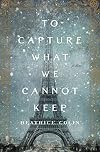
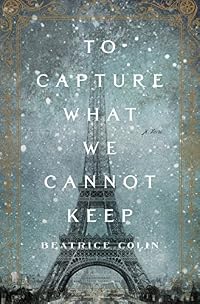
Impossible-to-remember title! (Authors, don’t do that!) Impossible to put down, though (at least for me). I must admit, I bought this book — preordered it, in fact — mostly on the basis of the gorgeous jacket illustration (Eiffel Tower, large snowflakes, metallic gold filigree border) and because I enjoy almost anything about Paris or the Eiffel Tower. And fortunately, this time it worked out for the best. The book is quite well written, and provides a lot of background about the construction of the Eiffel Tower, as well as some beautiful descriptions of Paris.
Overall, I really enjoyed the book, though some of the plot is far-fetched, and I was at times exasperated by the main character, Cait. It’s show more made clear to us more than once that she’s not like the typical Parisian woman, that she’s less conventional, more daring. But as the story unfolds, she fails again and again to stand up for herself and follow her heart. In addition, she sure doesn’t do a very good job of doing her job! She has no idea what her charges are up to and seems uninvolved with their comings and goings. I thought some plot elements were questionable. Jamie was at times just too cavalier to be believable (or in any way sympathetic). The duel just seemed slipped in there and not necessary. And why would Gustave care so much about whether Émile married Alice (i.e., enough to fire him)?
I liked it, though. Kept turning the pages, unwilling to pause for long. If you think of it as a romance novel, then it’s an especially intelligent and literary one. show less
Impossible-to-remember title! (Authors, don’t do that!) Impossible to put down, though (at least for me). I must admit, I bought this book — preordered it, in fact — mostly on the basis of the gorgeous jacket illustration (Eiffel Tower, large snowflakes, metallic gold filigree border) and because I enjoy almost anything about Paris or the Eiffel Tower. And fortunately, this time it worked out for the best. The book is quite well written, and provides a lot of background about the construction of the Eiffel Tower, as well as some beautiful descriptions of Paris.
Overall, I really enjoyed the book, though some of the plot is far-fetched, and I was at times exasperated by the main character, Cait. It’s show more made clear to us more than once that she’s not like the typical Parisian woman, that she’s less conventional, more daring. But as the story unfolds, she fails again and again to stand up for herself and follow her heart. In addition, she sure doesn’t do a very good job of doing her job! She has no idea what her charges are up to and seems uninvolved with their comings and goings. I thought some plot elements were questionable. Jamie was at times just too cavalier to be believable (or in any way sympathetic). The duel just seemed slipped in there and not necessary. And why would Gustave care so much about whether Émile married Alice (i.e., enough to fire him)?
I liked it, though. Kept turning the pages, unwilling to pause for long. If you think of it as a romance novel, then it’s an especially intelligent and literary one. show less
PEARL RULE @ 16%
Rating: 3* of five
The Publisher Says: Set against the construction of the Eiffel Tower, this novel charts the relationship between a young Scottish widow and a French engineer who, despite constraints of class and wealth, fall in love.
In February 1887, Caitriona Wallace and Émile Nouguier meet in a hot air balloon, floating high above Paris, France—a moment of pure possibility. But back on firm ground, their vastly different social strata become clear. Cait is a widow who because of her precarious financial situation is forced to chaperone two wealthy Scottish charges. Émile is expected to take on the bourgeois stability of his family's business and choose a suitable wife. As the Eiffel Tower rises, a marvel of steel show more and air and light, the subject of extreme controversy and a symbol of the future, Cait and Émile must decide what their love is worth.
Seamlessly weaving historical detail and vivid invention, Beatrice Colin evokes the revolutionary time in which Cait and Émile live—one of corsets and secret trysts, duels and Bohemian independence, strict tradition and Impressionist experimentation. To Capture What We Cannot Keep, stylish, provocative, and shimmering, raises probing questions about a woman's place in that world, the overarching reach of class distinctions, and the sacrifices love requires of us all.
I RECEIVED A DRC FROM THE PUBLISHER VIA NETGALLEY. THANK YOU.
My Review: Downloaded in 2016, the note I made for myself after abandoning the read that December (consider what December 2016 was like) was: "Émile...Concours Hippiques...guinguettes...zut alors!"
That made no sense, so I went back and re-read from the top. I got to chapter 6, ran into those words and thought, "I'm about sick of this," and quit again. It's better than competent writing, but I just do not care at all if straight people get together, cross class boundaries, find glory in the sack or end up holding it, in 2025. Straight ladies with historical tastes, Francophilia, and plucky-widow tolerances higher than mine are advised to seek it out.
Flatiron Books says "$11.99 please" at checkout. Read the sample, if it sounds good in your mental ear, go for it. show less
Rating: 3* of five
The Publisher Says: Set against the construction of the Eiffel Tower, this novel charts the relationship between a young Scottish widow and a French engineer who, despite constraints of class and wealth, fall in love.
In February 1887, Caitriona Wallace and Émile Nouguier meet in a hot air balloon, floating high above Paris, France—a moment of pure possibility. But back on firm ground, their vastly different social strata become clear. Cait is a widow who because of her precarious financial situation is forced to chaperone two wealthy Scottish charges. Émile is expected to take on the bourgeois stability of his family's business and choose a suitable wife. As the Eiffel Tower rises, a marvel of steel show more and air and light, the subject of extreme controversy and a symbol of the future, Cait and Émile must decide what their love is worth.
Seamlessly weaving historical detail and vivid invention, Beatrice Colin evokes the revolutionary time in which Cait and Émile live—one of corsets and secret trysts, duels and Bohemian independence, strict tradition and Impressionist experimentation. To Capture What We Cannot Keep, stylish, provocative, and shimmering, raises probing questions about a woman's place in that world, the overarching reach of class distinctions, and the sacrifices love requires of us all.
I RECEIVED A DRC FROM THE PUBLISHER VIA NETGALLEY. THANK YOU.
My Review: Downloaded in 2016, the note I made for myself after abandoning the read that December (consider what December 2016 was like) was: "Émile...Concours Hippiques...guinguettes...zut alors!"
That made no sense, so I went back and re-read from the top. I got to chapter 6, ran into those words and thought, "I'm about sick of this," and quit again. It's better than competent writing, but I just do not care at all if straight people get together, cross class boundaries, find glory in the sack or end up holding it, in 2025. Straight ladies with historical tastes, Francophilia, and plucky-widow tolerances higher than mine are advised to seek it out.
Flatiron Books says "$11.99 please" at checkout. Read the sample, if it sounds good in your mental ear, go for it. show less
This historical novel that begins in 1886 imagines a relationship between one of the engineers working on the Eiffel Tower, Émile Nouguier, and a Scottish widow, Caitriona (Cait) Wallace, who is temporarily staying in Paris. Cait has come as a chaperone to Jamie and Alice Arrol, whose uncle sent them on a “Grand Tour” of the continent. When Émile and Cait meet, they are attracted to one another, but they are from different social classes, which were rigidly separated in the Belle Époque of France. As Gustave Eiffel says to Émile: “My dear boy… we may be able to span huge ravines with iron, but in France men like us, professional men, no matter how wealthy, still cannot cross the social divide.”
Nevertheless, Émile and Cait show more embark on a surreptitious relationship (or so they think), set against the background of the ongoing construction of the tower, and of the reckless behaviors of Alice and Jamie in Paris. The historical structural and financial difficulties of assembling the tower, the fears and doubts of the populace, and the vagaries of weather and labor conditions all contribute to the background of the story. The author also limns the era well in terms of fashion and social mores, the artistic revolution that was going on simultaneously, the double standards for men and women, and the hypocritical two-layered nature of a society that was obsessed with appearances in public, while roiling underneath with sub rosa experimentation in sex and opium use.
Evaluation: The background on the construction of the Eiffel Tower was interesting, although I thought it could have been edited down a bit; the details tended to dominate the story. Alice and Jamie were absolutely repulsive; given their ages, it would have been nice to see them have some nuance or discipline. Cait and Émile were appealing characters, but Cait was a bit too much of a martyr. She suffered endlessly and unjustly, and the decisions she made just added to her martyrdom. Although the author tried to add a bit of redemption at the end, it didn’t seem like enough to make me feel happier about reading the book. show less
Nevertheless, Émile and Cait show more embark on a surreptitious relationship (or so they think), set against the background of the ongoing construction of the tower, and of the reckless behaviors of Alice and Jamie in Paris. The historical structural and financial difficulties of assembling the tower, the fears and doubts of the populace, and the vagaries of weather and labor conditions all contribute to the background of the story. The author also limns the era well in terms of fashion and social mores, the artistic revolution that was going on simultaneously, the double standards for men and women, and the hypocritical two-layered nature of a society that was obsessed with appearances in public, while roiling underneath with sub rosa experimentation in sex and opium use.
Evaluation: The background on the construction of the Eiffel Tower was interesting, although I thought it could have been edited down a bit; the details tended to dominate the story. Alice and Jamie were absolutely repulsive; given their ages, it would have been nice to see them have some nuance or discipline. Cait and Émile were appealing characters, but Cait was a bit too much of a martyr. She suffered endlessly and unjustly, and the decisions she made just added to her martyrdom. Although the author tried to add a bit of redemption at the end, it didn’t seem like enough to make me feel happier about reading the book. show less
This book was on one of my book shelves for awhile. I randomly chose it, and I'm glad I did. I finished it in one day.
The background is Paris France 1887-1889, and the plot is intriguing. Gustave Eiffel with his engineers are building an iron structure. It towers higher and higher, and looks like a magical structure of light, a building without any outer structure. It causes some to marvel, and many to call it an atrocity.
Weaving historical detail with a cast of characters who depict Paris, France in the time of struggling artists in their new, brazen form titled impressionism.
Paris is a mix of the upper class who dress to impress, while severely looking down upon the poorer lot. Juxtapositioned are prostitutes, opium dens, and an aura show more of sexuality. By the end of the book, the reader sees Paris as a fascinating city, with a severe undercurrent of seediness.
There are street beggars, people whose lot in life was suddenly changed by the end of a job, a death of a husband, and those who simply were not born into a higher echelon and have no means of ever fitting in with the rich and powerful.
The plot twirls around true-to-life characters of Gustave Eiffel, who is the main engineer of the tower is and his co- engineer Émile Nouguier both are famous for designing the architectural structure titled the Eiffel Tower, built for the 1889 Universal Exposition in Paris, France.
Emile falls in love with Scottish born Caitriona Wallace, a woman whose life is forever changed when her husband dies. All too soon, her finances are dwindling, and thus she takes a position of chaperone to two very spoiled young adults whose uncle funded their trip to Paris with the hope his nephew would become less immature, and his niece would find a suitable wealthy man to marry.
When Cait meets Emile Nouguier, both are drawn to each other. Alas, this is a tale of a woman of a much lower social status, and a man who desperately wants to break tradition and claim her as his wife.
While overall, the plot is marvelously woven, but, there seemed to be too much frivolous information that took away from what could have been a beautiful masterpiece.
Recommended.
3.5 Stars show less
The background is Paris France 1887-1889, and the plot is intriguing. Gustave Eiffel with his engineers are building an iron structure. It towers higher and higher, and looks like a magical structure of light, a building without any outer structure. It causes some to marvel, and many to call it an atrocity.
Weaving historical detail with a cast of characters who depict Paris, France in the time of struggling artists in their new, brazen form titled impressionism.
Paris is a mix of the upper class who dress to impress, while severely looking down upon the poorer lot. Juxtapositioned are prostitutes, opium dens, and an aura show more of sexuality. By the end of the book, the reader sees Paris as a fascinating city, with a severe undercurrent of seediness.
There are street beggars, people whose lot in life was suddenly changed by the end of a job, a death of a husband, and those who simply were not born into a higher echelon and have no means of ever fitting in with the rich and powerful.
The plot twirls around true-to-life characters of Gustave Eiffel, who is the main engineer of the tower is and his co- engineer Émile Nouguier both are famous for designing the architectural structure titled the Eiffel Tower, built for the 1889 Universal Exposition in Paris, France.
Emile falls in love with Scottish born Caitriona Wallace, a woman whose life is forever changed when her husband dies. All too soon, her finances are dwindling, and thus she takes a position of chaperone to two very spoiled young adults whose uncle funded their trip to Paris with the hope his nephew would become less immature, and his niece would find a suitable wealthy man to marry.
When Cait meets Emile Nouguier, both are drawn to each other. Alas, this is a tale of a woman of a much lower social status, and a man who desperately wants to break tradition and claim her as his wife.
While overall, the plot is marvelously woven, but, there seemed to be too much frivolous information that took away from what could have been a beautiful masterpiece.
Recommended.
3.5 Stars show less
I loved reading this book. It was well written and the descriptions of Paris for this time period were enchanting as well as realistic and historically accurate. I wanted a little more of the love story. It ended well and there were some spectacular moments throughout the book. I just wish there were a few more of them.
A love story set around the building of Paris's Eiffel Tower. This is the perfect short novel for a winter afternoon, filled with characters who surprise and slowly become sympathetic to the reader, and leads to a satisfying and tantalizing conclusion.
I received this ARC as a Goodreads Giveaway winner. I think I'd give it 2.5 stars...I can't say I liked it a lot, but it was a diverting and quick read, if predictable. I love historical fiction and the 19th century is my favorite era to read about but the book was merely ok. It is well written with some beautiful passages, but I had trouble caring much about the characters and thought certain parts of the story could have been fleshed out. Overall, not something I'd go out of my way to read but still enjoyable.
Members
- Recently Added By
Author Information
9+ Works 819 Members
Common Knowledge
- Canonical title
- To Capture What We Cannot Keep
- Original publication date
- 2016
- People/Characters
- Émile Nouguier; Caitriona Wallace; Alice Arroll; Jamie Arroll; William Arroll; Gustave Eiffel
- Important places
- Paris, France; Eiffel Tower, Paris, France; Glasgow, Scotland, UK
- Epigraph
- Before they meet at such an impressive height, the uprights appear to spring out of the ground, molded in a way by the action of the wind itself. ― Gustave Eiffel, 1885
- Dedication
- To Paul, with love
- First words
- The sand on the Champ de Mars was powdered with snow.
- Last words
- (Click to show. Warning: May contain spoilers.)The wind blew hot and dry and red while in a baobab tree a waxbill began to sing.
- Blurbers
- Chris Bohjalian; Kate Alcott; David Gillham
Classifications
Statistics
- Members
- 305
- Popularity
- 103,428
- Reviews
- 17
- Rating
- (3.33)
- Languages
- English, Italian
- Media
- Paper, Audiobook, Ebook
- ISBNs
- 23
- ASINs
- 4