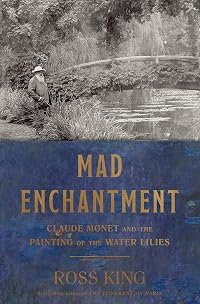
Mad Enchantment: Claude Monet and the Painting of the Water Lilies
by Ross King
On This Page
Description
Claude Monet is perhaps the world's most beloved artist, and among all his creations, the paintings of the water lilies in his garden at Giverny are most famous. Seeing them in museums around the world, viewers are transported by the power of Monet's brush into a peaceful world of harmonious nature. Monet himself intended them to provide "an asylum of peaceful meditation." Yet, as Ross King reveals in his magisterial chronicle of both artist and masterpiece, these beautiful canvases belie show more the intense frustration Monet experienced at the difficulties of capturing the fugitive effects of light, water, and color. They also reflect the terrible personal torments Monet suffered in the last dozen years of his life. Mad Enchantment tells the full story behind the creation of the Water Lilies, as the horrors of World War I came ever closer to Paris and Giverny, and a new generation of younger artists, led by Henri Matisse and Pablo Picasso, were challenging the achievements of Impressionism. By early 1914, French newspapers were reporting that Monet, by then 73 and one of the world's wealthiest, most celebrated painters, had retired his brushes. He had lost his beloved wife, Alice, and his eldest son, Jean. His famously acute vision--what Paul Cezanne called "the most prodigious eye in the history of painting"--was threatened by cataracts. And yet, despite ill health, self-doubt, and advancing age, Monet began painting again on a more ambitious scale than ever before. Linking great artistic achievement to the personal and historical dramas unfolding around it, Ross King presents the most intimate and revealing portrait of an iconic figure in world culture--from his lavish lifestyle and tempestuous personality to his close friendship with the fiery war leader Georges Clemenceau, who regarded the Water Lilies as one of the highest expressions of the human spirit. show lessTags
Recommendations




























Member Reviews
Proof positive that you don't have to be a nice person to be a great artist.
Oh, those temperamental artists! shouts the inner voice. In this case, Ross King renders a laudable biography of a slice of Monet's life, overflowing with the jagged edge of the artist's darker side. King convinces me, whether intentionally so or not, that I would not have liked Monet the Man: a self-indulgent, petulant, fractious old crank who swanned around like some troll-like prima donna. The flip side is, I would have loved Monet the Artist: I would have gladly spent all my waking hours gazing at the man at work and absorbing, with all my senses, his "mad enchantment".
I loved this book -- and hated it -- all at once.
I was disappointed to the extreme by the show more poor quality of the paper and the photographs/plates. To an artist, the senses are paramount: the importance of tactility, of optics, is everything. This book is as appealing as a canvas sack filled with last year's potatoes.
On visuals alone, I struggled with myself to even pick it up -- and in the end I opted to get it through the library rather than pay $39.95 Canadian for it, which is something I would have gladly done had it been of better quality. I'm surprised that the publishers chose such a cheap and tawdry venue for an important biography of an artist. Weren't they paying attention in Art 101?
For that alone, it barely scratches to a 3. It would have been a 5 otherwise.
Note to publishers: Don't disappoint temperamental artists -- they're so unpredictable! show less
Oh, those temperamental artists! shouts the inner voice. In this case, Ross King renders a laudable biography of a slice of Monet's life, overflowing with the jagged edge of the artist's darker side. King convinces me, whether intentionally so or not, that I would not have liked Monet the Man: a self-indulgent, petulant, fractious old crank who swanned around like some troll-like prima donna. The flip side is, I would have loved Monet the Artist: I would have gladly spent all my waking hours gazing at the man at work and absorbing, with all my senses, his "mad enchantment".
I loved this book -- and hated it -- all at once.
I was disappointed to the extreme by the show more poor quality of the paper and the photographs/plates. To an artist, the senses are paramount: the importance of tactility, of optics, is everything. This book is as appealing as a canvas sack filled with last year's potatoes.
On visuals alone, I struggled with myself to even pick it up -- and in the end I opted to get it through the library rather than pay $39.95 Canadian for it, which is something I would have gladly done had it been of better quality. I'm surprised that the publishers chose such a cheap and tawdry venue for an important biography of an artist. Weren't they paying attention in Art 101?
For that alone, it barely scratches to a 3. It would have been a 5 otherwise.
Note to publishers: Don't disappoint temperamental artists -- they're so unpredictable! show less
I will never look at these last painting of Monet the same way again. Especially the ones done of the willows or the rose arbor. Once I learned what was going on in Monet's life and his feelings about what was happening to France during WWI and how that affected his painting all the way from the subject matter he choose to the colors and time of day that he choose to depict on canvas. The violence around him is seriously a part of these paintings that makes them the antithesis of an anti-depressant, a sobriquet that he was often given. His twisted drooping willows are a symbol of a country and a man bowed but not giving up and his huge last paintings that were donated to the French government are very much a part of WWI.
This was an show more excellent book about the last great burst of creativity from the master of Impressionism. show less
This was an show more excellent book about the last great burst of creativity from the master of Impressionism. show less
I once had the opportunity to purchase an original Monet, and by "opportunity", I mean 20 some years ago my wife and I went into a gallery that had one for $14,000. An amount we did not have back then.
I got an advance look at this from NetGalley. This had the potential to be quite dry, but Mr. King did a very good job with the narrative. Incredibly researched and sourced, the later/last years of Monet and his challenges/triumphs with his lilies are laid out in beautiful detail. I have no reference frame to compare, as I've never read a bio of Monet, so I'll simply acknowledge that this appears quite thorough and unvarnished. I especially appreciated King's presentation of events for which he had no confirmation: "Clemenceau would have show more been conducted to a room he knew well, ..." Unlike hacks like Bill O'Reilly and his semi-ghost who state conjecture as fact, King does no such thing. And speaking of Clemenceau, the Tiger plays a prominent role in this biography - as one would expect if one knew his friendship with Monet.
I like Monet well enough, and though I have have a much deeper exposure to the art world in recent years, I admit I still have a hard time understanding
Or, on Monet changing landmarks:
I have an extremely hard time buying interpretations and inferences unless they are from the conformed words of the actual artist, but King has a plethora of references of the master's own words with respect to his feelings on color and composition and the subject at hand. (Color was a huge source of frustrations in Monet's cataract struggles.)
Bottom line, this is a fascinating story of perhaps the greatest Impressionist artist.
A couple of notes on the book: the review text had no index, or list of illustrations. Nor did it have any photos of the subject (lilies) - I don't know if permissions had not yet been obtained or there is no intent to include them. The photos in the galley (I use that term given the source - NetGalley) were gray-scale. For a book on Monet's water lilies, color would seem to be essential. show less
I got an advance look at this from NetGalley. This had the potential to be quite dry, but Mr. King did a very good job with the narrative. Incredibly researched and sourced, the later/last years of Monet and his challenges/triumphs with his lilies are laid out in beautiful detail. I have no reference frame to compare, as I've never read a bio of Monet, so I'll simply acknowledge that this appears quite thorough and unvarnished. I especially appreciated King's presentation of events for which he had no confirmation: "Clemenceau would have show more been conducted to a room he knew well, ..." Unlike hacks like Bill O'Reilly and his semi-ghost who state conjecture as fact, King does no such thing. And speaking of Clemenceau, the Tiger plays a prominent role in this biography - as one would expect if one knew his friendship with Monet.
I like Monet well enough, and though I have have a much deeper exposure to the art world in recent years, I admit I still have a hard time understanding
"Monet paints in a strange language", [a] reviewer had claimed in 1883, "whose secrets, together with a few initiates, he alone possesses."
Or, on Monet changing landmarks:
Faithfully depicting architectural features was less important to him than creating a striking composition."
I have an extremely hard time buying interpretations and inferences unless they are from the conformed words of the actual artist, but King has a plethora of references of the master's own words with respect to his feelings on color and composition and the subject at hand. (Color was a huge source of frustrations in Monet's cataract struggles.)
Bottom line, this is a fascinating story of perhaps the greatest Impressionist artist.
A couple of notes on the book: the review text had no index, or list of illustrations. Nor did it have any photos of the subject (lilies) - I don't know if permissions had not yet been obtained or there is no intent to include them. The photos in the galley (I use that term given the source - NetGalley) were gray-scale. For a book on Monet's water lilies, color would seem to be essential. show less
I’m not a non-fiction fan but I am an Impressionist fan, Monet in particular. But the cover of Ross King’s book and the book’s title, Mad Enchantment: Claude Monet and the Painting of the Water Lilies both convinced me the book was worth a try. I’ve seen some of Monet’s water lily paintings and they are magnificent.
I never really pictured Monet, never thought about his life or personality. I never thought about whether he was self-absorbed, whether he suffered for his art, how old he was when he passed away.
Ross King brought all of that into perspective. Mad Enchantment really covers the second half of Monet’s 80+ years, and paints an interesting, yet disturbing portrait of the artist (no pun intended). While I still hold show more Monet in high esteem for his talent, the (unearned) accompanying esteem for him as a person has diminished greatly. Instead, Monet comes across as a whiner, a self-centered individual who used his friends, fame and connections rather than cultivating them.
Ross describes art critics’ reviews of Monet’s works and I found very interesting, in particular, their discussion of the water lilies. Apparently water lilies represent the female form and so these water lilies represent women, especially nude female models that Monet’s jealous wife Alice wouldn’t let him paint. (I’m thinking they let their imaginations run wild!) Art critics!
Monet was temperamental and prone to outbursts of such magnitude that he would slash and burn paintings by the hundreds. I can’t imagine his output if so many paintings were destroyed. At the same time it appears he was a perfectionist which explains the magnificence of his works.
In the end, Monet did suffer for his art. He had cataracts and one theory is that his constant viewing of his ponds with the sunlight reflecting off might have been a cause of the cataracts. What could be worse that an artist with impaired vision.
All in all, Mad Enchantment: Claude Monet and the Painting of the Water Lilies was an enlightening read. show less
I never really pictured Monet, never thought about his life or personality. I never thought about whether he was self-absorbed, whether he suffered for his art, how old he was when he passed away.
Ross King brought all of that into perspective. Mad Enchantment really covers the second half of Monet’s 80+ years, and paints an interesting, yet disturbing portrait of the artist (no pun intended). While I still hold show more Monet in high esteem for his talent, the (unearned) accompanying esteem for him as a person has diminished greatly. Instead, Monet comes across as a whiner, a self-centered individual who used his friends, fame and connections rather than cultivating them.
Ross describes art critics’ reviews of Monet’s works and I found very interesting, in particular, their discussion of the water lilies. Apparently water lilies represent the female form and so these water lilies represent women, especially nude female models that Monet’s jealous wife Alice wouldn’t let him paint. (I’m thinking they let their imaginations run wild!) Art critics!
Monet was temperamental and prone to outbursts of such magnitude that he would slash and burn paintings by the hundreds. I can’t imagine his output if so many paintings were destroyed. At the same time it appears he was a perfectionist which explains the magnificence of his works.
In the end, Monet did suffer for his art. He had cataracts and one theory is that his constant viewing of his ponds with the sunlight reflecting off might have been a cause of the cataracts. What could be worse that an artist with impaired vision.
All in all, Mad Enchantment: Claude Monet and the Painting of the Water Lilies was an enlightening read. show less
This book has much more story than Monet. It centers around him, his work, his family his struggles, but it cover so much more. The first world war is prominent from the early whispers of war to the horrible realities of it. Monet, his famous artist friends, journalists, politicians and the community around him he so loved withered, many died. I learned many interesting details about the war in France from a new perspective, it was fascinating and heartbreaking.
Monet was a off centered man. His quirks had quirks when it came to his paintings and his garden. Luckily for the world his quirks fed his genius. This man was an introvert, loyal to his few friends and family. Volatile and moody he destroyed hundreds of paintings in his show more outrages. Time held him and the changes drove his paintings.There would be dozens of easels set up along his garden capturing the differences, at seven minute intervals. The need to catch each shadow, change of color, wind direction and seasonal changes.
I learned so much from this story. i learned about the lives of people in France during WW1 the changes, hardships, and suffering as well as the hope and fight for happiness. It is not a book I could read quickly I read it in small bits then found myself thinking about the moments I discovered.
I had no interest in Monet before this. I purchased a puzzle of his water lily painting then say then saw this book offered and thought, why not ? I finished my very difficult puzzle with the help of my adult children while sharing stories about the book with them. History as it should be written, interesting with personal stories is so interesting. show less
Monet was a off centered man. His quirks had quirks when it came to his paintings and his garden. Luckily for the world his quirks fed his genius. This man was an introvert, loyal to his few friends and family. Volatile and moody he destroyed hundreds of paintings in his show more outrages. Time held him and the changes drove his paintings.There would be dozens of easels set up along his garden capturing the differences, at seven minute intervals. The need to catch each shadow, change of color, wind direction and seasonal changes.
I learned so much from this story. i learned about the lives of people in France during WW1 the changes, hardships, and suffering as well as the hope and fight for happiness. It is not a book I could read quickly I read it in small bits then found myself thinking about the moments I discovered.
I had no interest in Monet before this. I purchased a puzzle of his water lily painting then say then saw this book offered and thought, why not ? I finished my very difficult puzzle with the help of my adult children while sharing stories about the book with them. History as it should be written, interesting with personal stories is so interesting. show less
Part biography, part history, part art, all fascinating. Basically the story of Monet from the beginning of the Great War to his death in 1926, focusing on his last great work. But so much detail - a portrait of France in the throes of war that I'd never encountered . Highly recommended for both history and art buffs. A good selection of plates and photos, too, with a wonderful cover/dust jacket.
As much as we imagine Monet and his tranquil home, Giverny, as a spot secluded in place and time, it wasn't. Monet was subject to the forces around him, while working on some of his most famous art, the Water Lilies series.
Mad Enchantment is a deeply researched, well-written biography of Claude Monet. It starts in the Belle Époque, a time of peace just before World War I. Author Ross King introduces us to Monet, as well as his family and companions. We learn about his benefactors, his friends, and his critics.
King includes charming personal details about the artist, "Monet loved birds and animals, even leaving the windows of his dining room open so the sparrows could help themselves to bread crumbs from the table."
We learn about the show more property in Giverney, as well as how the gardens inspired Monet's art as he entered his 70s.
As a former marketing professional, I was surprised to learn about Money's astute branding. Says King, "Monet’s use of this new term, “Grande Décoration,” which he pointedly capitalized, was intended to pique the interest of Koechlin, a respected art historian and administrator whose specialty happened to be the decorative arts."
All that said, I just didn't find the book riveting enough to read past the 30% mark. The writing is fairly dry, and focuses on the historical context of Monet's life rather than on the man himself.
Thanks to NetGalley and Bloomsbury USA for an advance copy in exchange for an honest review. show less
Mad Enchantment is a deeply researched, well-written biography of Claude Monet. It starts in the Belle Époque, a time of peace just before World War I. Author Ross King introduces us to Monet, as well as his family and companions. We learn about his benefactors, his friends, and his critics.
King includes charming personal details about the artist, "Monet loved birds and animals, even leaving the windows of his dining room open so the sparrows could help themselves to bread crumbs from the table."
We learn about the show more property in Giverney, as well as how the gardens inspired Monet's art as he entered his 70s.
As a former marketing professional, I was surprised to learn about Money's astute branding. Says King, "Monet’s use of this new term, “Grande Décoration,” which he pointedly capitalized, was intended to pique the interest of Koechlin, a respected art historian and administrator whose specialty happened to be the decorative arts."
All that said, I just didn't find the book riveting enough to read past the 30% mark. The writing is fairly dry, and focuses on the historical context of Monet's life rather than on the man himself.
Thanks to NetGalley and Bloomsbury USA for an advance copy in exchange for an honest review. show less
Members
- Recently Added By
Author Information

16+ Works 11,122 Members
Ross King is the award-winning and bestselling author of Brunelleschi's Dome, Michelangelo and the Popes Ceiling, The Judgment of Paris, Mad Enchantment, Leonardo and the Last Supper, and Machiavelli: Philosopher of Power, among other books. He and his wife live in Woodstock, Great Britain.
Awards and Honors
Awards
Common Knowledge
- People/Characters
- Claude Monet; Georges Clemenceau
- Important events
- World War I
- Dedication
- In loving memory of Claire King
Classifications
Statistics
- Members
- 401
- Popularity
- 77,328
- Reviews
- 9
- Rating
- (4.02)
- Languages
- 5 — Dutch, English, Hungarian, Italian, Portuguese
- Media
- Paper, Audiobook, Ebook
- ISBNs
- 16
- ASINs
- 4