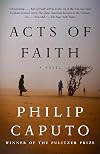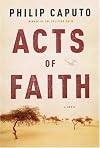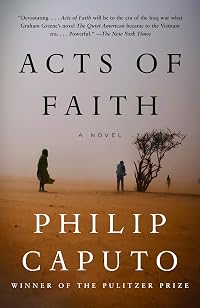
Acts of Faith
by Philip Caputo
On This Page
Description
This epic novel, based on the author's own experiences in Africa, tells the stories of pilots, aid workers, missionaries, and renegades struggling to relieve the misery wrought by the civil war in Sudan. The hearts of these men and women are in the right place, but as they plunge into a well of moral corruption for which they are ill-prepared, their hidden flaws conspire with circumstances to turn their strengths--bravery, compassion, daring, and empathy--into weaknesses. In pursuit of noble show more ends, they make ethical compromises; their altruism curdles into self-righteous zealotry and greed, entangling them in a web of conspiracies that leads, finally, to murder. A few, however, escape the moral trap and find redemption in the discovery that firm convictions can blind the best-intentioned man or woman to the difference between right and wrong.--From publisher description. show lessTags
Recommendations




































Member Reviews
Much to my surprise, this is a very good book. I read it expecting to be disappointed, because I was there during the period and events in which this book is set and they are rarely described accurately.
I was the director of one of the independent aid agencies working outside the UN umbrella, although fortunately not one of those described in the book. Despite the routine disclaimer that all characters are fictitious, I recognise many of them. I have often flown in the Caravan with "Tara" and sat in the jump-seat of the Gulfstream with "Wesley". I've drunk too much with the "defrocked Catholic priest". I've landed at Zulu 2 and visited many of the real locations named in the Nuba Mountains. I helped the real German Emergency Doctors show more with their logistics when they first moved into Sudan. "Quinette" has echoes of Emma, and it was "Doug" who first told me about this book when I bumped into him in one of his coffee shops in Nairobi recently.
I tend to read books about places and events I know very critically, looking for errors, but in this case I found myself giving it the benefit of the doubt. The general background was very good indeed and the fiction seemed to grow easily from it. Most of the general scenario is true, almost true, or at least plausible. It's only in the last fifty pages or so that the book moves into areas which are pure fiction.
Of course there are errors. No non-UN operator could ever have landed in government-controlled Malakal without being arrested, even with a damaged aircraft. We had engine problems once on a flight to the Nuba Mountains on an ancient DC3 but fortunately were able to land in Panyagor, which was SPLA-controlled, where our South American crew patched up the offending engine and eventually got us to Zulu 2. I remember the hump in the middle of that airstrip rather than the rough patch at one end in the novel. Caputo's treatment of the SPLA is very shallow. Interestingly he has tried to understand the murahiliin more than most observers. He ascribes far more professionalism to "Friends of the Frontline" than I would to their real life counterparts.
His treatment of the slave redemption business is very good.
I like the way he has portrayed the contradictions of the aid industry. It is very dysfunctional indeed, and yet few are inclined to really challenge it. Evaluations and assessments tinker around the edges, make superficial changes, expose occasional scandals or wrong-doing which can be dealt with self-righteously, but it is rare to find challenges to the aid culture as a whole. In my oft-expressed view, the aid industry needs fundamental and radical change. It won't happen - there are too many vested interests, mixed motives and keen young aid workers, as depicted in Caputo's book. show less
I was the director of one of the independent aid agencies working outside the UN umbrella, although fortunately not one of those described in the book. Despite the routine disclaimer that all characters are fictitious, I recognise many of them. I have often flown in the Caravan with "Tara" and sat in the jump-seat of the Gulfstream with "Wesley". I've drunk too much with the "defrocked Catholic priest". I've landed at Zulu 2 and visited many of the real locations named in the Nuba Mountains. I helped the real German Emergency Doctors show more with their logistics when they first moved into Sudan. "Quinette" has echoes of Emma, and it was "Doug" who first told me about this book when I bumped into him in one of his coffee shops in Nairobi recently.
I tend to read books about places and events I know very critically, looking for errors, but in this case I found myself giving it the benefit of the doubt. The general background was very good indeed and the fiction seemed to grow easily from it. Most of the general scenario is true, almost true, or at least plausible. It's only in the last fifty pages or so that the book moves into areas which are pure fiction.
Of course there are errors. No non-UN operator could ever have landed in government-controlled Malakal without being arrested, even with a damaged aircraft. We had engine problems once on a flight to the Nuba Mountains on an ancient DC3 but fortunately were able to land in Panyagor, which was SPLA-controlled, where our South American crew patched up the offending engine and eventually got us to Zulu 2. I remember the hump in the middle of that airstrip rather than the rough patch at one end in the novel. Caputo's treatment of the SPLA is very shallow. Interestingly he has tried to understand the murahiliin more than most observers. He ascribes far more professionalism to "Friends of the Frontline" than I would to their real life counterparts.
His treatment of the slave redemption business is very good.
I like the way he has portrayed the contradictions of the aid industry. It is very dysfunctional indeed, and yet few are inclined to really challenge it. Evaluations and assessments tinker around the edges, make superficial changes, expose occasional scandals or wrong-doing which can be dealt with self-righteously, but it is rare to find challenges to the aid culture as a whole. In my oft-expressed view, the aid industry needs fundamental and radical change. It won't happen - there are too many vested interests, mixed motives and keen young aid workers, as depicted in Caputo's book. show less
I found this book totally fascinating. I have no background in the culture, environment, or political situation of the Sudan; yet, I feel I have in some sense been there. Caputo provides a multi-layered picture of the people and places of this war-torn country. My mind's eye could easily envision the land and people; I could almost taste and smell the dust and sweat and had clear mental images of the major characters. The political situation is nothing short of a mess: "In Sudan the choice is never between the right thing and the wrong thing but between what is necessary and what isn't"
I found the characters, however, to be closer to symbols for the many factions working in Africa than real people. The dialogue was particularly show more distracting in places; it just didn't ring true. Nevertheless, these characters well depicted the forces at work -- the American do-gooder, the war lord, the cynic, the evangelist, the rebel leader, the old-rich, the new-rich, and the victim.
One review suggested that Caputo could better tell the story as non-fiction. He is certainly knowledgeable, and after doing a bit of research, the situation in the Sudan seems accurately presented. His strength is not in writing dialogue that is true; however, I would never have read this book if it wasn't presented as a novel. The relationships developed by the characters keep a reader's interest while providing a sound picture of the Sudan.
I loved the title of the book and if there is one thing I will definitely take from the book, it is the illustration of the conviction and fervor of those who were certain they were right -- so certain that the consequences never matter. At the same time, there are those who were never sure of the decisions they had to make, yet they acted. Both could be said to be carrying out acts of faith. Some because they were sure and others because there is simply nothing else to do. show less
I found the characters, however, to be closer to symbols for the many factions working in Africa than real people. The dialogue was particularly show more distracting in places; it just didn't ring true. Nevertheless, these characters well depicted the forces at work -- the American do-gooder, the war lord, the cynic, the evangelist, the rebel leader, the old-rich, the new-rich, and the victim.
One review suggested that Caputo could better tell the story as non-fiction. He is certainly knowledgeable, and after doing a bit of research, the situation in the Sudan seems accurately presented. His strength is not in writing dialogue that is true; however, I would never have read this book if it wasn't presented as a novel. The relationships developed by the characters keep a reader's interest while providing a sound picture of the Sudan.
I loved the title of the book and if there is one thing I will definitely take from the book, it is the illustration of the conviction and fervor of those who were certain they were right -- so certain that the consequences never matter. At the same time, there are those who were never sure of the decisions they had to make, yet they acted. Both could be said to be carrying out acts of faith. Some because they were sure and others because there is simply nothing else to do. show less
what a great mess of a book. Big, trying to cover everything in the Sudan. Romance, famine, adventure, war, techie airplane fantasies, white guys pushing religion, bombs, tru-love, escape, god-fearing, land-loving, and best of all: ticks-bugs-scopion bites. More characters than you probably could ever know in your hometown--with a focus on aid workers (of course) not on the aided.
read the thing.
read the thing.
Vast, memorable, and almost completely unsparing. I will try to come back and flesh this out a bit, but this was an excellent read with many things to teach and remind.
Great book. It tells many stories set within the war in Sudan.
Set in Sudan, Acts of Faith tells the story of relief workers from NGOs and pilots who work in and fly supplies (and weapons) into this proverbially war-torn part of Africa. It begins as a compelling read (although it fades as it progresses) based on Caputo's long experience as a war correspondent. I much prefer Caputo's earlier novel, "Horn of Africa," an updated "Heart of Darkness" tale of how a mercenary goes mad during a covert mission.
A compelling and highly readable account of a large cast of characters working in various ways to bring relief to the Sudan. The book is well researched and highly educational, and successfully portrays an extremely complex struggle. But perhaps its greatest asset is the rich character development at the heart of the novel; no group of saints, this cast of characters displays a wide array of motivations and convictions. Fascinating from start to finish.
Members
- Recently Added By
Author Information

22+ Works 4,882 Members
Philip Caputo was born on June 10, 1941 in Chicago, Illinois. He received a B.A. from Loyola University in 1964. He served in the U.S. Marine Corps from 1964 to 1967. His first book, A Rumor of War (1977), recounts his military tour of Vietnam. He has written more than fifteen books including Horn of Africa, Indian Country, Equation for Evil, show more Crossers, and The Longest Road. His journalism career began in 1968, when he joined the staff of the Chicago Tribune, serving as a general assignment and team investigative reporter until 1972 and then as a foreign correspondent for the next five years. In 1972 he and Hugh Jones received a Pulitzer Prize for their coverage of election fraud in the primaries. He has also written for the New York Times, Washington Post, the Boston Globe, the Los Angeles Times, and many other publications. He has worked as a screenwriter for Paramount Pictures and Michael Douglas Productions. (Bowker Author Biography) show less
Common Knowledge
- Canonical title
- Acts of Faith
- Original title
- Acts of Faith
- Original publication date
- 2005
- People/Characters
- Douglas Braithwaite; Fitzhugh Martin; Wesley Dare; Quinette Hardin; Diana Briggs; Ibrahim Idris ibn Nur-el-Din
- Important places
- Africa; East Africa; Kenya (Northern); Sudan
Classifications
Statistics
- Members
- 632
- Popularity
- 46,157
- Reviews
- 12
- Rating
- (3.71)
- Languages
- English, German
- Media
- Paper, Audiobook, Ebook
- ISBNs
- 4
- ASINs
- 5