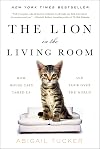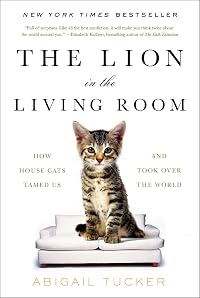
The Lion in the Living Room: How House Cats Tamed Us and Took Over the World
by Abigail Tucker
On This Page
Description
Cats are incredible creatures: they can eat practically anything and live almost anywhere. Tracing their rise from prehistory to the modern cat craze, Abigail Tucker presents an adventure through history, natural science, and pop culture. Tucker investigates the way house cats have used their relationship with humans to become one of the most powerful animals on the planet.Tags
Recommendations














Member Reviews
I am an unabashed cat person. My parents' Siamese cat Sinbad slept in my crib with me. I have had a series of Abyssinians because I can't have a mountain lion. I also have dogs, and have read LOTS of fun, serious, thoughtful, scientific books on our friend the dog and its history, evolution, psychology, training, etc. So I was hoping this one would fill a bit of a gap in the kitty lit. It did, sort of. Tucker is a journalist who has written for Smithsonian, and her writing is generally crisp, knowledgeable, and she has done her homework. Only occasionally does she fall prey to the temptation to make a groanable pun or cute aside. She tells the history of cats back through evolutionary time, and makes a case for cats having domesticated show more us instead of the other way around. There is some interesting info about cat brain development, and how their species has evolved to behave and look in ways antithetical to dogs: they are solitary, they don't like each other, they need their space, so they have no need for begging spaniel eyes, goofy smiles and other such expressive nonsense. And they are murderous. An entirely too long chapter enumerates the bloody havoc that our kitties have wrought on wildlife across the planet, and I quivered guiltily in my chair wanting to shout, "MY CATS ALL LIVE INDOORS!" There is another rambling and, frankly, really boring chapter about the history of memes on the internet and how cats have a lock on that market, and some rather vague and not very convincing speculation as to why that is. And that's where the book falls short: I suppose the title of the book is accurate, but I was hoping for more serious investigation into our very emotional bond with these stoic beings who do not entirely reciprocate. Is it merely the suck of unrequited love? Tucker mentions her big orange cat Cheetoh at intervals, and clearly she is fond of him, but we never quite get the "feel" of her attachment. Surely someone has done some research among cat people and gathered some data on what attracts us, what bonds us, why some of us would feel our lives would be so much emptier without that house panther posing on the table, hogging the pillows, purring on our shoulders, warming our laps, and just being generally decorative. Let me know if you find out. show less
I picked up this book because I have recently merged my solo feline with my husband’s solo feline, and it has been an uneasy process at best, so I was hoping to gain some insights. What I have learned is that the partnership between humans and cats is highly unlikely, as cats are naturally disinclined to hang out with any other animals, including humans, and have thrived for hundreds of years even when we have done our best to get rid of them. In fact, in trying to discover what mistakes my husband and I made while integrating our pets, I learned that even owning a cat, keeping this apex predator trapped inside our house, deprived of its natural instincts to hunt and bask in independence, while being constantly subjected to sensory show more irritants (not to mention company), is the peak of selfish cruelty. Cats have been solitary beasts since they evolved on the planet, and with the exception of their size, their bodies, instincts and manners have hardly changed in all that time. For some reason humans became fascinated with them and decided we needed to shack up with them, but it is not a particularly suitable match. This book contains tons of information about cats and our relationship with them. Were my questions answered? Unfortunately, some of them were, but the fact is that I have been a cat owner for nearly 50 years, and that’s not about to change. show less
An entertaining, educational, and fascinating look at our feline companions -- where they come from, what they do, why they do it, are all cats (big and small) the same, and do they even like us?
This may get a little personal, but it definitely effects (affects?) my perspective on the book...
My dog, Darcy, the most cat-like dog EVER and the greatest dog I've ever known who spent her entire 12+ years of life died at the end of March. Around the same time, our two older Ragdoll cats that we had adopted in January of 2016 also died. In true Melissa fashion, in times of stress, I collect things. While planning our wedding it was butterfly brooches and red lipstick. Having a toddler, adjusting to a new job, and (basically) the stress of show more living, it's been flowers and succulents. Add-on the stress of my Darcy dog and our girls all leaving me in the span of two weeks, I have now adopted 4 kittens. And I would take them ALL if my husband would let me. He will not.
So I picked up this book after watching an episode The Nature of Things: The Lion in Your Living Room. Between that show and this book, I've learned:
1. My cats probably don't like each other, they just tolerate each other (and their humans)
2. All cats are pretty much the same underneath their fur, super similar bone structures whether roaring lion or floppy Ragdoll.
3. Cat breeds are kind of a joke.
4. In some countries, cats are considered an invasive species.
5. Cats are manipulative and know how to play with their humans emotions to get what they want.
Basically, I live in a house with a toddler and four conniving, sneaky predators.
I'm in trouble. show less
This may get a little personal, but it definitely effects (affects?) my perspective on the book...
My dog, Darcy, the most cat-like dog EVER and the greatest dog I've ever known who spent her entire 12+ years of life died at the end of March. Around the same time, our two older Ragdoll cats that we had adopted in January of 2016 also died. In true Melissa fashion, in times of stress, I collect things. While planning our wedding it was butterfly brooches and red lipstick. Having a toddler, adjusting to a new job, and (basically) the stress of show more living, it's been flowers and succulents. Add-on the stress of my Darcy dog and our girls all leaving me in the span of two weeks, I have now adopted 4 kittens. And I would take them ALL if my husband would let me. He will not.
So I picked up this book after watching an episode The Nature of Things: The Lion in Your Living Room. Between that show and this book, I've learned:
1. My cats probably don't like each other, they just tolerate each other (and their humans)
2. All cats are pretty much the same underneath their fur, super similar bone structures whether roaring lion or floppy Ragdoll.
3. Cat breeds are kind of a joke.
4. In some countries, cats are considered an invasive species.
5. Cats are manipulative and know how to play with their humans emotions to get what they want.
Basically, I live in a house with a toddler and four conniving, sneaky predators.
I'm in trouble. show less
This was a fascinating look into all things cats -- how they became a part of humanity's circle (they just kinda showed up, probably), what we get out of the relationship (not much, really), and how much we have changed cats since their wild origins (hardly at all, it seems). Those expecting a lovey-dovey paean to the joys of feline companionship may be in for a rude awakening here, though. There's quite a lot of science here, and most of it is not particularly flattering towards the (not-so) humble house cat. If you happen to half-seriously believe that cats conspire to take over the world, your belief might be strengthened by some of what the author has to say here. And yet, it's worth reading anyways, because it's all so interesting. show more I learned quite a lot about cats from this book. The author has definitely done her homework and there's some good research presented here. This is mixed in with investigative reporting and personal anecdote and makes for a pretty compelling read. If you're a "cat person" (or maybe if you're a dog person looking for reasons to defend canine ownership!), I would definitely recommend getting a copy of this book. show less
This came across my attention in a "recommended" list and, as I live in a house with five cats for now and am always curious about these little carnivores, ... I set aside time to read it. A tad academic in presentation, it is unfortunately packaged for the mildly curious because it bears the sin of no citations in the text. Oh, there are notes in the back, but they are the type led by the sentence fragment indicator with no other links to - or more importantly, in - the text (I will allow that in the etext, the notes do hyperlink back to the text, but that does no one any good while reading the book!. Useless unless you want to go back and read the book again, from the back, and even then, useless. (It takes nothing in this modern age show more of digital composition and printing to include a tiny superscript. And it doesn’t “interrupt the flow”. Rant off.)
Some of this I knew, and some was an eye-opener, such as the pervasiveness of Toxoplasma, an organism that can only multiply in cat intestines, yet has been found in humpback whale brains! One researcher tested cat DNA from all over the world
"The International Union for Conservation of Nature ranks house cats as one of the world’s 100 worst invasive species, an unusually glamorous addition to the icky litany of advancing fungi, mollusks, shrubs, and other brainless, aimless beings." (I wonder where Homo sapiens ranks...) The author says that once cats are entrenched in an ecosystem, they are almost impossible to dislodge. It took from 1977 to 1991 for scientists and professional hunters (who continued for two years after to be sure) to eradicate cats from the Maron Island, and
Thoughts on humans as prey,
On the Trap-Neuter-Release efforts
On that Toxoplamosa parasite, it seems to have a beneficial effect for the predator cat:
I made a lot of other notes... if you have cats, you might want to read this. (I rather liked the clever clever chapter titles, too.) show less
Some of this I knew, and some was an eye-opener, such as the pervasiveness of Toxoplasma, an organism that can only multiply in cat intestines, yet has been found in humpback whale brains! One researcher tested cat DNA from all over the world
The project took nearly ten years but the results were worth the wait: from blue-blooded Persians to mangy strays, from Manhattan’s street-smart alley cats to the ferals of the New Zealand forest, it turns out that all house cats come not from a genetic mash-up of many feline species but only from Felis silvestris. More astonishingly, they are descended solely from the lybica subspecies, the Near Eastern type native to southern Turkey, Iraq, and Israel, where it still lives today.And that cats and mice/rats are not the cartoon enemies, as researcher Jamie Childs learned, showing the author night photographs "In one image, “the bulwark of Western society’s defense” pointedly ignores “mankind’s greatest natural enemy” scurrying just a few inches away. Kittens and adult rats stand close enough to touch." He said "I never saw a cat kill a rat." Cats follow rats because rats know where the trash is and cats will scavenge.
"The International Union for Conservation of Nature ranks house cats as one of the world’s 100 worst invasive species, an unusually glamorous addition to the icky litany of advancing fungi, mollusks, shrubs, and other brainless, aimless beings." (I wonder where Homo sapiens ranks...) The author says that once cats are entrenched in an ecosystem, they are almost impossible to dislodge. It took from 1977 to 1991 for scientists and professional hunters (who continued for two years after to be sure) to eradicate cats from the Maron Island, and
Likewise, the hard-won victory over the house cats of tiny San Nicolas Island, off the coast of California, was a “monumental achievement ” for the United States Navy, according to the commanding officer overseeing the missile-testing base there. It took years of planning, 18 months of trapping, and $3 million to expel the cats, which were hunting an endemic deer mouse and a federally protected species of night lizard. The cat stalkers had to be careful not to disturb Native American archaeological sites and to use special radio channels so they didn’t accidentally trigger naval munitions. Meanwhile, the battle-tested cats employed guerrilla tactics, eluding dogs and custom-built computerized traps and spurning “felid-attracting phonics,” aka digitally recorded meows. Finally, a professional bobcat hunter finished the job.I was there on San Nic a few times in the late 1990s. There weren’t that many cats then (and the Island fox was still quite endangered) but this doesn’t surprise me. In New Zealand, Gareth Morgan says “Every animal has its place in this world, but this one is so protected that it’s proliferated to an extreme extent.”
Thoughts on humans as prey,
Our [current] great ape relatives don't eat much meat, and neither did our early human-like kin, who started coming down out of the trees in Africa 6 or 7 million years ago, long after cats had settled into their spot at the tippy-top of the food chainCurious hypotheses.
[Well actually…. latest research indicates bipedal hominids originated outside, then migrated to, Africa, which casts doubts on the whole tree to plains theory]
[...]
Scientists are just starting to formally study our own legacy as prey, finding, for instance, that our color vision and depth perception may have first evolved as a system for detecting snakes. Experiments have shown that even very young children are better at recognizing the shapes of serpents than lizards; they also spot lions faster than antelope. Antipredation strategies persist in a host of modern human behaviors, from our tendency to go into labor in the deepest part of night (many of our predators would have hunted at dawn and dusk) to, perhaps, our appreciation of eighteenth-century landscape paintings, whose sweeping vistas give the pleasing sense that we would have seen danger coming before it ever got close.
On the Trap-Neuter-Release efforts
“Cats are reproductive machines,” says the Tufts University veterinarian Robert McCarthy. “All you need is males and females around. I pulled every paper. There is zero—zero—data that TNR works. It just doesn’t work at the level that it needs to work. If you have 100 cats and you neuter 30 of them, it’s not like the problem is 30 percent better. It’s nothing. You didn’t make any progress. It’s zero percent better.”I know from experience with a much smaller pest. I spent three hours back in 2013 snaring 300 of the 1000 or so gambusia in my pond and it dawned on me that all I had left was 700 smarter and faster fish. Miss a few cats and you've probably Darwined the same.
On that Toxoplamosa parasite, it seems to have a beneficial effect for the predator cat:
And not just cat prey; other infected animals (example given, Monterey Bay sea otters) are more likely to fall prey to larger predators. And the human effects?
From the perspective of a parasite transmitted via cat poop, this inbred terror of cat pee would be “a huge obstacle in transmission,” says Joanne Webster, who led the Oxford study. “We wanted to see if the parasite could dampen down that effect.” What they observed was more than a dampening—the parasite seemed to completely mute the rats’ fear instinct. The infected rodents no longer avoided cat urine. “It actually made them attracted,” Webster says.[...]The finding, which has since been replicated in many other labs, jibed with scientists’ growing interest in the so-called manipulation hypothesis.
Even in people with healthy immune systems, researchers are now picking up correlations between the parasite and a laundry list of ailments: Alzheimer’s disease, Parkinson’s disease, rheumatoid arthritis, obesity, brain cancer (an especially contested association), migraines, depression, bipolar disorder, infertility, heightened aggression, and obsessive-compulsive disorder. A University of Chicago study recently noted a connection to road rage incidents.Yes, correlations are not causation, but if you can't find any other reasonable cause...?
I made a lot of other notes... if you have cats, you might want to read this. (I rather liked the clever clever chapter titles, too.) show less
Cats have not evolved much through the process of their domestication (such as it is). My theory is that we're actually evolving to be more catlike. More people live solitary lives than ever before, avoiding direct human contact, and when we are forced to be around other people, we study our tiny electronic devices in an imitation of a cat's grooming behavior when caught in an uncomfortable situation. But this is my theory, not Abigail Tucker's.
Ms. Tucker looks at how cats came to be domesticated in the first place (hint: probably more their idea than ours), why we like them so much, how they affect various habitats they invade, how and whether we can counteract those effects, etc. As a nature/science journalist, she writes about these show more topics in a humorous, relatable way that kept my interest. (As a life-long "cat person," I'm admittedly her target audience, but this is really well written.)
I received an Advance Uncorrected Proof (in which I spotted a few errors that I hope were corrected before actual publication) from Simon & Schuster via Goodreads.
Karen's review is a lot more detailed and includes quotes (which I'm not supposed to use from the copy I received) and lots of pictures. show less
Ms. Tucker looks at how cats came to be domesticated in the first place (hint: probably more their idea than ours), why we like them so much, how they affect various habitats they invade, how and whether we can counteract those effects, etc. As a nature/science journalist, she writes about these show more topics in a humorous, relatable way that kept my interest. (As a life-long "cat person," I'm admittedly her target audience, but this is really well written.)
I received an Advance Uncorrected Proof (in which I spotted a few errors that I hope were corrected before actual publication) from Simon & Schuster via Goodreads.
Karen's review is a lot more detailed and includes quotes (which I'm not supposed to use from the copy I received) and lots of pictures. show less
A very interesting read about Cats and how they have influenced humans and how humans have adapted them for their own use. Goes into a lot of detail about how they're such a disaster for wildlife in most places that they live and it did make me wonder about what our cat gets up to when we're not watching (her current complaints about our presence ALL THE TIME! are entertaining).
It is somewhat sobering but at the same time I will not be getting rid of our cat, I will be getting every single one of them neutered though.
It is somewhat sobering but at the same time I will not be getting rid of our cat, I will be getting every single one of them neutered though.
Members
- Recently Added By
Lists

Science: Zoology
107 works; 1 member
Author Information
2+ Works 517 Members
Abigail Tucker's work has been featured in The Best American Science and Nature Writing, a yearly anthology. She is the New York Times bestselling author of The Lion in the Living Room: How House Cats Tamed Us and Took Over the World, named a Best Science Book of 2016 by Library Journal and Forbes, now translated into thirteen languages. A show more correspondent for Smithsonian magazine, she lives in New Haven, Connecticut, with her husband and four (equally amazing) children. show less
Some Editions
Awards and Honors
Distinctions
Notable Lists
Common Knowledge
- Canonical title*
- Un lion sur le canapé
- Original title
- The lion in the living room
- Original publication date
- 2016
- Epigraph
- "Oh, you can't help that," said the Cat: "we're all mad here."
-Alice's Adventures in Wonderland (1865) - Dedication
- For Mom
- Publisher's editor
- Marcus, Karyn
- Blurbers
- Kolbert, Elizabeth; Hare, Brian; Pepperberg, Irene; Williams, Wendy; Epstein, David; Conniff, Richard
- Original language
- English
*Some information comes from Common Knowledge in other languages. Click "Edit" for more information.
Classifications
Statistics
- Members
- 442
- Popularity
- 69,395
- Reviews
- 26
- Rating
- (3.46)
- Languages
- 6 — Dutch, English, French, German, Italian, Spanish
- Media
- Paper, Audiobook, Ebook
- ISBNs
- 16
- ASINs
- 4