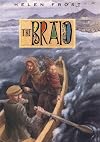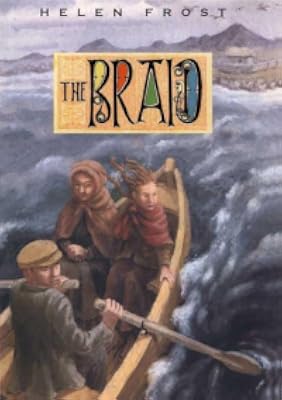
The Braid
by Helen Frost
On This Page
Description
Two Scottish sisters, living on the western island of Barra in the 1850s, relate, in alternate voices and linked narrative poems, their experiences after their family is forcibly evicted and separated with one sister accompanying their parents and younger siblings to Cape Breton, Canada, and the other staying behind with other family on the small island of Mingulay.Tags
Recommendations



Member Reviews
My VOYA rating: 5Q, 4P
This book was incredibly beautiful. The bond between the sisters folds the reader into its braid right from the start. The gentle lilting of the narrative verse is punctuated by what Frost calls "praise poems." The voice shifts from one sister to the next chapter by chapter. The story stands alone as a work of love and the unbreakable sisterly bond. It was only made more beautiful by Helen Frost's description of the form she invented for the novel. Inspired by the Celtic knot, Frost expertly weaves the lines in a way that leaves the reader realizing what a mad genius she is and respecting the novel on a newly discovered level.
This book was incredibly beautiful. The bond between the sisters folds the reader into its braid right from the start. The gentle lilting of the narrative verse is punctuated by what Frost calls "praise poems." The voice shifts from one sister to the next chapter by chapter. The story stands alone as a work of love and the unbreakable sisterly bond. It was only made more beautiful by Helen Frost's description of the form she invented for the novel. Inspired by the Celtic knot, Frost expertly weaves the lines in a way that leaves the reader realizing what a mad genius she is and respecting the novel on a newly discovered level.
There is some poetry that reads complete with rhyme and a galloping rhythm, and then there is poetry like this book where the word play and skill is so skillfully done that it is almost invisible to the reader.
This is the story of the intertwined lives of two sisters who are caught in the exodus from Scotland in the 1850s and escape into two very different lives that, like the poems that make up the story, are separate but braided together. Jeannie leaves Scotland for Canada with her mother, father, younger sisters and baby brother. Sarah stays with her grandmother, moving to an island in the Outer Hebrides. The two girls slowly grow up apart from one another and often unable to communicate in any way, though they remain connected by a show more braid of both their hair that each girl carries.
The stories of the girls are in turn tragic, amazing and typical of so many people forced to leave their homelands. The skillfulness of Frost's poetry makes their situation all the more moving. Once readers finish the book and reach the explanation of the poetic forms, they will find themselves turning back through the poems and marveling at what happened right in front of them but they were unaware of. It is amazing skill to write this well, but to do it with a limitation of form that doesn't ever seem to limit the writing is simply remarkable. show less
This is the story of the intertwined lives of two sisters who are caught in the exodus from Scotland in the 1850s and escape into two very different lives that, like the poems that make up the story, are separate but braided together. Jeannie leaves Scotland for Canada with her mother, father, younger sisters and baby brother. Sarah stays with her grandmother, moving to an island in the Outer Hebrides. The two girls slowly grow up apart from one another and often unable to communicate in any way, though they remain connected by a show more braid of both their hair that each girl carries.
The stories of the girls are in turn tragic, amazing and typical of so many people forced to leave their homelands. The skillfulness of Frost's poetry makes their situation all the more moving. Once readers finish the book and reach the explanation of the poetic forms, they will find themselves turning back through the poems and marveling at what happened right in front of them but they were unaware of. It is amazing skill to write this well, but to do it with a limitation of form that doesn't ever seem to limit the writing is simply remarkable. show less
Two Scottish sisters, living on the western island of Barra in the 1850s, relate, in alternate voices and linked narrative poems, their experiences after their family is forcible evicted and separated with one sister accompanying their parents and younger siblings to Cape Breton, Canada, and the other staying behind with other family on the small island of Mingulay. Each sister - Jeannie, who leaves Scotland during the Highland Clearances with her father, mother, and the younger children, and Sarah, who hides so she can stay behind with her grandmother - carries a length of the other's hair braided with her own. The braid binds them together when they are worlds apart and reminds them of who they used to be before they were evicted from show more the Western Isles, where their family had lived for many generations. show less
Helen Frost's The Braid takes the reader on a simple family journey across the Atlantic Ocean to the strange land of Canada's Cape Breton in the Mid-1800s, while at the same time allowing us to follow the delicate yarn that stretches across the sea back to Scotland and Mingulay where the rest of the family remains.
It was such an easy read, it only took me two short 15-minute Metro rides. I also didn't even notice the intricacy of the book, its narrative poems, and its praise poems. Frost's explanation of how the poems are interwoven together surprised me, perhaps because I was not looking for it or because it was so well done that I was not jarred out of the narrative by its style.
***Spoiler Alert***
Jeannie and Sarah are close sisters, show more who are separated by the Atlantic Ocean when Sarah makes a rash decision to hide away while the rest of the family boards a boat for Canada. Sarah stays behind in Scotland with her grandmother, while Jeannie boards the boat with her other sisters, brother, and parents.
Jeannie must step up to the plate in the New World and help provide for her family by begging strangers for food and shelter. She finds strength within herself. Sarah meanwhile succumbs to her emotional weakness, but turns out to be a positive for her. Jeannie, on the other hand, then transitions from an "adult" back to her childlike self.
***End Spoiler Alert***
This is another Young Adult novel that I would never have read without the advice of some great book bloggers and my Word Nerd partner. Helen Frost is a very creative author and this book is a simple story told in a unique way. I would love to recommend this to anyone who likes Young Adult novels and to those who just want a breath of fresh air. show less
It was such an easy read, it only took me two short 15-minute Metro rides. I also didn't even notice the intricacy of the book, its narrative poems, and its praise poems. Frost's explanation of how the poems are interwoven together surprised me, perhaps because I was not looking for it or because it was so well done that I was not jarred out of the narrative by its style.
***Spoiler Alert***
Jeannie and Sarah are close sisters, show more who are separated by the Atlantic Ocean when Sarah makes a rash decision to hide away while the rest of the family boards a boat for Canada. Sarah stays behind in Scotland with her grandmother, while Jeannie boards the boat with her other sisters, brother, and parents.
Jeannie must step up to the plate in the New World and help provide for her family by begging strangers for food and shelter. She finds strength within herself. Sarah meanwhile succumbs to her emotional weakness, but turns out to be a positive for her. Jeannie, on the other hand, then transitions from an "adult" back to her childlike self.
***End Spoiler Alert***
This is another Young Adult novel that I would never have read without the advice of some great book bloggers and my Word Nerd partner. Helen Frost is a very creative author and this book is a simple story told in a unique way. I would love to recommend this to anyone who likes Young Adult novels and to those who just want a breath of fresh air. show less
The story is told mostly in free verse narratives alternating from one sister’s voice to the other’s. The author uses syllabic measurements in each line to indicate the age of each girl. Interspersed between the narratives are praise poems. The author creatively uses the concept of braiding, mingling of ideas, as the basis for her poetic rules she follows. Easy to read, despite the intricate detail of poetic rules, the story unfolds about two sisters who must decide by themselves the pathway to follow. Heartwarming and poignant at the same time, the story reveals the severities of survival and death in new terrain. Older teens would better appreciate the intensity and complexities, but a younger reader will still understand the show more family situation. show less
A story told in inter-woven poems. The form of the poems was fascinating; the story was touching. A good choice for more mature elementary students or older teens who do not enjoy long books.
Helen Frost does a wonderful job at telling the story of two sisters Sarah and Jeannie. Their family was forced to leave their home in Scotland - each girl traveling to a different location. Their hardships and happinesses are told in an invented formal structure, comprised of narrative poems (told in alternating voices - from Jeannie, then Sarah) and in between, short praise poems. A short, yet satisfying read.
Members
- Recently Added By
Lists

A Child's Book Tour of Scotland
54 works; 3 members
Author Information

137+ Works 8,674 Members
Author Helen Frost was born in Brookings, South Dakota in 1949. She received a Bachelors degree in Elementary Education with an English concentration from Syracuse University and a Masters degree in English from Indiana University. She has taught writing from pre-school through university and has published poetry, children's books, anthologies, a show more play, and a book about teaching writing. Skin of a Fish, Bones of a Bird, a collection of poetry, won the Women Poets Series Competition in 1993. Poems from that collection were awarded the Robert H. Winner Memorial Award and the Mary Carolyn Davies Memorial Award by the Poetry Society of America. She worked with the Fort Wayne YWCA and the Fort Wayne Youtheatre to help high school students write about how they had been affected by violence. This workshop led to a play and an anthology of student writing, both entitled Why Darkness Seems So Light. Keesha's House was awarded a Michael L. Printz Honor from the American Library Association in 2004. (Bowker Author Biography) show less
Awards and Honors
Awards
Distinctions
Common Knowledge
- Original publication date
- 2006
- People/Characters
- Sarah; Jeannie; Willie; Grandma Peggy; Margaret; Flora (show all 7); Murdo
- Important places
- Cape Breton Island, Nova Scotia, Canada; Barra, Na h-Eileanan Siar, Scotland, UK; Mingulay, Na h-Eileanan Siar, Scotland, UK
- Important events
- Highland Clearances 1850
- Dedication
- Dedicated with love to my sisters Mary, Margaret, Kathy, Barbara, Dorothy, Nancy, and Karen
- First words
- All of us!
- Last words
- (Click to show. Warning: May contain spoilers.)Like the sea, it washed ashore, went out, leaving a braid of seashells on the sand.
Classifications
- Genres
- Poetry, Fiction and Literature, Children's Books, Kids, Teen
- DDC/MDS
- 813.6 — Literature & rhetoric American literature in English American fiction in English 2000-
- LCC
- PZ7 .F9205 .B — Language and Literature Fiction and juvenile belles lettres Fiction and juvenile belles lettres Juvenile belles lettres
- BISAC
Statistics
- Members
- 173
- Popularity
- 189,436
- Reviews
- 15
- Rating
- (3.91)
- Languages
- English
- Media
- Paper, Ebook
- ISBNs
- 5
- ASINs
- 1