At Paradise Gate
by Jane Smiley
On This Page
Description
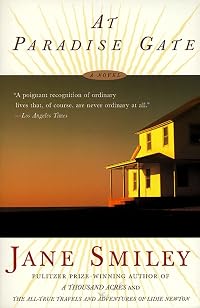
Infused with sharp insight, honesty, and emotion, At Paradise Gate is a treat for both the heart and the intellect. In this poignant story, best-selling author Jane Smiley pens a graceful portrait of an ordinary midwestern family confronting the mysteries of death and regeneration. While her 77-year-old husband lies upstairs, dying, Anna Robison spends her depleting energy defending their home. Their three middle-aged daughters and 23-year-old granddaughter have invaded, radiating vigor and show more good intentions. But the younger women temper their help with squabbling, ill-considered advice, and an abundant supply of their own problems. Pulitzer Prize-winning author Jane Smiley brilliantly captures the simple pleasures and troubles common to everyday life. With her dramatic performance, narrator Suzanne Toren highlights the satisfying family ties and the underlying domestic tensions. You won't want to miss another spell-binding title by Jane Smiley: A Thousand Acres. show lessTags
Recommendations
































Member Reviews
Some novels shout their message from the rooftops. Others convey it in a quieter, more reflective tone. Interestingly, I found [At Paradise Gate] to be an odd blending of both. On the one hand, the story is a noisy cacophony of voices and movement, not unlike any other family gathering steeped in reminiscing and punctuated with sibling rivalries, strongly voiced opinions/judgements and repeated unwanted offers of assistance, all under the guise of “being there for Mom in this time of need”, even when “being there” is, at times, the last thing Mom wants. The story doesn't contain any surprising 'reveals' considering the reader knows right from the start that Ike is terminally ill, but it does contain some wonderful insights into show more the mindset of an elderly woman who, after fifty-two years of marriage, is at a major crossroad, examining what was and what is yet to be as she faces the tension, anxiety and memory conjuring an approaching death vigil brings, followed by the release and the continuance of life. That examination is the quieter, more reflective tone of the story. The story is very much Anna's story. Ike and the girls are the 'noise' that Anna has to face while trying to come to terms with what this means to her and her life going forward. The conversations presented in the story are not unusual. It is the very ordinariness of the 36 hours captured that makes this one such a wonderful, rich read for me. The entire Robison family is laid bare for the reader, with all of their history and personality traits on display. By the time you finish reading this story, you will probably know the Robison family better than you know you own family, that is the depth Smiley brings to the story. You are pulled into their family and exposed in a way that would probably make a visitor squirm uncomfortably, but as a reader, it's just an acute, detailed display of literary voyeurism. One quote that sums up this story nicely is:
You know what marriage is? It's agreeing to take this person who is right now at the top of his form, full of hopes and ideas, feeling good, looking good, wildly interested in you because you're the same way, and sticking by him while he slowly disintegrates. And he does the same for you. you're his responsibility now, and he's yours. If no one else will take care of him, you will. If everyone else rejects you, he won't.
Overall, a story that speaks to the march of time, the frailty of love, and the depth of compassion that resides within all of us, even when it strained. show less
You know what marriage is? It's agreeing to take this person who is right now at the top of his form, full of hopes and ideas, feeling good, looking good, wildly interested in you because you're the same way, and sticking by him while he slowly disintegrates. And he does the same for you. you're his responsibility now, and he's yours. If no one else will take care of him, you will. If everyone else rejects you, he won't.
Overall, a story that speaks to the march of time, the frailty of love, and the depth of compassion that resides within all of us, even when it strained. show less
The story is told through the thoughts of 71-year-old Anna who was born at the turn of the 20th century. She's married to 77-year-old Ike who's upstairs in bed dying. Anna's three daughters and her granddaughter come visit every day, always bringing food and preparing meals.
Through Smiley's descriptions of places and inanimate objects -- masterfully rendered in descriptive, poetic language -- we follow Anna's thoughts as she looks back at her austere childhood with her German parents in the western US mountains.
We also learn her thoughts about her marriage with Ike. She reminisces about his physical strength and sense of humor. Wondering if she ever actually loved him, she remembers longing for him one day seven years into their show more marriage. Mostly, she recalls him as an abusive bully who beat their daughters too. Although we see him as a whiney, bossy, sarcastic, selfish old man, and amid all her negative thoughts of him, inexplicably she thinks to herself how much she loves him.
The family members don't really like each other. Their conversations consist of resentment and criticism as they talk about food, cooking and memories. The granddaughter distinguishes herself by not discussing food and being critical but rather by describing her albeit shallow thoughts about desiring a single life where she can just be in her own room without her needy husband whose child she's expecting. Grandmother Anna labels her a genius which, compared to the rest of them, she is.
I can't imagine a shallower group of people and had hoped for an ending that would elevate this tedious depressing book into something more than a mundane still life. show less
Through Smiley's descriptions of places and inanimate objects -- masterfully rendered in descriptive, poetic language -- we follow Anna's thoughts as she looks back at her austere childhood with her German parents in the western US mountains.
We also learn her thoughts about her marriage with Ike. She reminisces about his physical strength and sense of humor. Wondering if she ever actually loved him, she remembers longing for him one day seven years into their show more marriage. Mostly, she recalls him as an abusive bully who beat their daughters too. Although we see him as a whiney, bossy, sarcastic, selfish old man, and amid all her negative thoughts of him, inexplicably she thinks to herself how much she loves him.
The family members don't really like each other. Their conversations consist of resentment and criticism as they talk about food, cooking and memories. The granddaughter distinguishes herself by not discussing food and being critical but rather by describing her albeit shallow thoughts about desiring a single life where she can just be in her own room without her needy husband whose child she's expecting. Grandmother Anna labels her a genius which, compared to the rest of them, she is.
I can't imagine a shallower group of people and had hoped for an ending that would elevate this tedious depressing book into something more than a mundane still life. show less
Smiley has a way of making her readers uncomfortable in telling the truths that lie beneath the surfaces of All-American families. This novel peels away the layers of a marriage from its earliest days, told in flashback memories, through to the next generation of three daughters, and into the next with a granddaughter. The day-to-day interactions of the present are awkward with the characters trying to figure out how to act, to respond to one another, and, ultimately, to face the demise of the patriarch.
This is a story of family relationships, and in particular about how a marriage of 52 years plays out over time. Ike Robison is terminally ill, and his three middle-aged daughters and 23-year-old granddaughter descend on the family home to help their mother, Anna, care for Ike and herself. This is a story told through seemingly everyday conversations about dinner, an annoying dog, hiring a nurse..... At the same time, the conversations reveal a back story of growing up, of living a life when you are committed to someone for the long haul.
Jane Smiley's books for me are hit and miss, but this one is a real winner in my opinion..
Jane Smiley's books for me are hit and miss, but this one is a real winner in my opinion..
While seventy-seven year old Ike Robison is dying in his bedroom upstairs, his wife Anna defends the citadel of their marriage from the ill-considered, albeit loving invasion, of their three middle-aged daughters and twenty-three year old granddaughter. Helen, Claire and Susanna claim they have come to help their mother, Anna, and to cheer their father towards recuperation. Although, it appears to their mother that her daughters have arrived only to raid her refrigerator and to gripe and snipe at each other about their recollections of old rivalries.
Bright, fresh-faced Christine arrives and presents the family with a new set of problems - her impending pregnancy and forthcoming divorce. Anna, herself, is reflecting on her life. Her show more life has been difficult for Anna, her marriage to Ike harshly violent, uprooting and cold. Unburdened by sentiment, Anna acknowledges to herself that she is angry at her husband for abandoning her and that her daughters remain so dependent, even into their adulthood.
Despite the simmering anger and resentment which is directed at her husband, Anna has grown used to Ike and truly can't imagine her life without him. She is confronted by her own frailties, and the imminence of Ike's death has left her in a devastating conundrum about what she should do next. Anna ultimately achieves a quiet certainty about her right to what's left of her world.
I thought this was a very good book. It was an easy read for me, and even though nothing earth-shattering happened in the plot, At Paradise Gate by Jane Smiley was still a very pleasant read. This book was filled with moments of quiet introspection, rather than huge cliffhanger plot twists. The writing was beautiful and I give this book an A+! I would definitely recommend it to anyone who likes contemporary fiction. show less
Bright, fresh-faced Christine arrives and presents the family with a new set of problems - her impending pregnancy and forthcoming divorce. Anna, herself, is reflecting on her life. Her show more life has been difficult for Anna, her marriage to Ike harshly violent, uprooting and cold. Unburdened by sentiment, Anna acknowledges to herself that she is angry at her husband for abandoning her and that her daughters remain so dependent, even into their adulthood.
Despite the simmering anger and resentment which is directed at her husband, Anna has grown used to Ike and truly can't imagine her life without him. She is confronted by her own frailties, and the imminence of Ike's death has left her in a devastating conundrum about what she should do next. Anna ultimately achieves a quiet certainty about her right to what's left of her world.
I thought this was a very good book. It was an easy read for me, and even though nothing earth-shattering happened in the plot, At Paradise Gate by Jane Smiley was still a very pleasant read. This book was filled with moments of quiet introspection, rather than huge cliffhanger plot twists. The writing was beautiful and I give this book an A+! I would definitely recommend it to anyone who likes contemporary fiction. show less
this was just OK for me -- lacked the emotional impact and I had to read the Amazon review to jog my memory to figure out whether I had even read it before. One of her least memorable novels.
I found this to be an excellent read. The telling of this family's story struck a chord - the love, the dysfunction, the sadness - and the difficulty reconciling it all. Not as lyrical as Marilynne Robinson, but this book reminded me of one of her stories. This was my first Smiley book - and I look forward to reading more.
Members
- Recently Added By
Author Information

50+ Works 25,651 Members
Jane Smiley was born in Los Angeles, California on September 26, 1949. She received a B. A. from Vassar College in 1971 and an M.F.A. and a Ph.D from the University of Iowa. From 1981 to 1996, she taught undergraduate and graduate creative writing workshops at Iowa State University. Her books include The Age of Grief, The Greenlanders, Moo, Horse show more Heaven, Ordinary Love and Good Will, Some Luck, and Early Warning. In 1985, she won an O. Henry Award for her short story Lily, which was published in The Atlantic Monthly. A Thousand Acres received both the National Book Critics Circle Award and the Pulitzer Prize. (Bowker Author Biography) show less
Awards and Honors
Common Knowledge
- Canonical title
- At Paradise Gate
- Original publication date
- 1981
- People/Characters
- Ike Robison; Anna Robison; Helen; Claire; Susanna; Christine
- Epigraph
- ...while I complain of being able to glimpse no more than the shadow of the past, I may be insensitive to reality as it is taking shape at this very moment, since I have not reached the stage of development at which I would b... (show all)e capable of perceiving it. A few hundred years hence, in this same place, another traveler, as despairing as myself, will mourn the disappearance of what I might have seen, but failed to see. I am subject to a double infirmity; all that I perceive offends me, and I constantly reproach myself for not seeing as much as I should.
- Claude Levi-Strauss, Tristes Tropiques, 1955
(translated by J. and D. Weightman, 1974) - First words
- Like their father, Anna Robison's three daughters loved to remember.
- Last words
- (Click to show. Warning: May contain spoilers.)Claire said, "Is that Daddy?" and in the listening silence that followed, Anna spoke.
Classifications
Statistics
- Members
- 328
- Popularity
- 97,374
- Reviews
- 10
- Rating
- (3.36)
- Languages
- English, French, German
- Media
- Paper, Audiobook, Ebook
- ISBNs
- 18
- UPCs
- 1
- ASINs
- 5