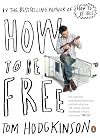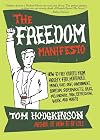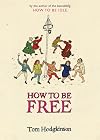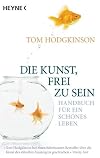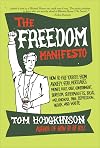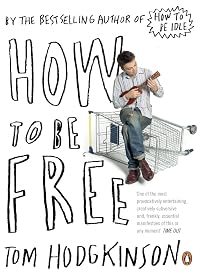
The Freedom Manifesto: How to Free Yourself from Anxiety, Fear, Mortgages, Money, Guilt, Debt, Government, Boredom, Supermarkets, Bills, Melancholy, Pain, Depression, Work, and Waste
by Tom Hodgkinson
On This Page
Description
The author of How to Be Idle, Tom Hodgkinson, now shares his delightfully irreverent musings on what true independence means and what it takes to be free. The Freedom Manifesto draws on French existentialists, British punks, beat poets, hippies and yippies, medieval thinkers, and anarchists to provide a new, simple, joyful blueprint for modern living. From growing your own vegetables to canceling your credit cards to reading Jean-Paul Sartre, here are excellent suggestions for nourishing show more mind, body, and spirit witty, provocative, sometimes outrageous, yet eminently sage advice for breaking with convention and living an uncluttered, unfettered, and therefore happier, life." show lessTags
Recommendations




Member Recommendations
Member Reviews
This is either the best or worst book to read when you’re finishing a PhD and thinking deep thoughts about what to do next with your life. I’m not sure which yet - ask me in a few years. ‘How to be Free’ continues in the same vein as [b:How to Be Idle|623922|How to Be Idle|Tom Hodgkinson|https://images.gr-assets.com/books/1388368701s/623922.jpg|1768914], which I greatly enjoyed. The former has a more philosophical and political bent, however. The tendency to skip thither and yon, drawing inspiration from Sartre and Chaucer, reminds me a little of a less obtuse Žižek. Hodgkinson makes no claims to present a coherent political philosophy, which is good because he doesn’t. Instead, he critiques many aspects of modern life - or show more rather, modern life in 2006 when the horrible invasion of smartphones had barely begun. Given his scathing words about blackberries, I don’t imagine he approves of them. The book is structured around pieces of mostly practical advice, like replacing your car with a bicycle, growing your own vegetables, and accepting that the only meaning of life is that which we create ourselves.
I am sympathetic to almost all that Hodgkinson says and his so-conservative-it’s-radical philosophy is interesting and appealing. He harks back to late Medieval times, which he feels exemplify freedom from centralised authority and local co-operation. It’s certainly a valid point that taking inspiration from the past rather than the future is more pragmatic, given that the future is only ever an illusion. Hodgkinson is strongest when dismantling consumerism and presenting the appeal of thrift and self-reliance, but weakest when assuming that everyone else (who isn’t a straight white man) enjoys the same things in life as him. Thus, I definitely agree with the pursuit of inexpensive pleasures, but drinking and smoking have no appeal for me. I prefer night-time walks, browsing libraries, and rambling discussions with friends. Also, I don’t want to learn the ukulele, I’d rather learn Spanish. Nonetheless, the neo-Medieval anarchism advanced here is not proscriptive. Moreover, it’s refreshing to be told not to worry about having a career and the comments on housing are very good. A mortgage is essentially renting a house from the bank, at great cost. If only renting wasn’t so appallingly insecure. It’s relaxing to read a book in praise of carelessness - what’s the point of trying to earn lots of money, to get more than anyone else? We’re all going to die anyway. Might as well enjoy life, rather than trying to purchase enjoyment in rare hours not spent working. show less
I am sympathetic to almost all that Hodgkinson says and his so-conservative-it’s-radical philosophy is interesting and appealing. He harks back to late Medieval times, which he feels exemplify freedom from centralised authority and local co-operation. It’s certainly a valid point that taking inspiration from the past rather than the future is more pragmatic, given that the future is only ever an illusion. Hodgkinson is strongest when dismantling consumerism and presenting the appeal of thrift and self-reliance, but weakest when assuming that everyone else (who isn’t a straight white man) enjoys the same things in life as him. Thus, I definitely agree with the pursuit of inexpensive pleasures, but drinking and smoking have no appeal for me. I prefer night-time walks, browsing libraries, and rambling discussions with friends. Also, I don’t want to learn the ukulele, I’d rather learn Spanish. Nonetheless, the neo-Medieval anarchism advanced here is not proscriptive. Moreover, it’s refreshing to be told not to worry about having a career and the comments on housing are very good. A mortgage is essentially renting a house from the bank, at great cost. If only renting wasn’t so appallingly insecure. It’s relaxing to read a book in praise of carelessness - what’s the point of trying to earn lots of money, to get more than anyone else? We’re all going to die anyway. Might as well enjoy life, rather than trying to purchase enjoyment in rare hours not spent working. show less
Here we have more anti-corporate, carpe-diem exhortations from Tom "How To Be Idle" Hodgkinson. He really, really would like to go back to the Middle Ages, before the Industrial Revolution (and Henry VIII's sacking of the churches) wrecked everything. One suspects that he romanticizes feudal England just a tad...but it's easy to enjoy Hodgkinson's enthused rants against mortgages, supermarket chains, wage slavery, companies that wring profit out of depression, soul-crushing jobs, and so on. "The Freedom Manifesto" is a bit cracked -- its author is here to provoke, not provide concrete plans -- but if you split the difference between the author's suggestions and our current societal norms, you'll probably end up cheerful.
Exhilarating. Re-read often to slip the mind-forg'd manacles. Though occasionally I did wonder who was minding Hodgkinson's kids while he was occupied with idling.
I sure don't agree with all of his premises, but he does raise some interesting points- and advocates some possibilities that most of us would not really think of otherwise.
Note that i do NOT favor his dicta to stop voting. I think voting is not only important, but a civil obligation. However, voting for what YOU want- not to try to game the system- is vital here. In the next election, I plan to vote green; I know they won't win, but I would hope that my vote, combined with others, might give the Powers That Be pause. I am no longer willing to vote for the "lesser evil".
I think the author is really ignorant about a lot of the history he raves about- like "Athens was great, except for a few slaves". Well, MOST Athenians were not citizens show more nor had a vote; not just the slaves, but the lower classes and the women.
And favoring the American South over the North because it was more courteous? How "courteously" did they treat the slaves???
I was also not impressed by his "revelation" that when women whinge- they don't want solutions! Since he'd been all along discussing male whingeing without the desire for solutions, the notion that this was a female peculiarity is ridiculous, and casts some doubt on his ability to get outside himself and see others fairly.
So: I think he has some interesting and enticing points, but his arguments from history show a partisan lack of historical knowledge and/or willful ignorance and/or intentional provocation.
However, I also think it's true that we can be more empowered to change our condition than we normally think of ourselves as being- and that's really valuable. show less
Note that i do NOT favor his dicta to stop voting. I think voting is not only important, but a civil obligation. However, voting for what YOU want- not to try to game the system- is vital here. In the next election, I plan to vote green; I know they won't win, but I would hope that my vote, combined with others, might give the Powers That Be pause. I am no longer willing to vote for the "lesser evil".
I think the author is really ignorant about a lot of the history he raves about- like "Athens was great, except for a few slaves". Well, MOST Athenians were not citizens show more nor had a vote; not just the slaves, but the lower classes and the women.
And favoring the American South over the North because it was more courteous? How "courteously" did they treat the slaves???
I was also not impressed by his "revelation" that when women whinge- they don't want solutions! Since he'd been all along discussing male whingeing without the desire for solutions, the notion that this was a female peculiarity is ridiculous, and casts some doubt on his ability to get outside himself and see others fairly.
So: I think he has some interesting and enticing points, but his arguments from history show a partisan lack of historical knowledge and/or willful ignorance and/or intentional provocation.
However, I also think it's true that we can be more empowered to change our condition than we normally think of ourselves as being- and that's really valuable. show less
There's a lot to quibble about in this book, but essentially I like the message of the book: stop being so distracted, and embrace the joys and sorrows of life. Or more simply: Be a human, not a machine.
Hodgkinson finds nice literary quotes, looks back (perhaps a bit romantically) to the past for inspiration, and shows you how you might lead your life differently to enjoy freedom and happiness. At times, he can be a bit repetitive, but that's okay. The book kinda encourages skimming and skipping around to what interests you.
Hodgkinson finds nice literary quotes, looks back (perhaps a bit romantically) to the past for inspiration, and shows you how you might lead your life differently to enjoy freedom and happiness. At times, he can be a bit repetitive, but that's okay. The book kinda encourages skimming and skipping around to what interests you.
It's hard to say all the ways this books disappointed me, because there are so many.
It started off well, pointing out flaws with our modern way of life, but then failed to offer any useful ways to counter this that I wasn't doing already. Sure, it's easy to quit your job and work from home if you're an author, but not everyone can do this. How about selling crafts? His description of people effectively living in a work-shy commune is fine, but they still need to either buy the house, or pay rent. How do they do that if they haven't got any money? It feels like it was written by a 16-year-old that wants to ignore all responsibility.
My biggest annoyance though was his looking back at the middle ages as some kind of great example of how show more life should be lived. Mr Wilkinson seems to think that the middle ages were one big party as he never once mentions all the bad that were around at the time. Wilkinson wouldn't last very long in his beloved middle ages, because instead of bailiffs chasing him for unpaid services he gladly took on, his propensity not to work would mean no food for the winter and certain death.
You don't need this book. All you need to know is to simplify your life. Buy less, take on as few services as you can, and do things you enjoy in your spare time. That's all there is to it. show less
It started off well, pointing out flaws with our modern way of life, but then failed to offer any useful ways to counter this that I wasn't doing already. Sure, it's easy to quit your job and work from home if you're an author, but not everyone can do this. How about selling crafts? His description of people effectively living in a work-shy commune is fine, but they still need to either buy the house, or pay rent. How do they do that if they haven't got any money? It feels like it was written by a 16-year-old that wants to ignore all responsibility.
My biggest annoyance though was his looking back at the middle ages as some kind of great example of how show more life should be lived. Mr Wilkinson seems to think that the middle ages were one big party as he never once mentions all the bad that were around at the time. Wilkinson wouldn't last very long in his beloved middle ages, because instead of bailiffs chasing him for unpaid services he gladly took on, his propensity not to work would mean no food for the winter and certain death.
You don't need this book. All you need to know is to simplify your life. Buy less, take on as few services as you can, and do things you enjoy in your spare time. That's all there is to it. show less
Occassionally I read the reviews by other people, and I wonder if they've read the same book as me!Tom Hodgkinson's book seems to me not to be a self help guide. It doesn't provide a programme to follow to be free, but it argues, occassionally eloquently, that it is possible for everyone to loosen their 'Mind Forged Manacles'. Much of his method for doing this revolves around taking control and responsibility for or and for your own life. If you hate your job then change it. If you have a nagging feeling that you're working to maintain a lifestyle in order to keep up with the Joneses, or to maintain a crippling mortgage then look at the alternatives.It felt to me more like a companion peace to the Chumbawamba and Crass albums that I've show more been listening to all these years. An easy introduction to the theory behind the calls for anarchy. Some of his arguments are of course flawed. At least, assuming that you're reading this post on a computer, then the call to take back understanding in technology so that you're not behest to 'the man' is optimistic at best. Like many others, I'm happy to buy the bits to build a computer, but I couldn't tell you how to make the chips themselves, (beyond a hand waving explanation) never mind actually designing the chips. We live in a world where the ability to purchase technology which is way beyond our individual understanding is part of modern life. I guess the question is whether you buy in to the rat race, or take a more moderate approach.It didn't provide any life changing suggestions to me. I think I fell out with the concept of consumerism a long time ago. My current PC is new, but the previous one was only replaced when it died on me after more than 6 years. My iPod is one that I bought second hand on eBay cos they were being sold off cheap by loads of people who had rushed out to buy an iPhone as soon as they became available (better for me, I chose to run Rockbox on it anyway...), but some of the ideas have given me food for thought, and as we embark on another years vegetable growing (something that we were doing before I read this book) it has given me a renewed enthusiasm for the joys of cultivation. show less
Members
- Recently Added By
Author Information

46+ Works 2,296 Members
Tom Hodgkinson is the author of The Freedom Manifesto and How to Be Idle. Editor of the British magazine The Idler, he also contributes a parenting column to The Daily Telegraph and writes for various newspapers and magazines in Britain. He lives on a farm in Devon, England, with his family.
Common Knowledge
- Canonical title
- The Freedom Manifesto: How to Free Yourself from Anxiety, Fear, Mortgages, Money, Guilt, Debt, Government, Boredom, Supermarkets, Bills, Melancholy, Pain, Depression, Work, and Waste
- Dedication
- For Victoria
- First words
- This is a book about good living, and at its heart is a simple truth: when you embrace Lady Liberty, life becomes easier, cheaper and much more fun.
- Last words
- (Click to show. Warning: May contain spoilers.)You can change your life in one second. Freedom is a state of mind.
PLAY
Classifications
Statistics
- Members
- 540
- Popularity
- 55,144
- Reviews
- 17
- Rating
- (3.82)
- Languages
- 7 — Catalan, Dutch, English, Finnish, German, Italian, Spanish
- Media
- Paper, Ebook
- ISBNs
- 11
- ASINs
- 3