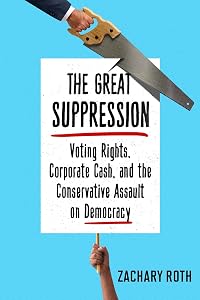
The Great Suppression: Voting Rights, Corporate Cash, and the Conservative Assault on Democracy
by Zachary Roth
On This Page
Description
"A deeply reported look inside the new conservative movement working to undermine American democracy. Control of the country is up for grabs--and Republicans have been rigging the game in their favor. Twenty-two states have passed restrictions on voting. Ruthless gerrymandering has given the GOP a long-term grip on Congress. Meanwhile, the Supreme Court has eviscerated campaign finance laws, boosting candidates backed by big money. It would be worrying enough if these were just schemes for show more partisan advantage. But the reality is even more disturbing. As reporter Zachary Roth reveals, a growing number of Republicans distrust the very idea of democracy--and they're doing everything they can to limit it. In The Great Suppression, Roth unearths the deep historical roots of this anti-egalitarian worldview, and introduces us to its modern-day proponents: The GOP officials pushing to make it harder to cast a ballot; the lawyers looking to scrap all limits on money in politics; the libertarian scholars reclaiming judicial activism to roll back the New Deal; and the corporate lobbyists working to ban local action on everything from the minimum wage to the environment. And he travels from Rust Belt cities to southern towns to show us how these efforts are hurting the most vulnerable Americans and preventing progress on pressing issues. A sharp, searing polemic in the tradition of Rachel Maddow and Matt Taibbi, The Great Suppressionis an urgent wake-up call about a threat to our most cherished values, and a rousing argument for why we need democracy now more than ever"-- show lessTags
Recommendations


Member Reviews
I missed hearing about Robert Kennedy’s assassination for two days thanks to a camping trip. I was just a child at the time but ever since I have been a news junkie. Thanks to that I was already aware of most of the laws that Zachary Roth mentions in his book, The Great Suppression : voting rights, corporate cash, and the conservative assault on democracy. What made me feel inadequate was how I missed putting the big picture together.
Suppressing the number of voters in demographics that might not agree with their conservative policies has been an obvious tactic of the GOP for years. Decades if you look at our nation's history. In fact, “We the People” included only white male property owners at the time of the nations founding. show more Roth points out that voter suppression is just the tip of the iceberg. The GOP, the party of small government, is pushing push to restrict our right to self rule. Over and over Roth pointed out GOP initiatives, often written with the corporate special interest group ALEC, designed to reduce America's local government’s powers to pass lawS not favoring corporate special interests.
Roth exposes anti-democratic (small D democratic) policies that the GOP is using to restrict every individual citizen’s rights. True “small government” conservatives should read this book. Any American that values the ability of people to decide the course their government should read this book. show less
Suppressing the number of voters in demographics that might not agree with their conservative policies has been an obvious tactic of the GOP for years. Decades if you look at our nation's history. In fact, “We the People” included only white male property owners at the time of the nations founding. show more Roth points out that voter suppression is just the tip of the iceberg. The GOP, the party of small government, is pushing push to restrict our right to self rule. Over and over Roth pointed out GOP initiatives, often written with the corporate special interest group ALEC, designed to reduce America's local government’s powers to pass lawS not favoring corporate special interests.
Roth exposes anti-democratic (small D democratic) policies that the GOP is using to restrict every individual citizen’s rights. True “small government” conservatives should read this book. Any American that values the ability of people to decide the course their government should read this book. show less
 This review was written for LibraryThing Early Reviewers.
I had a terrible time reading this book. My problems had nothing to do with the quality of the book. Indeed, it was very well-written. The narrative style was good and the book had excellent access points which made it easy to cross-reference and ease my way into the content. There was an introduction; table of contents; acknowledgements; exhaustive notes and an index. (My copy which was an uncorrected proof/not for sale publication did not contain an index - only the pages where it would be in the published copy. It is a shame because I would have used it extensively. I received this copy as part of Library Thing’s early review program.) I checked many of the notes and they were correct. I extended my reading because of the notes and show more bibliographical references. They were compelling.
What is my problem, you may ask? My problem was the subject matter. I spent many minutes (too many to count) violently cursing, gagging, shouting, snarling and just plain furious.
THE GREAT SUPPRESSION: VOTING RIGHTS, CORPORATE CASH, AND THE CONSERVATIVE ASSAULT ON DEMOCRACY by Zachary Roth (national reporter for MSNBC) exposes the roots of the Republican Party’s premeditated, deliberate, unethical, outrageous, disgusting, devious, calculating assault on the democratic principles and laws of the United States. The Republican super-rich and corporate interests control the GOP and mandate adherence to certain policies which cast aside average citizens as unimportant non-beings who do not deserve the right to vote or to elect their own community leaders. The Republican Party wants to limit voting by undesirables (think poor, certain religions & certain ethnicities); they pour corporate and think tank money into campaigns; practice preemption tactics (this is an interesting theory); use gerrymandering to control regions of the country; and manipulate Congressional rules. This is just the beginning.
If you read the epilogue which highlights the problems in Flint, Michigan, you will experience every one of the GOP’s vicious, deliberate assaults on U.S. democracy.
The book is not a debate or discussion. It is a documented, well-researched, factual account of the Republican Party’s goal to suppress democratic principles so as to advance their own agenda of supremacy of the rich.
Read this book. I double-dog dare you. show less
What is my problem, you may ask? My problem was the subject matter. I spent many minutes (too many to count) violently cursing, gagging, shouting, snarling and just plain furious.
THE GREAT SUPPRESSION: VOTING RIGHTS, CORPORATE CASH, AND THE CONSERVATIVE ASSAULT ON DEMOCRACY by Zachary Roth (national reporter for MSNBC) exposes the roots of the Republican Party’s premeditated, deliberate, unethical, outrageous, disgusting, devious, calculating assault on the democratic principles and laws of the United States. The Republican super-rich and corporate interests control the GOP and mandate adherence to certain policies which cast aside average citizens as unimportant non-beings who do not deserve the right to vote or to elect their own community leaders. The Republican Party wants to limit voting by undesirables (think poor, certain religions & certain ethnicities); they pour corporate and think tank money into campaigns; practice preemption tactics (this is an interesting theory); use gerrymandering to control regions of the country; and manipulate Congressional rules. This is just the beginning.
If you read the epilogue which highlights the problems in Flint, Michigan, you will experience every one of the GOP’s vicious, deliberate assaults on U.S. democracy.
The book is not a debate or discussion. It is a documented, well-researched, factual account of the Republican Party’s goal to suppress democratic principles so as to advance their own agenda of supremacy of the rich.
Read this book. I double-dog dare you. show less
This review was written for LibraryThing Early Reviewers.The problem with trying to review any book about political issues is that bias is unavoidable. How can a reviewer be objective about something that is inherently subjective? I’ll try to keep it simple and focused.
Roth’s general thesis in The Great Suppression is that Conservatives (Republicans are not targeted as a party) have strongly pursued measures that limit the political voice of minority and lower SES Americans in an intentional effort to limit full democracy. The book attempts to demonstrate this and to highlight the weak defenses for these measures. These defenses run the gamut from pointing out the Founders’ intent to relying on misleading or insubstantial data (e.g. 2 cases of in-person voter fraud since 2000 to justify show more Texas’ new voter ID laws). In one instance (*I think it was in discussing NC gerrymandering issues*), a legislator argued that redrawing the districts to redistribute democratic votes was legal since it did not use race as a factor – an argument built on a lack of concern for the democratic process.
However, what is most disconcerting here is the way Roth implicitly frames the Conservative movement as willing to bend its own ideology in an effort to achieve its own ends (i.e. controlling each branch of government at both the state and federal level). For years, the general consensus among Conservatives has been to scale back regulation and legislation at the federal level and allow it to happen at the state and local levels. Yet, Conservative politicians began to lead a “preemption” movement to prevent local governments from passing bills related to wage increases or more inclusive voting practices (see Ch 3).
I am sure that many conservative reviewers may ask Roth to turn some of the arguments back onto Democrats or Liberals. I believe this is a valid request and something that I would have liked to see more honesty in. The only real occasion that Roth attempted to demonstrate his awareness of a counterargument was in reference to the legalization of same-sex marriages and its effect on county governments: “But we didn’t wring our hands about the threat to local democracy…” (79). I also disagreed with Roth’s assertion that the Electoral College has a “small state bias” (147), though he clearly explained his reasoning.
I would not characterize Roth’s style as polemical or aggressive (or really even angry); I think he is simply flabbergasted. Biased though he his, I would recommend Conservatives read through this for a chance to consider their actions from another perspective. In saying that I am not suggesting that Roth could not also benefit from a conservative rebuttal to his work. Our willingness to enter into healthy debate and compromise – something that members of both major parties seem unwilling or unable to do – is the only effective way to heal what many (on both sides) feel is a broken democratic system. 4 stars (with the admission that I agree with many of Roth’s arguments)
Thanks to LibraryThing and Crown for this ARC. show less
Roth’s general thesis in The Great Suppression is that Conservatives (Republicans are not targeted as a party) have strongly pursued measures that limit the political voice of minority and lower SES Americans in an intentional effort to limit full democracy. The book attempts to demonstrate this and to highlight the weak defenses for these measures. These defenses run the gamut from pointing out the Founders’ intent to relying on misleading or insubstantial data (e.g. 2 cases of in-person voter fraud since 2000 to justify show more Texas’ new voter ID laws). In one instance (*I think it was in discussing NC gerrymandering issues*), a legislator argued that redrawing the districts to redistribute democratic votes was legal since it did not use race as a factor – an argument built on a lack of concern for the democratic process.
However, what is most disconcerting here is the way Roth implicitly frames the Conservative movement as willing to bend its own ideology in an effort to achieve its own ends (i.e. controlling each branch of government at both the state and federal level). For years, the general consensus among Conservatives has been to scale back regulation and legislation at the federal level and allow it to happen at the state and local levels. Yet, Conservative politicians began to lead a “preemption” movement to prevent local governments from passing bills related to wage increases or more inclusive voting practices (see Ch 3).
I am sure that many conservative reviewers may ask Roth to turn some of the arguments back onto Democrats or Liberals. I believe this is a valid request and something that I would have liked to see more honesty in. The only real occasion that Roth attempted to demonstrate his awareness of a counterargument was in reference to the legalization of same-sex marriages and its effect on county governments: “But we didn’t wring our hands about the threat to local democracy…” (79). I also disagreed with Roth’s assertion that the Electoral College has a “small state bias” (147), though he clearly explained his reasoning.
I would not characterize Roth’s style as polemical or aggressive (or really even angry); I think he is simply flabbergasted. Biased though he his, I would recommend Conservatives read through this for a chance to consider their actions from another perspective. In saying that I am not suggesting that Roth could not also benefit from a conservative rebuttal to his work. Our willingness to enter into healthy debate and compromise – something that members of both major parties seem unwilling or unable to do – is the only effective way to heal what many (on both sides) feel is a broken democratic system. 4 stars (with the admission that I agree with many of Roth’s arguments)
Thanks to LibraryThing and Crown for this ARC. show less
This review was written for LibraryThing Early Reviewers.This was a difficult book. Difficult, because I was brought up to think that American democracy works. But I'm white, and female but born late enough that of course I will get to vote. Probably always.
Roth details multiple ways in which the right of folks not like me -- Black people, brown people, poor people -- to vote has been increasingly limited through various strategems. Those were interesting enough, and have been detailed in the news as they've been introduced, and litigated. Voter ID laws. Closing of early voting opportunities. Most recently this week, the refusal of FL to extend voter registration deadlines even as Hurricane Matthew bore down on the state. Equally interesting were the chapters explaining how local governance show more by the people gets overturned on the state and national level if the will of the (local) people isn't in line with the interests of government. This flies in the face of the Conservative idea of states' rights (and the corresponding local rights, for those cases where it's the state that imposes on its people). And the ways that election donation money buys politicians and effectively disenfranchises the middle and poor classes is nothing surprising as well. Disappointing, yes, and what can you do but shake your head and say, but what really can someone like me do?
But what was challenging about this was Roth's description of the philosophical underpinnings of the idea that some people should be disenfranchised: that the wealthy, the educated, those used to being in charge, know more how to keep the government functioning for all. It was challenging because yes, today I'm distressed that Black voters in SC are having their access to voting limited. Because I think their interests, and their rights, are rights for all. But I'm also sitting here looking at the latest about Trump, and how Evangelical Christians are still overwhelmingly supportive of his candidacy, and thinking, these crazy people, these people who put their version of religion over the basic rights of all (against even the Old Testament prophets and the model of Jesus' care for the poor), these ignorant masses of poor people VOTING AGAINST THEIR OWN INTERESTS in the name of ideology, these racists -- wouldn't it be nice if we could just keep them from voting? (And if they don't get their way, they'll vote with their guns.) That makes me a hypocrite, because in my heart I too think that some folks just shouldn't be allowed to vote.
OTOH, would I keep them from voting? I'm not sure I would...but I sure would drag them off to get some education. Force them to meet and interact with people not like them. Force them to learn some economics. To engage in some critical thinking about their religion, and maybe even actually read the Bible for themselves, instead of listening to their demagogue preachers. And then I'd let them vote.
But I sure as hell don't want them voting in November -- just as I sure don't want to see Black, or Latino, or whatever, citizens kept from voting. show less
Roth details multiple ways in which the right of folks not like me -- Black people, brown people, poor people -- to vote has been increasingly limited through various strategems. Those were interesting enough, and have been detailed in the news as they've been introduced, and litigated. Voter ID laws. Closing of early voting opportunities. Most recently this week, the refusal of FL to extend voter registration deadlines even as Hurricane Matthew bore down on the state. Equally interesting were the chapters explaining how local governance show more by the people gets overturned on the state and national level if the will of the (local) people isn't in line with the interests of government. This flies in the face of the Conservative idea of states' rights (and the corresponding local rights, for those cases where it's the state that imposes on its people). And the ways that election donation money buys politicians and effectively disenfranchises the middle and poor classes is nothing surprising as well. Disappointing, yes, and what can you do but shake your head and say, but what really can someone like me do?
But what was challenging about this was Roth's description of the philosophical underpinnings of the idea that some people should be disenfranchised: that the wealthy, the educated, those used to being in charge, know more how to keep the government functioning for all. It was challenging because yes, today I'm distressed that Black voters in SC are having their access to voting limited. Because I think their interests, and their rights, are rights for all. But I'm also sitting here looking at the latest about Trump, and how Evangelical Christians are still overwhelmingly supportive of his candidacy, and thinking, these crazy people, these people who put their version of religion over the basic rights of all (against even the Old Testament prophets and the model of Jesus' care for the poor), these ignorant masses of poor people VOTING AGAINST THEIR OWN INTERESTS in the name of ideology, these racists -- wouldn't it be nice if we could just keep them from voting? (And if they don't get their way, they'll vote with their guns.) That makes me a hypocrite, because in my heart I too think that some folks just shouldn't be allowed to vote.
OTOH, would I keep them from voting? I'm not sure I would...but I sure would drag them off to get some education. Force them to meet and interact with people not like them. Force them to learn some economics. To engage in some critical thinking about their religion, and maybe even actually read the Bible for themselves, instead of listening to their demagogue preachers. And then I'd let them vote.
But I sure as hell don't want them voting in November -- just as I sure don't want to see Black, or Latino, or whatever, citizens kept from voting. show less
This review was written for LibraryThing Early Reviewers.Although those of us who make a reasonable effort to keep up with the news have known, in a piecemeal way, most of the points covered in Zachary Roth's book, it is still an eye-opener. It rounds up the numerous nefarious activities of the Republicans over the past eight years to suppress popular democracy, all in one package.
According to radical conservatives and their propaganda mouthpieces Fox News and Rush Limbaugh, the people who voted for Obama (or Clinton or Carter or any Democrat) were not qualified to make such an important decision. Indeed, ANY government of Democrats is illegitimate because they bribe their potential voters with welfare, food stamps, and government assistance.
This harks back to the formative years of the show more United States when Madison wrote into the Constitution "all MEN are created equal" (but not women and the 2/3 black man). Of course, Madison meant WHITE men of property. The highly-lauded Alexander Hamilton said the "rich and well-born" should maintain supremacy. This is currently echoed by the radical right Heritage Foundation which says the Constitution was meant to protect us "from the dangers of unchecked popular democracy".
Since the beginning of the Obama administration the Republicans (puppets of the Top 1/10%, the American Oligarchy) have used every means at their disposal to remove "unqualified" voters from the picture. The most glaring example was the gutting of the Voting Rights Act in June 2013 by the corrupt Scalia Supreme Court, Scalia himself saying the ruling was to get rid of "racial entitlement".
Even worse has been the near-elimination of campaign-finance laws since the Reagan Administration. The organization Citizens United and the appointment of Samuel Alito to SCOTUS put the final nails in the campaign finance laws coffin. In a sweeping Supreme Court decision, Citizens United lawyers using the fraudulent argument that corporations are people (they are not) and limiting the money spent in a campaign was equivalent to limiting free speech, the super-corrupt Scalia-Alito Court bought that ridiculousness and corporations from then-on could spend unlimited amounts of money on politics. The Koch Brothers have said they will spend close to a billion dollars on the 2016 campaigns.
The Republicans have been frighteningly successful in taking over state governments, legislatures, and governorships. One of their tools has been the use of pre-emptive laws to ban local governments from passing any kind of legislation inimical to the desires of the Top 1/10%. Roth uses the case of Denton Texas which passed local laws limiting fracking in its environs. The State of Texas promptly nullified the decision by the majority of citizens of Denton by passing a bill that forbade any local laws that interfered with "energy development activities".
Of course, the latest and most prominent of pre-emption laws was passed by the North Carolina legislature and signed into law by the governor forbidding any local governments (Charlotte, Asheville) from enacting any non-discrimination laws for LGBTs. Wrongly termed the "bathroom bill" by a sympathetic media, this pernicious law takes away any possible LGBT rights (except marriage) in the entire state of North Carolina.
Other areas of voter suppression covered by Roth are: A decision by the venal SCOTUS that effectively allowed all-out gerrymandering; the attempt to repeal the 17th amendment (senators elected by popular vote) thus putting the election of senators back into the hands of state legislatures; strengthening the Electoral College to represent people "of wealth" (the Founders established it for that very reason); reversing the right of felons to vote; and many other voter suppression activities in the under-current.
Zachary Roth's book is a great read for those of us who think our rights as common citizens are under attack by the American Oligarchy and their Republican enablers. Alas, those who should really read it can't. show less
According to radical conservatives and their propaganda mouthpieces Fox News and Rush Limbaugh, the people who voted for Obama (or Clinton or Carter or any Democrat) were not qualified to make such an important decision. Indeed, ANY government of Democrats is illegitimate because they bribe their potential voters with welfare, food stamps, and government assistance.
This harks back to the formative years of the show more United States when Madison wrote into the Constitution "all MEN are created equal" (but not women and the 2/3 black man). Of course, Madison meant WHITE men of property. The highly-lauded Alexander Hamilton said the "rich and well-born" should maintain supremacy. This is currently echoed by the radical right Heritage Foundation which says the Constitution was meant to protect us "from the dangers of unchecked popular democracy".
Since the beginning of the Obama administration the Republicans (puppets of the Top 1/10%, the American Oligarchy) have used every means at their disposal to remove "unqualified" voters from the picture. The most glaring example was the gutting of the Voting Rights Act in June 2013 by the corrupt Scalia Supreme Court, Scalia himself saying the ruling was to get rid of "racial entitlement".
Even worse has been the near-elimination of campaign-finance laws since the Reagan Administration. The organization Citizens United and the appointment of Samuel Alito to SCOTUS put the final nails in the campaign finance laws coffin. In a sweeping Supreme Court decision, Citizens United lawyers using the fraudulent argument that corporations are people (they are not) and limiting the money spent in a campaign was equivalent to limiting free speech, the super-corrupt Scalia-Alito Court bought that ridiculousness and corporations from then-on could spend unlimited amounts of money on politics. The Koch Brothers have said they will spend close to a billion dollars on the 2016 campaigns.
The Republicans have been frighteningly successful in taking over state governments, legislatures, and governorships. One of their tools has been the use of pre-emptive laws to ban local governments from passing any kind of legislation inimical to the desires of the Top 1/10%. Roth uses the case of Denton Texas which passed local laws limiting fracking in its environs. The State of Texas promptly nullified the decision by the majority of citizens of Denton by passing a bill that forbade any local laws that interfered with "energy development activities".
Of course, the latest and most prominent of pre-emption laws was passed by the North Carolina legislature and signed into law by the governor forbidding any local governments (Charlotte, Asheville) from enacting any non-discrimination laws for LGBTs. Wrongly termed the "bathroom bill" by a sympathetic media, this pernicious law takes away any possible LGBT rights (except marriage) in the entire state of North Carolina.
Other areas of voter suppression covered by Roth are: A decision by the venal SCOTUS that effectively allowed all-out gerrymandering; the attempt to repeal the 17th amendment (senators elected by popular vote) thus putting the election of senators back into the hands of state legislatures; strengthening the Electoral College to represent people "of wealth" (the Founders established it for that very reason); reversing the right of felons to vote; and many other voter suppression activities in the under-current.
Zachary Roth's book is a great read for those of us who think our rights as common citizens are under attack by the American Oligarchy and their Republican enablers. Alas, those who should really read it can't. show less
This review was written for LibraryThing Early Reviewers.I really, really need to learn to stay away from books like this... they wreak havoc on my blood pressure. What we have going on in our country is not representational democracy. It's also not republicanism. What it is... well it's the tail wagging the dog. The tail in this instance is the needs and desires of the 1%. They're using every last dirty trick; voter suppression, gerrymandering, a myopic Supreme Court that gave us Citizen's United, massive lobbying efforts, and yes, an uninformed electorate to hold sway over the other 99% of us. If this book isn't enough to make you mad as hell, well then you're part of the problem. That the system allows for this sort of rigging is wrong, it's injustice, and it's becoming dangerous as more show more and more citizens are disenfranchised. show less
This review was written for LibraryThing Early Reviewers.The Great Suppression is a fast and easy read, and so packed with information that I'm keeping it handy so I can look up things again. I missed the index immediately, which is not available in this "uncorrected proof" edition. About half of the book refers to actions and stories that I had never heard of. Why not? I can't watch Bill Moyers all the time to keep up on what's happening, and a one hour program can't keep up either. Zachary Roth has done the research and dug up all the stories for us that document the massive and long term planning of the conservatives, showing how the liberals were losing ground even as they celebrated their perceived gains. A painful book for any advocate of democracy to read. He takes up the three show more branches of government and shows how they have been undermined in order to fit the conservative mind set. I suppose I have a bias toward journalists and like their style of writing. They TRY to get themselves out of the story. That's unfortunate in this case, because there is a missing chapter -- the one on how the 4th Estate -- the newspapers and news sources -- was also targeted, and why I would have seen many of these stories in an earlier era when newspapers and news on television actually contained news. I can only hope Roth will write a sequel with the tales of how access to information critical to decisions was lost. show less
This review was written for LibraryThing Early Reviewers.Members
- Recently Added By
Author Information
1 Work 110 Members
Awards and Honors
Awards
Classifications
- Genres
- Nonfiction, Politics and Government, General Nonfiction
- DDC/MDS
- 320.520973 — Society, government, & culture Political science Types of Government Political ideologies Conservatism Standard subdivisions History, geographic treatment, biography North America United States
- LCC
- JC573.2 .U6 .R67 — Political Science Political theory Political theory. The state. Theories of the state Purpose, functions, and relations of the state
- BISAC
Statistics
- Members
- 110
- Popularity
- 294,433
- Reviews
- 47
- Rating
- (3.85)
- Languages
- English
- Media
- Paper, Audiobook, Ebook
- ISBNs
- 8
- ASINs
- 1