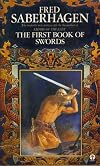
The First Book of Swords
by Fred Saberhagen
Book of Swords (1), Ardneh's World (5 (First Book of Swords))
On This Page
Description
In all twelve years of Mark's life, the sword that hangs on the wall in his home has never been used. It is only when a small group of strangers enters his village one day demanding to see the sword that Mark truly begins to understand it is no ordinary blade. When a fight breaks out, the sword takes on a life of its own, mercilessly cutting down all in its path. Mark is the only one to walk away from the bloodbath. When his mother sees one of the strangers-the Duke's cousin-lying with show more Mark's arrow buried in his throat, she commands her son to flee. Left with no choice, he takes up the sword and runs. Little does he know, he is running straight into a far greater war.This is a world of dragon-hunters, knights, and enchantresses. Of power-hungry rulers and gods that walk among humans. And a group of magical swords that has the power to determine the fate of them all. show lessTags
Recommendations




















Member Reviews
This book is the introduction to the world of the Swords and the bored gods.
On the one hand, very '70s- impressionistic, quickly written, drawing heavily on archetype characters. But Saberhagen, the man behind Berserker, makes these things his own.
In the beginning the gods are bored- and they are all the gods of classic antiquity. So Vulcan is commissioned to "make the Swords for the Game", and realizes he can use the essence of humanity in their forging.
Jorge, a blacksmith in a remote village, is the only survivor of a group of men called to aid Vulcan in the forging- his right arm taken, and a flawless, simple blade given in payment. "His" son Mark later unwillingly comes into possession of the blade- but neither it nor Mark are show more entirely what they seem.
Meanwhile, nobles throughout the world begin to move to procure these strange magic Swords that have appeared, each with their own characteristics.
Saberhagen aimed high with this one, didn't entirely support the quality of his concepts with his technical execution, but a worthwhile read nonetheless. There are 12 Swords of Power, each a weapon with but 11 other peers, each with a special gift it bestows on its bearer. There is a rhyme in the back of the back that contains the essence of Sword-lore- questions that remain are "what are demons?" "Who is the mysterious Emperor?" "Where did these gods come from?" "What is the point of the Swords?"
Each Sword's ability comes with a vulnerability; and each sword has a more subtle second gift. Coinspinner, the Sword of Chance or Sword of Luck, makes its bearer supernaturally lucky- but it will randomly teleport itself away from/arrange to be lost by its own, representing the fickleness of chance. Its secondary gift is guidance- it can tell you, used as a dousing rod, in which direction your path lay that gave you the greatest chance of success. So their magic is not so simple; and no Sword fully dominates the others once that is understood. show less
On the one hand, very '70s- impressionistic, quickly written, drawing heavily on archetype characters. But Saberhagen, the man behind Berserker, makes these things his own.
In the beginning the gods are bored- and they are all the gods of classic antiquity. So Vulcan is commissioned to "make the Swords for the Game", and realizes he can use the essence of humanity in their forging.
Jorge, a blacksmith in a remote village, is the only survivor of a group of men called to aid Vulcan in the forging- his right arm taken, and a flawless, simple blade given in payment. "His" son Mark later unwillingly comes into possession of the blade- but neither it nor Mark are show more entirely what they seem.
Meanwhile, nobles throughout the world begin to move to procure these strange magic Swords that have appeared, each with their own characteristics.
Saberhagen aimed high with this one, didn't entirely support the quality of his concepts with his technical execution, but a worthwhile read nonetheless. There are 12 Swords of Power, each a weapon with but 11 other peers, each with a special gift it bestows on its bearer. There is a rhyme in the back of the back that contains the essence of Sword-lore- questions that remain are "what are demons?" "Who is the mysterious Emperor?" "Where did these gods come from?" "What is the point of the Swords?"
Each Sword's ability comes with a vulnerability; and each sword has a more subtle second gift. Coinspinner, the Sword of Chance or Sword of Luck, makes its bearer supernaturally lucky- but it will randomly teleport itself away from/arrange to be lost by its own, representing the fickleness of chance. Its secondary gift is guidance- it can tell you, used as a dousing rod, in which direction your path lay that gave you the greatest chance of success. So their magic is not so simple; and no Sword fully dominates the others once that is understood. show less
A little over a decade ago, Vulcan voluntelled some men to help him create a handful of magic swords. The process killed all of them but one, and that guy lost his arm. Vulcan gave him one of the swords as payment for his labor, though, and for years it hung on the wall of his hut. When some bad guys come to town looking for it and start a ruckus that ends in one of the man's sons dead, the other son grabs the sword and heads for the hills. Or mountains, rather. So starts Mark's adventures with his father's sword, which turns out to be wanted by a lot of powerful people for a lot of different reasons.
It started out very promising (I love the twist on the Greek gods), and I like Mark's character pretty well, but by the middle it started show more dragging for me some and it never really picked back up its original speed. I didn't hate it, but I don't think I'll be going on with the series. show less
It started out very promising (I love the twist on the Greek gods), and I like Mark's character pretty well, but by the middle it started show more dragging for me some and it never really picked back up its original speed. I didn't hate it, but I don't think I'll be going on with the series. show less
This is another book that I read young enough that I can't be really objective about it. However, it holds up to a reread well enough, which is always a huge relief.
The First... is an oddly structured book. Mark, whose conception we see in the prologue, and the Swords (which... likewise) are the main characters of this series. (Yes, the main characters are largely inanimate objects.) The essay at the end (about which more in a bit) mentions that the series was written as the basis for "microcomputer" game. This actually makes quite a bit of sense in hindsight - The First... is as much a dungeonmaster's guide as a story in itself. The language is a bit dry, but it's more a style than a flaw.
Nonetheless, there is the story, or the first show more part of one, as young Mark sets off with his father's Sword with the authorities hot on his heels. He encounters gods, dragons, and an army on the way. The story takes a rather strange detour in the middle as we follow Nestor on a side-quest - he never really rises above secondary character status and, unlike very nearly all of the characters in this book, we never see him in the sequels. I found this section disconcerting and a little boring as a youngster - now I can roll with it and just enjoy the additional worldbuilding, but it's still a trifle clumsy.
There is a strong female secondary character, and a pair of well-written tertiary ones. The book fails the Bechdel test rather egregiously, though, because there are *only* three named female characters and they never actually interact. However, this is such a pleasant improvement over the last couple books I've read that I'll forgive it.
A brief note on the essay at the back: I found it utterly fascinating as a kid, both for its handy synopsis of the prequel series (which I did not read until it was reprinted years later) and for its glib analysis of the Swords and the (admittedly terrible) poetry attached to them. It gave the series a gravity that it does not perhaps deserve. Now I'm much less impressed by it - it's Eurocentric in the extreme, if nothing else - but I prefer the paperback edition that contains it just for the nostalgia value.
On the whole, a pleasant visit with an old friend. show less
The First... is an oddly structured book. Mark, whose conception we see in the prologue, and the Swords (which... likewise) are the main characters of this series. (Yes, the main characters are largely inanimate objects.) The essay at the end (about which more in a bit) mentions that the series was written as the basis for "microcomputer" game. This actually makes quite a bit of sense in hindsight - The First... is as much a dungeonmaster's guide as a story in itself. The language is a bit dry, but it's more a style than a flaw.
Nonetheless, there is the story, or the first show more part of one, as young Mark sets off with his father's Sword with the authorities hot on his heels. He encounters gods, dragons, and an army on the way. The story takes a rather strange detour in the middle as we follow Nestor on a side-quest - he never really rises above secondary character status and, unlike very nearly all of the characters in this book, we never see him in the sequels. I found this section disconcerting and a little boring as a youngster - now I can roll with it and just enjoy the additional worldbuilding, but it's still a trifle clumsy.
There is a strong female secondary character, and a pair of well-written tertiary ones. The book fails the Bechdel test rather egregiously, though, because there are *only* three named female characters and they never actually interact. However, this is such a pleasant improvement over the last couple books I've read that I'll forgive it.
A brief note on the essay at the back: I found it utterly fascinating as a kid, both for its handy synopsis of the prequel series (which I did not read until it was reprinted years later) and for its glib analysis of the Swords and the (admittedly terrible) poetry attached to them. It gave the series a gravity that it does not perhaps deserve. Now I'm much less impressed by it - it's Eurocentric in the extreme, if nothing else - but I prefer the paperback edition that contains it just for the nostalgia value.
On the whole, a pleasant visit with an old friend. show less
I enjoyed the book, and hugely appreciate that even though went got war, he didn't get bogged down in detailed battle scenes, but let us focus on what some non-combatants were doing sometimes. I'm curious about what happens next, but don't feel driven to get the next book in my hands right away....
This was the start of a very interesting concept series - a series about a set of very magical swords, each with its own unique power. Each sword had the potential to raise kingdoms and perhaps even threaten the gods who created them, what would happen if anyone collected too many?
This was a very well written story about the beginnings of the swords and what some ordinary people made of them. A great book for sword (and not much sorcery) fans!
This was a very well written story about the beginnings of the swords and what some ordinary people made of them. A great book for sword (and not much sorcery) fans!
The First book in Fred Saberhagen’s trilogy about the 12 swords of power. This is an interesting novel that takes place in the far future, but has the feel, and elements of, a medieval swords and sorcery novel. In the future, post apocalyptic, mankind is able to survive only because of technology. There are some humans that believe themselves to be gods, and they create swords that are magical, in order to play games with mankind. While good, this book was clearly a setup for the rest of the series and I dislike that. I believe that a book should be a complete thought unto itself and, while a part of a series, should not need the rest of the series to be a full thought.
A blast from the past. I read this series many years ago and I'm enjoying it as much this time around as I did the first time!
Members
- Recently Added By
Author Information

195+ Works 24,557 Members
Author Fred Saberhagen was born in Chicago, Illinois on May 18, 1930. Before writing full time, he served in the Air Force, worked as an electronics technician, and wrote and edited for the Encyclopaedia Britannica. His first novel, The Golden People, was published in 1964. He has written science fiction, fantasy, alternate history, and historical show more fantasy. The novel Berserker was published in 1967 and became the first book in his popular Berserker series. His company, Berserker Works, Ltd., has produced several computer games based on his characters. He died on June 29, 2007. (Bowker Author Biography) show less
Series


Belongs to Publisher Series
Drakar & Demoner (35)
Work Relationships
Is contained in
Common Knowledge
- Canonical title
- The First Book of Swords
- Original publication date
- 1983
- People/Characters
- Jord; Mark; Duke Fratkin; Sir Andrew; Nestor; Ben of Purkinje (show all 7); Barbara
- Important places
- Sir Andrew's Castle
- First words
- In what felt to him like the first cold morning of the world, he groped for fire.
Classifications
Statistics
- Members
- 942
- Popularity
- 28,300
- Reviews
- 10
- Rating
- (3.44)
- Languages
- English, German, Swedish
- Media
- Paper, Audiobook, Ebook
- ISBNs
- 16
- ASINs
- 6