On This Page
Description
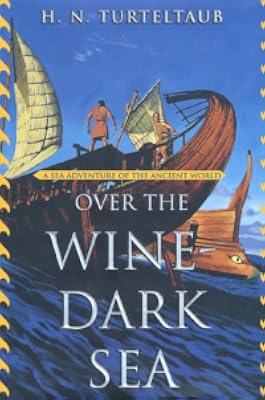
Menedemos, the young dashing sea captain, and his helper, the scholarly Sostratos, are sea-traders from the Greek island of Rhodes. Fearless sailors, they will travel any distance for profit or treasure.Tags
Recommendations













Member Reviews
Harry Turtledove writes these historical fictions under the name Turtletaub, I guess because of a marketing decision, so the books aren't pre-sold to his WWII and US Civil War Alternates readers. And to my tastes, these are superior products, and the adventures of a couple of Hellenistic Rhodians are good entertainment. We meet the pair, and their world of the divided Greek powers dueling it out over the empire conquered by Alexander in this outing.
We come to understand that domestic slaves are family members, that Greek cuisine of the period was a lot duller than our contemporary array, and a more classical view of sex as a plot driver. I think the Sci-Fi readers could benefit from this less sensational approach to the past.
We come to understand that domestic slaves are family members, that Greek cuisine of the period was a lot duller than our contemporary array, and a more classical view of sex as a plot driver. I think the Sci-Fi readers could benefit from this less sensational approach to the past.
I have trouble appreciating historical novels, but I was curious as to what Harry Turtledove, author of numerous alternate histories and here writing under a pen name, would do with historical fiction set not too far outside of his formal training in Byzantine history.
Set in 310 BC, it features only two main characters - not several like his alternate history novels - who are cousins going on a trading voyage for their family business. Menedemos is younger but still the alpha male. Smart, but not intellectual, impulsive, charismatic, a natural leader and frequent bedder of other men's wives; he's the captain. The older Sostratos is not as comfortable among others, an intellectual and would-be historian, not at all impulsive and not as show more physically gifted as his cousin. They bicker about much, not the least the merits of Homer, Aristophanes, and Thucydides.
The novel is a leisurely description of a trading trip through the Mediterranean from Rhodes to Italy and Sicily. This is a workaday novel with no secret messages being carried, no quest for fabled or magical items, no endangered beautiful princesses , no villain to pursue or flee. The most exotic thing is the cousins' attempts to get rid of a load of peacocks. In his afterwords, Turtledove gives his historical sources for some of the events and characters. (It turns out Menedemos is an historical character though Turtledove gives no further details.)
Turtledove keeps his usual tics down to a minimum. In other words, there aren't too many puns, and the author doesn't spend as much time as usual blatantly emphasizing the callousness of our heroes to the moral evils of the novel's world.
If you want a detailed description of the minutia of this world, I suspect this isn't the novel for you. I thought I got enough details without Turtledove trying to show off his research. Whenever I've encountered that sort of historical novel before, I get impatient and think I might as well just read a straight history about the same time period. Neither cousin being a famous historical personage was also a plus for me. show less
Set in 310 BC, it features only two main characters - not several like his alternate history novels - who are cousins going on a trading voyage for their family business. Menedemos is younger but still the alpha male. Smart, but not intellectual, impulsive, charismatic, a natural leader and frequent bedder of other men's wives; he's the captain. The older Sostratos is not as comfortable among others, an intellectual and would-be historian, not at all impulsive and not as show more physically gifted as his cousin. They bicker about much, not the least the merits of Homer, Aristophanes, and Thucydides.
The novel is a leisurely description of a trading trip through the Mediterranean from Rhodes to Italy and Sicily. This is a workaday novel with no secret messages being carried, no quest for fabled or magical items, no endangered beautiful princesses , no villain to pursue or flee. The most exotic thing is the cousins' attempts to get rid of a load of peacocks. In his afterwords, Turtledove gives his historical sources for some of the events and characters. (It turns out Menedemos is an historical character though Turtledove gives no further details.)
Turtledove keeps his usual tics down to a minimum. In other words, there aren't too many puns, and the author doesn't spend as much time as usual blatantly emphasizing the callousness of our heroes to the moral evils of the novel's world.
If you want a detailed description of the minutia of this world, I suspect this isn't the novel for you. I thought I got enough details without Turtledove trying to show off his research. Whenever I've encountered that sort of historical novel before, I get impatient and think I might as well just read a straight history about the same time period. Neither cousin being a famous historical personage was also a plus for me. show less
310 BC--nearly a generation after Alexander the Great's death, while his generals are still squabbling about how to divide Alexander's Empire. Interesting and readable humorous novel of two cousins, Menedemos and Sostrates. one a sea captain and the other a quartermaster-cum-accountant, on a trading voyage from Rhodes, Greek island-hopping, to the Italian mainland: Taras and other cities, buying and selling goods throughout their voyage: Chian wine, Coan silk, papyrus, ink, AND peafowl. At different points they are harried by Romans, they overcome a pirate ship, take grain to Syracuse on Sicily. At that time Syracuse is fighting a war against Carthage. In Taras, each cousin has woman trouble, so much so they decide never to return to show more that city. Much ado about maintaining on shipboard and selling the peafowl and their chicks for a decent price. Banter between the two cousins, who are completely opposite in personality. Menedemos is impulsive and doesn't think ahead; Sostratos is scholarly, cautious, and does consider consequences. The author did teach us painlessly about customs of those times.
Recommended. show less
Recommended. show less
I love alternate history, and am generally a fan of Turteltaub's books (the ones he writes under his other name, Turtledove). I know he has a good command of history, so I thought this ancient Greek sea-faring story would be interesting. This one, though, was disappointing. I kept thinking, "When does the story start?" by which I mean, at what point does the plot thicken? When does the drama heighten? When do the protagonists get into difficulties that become more difficult before they get out again?
Answer: it doesn't, and they don't. It seems like the author was so intent on exploring the historical/cultural milieu in this one (which he brings nicely alive), that the dramatic arc is sadly neglected or overlooked in consequence. This show more is at best a very "low key" excusion through the minimally challenging lives of the protagonists. It is not the robust storytelling Turteltaub is capable of. show less
Answer: it doesn't, and they don't. It seems like the author was so intent on exploring the historical/cultural milieu in this one (which he brings nicely alive), that the dramatic arc is sadly neglected or overlooked in consequence. This show more is at best a very "low key" excusion through the minimally challenging lives of the protagonists. It is not the robust storytelling Turteltaub is capable of. show less
Menedemos and his cousin Sostratos are traders, the sons of merchants living in Rhodes. This is the story of one of their summer trips where they take fine goods, silks, perfumes, peacocks, and wine to sell along the western coast of Italy.
It's wonderfully historically accurate and a very entertaining read. It wasn't exactly what I expected having read a number of Mr. Turtledove's sci-fi/history books, but I enjoyed it greatly as a faithful representation of that time in the Mediterranean Sea. I'm looking forward to reading the next book in the series.
It's wonderfully historically accurate and a very entertaining read. It wasn't exactly what I expected having read a number of Mr. Turtledove's sci-fi/history books, but I enjoyed it greatly as a faithful representation of that time in the Mediterranean Sea. I'm looking forward to reading the next book in the series.
this book was historically very informative. i liked the writing style. funny, good story.
Ratings
Members
- Recently Added By
Author Information

279+ Works 43,221 Members
Harry Turtledove was born in Los Angeles, California on June 14, 1949. He received a Ph.D. in Byzantine history from UCLA in 1977. From the late 1970's to the early 1980's, he worked as a technical writer for the Los Angeles County Office of Education. He left in 1991 to become full-time writer. His first two novels, Wereblood and Werenight, were show more published in 1979 under the pseudonym Eric G. Iverson because his editor did not think people would believe that Turtledove was his real name. He used this name until 1985 when he published Herbig-Haro and And So to Bed under his real name. He has received numerous awards including the Homer Award for Short Story for Designated Hitter in 1990, the John Esthen Cook Award for Southern Fiction for Guns of the Southand in 1993, and the Hugo Award for Novella for Down in the Bottomlands in 1994. (Bowker Author Biography) show less
Series

Work Relationships
Common Knowledge
- Canonical title
- Over the Wine-Dark Sea
- Original publication date
- 2001
- People/Characters
- Menedemos; Sostratos
- Important places
- Ancient Greece; Rhodes, Greece
- Dedication
- This book is for Professor Stanley Burstein of California State University, Los Angeles, and for Noreen Doyle, with many thanks for their friendship and for their help with my research.
- First words
- Menedemos and his cousing Sostratos walked down toward the Aphrodite in the main harbor of Rhodes.
- Publisher's editor
- Nielsen Hayden, Patrick
Classifications
- Genres
- Fiction and Literature, General Fiction, Historical Fiction, Fantasy
- DDC/MDS
- 813.54 — Literature & rhetoric American literature in English American fiction in English 1900-1999 1945-1999
- LCC
- PS3570 .U758 .O94 — Language and Literature American literature American literature Individual authors 1961-
- BISAC
Statistics
- Members
- 142
- Popularity
- 231,835
- Reviews
- 6
- Rating
- (3.53)
- Languages
- English
- Media
- Paper, Audiobook, Ebook
- ISBNs
- 8
- ASINs
- 2