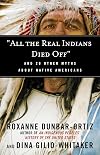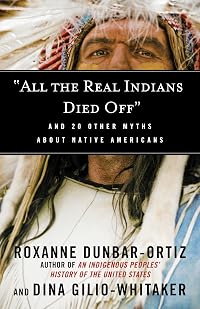
All the Real Indians Died off and 20 Other Myths About Native Americans
by Roxanne Dunbar-Ortiz, Dina Gilio-Whitaker
On This Page
Description
Dunbar-Ortiz deftly shows how myths about Native Americans are rooted in the fears and prejudice of European settlers and in the larger political agendas of a settler state aimed at acquiring Indigenous land and are tied to narratives of erasure and disappearance. Accessibly written and revelatory, All the Real Indians Died Off challenges readers to rethink what they have been taught about Native Americans and history.Tags
Recommendations



Member Reviews
This is a very 101 level book. If you know nothing about Native issues, then read it immediately. These are things all U.S. citizens and residents should know.
If you are already familiar with these topics, you won't learn anything new. That said, this book does give you some great ammunition if you struggle to explain to the willfully ignorant why it's important to describe the decimation of Native populations as "genocide," why Washington's NFL team name is problematic, why it's problematic to dress up as an "Indian" for Halloween, and similar topics.
(I'd like to note that I have a pretty serious issue with the identity politics that Roxanne Dunbar-Ortiz perpetuates in her own life, claiming a Native identity with no proof, but that show more does not appear in this book. Indeed, this book's value overrides any of my personal concerns about her.) show less
If you are already familiar with these topics, you won't learn anything new. That said, this book does give you some great ammunition if you struggle to explain to the willfully ignorant why it's important to describe the decimation of Native populations as "genocide," why Washington's NFL team name is problematic, why it's problematic to dress up as an "Indian" for Halloween, and similar topics.
(I'd like to note that I have a pretty serious issue with the identity politics that Roxanne Dunbar-Ortiz perpetuates in her own life, claiming a Native identity with no proof, but that show more does not appear in this book. Indeed, this book's value overrides any of my personal concerns about her.) show less
 This review was written for LibraryThing Early Reviewers.
Belongs in high school libraries everywhere.
(Full disclosure: I received an electronic ARC for review through Edelweiss.)
Non-Natives thus position themselves, either wittingly or unwittingly, as being the true experts about Indians and their histories—and it happens at all levels of society, from the uneducated all the way up to those with advanced college degrees, and even in the halls of Congress. [...]
The result is the perpetual erasure of Indians from the US political and cultural landscape. In short, for five centuries Indians have been disappearing in the collective imagination. They are disappearing in plain sight.
###
Imagining huge fields of gold, which did not exist, Columbus instituted what later became known as the show more encomienda system, large estates run on forced labor for the purposes of extracting gold. Las Casas reported that when mining quotas were not met by the Indians excavating the gold, their hands were cut off and they bled to death. When they attempted to flee, they were hunted down with dogs and killed. So little gold existed in Hispaniola that the island turned into a massive killing field.
###
He [King George] has excited domestic insurrections amongst us, and has endeavored to bring on the inhabitants of our frontiers, the merciless Indian savages, whose known rule of warfare, is undistinguished destruction of all ages, sexes and conditions.
—Declaration of Independence
###
-- 4.5 stars --
Native Americans should be honored to have sports teams named after them.
The Indians lost the war, why can't they move on already?
Indian casinos make everyone rich.
Whether your ancestors were indigenous to North America or not, no doubt you're familiar with at least a few of these myths about Native Americans. Actually, that's an understatement, given that our culture - right down to its founding documents - is steeped in such half-truths, contested theories, and outright lies. They're taught in our high school history books (Columbus discovered America; the convoluted and decontextualized myth of Thanksgiving), trotted out for celebrations (Native American mascots; cultural appropriation in Halloween costumes), and have been used to strip Native tribes of their lands, power, and self-determination ("real" Indians live on reservations/meet blood quantum requirements/belong to a tribe/adhere to certain spiritual practices).
This last is accomplished primarily through erasure. The most pernicious myth - the titular "All the Real Indians Died Off" - has been used to erase Native peoples from both the past and present. After all, if Native Americans no longer exist, then they've no need of tribal lands. (Convenient, that.) This erasure can be violent and bloody, as it was so often in the past: through genocide or "extermination," supported at both the state and federal levels. Often it comes in much more insidious, systemic forms: "the forcible transfer of children throughout the Indian boarding school era and the extent of transracial Indian adoption in the nineteenth and twentieth centuries"; restrictive blood quantum requirements that bar many people from rightfully claiming their Native descent; religious conversion; policies that force or encourage intermarriage; incentives that cause young people to immigrate from reservations to urban centers; and so on.
Many of the myths explored here stem from this singular narrative; "It can be thought of as the central organizing myth from which most other popular myths about Native people arise." Indeed, it quickly becomes apparent just how interconnected each myth is; they all feed into and support one another, in ways both subtle and overt.
"All the Real Indians Died Off" reads a little like James Loewen's Lies My Teacher Told Me, albeit with a singular, laser-like focus. I thought I was reasonably well-informed on these subjects - everyone knows that Columbus was a murderous dirtbag who couldn't navigate for shit, right? and Thanksgiving is just a nice story we like to tell kids as they finger-paint turkeys, yeah? - yet I continually found myself surprised, almost always not in a good way. Thomas Jefferson's description of Native Americans as "savages" in the freaking Declaration of Independence - you know, the document of Life, Liberty and the pursuit of Happiness and all that jazz - made my jaw drop. But the most shocking thing has got to be the Marshall court's "trilogy" of rulings concerning Native sovereignty - in particular, Johnson v. M’Intosh (1823), which was based in part on papal bulls, including those that became the basis for the Doctrine of Discovery. (In short, invaders = keepers.) Separation of church and state, anyone?
At just over 200 pages, "All the Real Indians Died Off" is a short little book that packs a powerful, passionate punch. Dunbar-Ortiz and Gilio-Whitaker provide a compelling yet succinct overview (and sound debunking) of each myth, all the while demonstrating how they relate to each other - and the erasure of Indigenous Americans, with the ultimate goal of stripping them of their land.
In fact, their skill is all the more impressive when you consider that the last quarter of the book is actually a timeline of Native American history. Take away the timeline and (copious) notes, and the mythology section comes in at a tick over 150 pages.
Considering the book's length, I wish the authors had included a few more myths - especially the idea that tribal courts are inferior and it would be unjust to subject non-Natives to tribal laws when on tribal land. This is addressed briefly, in the context of the epidemic of rape faced by Native American women, usually by non-Native perpetrators. (#19, “What’s the Problem with Thinking of Indian Women as Princesses or Squaws?”) This is just one that's fresh in my mind, thanks to a recent episode of Full Frontal, but I'm sure there are dozens more - especially those that converge with other forms of oppression and marginalization.
Also, while the discussion of the land bridge theory is indeed fascinating (like many of you, I learned this as a fact in middle and high school), I'm not quite sure why the myth that “Indians Were the First Immigrants to the Western Hemisphere” is necessarily pernicious. Incorrect and an example of scientific stubbornness, sure, but harmful? If anything, doesn't being the first ones here bolster Native American claims to the land? (Theoretically, anyway.) Of all the myths, this is the only one that maybe could have been explained better. I feel like I'm missing something.
Otherwise, it's an engaging and informative read. The language sometimes veers into the academic, but for the most part it's fairly accessible. The book is well-researched and meticulously documented. The authors do a commendable job distilling complex topics into easily digestible chapters. Each chapter could easily fill an entire book - and indeed, Dunbar-Ortiz and Gilio-Whitaker frequently reference books written by others - yet the discussion is both clear and concise.
I'd definitely recommend this to high school students; if anything, learning about the more troubling and problematic aspects of our history makes it more interesting, engaging, and alive. I didn't really get into history until I read Roots - as an elective for my tenth grade English class. Plus there's that whole thing about those who don't know history being doomed to repeat it. And whether it's slavery (of both Africans and Native Americans) that helped America grow its economy, or the massive land theft and genocide that our country is founded on, the echoes are still felt today: in the denial of tribal sovereignty; the appropriation of Native spiritual practices by New Agers; the dearth of health care on reservations; and the destruction of sacred sites by megacorporations.
TABLE OF CONTENTS
Authors’ Note • ix
Introduction • 1
MYTH 1: “All the Real Indians Died Off” • 7
MYTH 2: “Indians Were the First Immigrants to the Western Hemisphere” • 14
MYTH 3: “Columbus Discovered America” • 23
MYTH 4: “Thanksgiving Proves the Indians Welcomed Pilgrims” • 32
MYTH 5: “Indians Were Savage and Warlike” • 38
MYTH 6: “Indians Should Move On and Forget the Past” • 44
MYTH 7: “Europeans Brought Civilization to the Backward Indians” • 51
MYTH 8: “The United States Did Not Have a Policy of Genocide” • 58
MYTH 9: “US Presidents Were Benevolent or at Least Fair-Minded Toward Indians” • 67
MYTH 10: “The Only Real Indians Are Full-Bloods, and They Are Dying Off” • 76
MYTH 11: “The United States Gave Indians Their Reservations” • 82
MYTH 12: “Indians Are Wards of the State” • 87
MYTH 13: “Sports Mascots Honor Native Americans” • 92
MYTH 14: “Native American Culture Belongs to All Americans” • 100
MYTH 15: “Most Indians Are on Government Welfare” • 109
MYTH 16: “Indian Casinos Make Them All Rich” • 117
MYTH 17: “Indians Are Anti-Science” • 123
MYTH 18: “Indians Are Naturally Predisposed to Alcohol” • 130
MYTH 19: “What’s the Problem with Thinking of Indian Women as Princesses or Squaws?” • 137
MYTH 20: “Native Americans Can’t Agree on What to Be Called” • 145
MYTH 21: “Indians Are Victims and Deserve Our Sympathy” • 150
Historical Time Line • 159
Acknowledgments • 179
Notes • 181
http://www.easyvegan.info/2016/10/07/all-the-real-indians-died-off-by-roxanne-du... show less
(Full disclosure: I received an electronic ARC for review through Edelweiss.)
Non-Natives thus position themselves, either wittingly or unwittingly, as being the true experts about Indians and their histories—and it happens at all levels of society, from the uneducated all the way up to those with advanced college degrees, and even in the halls of Congress. [...]
The result is the perpetual erasure of Indians from the US political and cultural landscape. In short, for five centuries Indians have been disappearing in the collective imagination. They are disappearing in plain sight.
###
Imagining huge fields of gold, which did not exist, Columbus instituted what later became known as the show more encomienda system, large estates run on forced labor for the purposes of extracting gold. Las Casas reported that when mining quotas were not met by the Indians excavating the gold, their hands were cut off and they bled to death. When they attempted to flee, they were hunted down with dogs and killed. So little gold existed in Hispaniola that the island turned into a massive killing field.
###
He [King George] has excited domestic insurrections amongst us, and has endeavored to bring on the inhabitants of our frontiers, the merciless Indian savages, whose known rule of warfare, is undistinguished destruction of all ages, sexes and conditions.
—Declaration of Independence
###
-- 4.5 stars --
Native Americans should be honored to have sports teams named after them.
The Indians lost the war, why can't they move on already?
Indian casinos make everyone rich.
Whether your ancestors were indigenous to North America or not, no doubt you're familiar with at least a few of these myths about Native Americans. Actually, that's an understatement, given that our culture - right down to its founding documents - is steeped in such half-truths, contested theories, and outright lies. They're taught in our high school history books (Columbus discovered America; the convoluted and decontextualized myth of Thanksgiving), trotted out for celebrations (Native American mascots; cultural appropriation in Halloween costumes), and have been used to strip Native tribes of their lands, power, and self-determination ("real" Indians live on reservations/meet blood quantum requirements/belong to a tribe/adhere to certain spiritual practices).
This last is accomplished primarily through erasure. The most pernicious myth - the titular "All the Real Indians Died Off" - has been used to erase Native peoples from both the past and present. After all, if Native Americans no longer exist, then they've no need of tribal lands. (Convenient, that.) This erasure can be violent and bloody, as it was so often in the past: through genocide or "extermination," supported at both the state and federal levels. Often it comes in much more insidious, systemic forms: "the forcible transfer of children throughout the Indian boarding school era and the extent of transracial Indian adoption in the nineteenth and twentieth centuries"; restrictive blood quantum requirements that bar many people from rightfully claiming their Native descent; religious conversion; policies that force or encourage intermarriage; incentives that cause young people to immigrate from reservations to urban centers; and so on.
Many of the myths explored here stem from this singular narrative; "It can be thought of as the central organizing myth from which most other popular myths about Native people arise." Indeed, it quickly becomes apparent just how interconnected each myth is; they all feed into and support one another, in ways both subtle and overt.
"All the Real Indians Died Off" reads a little like James Loewen's Lies My Teacher Told Me, albeit with a singular, laser-like focus. I thought I was reasonably well-informed on these subjects - everyone knows that Columbus was a murderous dirtbag who couldn't navigate for shit, right? and Thanksgiving is just a nice story we like to tell kids as they finger-paint turkeys, yeah? - yet I continually found myself surprised, almost always not in a good way. Thomas Jefferson's description of Native Americans as "savages" in the freaking Declaration of Independence - you know, the document of Life, Liberty and the pursuit of Happiness and all that jazz - made my jaw drop. But the most shocking thing has got to be the Marshall court's "trilogy" of rulings concerning Native sovereignty - in particular, Johnson v. M’Intosh (1823), which was based in part on papal bulls, including those that became the basis for the Doctrine of Discovery. (In short, invaders = keepers.) Separation of church and state, anyone?
At just over 200 pages, "All the Real Indians Died Off" is a short little book that packs a powerful, passionate punch. Dunbar-Ortiz and Gilio-Whitaker provide a compelling yet succinct overview (and sound debunking) of each myth, all the while demonstrating how they relate to each other - and the erasure of Indigenous Americans, with the ultimate goal of stripping them of their land.
In fact, their skill is all the more impressive when you consider that the last quarter of the book is actually a timeline of Native American history. Take away the timeline and (copious) notes, and the mythology section comes in at a tick over 150 pages.
Considering the book's length, I wish the authors had included a few more myths - especially the idea that tribal courts are inferior and it would be unjust to subject non-Natives to tribal laws when on tribal land. This is addressed briefly, in the context of the epidemic of rape faced by Native American women, usually by non-Native perpetrators. (#19, “What’s the Problem with Thinking of Indian Women as Princesses or Squaws?”) This is just one that's fresh in my mind, thanks to a recent episode of Full Frontal, but I'm sure there are dozens more - especially those that converge with other forms of oppression and marginalization.
Also, while the discussion of the land bridge theory is indeed fascinating (like many of you, I learned this as a fact in middle and high school), I'm not quite sure why the myth that “Indians Were the First Immigrants to the Western Hemisphere” is necessarily pernicious. Incorrect and an example of scientific stubbornness, sure, but harmful? If anything, doesn't being the first ones here bolster Native American claims to the land? (Theoretically, anyway.) Of all the myths, this is the only one that maybe could have been explained better. I feel like I'm missing something.
Otherwise, it's an engaging and informative read. The language sometimes veers into the academic, but for the most part it's fairly accessible. The book is well-researched and meticulously documented. The authors do a commendable job distilling complex topics into easily digestible chapters. Each chapter could easily fill an entire book - and indeed, Dunbar-Ortiz and Gilio-Whitaker frequently reference books written by others - yet the discussion is both clear and concise.
I'd definitely recommend this to high school students; if anything, learning about the more troubling and problematic aspects of our history makes it more interesting, engaging, and alive. I didn't really get into history until I read Roots - as an elective for my tenth grade English class. Plus there's that whole thing about those who don't know history being doomed to repeat it. And whether it's slavery (of both Africans and Native Americans) that helped America grow its economy, or the massive land theft and genocide that our country is founded on, the echoes are still felt today: in the denial of tribal sovereignty; the appropriation of Native spiritual practices by New Agers; the dearth of health care on reservations; and the destruction of sacred sites by megacorporations.
TABLE OF CONTENTS
Authors’ Note • ix
Introduction • 1
MYTH 1: “All the Real Indians Died Off” • 7
MYTH 2: “Indians Were the First Immigrants to the Western Hemisphere” • 14
MYTH 3: “Columbus Discovered America” • 23
MYTH 4: “Thanksgiving Proves the Indians Welcomed Pilgrims” • 32
MYTH 5: “Indians Were Savage and Warlike” • 38
MYTH 6: “Indians Should Move On and Forget the Past” • 44
MYTH 7: “Europeans Brought Civilization to the Backward Indians” • 51
MYTH 8: “The United States Did Not Have a Policy of Genocide” • 58
MYTH 9: “US Presidents Were Benevolent or at Least Fair-Minded Toward Indians” • 67
MYTH 10: “The Only Real Indians Are Full-Bloods, and They Are Dying Off” • 76
MYTH 11: “The United States Gave Indians Their Reservations” • 82
MYTH 12: “Indians Are Wards of the State” • 87
MYTH 13: “Sports Mascots Honor Native Americans” • 92
MYTH 14: “Native American Culture Belongs to All Americans” • 100
MYTH 15: “Most Indians Are on Government Welfare” • 109
MYTH 16: “Indian Casinos Make Them All Rich” • 117
MYTH 17: “Indians Are Anti-Science” • 123
MYTH 18: “Indians Are Naturally Predisposed to Alcohol” • 130
MYTH 19: “What’s the Problem with Thinking of Indian Women as Princesses or Squaws?” • 137
MYTH 20: “Native Americans Can’t Agree on What to Be Called” • 145
MYTH 21: “Indians Are Victims and Deserve Our Sympathy” • 150
Historical Time Line • 159
Acknowledgments • 179
Notes • 181
http://www.easyvegan.info/2016/10/07/all-the-real-indians-died-off-by-roxanne-du... show less
A necessary primer on many myths that USians are brought up believing about Native Americans. Reading books like this just makes me angry about how miseducated I was as a child, and how that miseducation continues to this day. I think it covers some really necessary topics about how racism and white supremacy has conspired over the years to try and eliminate the presence of indigenous peoples on this continent. There were definitely some things I would have liked to have read more about, but I guess this just means I'll have to find some more related books!
This review was written for LibraryThing Early Reviewers.A thought provoking look at race relations in this country, this time from the Native American point of view. Twenty-one myths are covered with facts and documentation to explain to European Americans their view point. Ideas such as Thanksgiving, Columbus and sports mascots are covered that turn our preconceived ideas on their head. Each chapter is a stand alone discussion for us to have. Some have more meat on their bones but each is well worth the thought put in to them. There are no 'solutions' offered; no 'this is what you should do or think' but instead the ideas are put out there for us to digest. I particularly like the historical time line in the back which outlines chronological facts from prehistoric time to the present. show more Concise and thoughtful. Well done. show less
This review was written for LibraryThing Early Reviewers.A series of chapters, each "busting" one myth about Native Americans. For the most part they were very good. While I was already at least partly aware of the truth behind each myth, I still learned a lot of facts from each chapter. Generally, my biggest quibble would be that there was a lack of primary sources being cited, it was mostly secondary sources. Why quote Howard Zinn quoting Bartolome de las Casas when you could just quote de las Casas himself?
The exception to my overall agreement with the book was chapter two, which deals with the myth "Native Americans were the first immigrants to North America". The authors' thesis for this chapter was not explicitly stated, but I believe they are arguing that Native American religion and show more oral tradition asserts that they have always lived in North America. This could be framed as a "respect Native religions (including creation myths)" argument, which I agree is important, but in the case of land rights one would have to also consider that the invading colonists' religion (Christianity) told them that North America was their right as well. "Native Americans were here first" is a good argument for Native land rights because it is a fact; "their religion says this land is theirs" is not a good argument because it can equally be used against them. Aside from religion, the only argument against Native American immigration is the same argument seen from Christian creation arguments as well - scientists & historians aren't sure if the immigration happened 10,000 years ago or 20,000 years ago, and thus all science and history must be wrong. This chapter was very early in the book, and left a bad taste in my mouth for subsequent chapters. If the authors thought it was important to include in the book, that is fine, but I wish it hadn't been at the beginning.
I think I would prefer to read shorter-form works by these authors, like essays or newspaper columns (or even these chapters on an individual basis). They were interesting, I learned things, and I like their point of view! But I thought this book was just okay. I'm not sure what the intended audience is. show less
The exception to my overall agreement with the book was chapter two, which deals with the myth "Native Americans were the first immigrants to North America". The authors' thesis for this chapter was not explicitly stated, but I believe they are arguing that Native American religion and show more oral tradition asserts that they have always lived in North America. This could be framed as a "respect Native religions (including creation myths)" argument, which I agree is important, but in the case of land rights one would have to also consider that the invading colonists' religion (Christianity) told them that North America was their right as well. "Native Americans were here first" is a good argument for Native land rights because it is a fact; "their religion says this land is theirs" is not a good argument because it can equally be used against them. Aside from religion, the only argument against Native American immigration is the same argument seen from Christian creation arguments as well - scientists & historians aren't sure if the immigration happened 10,000 years ago or 20,000 years ago, and thus all science and history must be wrong. This chapter was very early in the book, and left a bad taste in my mouth for subsequent chapters. If the authors thought it was important to include in the book, that is fine, but I wish it hadn't been at the beginning.
I think I would prefer to read shorter-form works by these authors, like essays or newspaper columns (or even these chapters on an individual basis). They were interesting, I learned things, and I like their point of view! But I thought this book was just okay. I'm not sure what the intended audience is. show less
This review was written for LibraryThing Early Reviewers.Having read “An Indigenous Peoples’ History of the United States”, this book written by the same author and Dina Gilio-Whitaker was as honest and comprehensive and did not disappoint. The book covers many interesting fallacies about Indigenous Peoples which were considered absolutely true and, in many instances, are still being taught today. The People did not disappear or vanish nor were they all assimilated into the colonial or European culture. The myth not only challenges the whereabouts of their physicality but also the cultural entities of The People. Today, authors are coming forth to teach of their identities and their cultures. I wonder how many non-Natives look for them or learn from them.
The truth of the adventures of show more Columbus has come to light, yet many continue to ignore the many catastrophes he caused. The book enlightens us as to his motivations and the rewards he sought. He was a slave trader under the Portuguese flag but was initially seeking his fortune in gold. The epic tales of the genocide he perpetuated were fleshed out much more vividly here. It’s amazing how we as a country can turn a blind eye or deaf ear to the horror he caused. Today, states and individual cities are changing the celebration of Columbus Day to Indigenous Peoples Day. This is a commendable start but much more can be done to attempt to rectify the many years of intentional mistruths.
A section deals with how the United States “gave the Indians their reservations”. They had their own lands taken from them and were forced on, many times, lands unsuitable for subsistence. It details stories of the colonial “massive land grab” that kept pushing Native people farther and farther west. The inequities are reflected and many are shown to be still prejudiced to even fair treatment of The People. It speaks of forced assimilation to learn the language, the dress, and lifestyle of the conquerors and how Natives were punished for even trying to speak their own languages or practice their own traditions.
Another most interesting chapter covers the myth that “Indians are anti-science”. It then details many of the ingenious ways that Natives created many unique devices for their survival which should be considered quite scientific for their time periods. It delineates areas of astronomy, hydraulic engineering, agriculture, transportation and more.
Each chapter is unique and enlightening. Whether or not we are Indigenous People ourselves, the truth of this book should be told and each reader can assume the responsibility to help set the record straight and end the falsehoods that have been perpetuated for far too long. I’m very grateful to have read this book and will gladly share these truths. show less
The truth of the adventures of show more Columbus has come to light, yet many continue to ignore the many catastrophes he caused. The book enlightens us as to his motivations and the rewards he sought. He was a slave trader under the Portuguese flag but was initially seeking his fortune in gold. The epic tales of the genocide he perpetuated were fleshed out much more vividly here. It’s amazing how we as a country can turn a blind eye or deaf ear to the horror he caused. Today, states and individual cities are changing the celebration of Columbus Day to Indigenous Peoples Day. This is a commendable start but much more can be done to attempt to rectify the many years of intentional mistruths.
A section deals with how the United States “gave the Indians their reservations”. They had their own lands taken from them and were forced on, many times, lands unsuitable for subsistence. It details stories of the colonial “massive land grab” that kept pushing Native people farther and farther west. The inequities are reflected and many are shown to be still prejudiced to even fair treatment of The People. It speaks of forced assimilation to learn the language, the dress, and lifestyle of the conquerors and how Natives were punished for even trying to speak their own languages or practice their own traditions.
Another most interesting chapter covers the myth that “Indians are anti-science”. It then details many of the ingenious ways that Natives created many unique devices for their survival which should be considered quite scientific for their time periods. It delineates areas of astronomy, hydraulic engineering, agriculture, transportation and more.
Each chapter is unique and enlightening. Whether or not we are Indigenous People ourselves, the truth of this book should be told and each reader can assume the responsibility to help set the record straight and end the falsehoods that have been perpetuated for far too long. I’m very grateful to have read this book and will gladly share these truths. show less
This review was written for LibraryThing Early Reviewers.The authors chose to frame this as 21 "myths" for marketing purposes, kind of like a ZergNet list for serious people, but it's really just 21 topics they wanted to write about. In 2016, do we still need to debunk the "myth" that Columbus discovered America? And who says Indians are anti-science, or more anti-science than the general public, which admittedly in the current era, seems pretty anti-science? Some chapters in this book are good and provide nice summaries of complex issues. The chapters on genocide, sports mascots, and cultural appreciation are decent. On the other hand, some chapters are train wrecks that lack direction. The chapter "Indians are wards of the state" contains some good reference information, but it's a snore to show more read. And Myth #20, called "Native Americans can't agree on what to be called" is funny, since it pretty much concludes that Native Americans can't agree on what to be called. A very mixed bag. show less
Members
- Recently Added By
Lists

Beacon Press
39 works; 1 member
Author Information

18+ Works 4,713 Members
Roxanne Dunbar-Ortiz is Professor Emerita of Ethnic Studies and Women's Studies at California State University, East Bay.
3 Works 768 Members
Dina Gilio-Whitaker (Colviile Confederated Tribes) is a lecturer of American Indian studies at California State University San Marcos, She is the coauthor, with Roxanne Dunbar-Ortiz, of "All the Real Indians Died Off" and 20 Other Myths About Native Americans. She lives in San Clemente, California.
Some Editions
Awards and Honors
Notable Lists
Common Knowledge
- Canonical title
- All the Real Indians Died off and 20 Other Myths About Native Americans
- Original publication date
- 2016
- Important places
- American West
Classifications
Statistics
- Members
- 348
- Popularity
- 90,672
- Reviews
- 17
- Rating
- (3.96)
- Languages
- English
- Media
- Paper, Audiobook, Ebook
- ISBNs
- 8
- ASINs
- 2