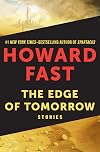
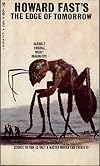
The Edge of Tomorrow
by Howard Fast
On This Page
Description
Vintage science fiction tales from an American masterBig bugs, cloned cats, and feral star-children play leading roles in the seven stories that make up Fast's unconventional and thought-provoking collection. The Edge of Tomorrow is a significant foray into science fiction by one of the twentieth century's most prolific novelists. In looking beyond our universe, Fast reveals much about the America of his timewhere the Cold War and a nascent civil rights movement stoked unconscious fears and show more desires. From ';The First Men,' about scientists tampering with genetic engineering, to ';The Large Ant,' about a man's thoughtless violence against nature, these stories are as relevant today as when they were first written.This ebook features an illustrated biography of Howard Fast including rare photos from the author's estate. show lessTags
Recommendations






Member Reviews
Review of The Large Ant from this book.
Ants make me squirm, so I was not keen to read this 1960 short story from “The Edge of Tomorrow”, but although this does feature a large ant, I’m grateful that “the government man” didn’t allow the inclusion of any photos - it’s framed as a true story that no one will believe amid a slew of fake news.
The narrator stays in a remote shack after his friends have left. He awakes to a large ant, and instinctively clubs it to death. He’s revolted by it, and by his reaction, but takes the body with him so a museum entomologist can have a look. That’s the setup.
The story itself is a Twilight Zone-type speculative fiction that is a mirror for the weaknesses of humankind - and why show more physical strength and violence are so often the response to the unfamiliar. It was compulsive, philosophical, and powerful.
Image: Entomology jars - none containing ants. (Source)
Quotes
• How will “it” end? “One held that sooner or later there would be too many people; another that we would do each other in, and the atom bomb made that a very good likelihood… All sorts of notions except the simple fact that we were what we were… we have never been any good at changing ourselves or the way we behave.” I didn’t fully agree with the last part, but went with it, and came to see Fast’s point.
• “Aside from a racetrack, a museum is the most interesting and unexpected place in the world.”
• “We don’t look carefully at a thing that is horrible or repugnant to us.”
• “A cultured and intelligent man, yet you cannot conceive of a mentality that does not include weapons as a prime necessity.”
• “If they are without the curse of murder, they may also be without the curse of fear… fear and hatred are two sides of the same coin.”
See also
• Six months’ ago, Short Story Club read - and I disliked - Calvino’s The Argentine Ant (which would be more accurately called “The Plague of Argentine Ants”: see my review HERE).
• In Manguel’s anthology of “fantastic” literature, this follows on from an equally good, but very different, piece that explores similar themes about the human propensity for violence and war: Marco Denevi’s A Dog in Dürer’s Etching “The Knight, Death and the Devil”, which I reviewed HERE.
• I detest ants, but not all insects: Kafka’s Metamorphosis (see my review HERE) makes me ponder, tear up, and chuckle every time.
• Any debate about catastrophic collapse versus technological solutions reminds me of Kenneth Boulding’s A Conservationist’s Lament and The Technologist’s Reply. You can read both poems in my review of Jonathan Swift's A Modest Proposal, HERE.
• Howard Fast also wrote epics that were filmed, including Spartacus, Moses, and The Prince of Egypt.
Short story club
I read this in Black Water: The Anthology of Fantastic Literature, by Alberto Manguel, from which I’m reading one story a week with The Short Story Club, starting 4 September 2023.
I can’t find an online version of this story to link to.
You can join the group here. show less
Ants make me squirm, so I was not keen to read this 1960 short story from “The Edge of Tomorrow”, but although this does feature a large ant, I’m grateful that “the government man” didn’t allow the inclusion of any photos - it’s framed as a true story that no one will believe amid a slew of fake news.
The narrator stays in a remote shack after his friends have left. He awakes to a large ant, and instinctively clubs it to death. He’s revolted by it, and by his reaction, but takes the body with him so a museum entomologist can have a look. That’s the setup.
The story itself is a Twilight Zone-type speculative fiction that is a mirror for the weaknesses of humankind - and why show more physical strength and violence are so often the response to the unfamiliar. It was compulsive, philosophical, and powerful.
Image: Entomology jars - none containing ants. (Source)
Quotes
• How will “it” end? “One held that sooner or later there would be too many people; another that we would do each other in, and the atom bomb made that a very good likelihood… All sorts of notions except the simple fact that we were what we were… we have never been any good at changing ourselves or the way we behave.” I didn’t fully agree with the last part, but went with it, and came to see Fast’s point.
• “Aside from a racetrack, a museum is the most interesting and unexpected place in the world.”
• “We don’t look carefully at a thing that is horrible or repugnant to us.”
• “A cultured and intelligent man, yet you cannot conceive of a mentality that does not include weapons as a prime necessity.”
• “If they are without the curse of murder, they may also be without the curse of fear… fear and hatred are two sides of the same coin.”
See also
• Six months’ ago, Short Story Club read - and I disliked - Calvino’s The Argentine Ant (which would be more accurately called “The Plague of Argentine Ants”: see my review HERE).
• In Manguel’s anthology of “fantastic” literature, this follows on from an equally good, but very different, piece that explores similar themes about the human propensity for violence and war: Marco Denevi’s A Dog in Dürer’s Etching “The Knight, Death and the Devil”, which I reviewed HERE.
• I detest ants, but not all insects: Kafka’s Metamorphosis (see my review HERE) makes me ponder, tear up, and chuckle every time.
• Any debate about catastrophic collapse versus technological solutions reminds me of Kenneth Boulding’s A Conservationist’s Lament and The Technologist’s Reply. You can read both poems in my review of Jonathan Swift's A Modest Proposal, HERE.
• Howard Fast also wrote epics that were filmed, including Spartacus, Moses, and The Prince of Egypt.
Short story club
I read this in Black Water: The Anthology of Fantastic Literature, by Alberto Manguel, from which I’m reading one story a week with The Short Story Club, starting 4 September 2023.
I can’t find an online version of this story to link to.
You can join the group here. show less
Stories with a pretentious tone, messy/tedious structure, and bad science. It's clearly the author's intention to be profound and mind-blowing, but his ideas are dumb and poorly thought out.
Ratings
Members
- Recently Added By
Author Information

183+ Works 8,236 Members
Howard Fast was born on November 11, 1914 in Manhattan. At the age of 17, he sold his first story to Amazing Stories magazine. The next year he sold his first novel, Two Villages, to the Dial Press for a $100 advance. During his lifetime, he wrote more than 80 books, including Conceived in Liberty, The Unvanquished, Citizen Tom Paine, Freedom show more Road, April Morning, The Immigrants, Second Generation, The Establishment, The Legacy, and Greenwich. He won the Stalin International Peace Prize in 1953. A member of the Communist party, he served three months in a federal prison in 1950 for refusing to testify about his political activity. Blacklisted as a result, he founded his own publishing house, Blue Heron Press, which released his novel Spartacus in 1951. In 1957, he wrote a book about his political experiences entitled The Naked God. He also wrote a series of detective stories under the name E. V. Cunningham. He died on March 12, 2003 at the age of 88. (Bowker Author Biography) show less
Series
Belongs to Publisher Series
Work Relationships
Contains
Has as a commentary on the text
Common Knowledge
- Original title
- The Edge of Tomorrow
- Original publication date
- 1961
- First words
- My dear sister: I found it.
- Last words
- (Click to show. Warning: May contain spoilers.)Like the others, he knew that he was returning to a place unique and precious in its singularity - Earth, the sole habitat of man.
- Original language*
- Inglés
- Disambiguation notice
- Contents:
The First Men
The Large Ant
Of Time and Cats
Cato the Martian
The Cold, Cold Box
The Martian Shop
The Sight of Eden
*Some information comes from Common Knowledge in other languages. Click "Edit" for more information.
Classifications
Statistics
- Members
- 176
- Popularity
- 185,693
- Reviews
- 2
- Rating
- (3.00)
- Languages
- 5 — English, French, German, Portuguese, Spanish
- Media
- Paper, Audiobook, Ebook
- ISBNs
- 4
- ASINs
- 21