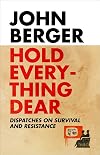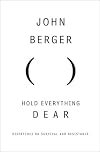
Hold Everything Dear: Dispatches on Survival and Resistance
by John Berger
On This Page
Description
From the War on Terror to resistance in Ramallah and traumatic dislocation in the Middle East, Berger explores the uses of art as an instrument of political resistance. Visceral and passionate, Hold Everything Dear is a profound meditation on the far extremes of human behaviour, and the underlying despair.Tags
Recommendations






































Member Reviews
This is such a pretty and satisfying book to hold in my hand, a light paperback clean white, font and punctuation the only marks. The prose reads exactly like the interview I once watched between John Berger and a young cultural critic from the BBC. Berger was older, had retired to the Alps, lived in a tiny village where the peasant occupants gave him joy and his table was covered in red gingham and he replied to the critic’s adulatory questions in a voice that measured moments, every word weighed, leaving quiet before giving answers if he needed to take time.
If you measure the book thematically it is not connected but it clearly threads through the thoughts of one man over a certain decade. It isn’t strictly a linear decade but show more perhaps there is a certain decade of thought, dominated by 2001 at the center. “Twelve Theses on the Economy of the Dead” is either a religion or a writing prompt. “Undefeated Despair” is the only kind of travel writing I would like to read. “Where Are We?” diagnoses us. Of course the rest of them are good in one way or another, “From the human capacity to arrange, to place, come language and communication” (82). He has written some essays without concrete answers at the end and it is nice not to be told, neatly, what to think. This is a piece of mid-2000s, of all the despair that a soul feels when looking at what is happening, honestly, in the world at any moment one happens to be alive.
“In our exchanges, such as they are, in the midday company we offer one another, there is a substratum of what I can only describe as gratitude.” 127. This is the whole of it—a set of essays, gratitude underneath. show less
If you measure the book thematically it is not connected but it clearly threads through the thoughts of one man over a certain decade. It isn’t strictly a linear decade but show more perhaps there is a certain decade of thought, dominated by 2001 at the center. “Twelve Theses on the Economy of the Dead” is either a religion or a writing prompt. “Undefeated Despair” is the only kind of travel writing I would like to read. “Where Are We?” diagnoses us. Of course the rest of them are good in one way or another, “From the human capacity to arrange, to place, come language and communication” (82). He has written some essays without concrete answers at the end and it is nice not to be told, neatly, what to think. This is a piece of mid-2000s, of all the despair that a soul feels when looking at what is happening, honestly, in the world at any moment one happens to be alive.
“In our exchanges, such as they are, in the midday company we offer one another, there is a substratum of what I can only describe as gratitude.” 127. This is the whole of it—a set of essays, gratitude underneath. show less
A poet translates the newspaper, taking the imediate explosions and sifting through them to find terrible urgent beauty. The book begins with an invocation to the dead, and they remain present throught the journey to fear, despair and desire. After examining the terrible kinds of survival that is to left to people who have lost everything and still live, Berger brings us to desire and its ability to create another world, a chance for something to work right, to give a reprieve from pain, even if just for a moment. Art, of course, is present, as endurance, as witness and as creation. Berger has successfully added a depth and weight to discussions of our current times.
Illuminating thoughts. Finally, it clicks.
Visceral y apasionada, esta obra aúna la más lúcida perspectiva literaria con el más reflexivo activismo político y social y sugiere el pensamiento y la acción que podrían ayudar a acabar con la injusticia y el sufrimiento en el mundo. John Berger analiza la esencia del terrorismo y el drama del desarraigo de millones de personas que se han visto obligados por la pobreza y la guerra a vivir en calidad de refugiados. Su mirada implacable ilumina la situación de Afganistán, Irak, Palestina, Serbia, Bosnia, China, Indonesia, y todos aquellos lugares donde la gente se ve privada de la más básica de las libertades. Con la esperanza entre los dientes es un polémico e incisivo retrato de nuestro tiempo, una profunda meditación show more acerca del significado actual del compromiso político. show less
Feb 5, 2022Spanish
Ratings
Members
- Recently Added By
Author Information

150+ Works 17,204 Members
John Peter Berger was born in London, England on November 5, 1926. After serving in the British Army from 1944 to 1946, he enrolled in the Chelsea School of Art. He began his career as a painter and exhibited work at a number of London galleries in the late 1940s. He then worked as an art critic for The New Statesman for a decade. He wrote fiction show more and nonfiction including several volumes of art criticism. His novels include A Painter of Our Time, From A to X, and G., which won both the James Tait Black Memorial Prize and the Booker Prize in 1972. His other works include an essay collection entitled Permanent Red, Into Their Labors, and a book and television series entitled Ways of Seeing. In the 1970s, he collaborated with the director Alain Tanner on three films. He wrote or co-wrote La Salamandre, The Middle of the World, and Jonah Who Will Be 25 in the Year 2000. He died on January 1, 2017 at the age of 90. (Bowker Author Biography) show less
Awards and Honors
Awards
Common Knowledge
- Original publication date
- 2007; 2016 (2nd) (2nd)
Classifications
- Genres
- Nonfiction, Philosophy, Biography & Memoir
- DDC/MDS
- 355.033 — Society, government, & culture Public administration & military science The Military - Land, Air & Sea / Warfare National Security National Security
- LCC
- JZ5588 .B467 — Political Science International relations International relations Promotion of peace. Peaceful change International security. Disarmament. Global survival
- BISAC
Statistics
- Members
- 289
- Popularity
- 111,318
- Reviews
- 4
- Rating
- (4.13)
- Languages
- 5 — English, French, Italian, Spanish, Turkish
- Media
- Paper, Ebook
- ISBNs
- 15
- ASINs
- 4