On This Page
Description
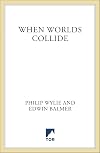
A runaway planet hurtles toward Earth. As it draws near, massive tidal waves, earthquakes, and volcanic eruptions wrack our planet, devastating continents, drowning cities, and wiping out millions. In central North America, a team of scientists race to build a spacecraft powerful enough to escape the doomed Earth. Their greatest threat, they soon discover, comes not from the skies but from other humans. A crackling plot and sizzling, cataclysmic vision have made When Worlds Collide one of show more the most popular and influential end-of-the-world novels of all time. show lessTags
Recommendations




















Member Reviews
This is classic 1930's science fiction. When Worlds Collide is a ripping yarn in which two wayward planets (Bronson Alpha and Bronson Beta: one a destroyer, one a savior) approach us from deep space: one on a path to destroy Earth, the other a potential haven for the survival of the human race if The League of The Last Days can build a nuclear powered Space Ship, stave off a mob of attacking marauders, and successfully navigate the ship to this "new" earth. As usual, the book is far superior to the 1951 film version whose plot is completely stripped down and simplified.
If you can wade through some stilted oratory dialogue and some painful expository dialogue, there's much to enjoy here in both the fast-paced story and in Philip Wylie's show more writing style. Some cool, evocative phrases like "The Bronson Bodies rose in frightful majesty."... The jaw-dropping descriptions of the horrific cataclysms that befall earth ... And the awe-inspiring description of the sky and celestial beauty of Bronson Beta. show less
If you can wade through some stilted oratory dialogue and some painful expository dialogue, there's much to enjoy here in both the fast-paced story and in Philip Wylie's show more writing style. Some cool, evocative phrases like "The Bronson Bodies rose in frightful majesty."... The jaw-dropping descriptions of the horrific cataclysms that befall earth ... And the awe-inspiring description of the sky and celestial beauty of Bronson Beta. show less
Number 4 in the list of 50 essential science fiction books and the first American entry, which turns out to be a cracker. We are in the world of pulp fiction, where the story line carries all before it. It is co authored and I suspect that Edwin Balmer was the ideas man and if so he certainly came up with a good one here.
Two rogue planets: Bronson alpha and Bronson Beta are hurtling towards the solar system; they have been tracked by the scientific community, who have formed a league of the last days. When news is released to the public it is predicted that Bronson Alpha will collide with the earth, so causing it's destruction, however as a twist to this end of world scenario, 7 months before the collision the two planets will pass so show more close to the earth that there will be cataclysmic changes to the surface of our world and most of the population will not survive this first "passing." The League of the last days have formed their own community of brilliant scientists who under the leadership of Dr Hendron plan a daring venture to build a space ship to leave earth and settle on Bronson Beta The community must first survive the initial passing of the planets, must get a nuclear powered spaceship built and fight of the marauding groups of fellow survivors before any attempt is made to land on Bronson Alpha. Many of the classic elements of sci-fi are here: scientific discoveries, space travel, dystopia, end of this world and a new beginning,
Written in 1932 this novel is very much of it's time; it is the scientists who will save humanity and they are all white Caucasian males, Some women will assist the scientists, but their main function is domestic arrangements and later breeding stock, A couple of alpha males are in respectful competition for the prettiest most intelligent woman and it is America who will lead the way. The prose can be a bit stilted at times and some of the conversations seem to come from 1930's Hollywood movies, but if you can read past the dated feel to the text then there is much to enjoy here. There is genuine suspense, there is also a brilliant description of a closed community fighting for survival. The dystopia after the first passing has a certain realism but also a sense of wonder that you find in the very best science fiction. The psychology of a group fighting to keep a civilization in the face of savagery is a key theme as is thoughts on a new community and new beginnings.
For me the book had the feel of an exciting science fiction yarn, something that I would certainly have enjoyed as a teenager and reading it today it still had much to offer. At times it had the power to stir the imagination and it was certainly a page turner, although I had to be careful turning the pages of my 1975 paperback copy lest the book might disintegrate. I can understand why the book has it's classic (Sci-fi classic that is) status. I am tempted to dip into other books by Philip Wylie and I rate this novel at 4 stars. show less
Two rogue planets: Bronson alpha and Bronson Beta are hurtling towards the solar system; they have been tracked by the scientific community, who have formed a league of the last days. When news is released to the public it is predicted that Bronson Alpha will collide with the earth, so causing it's destruction, however as a twist to this end of world scenario, 7 months before the collision the two planets will pass so show more close to the earth that there will be cataclysmic changes to the surface of our world and most of the population will not survive this first "passing." The League of the last days have formed their own community of brilliant scientists who under the leadership of Dr Hendron plan a daring venture to build a space ship to leave earth and settle on Bronson Beta The community must first survive the initial passing of the planets, must get a nuclear powered spaceship built and fight of the marauding groups of fellow survivors before any attempt is made to land on Bronson Alpha. Many of the classic elements of sci-fi are here: scientific discoveries, space travel, dystopia, end of this world and a new beginning,
Written in 1932 this novel is very much of it's time; it is the scientists who will save humanity and they are all white Caucasian males, Some women will assist the scientists, but their main function is domestic arrangements and later breeding stock, A couple of alpha males are in respectful competition for the prettiest most intelligent woman and it is America who will lead the way. The prose can be a bit stilted at times and some of the conversations seem to come from 1930's Hollywood movies, but if you can read past the dated feel to the text then there is much to enjoy here. There is genuine suspense, there is also a brilliant description of a closed community fighting for survival. The dystopia after the first passing has a certain realism but also a sense of wonder that you find in the very best science fiction. The psychology of a group fighting to keep a civilization in the face of savagery is a key theme as is thoughts on a new community and new beginnings.
For me the book had the feel of an exciting science fiction yarn, something that I would certainly have enjoyed as a teenager and reading it today it still had much to offer. At times it had the power to stir the imagination and it was certainly a page turner, although I had to be careful turning the pages of my 1975 paperback copy lest the book might disintegrate. I can understand why the book has it's classic (Sci-fi classic that is) status. I am tempted to dip into other books by Philip Wylie and I rate this novel at 4 stars. show less
The Earth is being side-swiped by a passing gas-giant planet that happens to have a companion satellite of the same size as Earth. The premise is only hokey when you take into account a) the gas giant has an Earth size planet for a satellite; b) the gas giant approaches just near enough the Earth on the first pass to shake up the Earth and allow some people to fly across to colonize the newly warming gas giant’s satellite; c) the gas giant completely destroys the Earth on its return orbit around the sun, before continuing on into space forever; d) the satellite Earth-type planet is caught and manages to stay behind to eccentrically orbit the sun. This scenario is so far-fetched that one is amazed when the various protagonists don’t show more see anything special about this astronomically impossible occurrence and give zero credence to mention of “divine intervention” from any one, be it God or a superior civilization in space.
Wylie and Balmer have decided to base their story on just this one premise and only ask us to accept the possibility and explore their potential survival scenario with that caveat. So, if we suspend disbelief for a few pages, and accept the stereotyped attitudes of the ‘30s as presented, I think it is a great story. show less
Wylie and Balmer have decided to base their story on just this one premise and only ask us to accept the possibility and explore their potential survival scenario with that caveat. So, if we suspend disbelief for a few pages, and accept the stereotyped attitudes of the ‘30s as presented, I think it is a great story. show less
The Earth is being side-swiped by a passing gas-giant planet that happens to have a companion satellite of the same size as Earth. The premise is only hokey when you take into account a) the gas giant has an Earth size planet for a satellite; b) the gas giant approaches just near enough the Earth on the first pass to shake up the Earth and allow some people to fly across to colonize the newly warming gas giant’s satellite; c) the gas giant completely destroys the Earth on its return orbit around the sun, before continuing on into space forever; d) the satellite Earth-type planet is caught and manages to stay behind to eccentrically orbit the sun. This scenario is so far-fetched that one is amazed when the various protagonists don’t show more see anything special about this astronomically impossible occurrence and give zero credence to mention of “divine intervention” from any one, be it God or a superior civilization in space.
Wylie and Balmer have decided to base their story on just this one premise and only ask us to accept the possibility and explore their potential survival scenario with that caveat. So, if we suspend disbelief for a few pages, and accept the stereotyped attitudes of the ‘30s as presented, I think it is a great story. show less
Wylie and Balmer have decided to base their story on just this one premise and only ask us to accept the possibility and explore their potential survival scenario with that caveat. So, if we suspend disbelief for a few pages, and accept the stereotyped attitudes of the ‘30s as presented, I think it is a great story. show less
This review is written with a GPL 4.0 license and the rights contained therein shall supersede all TOS by any and all websites in regards to copying and sharing without proper authorization and permissions. Crossposted at WordPress, Blogspot, & Librarything by Bookstooge’s Exalted Permission
Title: When Worlds Collide
Series: Bronson Beta #1
Authors: Philip Wylie and Edwin Balmer
Rating: 5 of 5 Stars
Genre: SF
Pages: 225
Words: 83.5K
Synopsis:
From Wikipedia.org
Sven Bronson, a Swedish astronomer working at an observatory in South Africa, discovers a pair of rogue planets, Bronson Alpha and Bronson Beta, which will soon enter the Solar System. In eight months, they will pass close enough to cause catastrophic damage to the Earth. Sixteen months show more later, after swinging around the Sun, Bronson Alpha (a gas giant) will return to pulverize the Earth and leave. It is hoped that Bronson Beta (discovered to be Earth-like and potentially habitable) will remain and assume a stable orbit.
Scientists led by Cole Hendron work desperately to build an atomic rocket to transport enough people, animals and equipment to Bronson Beta in an attempt to save the human race. Various countries do the same. The United States evacuates coastal regions in preparation for the first encounter. As the planets approach, observers see through their telescopes cities on Bronson Beta. Tidal waves sweep inland at a height of 750 feet (230 m), volcanic eruptions and earthquakes add to the deadly toll, and the weather runs wild for more than two days. As a token of things to come, Bronson Alpha grazes and destroys the Moon.
Three men take a floatplane to check out conditions across the United States and meet with the President in Hutchinson, Kansas, the temporary capital of the United States. It is discovered that the entire Southeast region flooded, the Great Lakes rose and emptied into the Saint Lawrence region, and Connecticut has become an island archipelago. All three are wounded fighting off a mob at their last stop, but manage to return with a precious sample of an extremely heat-resistant metal one of them had noticed. This solves the last remaining engineering obstacle, as no material had been found before to make rocket tubes capable of withstanding the heat of the atomic exhaust for very long.
Five months before the end, desperate mobs attack the camp, killing over half of Hendron's people before they are defeated. With the rocket tube breakthrough, the survivors are able to build a second, larger ship that can carry everyone left alive (instead of only 100 of the roughly thousand people Hendron had recruited). The two American ships take off, but lose contact with each other. Other ships are seen launching from Europe; the French ship's tubes melt, causing it to explode in the upper atmosphere. The original American ship makes a successful landing, but it is unknown if anyone else made it. The survivors find that Bronson Beta is habitable. They also find a road.
My Thoughts:
This is the 3rd “Official” time that I've read this book but I know I read it at least once in Bibleschool and two or three times in highschool, so we're talking at least six times. And I realized that I enjoyed it just as much this time as I have in the past, so its rating got bumped up to 5stars.
This is completely a comfort read. It has the 1930's American mindset, so not only is Scyenze going to save humanity, but humanity is going to save itself. And they do a fine strapping job of it, with brawn, panache and manly friendship overcoming even jealous love interests. You don't get stuff like this anymore. I know because of the review for a book that is coming up for Wednesday :-/
Everyone involved is a paragon of virtue. Even when they struggle with wanting to do the wrong thing, they realize it is wrong and fight and overcome it. Scientists are pure of motive and have no underlying idealogy outside of Truth Seeking, just like how we want them to be even today. The men are brawnly and smart, the women kind and gentle.
The disaster is fantastic, I have to admit. When Bronson Alpha passes Earth for the first time and destroys the moon and causes complete havoc on earth, the authors do a fantastic job of describing the cataclysmic occurrences in such an understated manner that it's not horrifying until after you've read it and think about what just occurred. It's described in a macro enough scale that as long as you have a rough idea of world geography (in terms of land masses and bodies of water) then you too can join in on the horrifying fun of it all.
Of course, the absolute nonsense about Bronson Beta having a breathable atmosphere and even having cities that survived is just something you have to put up. Hence the “scyenze” tag. But it's no more fantastic than John Carter waking up on Mars and marrying a Pod Woman Princess.
★★★★★ show less
Title: When Worlds Collide
Series: Bronson Beta #1
Authors: Philip Wylie and Edwin Balmer
Rating: 5 of 5 Stars
Genre: SF
Pages: 225
Words: 83.5K
Synopsis:
From Wikipedia.org
Sven Bronson, a Swedish astronomer working at an observatory in South Africa, discovers a pair of rogue planets, Bronson Alpha and Bronson Beta, which will soon enter the Solar System. In eight months, they will pass close enough to cause catastrophic damage to the Earth. Sixteen months show more later, after swinging around the Sun, Bronson Alpha (a gas giant) will return to pulverize the Earth and leave. It is hoped that Bronson Beta (discovered to be Earth-like and potentially habitable) will remain and assume a stable orbit.
Scientists led by Cole Hendron work desperately to build an atomic rocket to transport enough people, animals and equipment to Bronson Beta in an attempt to save the human race. Various countries do the same. The United States evacuates coastal regions in preparation for the first encounter. As the planets approach, observers see through their telescopes cities on Bronson Beta. Tidal waves sweep inland at a height of 750 feet (230 m), volcanic eruptions and earthquakes add to the deadly toll, and the weather runs wild for more than two days. As a token of things to come, Bronson Alpha grazes and destroys the Moon.
Three men take a floatplane to check out conditions across the United States and meet with the President in Hutchinson, Kansas, the temporary capital of the United States. It is discovered that the entire Southeast region flooded, the Great Lakes rose and emptied into the Saint Lawrence region, and Connecticut has become an island archipelago. All three are wounded fighting off a mob at their last stop, but manage to return with a precious sample of an extremely heat-resistant metal one of them had noticed. This solves the last remaining engineering obstacle, as no material had been found before to make rocket tubes capable of withstanding the heat of the atomic exhaust for very long.
Five months before the end, desperate mobs attack the camp, killing over half of Hendron's people before they are defeated. With the rocket tube breakthrough, the survivors are able to build a second, larger ship that can carry everyone left alive (instead of only 100 of the roughly thousand people Hendron had recruited). The two American ships take off, but lose contact with each other. Other ships are seen launching from Europe; the French ship's tubes melt, causing it to explode in the upper atmosphere. The original American ship makes a successful landing, but it is unknown if anyone else made it. The survivors find that Bronson Beta is habitable. They also find a road.
My Thoughts:
This is the 3rd “Official” time that I've read this book but I know I read it at least once in Bibleschool and two or three times in highschool, so we're talking at least six times. And I realized that I enjoyed it just as much this time as I have in the past, so its rating got bumped up to 5stars.
This is completely a comfort read. It has the 1930's American mindset, so not only is Scyenze going to save humanity, but humanity is going to save itself. And they do a fine strapping job of it, with brawn, panache and manly friendship overcoming even jealous love interests. You don't get stuff like this anymore. I know because of the review for a book that is coming up for Wednesday :-/
Everyone involved is a paragon of virtue. Even when they struggle with wanting to do the wrong thing, they realize it is wrong and fight and overcome it. Scientists are pure of motive and have no underlying idealogy outside of Truth Seeking, just like how we want them to be even today. The men are brawnly and smart, the women kind and gentle.
The disaster is fantastic, I have to admit. When Bronson Alpha passes Earth for the first time and destroys the moon and causes complete havoc on earth, the authors do a fantastic job of describing the cataclysmic occurrences in such an understated manner that it's not horrifying until after you've read it and think about what just occurred. It's described in a macro enough scale that as long as you have a rough idea of world geography (in terms of land masses and bodies of water) then you too can join in on the horrifying fun of it all.
Of course, the absolute nonsense about Bronson Beta having a breathable atmosphere and even having cities that survived is just something you have to put up. Hence the “scyenze” tag. But it's no more fantastic than John Carter waking up on Mars and marrying a Pod Woman Princess.
★★★★★ show less
The prejudices of the 30's are very present in this book. I also found it awkward and the conversation stilted at many points. Much talk and reflection with convoluted scientific and theological ideas, that is common in books from this era too. The premise of the book, that the earth will be destroyed at a set time by a planet collision, now what are we going to do about it? Is a good one and an interesting concept with lots of promise. What would people do if they truly knew the day life would end? Would they turn savage? Would they try to escape? Commit suicide? What would you do? That in itself provided enough interest for me to finish this book and find out the author's ideas, whether I agreed with them or not. The prejudices of show more course, were that only the Anglo/Saxon western civilization was deemed worthy a spot on the escape rocket. Other rocket were attempted by some of the other nations, but no one thought it essential to preserve any of the other races on earth. Also, though they took women, and looked for intelligent ones, they only took them for breeding and housekeeping duties. We've come a long way, baby. I can forgive them much of that though, because they did have the foresight to insulate the rocketship with thousands of books so they could begin with a library. I think I would have chosen, if invited, to stay here and meet my end on the earth. I have no use for elitist scientific communities. They frighten me. show less
This is an older story but it has for the most part survived the aging that some sci-fi doesn't. I am not familiar enough with the astrophysics to make a judgement one way or another, but it works for this story. The other sciences have been somewhat been superseded, but the social science hasn't. People are portrayed in ways that could be expected were the world to end, from self sacrifice to survival of the fittest. If you would like to get some vintage sci-fi this is a pretty good one to read.
Members
- Recently Added By
Lists

Recommended Apocalyptic Novels
53 works; 24 members

Read the book and saw the movie
1,170 works; 195 members
Apocalyptic Classics
11 works; 4 members

1930s
262 works; 5 members

AbeBooks: 50 essential science fiction books
50 works; 6 members
Author Information

56+ Works 3,142 Members
Philip Wylie was a popular author of pulp fiction, sci-fi, and mysteries, as well as social commentary and nonfiction titles on a variety of subjects. His works include When Worlds Collide, Gladiator, and Generation of Vipers.
24+ Works 1,303 Members
Awards and Honors
Notable Lists
Series

Belongs to Publisher Series
Work Relationships
Is contained in
Has the adaptation
Common Knowledge
- Canonical title
- When Worlds Collide
- Original title
- When Worlds Collide
- Original publication date
- 1932
- Important places
- Earth; Bronson Beta
- Related movies
- When Worlds Collide (1951 | IMDb)
- Dedication
- To
Sally and Grace - First words
- The secret itself was still safe.
- Last words
- (Click to show. Warning: May contain spoilers.)The first day on the new Earth had begun.
- Disambiguation notice
- This entry represents editions containing only "When Worlds Collide". A number of editions using this title have been published containing both "When Worlds Collide" and "After Worlds Collide". If you have ... (show all)one of these editions, please separate it and combine with the omnibus entry.
Classifications
Statistics
- Members
- 502
- Popularity
- 60,022
- Reviews
- 14
- Rating
- (3.67)
- Languages
- English, German, Spanish
- Media
- Paper, Audiobook, Ebook
- ISBNs
- 15
- UPCs
- 2
- ASINs
- 36