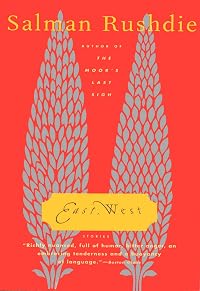
East, West
by Salman Rushdie
On This Page
Description
A rickshaw driver dreams of being a Bombay movie star; Indian diplomats, who as childhood friends hatched Star Trek fantasies, must boldly go into a hidden universe of conspiracy and violence; and Hamlet's jester is caught up in murderous intrigues. In Rushdie's hybrid world, an Indian guru can be a redheaded Welshman, while Christopher Columbus is an immigrant, dreaming of Western glory. Rushdie allows himself, like his characters, to be pulled now in one direction, then in another. Yet he show more remains a writer who insists on our cultural complexity; who, rising beyond ideology, refuses to choose between East and West and embraces the world. show lessTags
Recommendations






Member Reviews
Rushdie is one of my favorite authors, but I've never read any of his short stories. Happy to say he's at the top of his game here. He's my Wizard of Words - five words into anything he writes and I'm ensorcelled. The stories in the first two sections (East and West) were previously published elsewhere, but the three stories in the third section, 'East,West' are original and two of them were my favorites - Chekov and Zulu, which improbably and brilliantly weaves together Star Trek and the assassination of Indira Ghandi, and The Courter, which is funny/tender - a combo that can so easily turn into treacle, but doesn't.
A collection of nine stories - three set in the East, three in the West, and three that cross the borders of the two by involving Eastern characters in a Western setting. Of the nine, six were published elsewhere first, and you can feel it - meaning that the collection feels a bit like the theme was made to fit the stories and not the other way around. There are some great tales in here, and a few that didn't quite work for me; but they all carry Rushdie's voice, and the volume as a whole is certainly worth reading.
Kis rushdieológia, a hármas szám szentségének jegyében, háromszor három novella segítségével:
1.) Az első blokk a keleti tárgyú elbeszélésekből ad ízelítőt: a muzulmán India életképeiből tálalnak nekünk három finomságot. Melegen. Egzotikum, szemernyi misztikum és gazdag mesélőkedv. Kellemes.
2.) Ha egy bevándorló belecsöppen az angolszász kultúrkörbe, falatozik belőle, majd emésztgetni kezdi, mi az első, amit visszaböfög? Alighanem egy Shakespeare-parafrázis. Nem csoda tehát, hogy Rushdie nyugati tárgyú novellái egy Yorick című szösszenettel kezdődnek, amiben írónk saját invenciózus értelmezését adja a Hamletnek. És a többi is valami ilyesmi. Enyhén okoskodó, játékosan show more modoros szövegek ezek, szerintem a kötet leggyengébb része.
3.) Szerencsére a harmadik blokkban Rushdie visszatér az emberekhez: indiaiakhoz, akik Angliába csöppentek. Kelet és Nyugat konfliktusai jelennek tehát meg ebben a novellatriászban, ami ugye izgalmas dolog, következésképpen nekem ez az egység tetszett legjobban. (Bááár… a triász első elbeszélését a szerző egy bántóan olcsó húzással zárja le.) Ezekből a szövegekből már világos, mitől nagy epikus regényíró Rushdie: apróságokat, marginális eseményeket, mellékszálakat és –szereplőket képes erős színekkel, izgalmasan megragadni, ezzel felettébb oxigéndús szövegteret hozva létre. Szóval a vége jó. Tehát minden jó. show less
1.) Az első blokk a keleti tárgyú elbeszélésekből ad ízelítőt: a muzulmán India életképeiből tálalnak nekünk három finomságot. Melegen. Egzotikum, szemernyi misztikum és gazdag mesélőkedv. Kellemes.
2.) Ha egy bevándorló belecsöppen az angolszász kultúrkörbe, falatozik belőle, majd emésztgetni kezdi, mi az első, amit visszaböfög? Alighanem egy Shakespeare-parafrázis. Nem csoda tehát, hogy Rushdie nyugati tárgyú novellái egy Yorick című szösszenettel kezdődnek, amiben írónk saját invenciózus értelmezését adja a Hamletnek. És a többi is valami ilyesmi. Enyhén okoskodó, játékosan show more modoros szövegek ezek, szerintem a kötet leggyengébb része.
3.) Szerencsére a harmadik blokkban Rushdie visszatér az emberekhez: indiaiakhoz, akik Angliába csöppentek. Kelet és Nyugat konfliktusai jelennek tehát meg ebben a novellatriászban, ami ugye izgalmas dolog, következésképpen nekem ez az egység tetszett legjobban. (Bááár… a triász első elbeszélését a szerző egy bántóan olcsó húzással zárja le.) Ezekből a szövegekből már világos, mitől nagy epikus regényíró Rushdie: apróságokat, marginális eseményeket, mellékszálakat és –szereplőket képes erős színekkel, izgalmasan megragadni, ezzel felettébb oxigéndús szövegteret hozva létre. Szóval a vége jó. Tehát minden jó. show less
Rushdie is an author I've always wanted to read more of than I have. I'm mostly familiar with him through his children's novel, "Haroun and the Sea of Stories," as well as at least one novel that I read in herky-jerky bits and pieces during my 20s. I think it's entirely fair to say that Rushdie is one of those writers I always feel, snobbishly, like I *should* have read, and I've enjoyed seeing him interviewed and talking about other books and films. It finally dawned on me, then, that a short story collection like "East, West" might be my "way in" to a fuller appreciation of his work.
It's a challenging set of stories. What is immediately apparent is the mastery Rushdie has with the English language, because even the stories I didn't show more enjoy, content-wise, had a real flow that made them like music to read. I found myself wondering if Rushdie ever reads his own work aloud for audiences; in many cases, I felt like these would be even more of a joy to hear performed by the author. As stories, though, they were sometimes a little beyond me (hard as that is to admit). The collection is split into three sections - "East," "West," and "East, West" - with three stories in each. You can guess the thematic separation between these sections ("East" largely indicating India and "West" Britain). To be perfectly fair, most of the first six left me feeling a little distant, with probably "The Prophet's Hair" - which is rather like a mournful, bad-luck Indian fairy tale - the most engaging of the lot. However, I was surprised to find how much I enjoyed all three stories of the final section, each of them playing on themes as varied as infidelity, loyalty, and a shared love of the original "Star Trek" to find an interesting shared space between Indian upbringing and British culture. Those stories made my reading of the volume completely worthwhile.
Would I recommend the collection? Contrary to my original theory, I think these might come off better if you are already familiar with Rushdie's longer work. His stories are dense and literate, and I think if you know the patterns of his writing, they might be a little easier to engage. That said, I'm certainly glad I made the attempt. Reading "East, West" has made me want to move back toward Rushdie novels and give them a more determined try. This time, I'll be better prepared for the density, and I always like to read beautiful music. show less
It's a challenging set of stories. What is immediately apparent is the mastery Rushdie has with the English language, because even the stories I didn't show more enjoy, content-wise, had a real flow that made them like music to read. I found myself wondering if Rushdie ever reads his own work aloud for audiences; in many cases, I felt like these would be even more of a joy to hear performed by the author. As stories, though, they were sometimes a little beyond me (hard as that is to admit). The collection is split into three sections - "East," "West," and "East, West" - with three stories in each. You can guess the thematic separation between these sections ("East" largely indicating India and "West" Britain). To be perfectly fair, most of the first six left me feeling a little distant, with probably "The Prophet's Hair" - which is rather like a mournful, bad-luck Indian fairy tale - the most engaging of the lot. However, I was surprised to find how much I enjoyed all three stories of the final section, each of them playing on themes as varied as infidelity, loyalty, and a shared love of the original "Star Trek" to find an interesting shared space between Indian upbringing and British culture. Those stories made my reading of the volume completely worthwhile.
Would I recommend the collection? Contrary to my original theory, I think these might come off better if you are already familiar with Rushdie's longer work. His stories are dense and literate, and I think if you know the patterns of his writing, they might be a little easier to engage. That said, I'm certainly glad I made the attempt. Reading "East, West" has made me want to move back toward Rushdie novels and give them a more determined try. This time, I'll be better prepared for the density, and I always like to read beautiful music. show less
A fascinating curate's egg of a collection.
The first three "East" stories are disarmingly charming. My favourite story in the book is the first story "Good Advice Is Rarer Than Rubies", which is brilliantly simple, beautiful, romantic and unsurprisingly surprising; the very image of the principal character, on whom I think I have a bit of a crush. The following two stories are distinctly, charmingly, but very differently eastern - first "The Free radio" a modern parable with the bones of the dark side of India poking through and then "The Prophet’s Hair" which has that whole One Thousand and One Nights thing going on.
The second three "West" stories are, in sharp contrast, everything I dislike about smart-arsed english story telling in show more the knowing post magic realism world. They read like bad pastiches of Julian Barnes meets Tom Stoppard, ie "Yorick"; or of David Mitchell, ie " At the Auction of the Ruby Slippers" or Julian Barnes dumoing Stoppard for my mum ", ie "Christopher Columbus and Queen Isabella of Spain Consummate Their Relationship". All three were to me as bad as the first three were good. Did Rushdie write them partcularly badly to make some point about western literature?
But the last three "East meets West" are really the whole point of the book for me. All three explore the interaction of modern Western culture with ancient Eastern culture. All happen within the UK and within a very British society which is far more than just the backdrop - it is almost a character in the stories. I agree with the other reviewer that these three stories really do show Rushdie’s mastery of the language and are filled with wonderful prose. All that and a there is a sexy Mauritian in the book too.
If it hadn't been for the disappointing middle section I would be saying this is the best book of short stories I have read for some years. show less
The first three "East" stories are disarmingly charming. My favourite story in the book is the first story "Good Advice Is Rarer Than Rubies", which is brilliantly simple, beautiful, romantic and unsurprisingly surprising; the very image of the principal character, on whom I think I have a bit of a crush. The following two stories are distinctly, charmingly, but very differently eastern - first "The Free radio" a modern parable with the bones of the dark side of India poking through and then "The Prophet’s Hair" which has that whole One Thousand and One Nights thing going on.
The second three "West" stories are, in sharp contrast, everything I dislike about smart-arsed english story telling in show more the knowing post magic realism world. They read like bad pastiches of Julian Barnes meets Tom Stoppard, ie "Yorick"; or of David Mitchell, ie " At the Auction of the Ruby Slippers" or Julian Barnes dumoing Stoppard for my mum ", ie "Christopher Columbus and Queen Isabella of Spain Consummate Their Relationship". All three were to me as bad as the first three were good. Did Rushdie write them partcularly badly to make some point about western literature?
But the last three "East meets West" are really the whole point of the book for me. All three explore the interaction of modern Western culture with ancient Eastern culture. All happen within the UK and within a very British society which is far more than just the backdrop - it is almost a character in the stories. I agree with the other reviewer that these three stories really do show Rushdie’s mastery of the language and are filled with wonderful prose. All that and a there is a sexy Mauritian in the book too.
If it hadn't been for the disappointing middle section I would be saying this is the best book of short stories I have read for some years. show less
He is not at his best here, though he tried real hard; my personal parameter of Rushdie's best is Midnight's Children on the scale of his usual classical narrative and craft, and Haroun and the Sea of Stories on the scale of sheer storytelling. Perhaps some of the stories, especially two really odd ones in the 'West' failed to hit the cord because he tried too hard to carry a craft he is not good at; consequently, the narrative comes out as a fragmented assortment, which is neither imagination nor plot driven. Anyway, it is a fast, casual read and two or three stories are really worthwhile the time.
I found the first section, East, to be really engaging and fascinating to read. Original and lyrical storytelling and great imagination.
I couldn't really get into any of the other stories/sections. Just seemed odd and didn't click with me at all. with the exception of Ruby Red Shoes which was both baffling and beautiful.
So about middling, 4-5* stories and 5 others which could be ignored.
I couldn't really get into any of the other stories/sections. Just seemed odd and didn't click with me at all. with the exception of Ruby Red Shoes which was both baffling and beautiful.
So about middling, 4-5* stories and 5 others which could be ignored.
Members
- Recently Added By
Published Reviews
ThingScore 63
This sometimes poignant and intimate, sometimes boisterously inventive, sometimes gently provocative collection of short stories, formally wide-ranging though it is, is structured as a tight little syllogism. There are exactly nine stories, three each in three sections, with thesis ("East"), antithesis ("West") and a final synthesis ("East, West") wherein the twain do meet.
added by jlelliott
Though these stories are recounted with verve and wit and make for entirely enjoyable reading, they evaporate from the reader's mind seconds after reading. Their "surprise" endings are completely predictable; their philosophical subtext, nil.
added by jlelliott
Lists

Five star books
1,767 works; 110 members

Books Read in 2015
3,299 works; 126 members
Author Information

87+ Works 70,146 Members
Salman Rushdie was born in India on June 19, 1947. He was raised in Pakistan and educated in England. His novels include Grimus, Shame, The Satanic Verses, Haroun and the Sea of Stories, The Moor's Last Sigh, The Ground Beneath Her Feet, Fury, Shalimar the Clown, The Enchantress of Florence, Luka and the Fire of Life, and The Golden House. His show more non-fiction works include Joseph Anton, Imaginary Homelands, The Jaguar Smile, and Step across This Line. He also wrote a collection of short stories entitled East, West. He has received numerous awards including the Whitbread Prize for Best Novel twice, the James Tait Black Prize, the French Prix du Meilleur Livre Étranger, the Booker Prize in 1981 for Midnight's Children, and the 2014 PEN/Pinter Prize. (Bowker Author Biography) show less
Some Editions
Awards and Honors
Awards
Series
Belongs to Publisher Series
Work Relationships
Common Knowledge
- Canonical title*
- Oost, West
- Original title
- East, West
- Original publication date
- 1994 (Collection) (Collection)
- Important places*
- India; Denemarken; Spanje; Verenigd Koninkrijk
- First words
- On the last Tuesday of the month, the dawn bus, its headlamps still shining, brought Miss Rehana to the gates of the British Consulate.
- Last words
- (Click to show. Warning: May contain spoilers.)'I'm the porter, sir,' the man said. 'I don't know anything about any mix-up.'
- Blurbers*
- Heijne, Bas; Kuipers, Willem
- Original language*
- Engels
*Some information comes from Common Knowledge in other languages. Click "Edit" for more information.
Classifications
Statistics
- Members
- 1,773
- Popularity
- 12,438
- Reviews
- 17
- Rating
- (3.50)
- Languages
- 18 — Czech, Danish, Dutch, English, Finnish, French, German, Hungarian, Italian, Norwegian (Bokmål), Polish, Romanian, Russian, Croatian, Spanish, Swedish, Turkish, Portuguese (Portugal)
- Media
- Paper, Audiobook, Ebook
- ISBNs
- 61
- ASINs
- 13