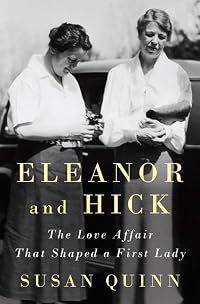
Eleanor and Hick: The Love Affair That Shaped a First Lady
by Susan Quinn
On This Page
Description
A warm, intimate account of the love between Eleanor Roosevelt and reporter Lorena Hickok--a relationship that, over more than three decades, transformed both women's lives and empowered them to play significant roles in one of the most tumultuous periods in American history. "In 1933, as her husband assumed the presidency, Eleanor Roosevelt embarked on the claustrophobic, duty-bound existence of the First Lady with dread. By that time, she had put her deep disappointment in her marriage show more behind her and developed an independent life--now threatened by the public role she would be forced to play. A lifeline came to her in the form of a feisty campaign reporter for the Associated Press: Lorena Hickok. Over the next thirty years, until Eleanor's death, the two women carried on an extraordinary relationship: They were, at different points, lovers, confidantes, professional advisors, and caring friends. They couldn't have been more different. Eleanor had been raised in one of the nation's most powerful political families and was introduced to society as a debutante before marrying her distant cousin, Franklin. Hick, as she was known, had grown up poor in rural South Dakota and worked as a servant girl after escaping an abusive home, eventually becoming one of the most respected reporters at the AP. Her admiration drew the buttoned-up Eleanor out of her shell, and the two fell in love. For the next thirteen years, Hick had her own room at the White House, next to the First Lady's. These fiercely compassionate women inspired each other to right the wrongs of the turbulent era in which they lived. During the Depression, Hick reported from the nation's poorest areas for the WPA, and Eleanor used these reports to lobby her husband for New Deal programs. Hick encouraged Eleanor to turn their frequent letters into her popular and long-lasting syndicated column 'My Day,' and to befriend the female journalists who became her champions. When Eleanor's tenure as First Lady ended with FDR's death, Hick urged her to continue to use her popularity for important causes--advice Eleanor took by leading the UN's postwar Human Rights Commission. At every turn, the bond between these two women was grounded in their determination to better their troubled world. Deeply researched and told with great warmth, Eleanor and Hick is a vivid portrait of love and a revealing look at how an unlikely romance influenced some of the most consequential years in American history"--Publisher description. show lessTags
Recommendations
Member Reviews
Eleanor in this context being of course Eleanor Roosevelt, wife of Franklin and niece of Theodore. And Hick being less obviously Lorena Hickok, a respected reporter for the Associated Press who fell in love with Eleanor while writing a series of articles about her just before FDR's first presidential election victory. And Eleanor, it seems, loved Hick back, although such a love affair was destined to be thwarted by the individual circumstances of their lives.
Much of the author's evidence for the love affair between Eleanor and Hick is drawn from an archive of letters exchanged between them. The letters were donated by Hick to the FDR Library, with the proviso that they not be made available until after she died (Eleanor had died several show more years earlier). I appreciated that Quinn was careful not to draw unsupported conclusions about whether their love affair was physically consummated — there simply is no evidence to tell us either way. But it seems clear that the two women at the very least shared an extremely deep emotional bond and attachment that lasted the rest of their lives, even though it didn't always make them happy. Hick, in particular, comes across as someone who wanted much more than Eleanor was able to give her, and suffered jealously whenever the First Lady spent time with other close friends than her.
Apart from the personal relationship between Eleanor and Hick, time and again I was struck by the ways that times were different in the 1930s and 1940s. The Roosevelts seem to have treated the White House as their personal Howard Johnson Motor Lodge, with any number of people actually living in the White House with them for months or years at a time — close friends, extended family, pets of friends and family. And the press, including Hick, were privy to many personal details about the marriage and family life of FDR and Eleanor that would doubtless have created scandal, and tacitly agreed not to write about them. Bill Clinton must weep a bitter tear and then toss back some whiskey whenever he thinks about that.
I've been meaning to read a biography of Eleanor Roosevelt for some time, and I learned a lot to admire about her here even beyond what I already knew. Quinn is clear-eyed about the personal faults in Hick, Eleanor, FDR, and their children, all of whom suffered to varying degrees from the stifling attention of being in the close orbit of a beloved President. I'd still like to read a more comprehensive biography of this remarkable woman sometime, but this was a good place to start. show less
Much of the author's evidence for the love affair between Eleanor and Hick is drawn from an archive of letters exchanged between them. The letters were donated by Hick to the FDR Library, with the proviso that they not be made available until after she died (Eleanor had died several show more years earlier). I appreciated that Quinn was careful not to draw unsupported conclusions about whether their love affair was physically consummated — there simply is no evidence to tell us either way. But it seems clear that the two women at the very least shared an extremely deep emotional bond and attachment that lasted the rest of their lives, even though it didn't always make them happy. Hick, in particular, comes across as someone who wanted much more than Eleanor was able to give her, and suffered jealously whenever the First Lady spent time with other close friends than her.
Apart from the personal relationship between Eleanor and Hick, time and again I was struck by the ways that times were different in the 1930s and 1940s. The Roosevelts seem to have treated the White House as their personal Howard Johnson Motor Lodge, with any number of people actually living in the White House with them for months or years at a time — close friends, extended family, pets of friends and family. And the press, including Hick, were privy to many personal details about the marriage and family life of FDR and Eleanor that would doubtless have created scandal, and tacitly agreed not to write about them. Bill Clinton must weep a bitter tear and then toss back some whiskey whenever he thinks about that.
I've been meaning to read a biography of Eleanor Roosevelt for some time, and I learned a lot to admire about her here even beyond what I already knew. Quinn is clear-eyed about the personal faults in Hick, Eleanor, FDR, and their children, all of whom suffered to varying degrees from the stifling attention of being in the close orbit of a beloved President. I'd still like to read a more comprehensive biography of this remarkable woman sometime, but this was a good place to start. show less
This book tackles one of those lesser known bits of history -- specifically, the relationship between First Lady Eleanor Roosevelt and AP reporter Lorena Hickok. It has been suggested in the past that these two were more than friends, and this book takes a definite stand on that, noting the author's belief that the Roosevelt and Hickok had a romantic, physical relationship. While there were times that I felt Quinn's own research did not 100 percent support that stand,* I found this book to be a gem overall.
The book works as almost a dual biography. It gives information on both women, starting from their childhoods all the way through to their deaths. In addition, lots of historical context is given, so that the reader learns much about show more life in the U.S. during the Great Depression, the World's Fair, World War II, etc. An insider's look at the political scene is explored as well. There was definitely a lot that I learned about this era in history from reading Eleanor and Hick. Also, with both women being ahead of their time, there was so much that was applicable to today, especially issues related to social justice.
Quinn certainly did her research for this book, using a multitude of sources for it. These include letters exchanged between the two women (more than 3,300 over a 30-year period beginning in 1932), the unpublished autobiography of Lorena Hickok, Eleanor Roosevelt's memoirs and "My Day" columns, various newspaper articles, and occasional bits of other people's memoirs (e.g., Roosevelt's grandson Curtis). Furthermore, Quinn's writing style is easy and accessible, making this a smooth-flowing and enjoyable read. Although many historical facts are included, it never feels dull or taxing. I highly recommend this book for those who love history and/or biographies.
*Although many of the letters do suggest that there was perhaps a romantic relationship, it appears that Roosevelt had several other similarly passionate friendships. And, there was also indication that Hickok resumed a previous love affair during the same time she was supposedly in a relationship with Roosevelt. show less
The book works as almost a dual biography. It gives information on both women, starting from their childhoods all the way through to their deaths. In addition, lots of historical context is given, so that the reader learns much about show more life in the U.S. during the Great Depression, the World's Fair, World War II, etc. An insider's look at the political scene is explored as well. There was definitely a lot that I learned about this era in history from reading Eleanor and Hick. Also, with both women being ahead of their time, there was so much that was applicable to today, especially issues related to social justice.
Quinn certainly did her research for this book, using a multitude of sources for it. These include letters exchanged between the two women (more than 3,300 over a 30-year period beginning in 1932), the unpublished autobiography of Lorena Hickok, Eleanor Roosevelt's memoirs and "My Day" columns, various newspaper articles, and occasional bits of other people's memoirs (e.g., Roosevelt's grandson Curtis). Furthermore, Quinn's writing style is easy and accessible, making this a smooth-flowing and enjoyable read. Although many historical facts are included, it never feels dull or taxing. I highly recommend this book for those who love history and/or biographies.
*Although many of the letters do suggest that there was perhaps a romantic relationship, it appears that Roosevelt had several other similarly passionate friendships. And, there was also indication that Hickok resumed a previous love affair during the same time she was supposedly in a relationship with Roosevelt. show less
Eleanor and Hick THE LOVE AFFAIR THAT SHAPED A FIRST LADY By SUSAN QUINN is a keeper. This is the fourth or fifth book I have read on the topic of these three women and each has given it's own special flavor to the story. This one draws you in immediately, and makes you feel the not only the connection between these two women, but the particular pain of Hick's. The fact that these two women couldn't have come from backgrounds that were more different, they were deeply drawn to each other.
While Eleanor is pretty much the world to Hick, and clearly loves her, Eleanor's position as first lady, her duties and in fact her entire personality make it clear that while she has strong feelings for Hick, other things, other people, other projects, show more draw her away. As much as I admire Eleanor for the changes she helped to make during a difficult time in our nation, I often feel that Hick's feelings are not completely explored or understood.She would never come first to Eleanor. Living this love during the time period was difficult enough, but for Hick, feeling that she was second, third or lower in importance must have been difficult. Throughout it all, Hick was staunchly patient, helpful and loving. I don't think she was often happy. show less
While Eleanor is pretty much the world to Hick, and clearly loves her, Eleanor's position as first lady, her duties and in fact her entire personality make it clear that while she has strong feelings for Hick, other things, other people, other projects, show more draw her away. As much as I admire Eleanor for the changes she helped to make during a difficult time in our nation, I often feel that Hick's feelings are not completely explored or understood.She would never come first to Eleanor. Living this love during the time period was difficult enough, but for Hick, feeling that she was second, third or lower in importance must have been difficult. Throughout it all, Hick was staunchly patient, helpful and loving. I don't think she was often happy. show less
Being an account of First Lady Eleanor Roosevelt's love affair with Associated Press newshound Lenora Hickok. The author assumes that the two enjoyed a physical relationship, a conclusion other writers--especially, oddly, individuals of a leftish persuasion-- have been loath to draw. She assumes this on the basis of their correspondence, which indeed goes well beyond "affectionate", and, though it must be said that plenty of individuals have exchanged similar letters over the years without meeting each other, let alone having had carnal relations, her assumption is indeed sort of the Ockham's Razor conclusion after reading the letters.
As for the book, to me it resembled one of those storied sandwiches, butt of many a joke, which show more consists of two luscious slices of bread with a repugnant meat filling the space between. The first and last hundred pages of the book are a delight, illuminating the joys and sorrows, ups and downs, triumphs and tragedies of the women's relationship in a sympathetic but not uncritical manner. Alas and alack, that leaves almost 200 pages of middle, which is essentially a superficial history of Roosevelt's war administration. Since this is familiar ground to every schoolchild in America, it will be review for most, and makes for a longish book. This book doesn't really need any filler, but if it did, Quinn's tangents peeking into the broader experience of the now forgotten but apparently numerous political tribades during this period are much more interesting and worthy of expansion than this rather tired collection of familiar political and military anecdotes. show less
As for the book, to me it resembled one of those storied sandwiches, butt of many a joke, which show more consists of two luscious slices of bread with a repugnant meat filling the space between. The first and last hundred pages of the book are a delight, illuminating the joys and sorrows, ups and downs, triumphs and tragedies of the women's relationship in a sympathetic but not uncritical manner. Alas and alack, that leaves almost 200 pages of middle, which is essentially a superficial history of Roosevelt's war administration. Since this is familiar ground to every schoolchild in America, it will be review for most, and makes for a longish book. This book doesn't really need any filler, but if it did, Quinn's tangents peeking into the broader experience of the now forgotten but apparently numerous political tribades during this period are much more interesting and worthy of expansion than this rather tired collection of familiar political and military anecdotes. show less
I thought I knew a lot about Eleanor Roosevelt, but I was missing one important part. It's not clear whether Eleanor and Hick's relationship was ever sexual, but it's clear that it was a love affair. Many of Eleanor's best women friends were lesbians, although for the most part, the couples did not include her. These were things not talked about by the press in those days. Franklin's disability was not displayed in images either. Those were different times -- a whole other world from what we have now. Eleanor had a tremendous capacity for work, for caring about people she met, who often became life-long friends, for people in general, and for loving in a variety of ways.
A good book that seemed to take a long time to get through. Eleanor Roosevelt and Lorena Hickock had a long-term relationship. Early in the marriage when Eleanor discovered Franklin's breakage of his marriage vows to woe Eleanor's private secretary, Eleanor knew that wanted to divorce him, but his running for the US Presidency precluded that option. She was by his side when necessary, but basically found her own options for closeness and love.
Different in personality, Hick was broad in both weight and in the way she expressed herself. Eleanor chose the middle ground in conflict. Formerly a highly acclaimed AP reporter, Hick gave this up in order to be by Eleanor when ever possible. Traveling throughout the mid west during American's show more terrible financial depression, she wrote to FDR of grown men crying while standing in line hoping for employment in order to feed his family.
There were interesting tidbits throughout the book, particularly how the Roosevelts freely used the White House as a stopping place for friends and relatives to stay long term.
Highly intelligent, both women pushed for jobs programs and personally fed people throughout their travels.
Hick seemed to want more than Eleanor could give. Theirs was a long lasting relationship that had tremendous range of feeling and compassion. show less
Different in personality, Hick was broad in both weight and in the way she expressed herself. Eleanor chose the middle ground in conflict. Formerly a highly acclaimed AP reporter, Hick gave this up in order to be by Eleanor when ever possible. Traveling throughout the mid west during American's show more terrible financial depression, she wrote to FDR of grown men crying while standing in line hoping for employment in order to feed his family.
There were interesting tidbits throughout the book, particularly how the Roosevelts freely used the White House as a stopping place for friends and relatives to stay long term.
Highly intelligent, both women pushed for jobs programs and personally fed people throughout their travels.
Hick seemed to want more than Eleanor could give. Theirs was a long lasting relationship that had tremendous range of feeling and compassion. show less
I had only a cursory knowledge of FDR's presidency and was vaguely aware that Eleanor Roosevelt was an important influence and politically active in her own right. So, I learned a lot and found this book provided a look into the workings of the White House and how various decisions played out. The relationship between Eleanor and Hick (Lorena Hickok) was the centre for this narrative. The Roosevelts didn't have a happy marriage; he was serially unfaithful to her and she never wanted to be FLOTUS. Eleanor looked elsewhere for companionship and love. Hick was an important person in her life and their letters to each other survived and provide a lot of the details found in this book. It's well written and gives a good portrait of the two show more title characters. It provides another perspective of an important time in U.S. history, thereby adding depth to our understanding . show less
Members
- Recently Added By
Lists

Top Five Books of 2019
387 works; 111 members

Club Read's Recommended Nonfiction Written by Women
618 works; 30 members

Biographies: Women
112 works; 1 member
Author Information

5 Works 880 Members
Some Editions
Awards and Honors
Awards
Distinctions
Common Knowledge
- Canonical title
- Eleanor and Hick: The Love Affair That Shaped a First Lady
- Original publication date
- 2016
- People/Characters
- Eleanor Roosevelt; Lorena Hickok; Franklin Delano Roosevelt
- First words
- By the time Franklin Roosevelt was elected president in 1932, his wife, Eleanor, had succeeded in forging an independent life for herself -- a life of teaching, writing, and political activism. - Introduction
By the time Franklin Delano Roosevelt was nominated for President, in August 1932, some doubted whether a survivor of polio, paralyzed from the waist down, had the strength to conduct a vigorous campaign, let alone lead the c... (show all)ountry out of the worst economic depression in its history. -Chapter One - Last words
- (Click to show. Warning: May contain spoilers.)In the shade of the dogwood, there is a brass plaque that reads: Lorena Hickok / "Hick" / Mar. 1893 May 1968 / East Troy, WI. Hyde Park, NY / A.P. Reporter / Author / Activist / and / Friend of E.R.
- Blurbers
- Marshall, Megan; Hamilton, Nigel; Gabriel, Mary; Maraniss, David
- Canonical DDC/MDS
- 973.9170924
- Canonical LCC
- E807.1.R48
Classifications
- Genres
- History, Nonfiction, Biography & Memoir, General Nonfiction, LGBTQ+, Sexuality and Gender Studies
- DDC/MDS
- 973.9170924 — History & geography History of North America United States 1901- World Wars and Depression Era (1901-1953) Franklin Delano Roosevelt (1933-1937) New Deal, Social Security Act Standard subdivisions History, geographic treatment, biography Biography
- LCC
- E807.1 .R48 — History of the United States United States Twentieth century Franklin Delano Roosevelt's administrations,
- BISAC
Statistics
- Members
- 397
- Popularity
- 78,719
- Reviews
- 16
- Rating
- (3.79)
- Languages
- English, Korean
- Media
- Paper, Audiobook, Ebook
- ISBNs
- 11
- ASINs
- 3