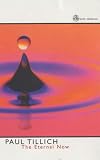
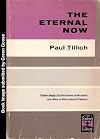
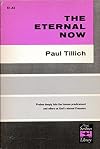
The Eternal Now
by Paul Tillich
On This Page
Description
Sixteen sermons delivered over the past eight years, revealing man's insecurities, evasions and fears, offering him God's blessing.Tags
Recommendations













Member Reviews
Tillich was famous for, among other things, recasting the Christian faith in the language of the day. That day being the late 1950s/early 1960s, many of these sermons seem "dated." The 60's existentialism and the heavily male-dominated language are not terribly helpful for the reader today, IMHO. However, within a few of these sermons lurk gems of wisdom that were quite worth thinking about. His thoughts on the command, "You Shall not take the name of the Lord your God in vain" were especially helpful.
He acknowledges the difficulty of speaking about God in the modern world:
Everyone at one time or another finds himself in a situation where he must decide whether he shall use or avoid the name of God, whether he shall talk with personal show more involvement about religious matters, either for or against them.
And then there's this point, which acknowledges a subtle but popular use of God's name in vain:
There is a form of misuse of the name of God that offends those who hear it with a sensitive ear, just because it did not worry those who misused it without sensitivity. I speak now of a public use of the name of God which has little to do with God, but much to do with human purpose -- good or bad. Those of us who are grasped by the mystery present in the name of God are often stung when this name is used in governmental and political speeches, in opening prayers for conferences and dinners, in secular and religious advertisements, and in international war propaganda. (Bringing his line of thought about using God's name in vain into the present day, one might add usage where it is claimed that God is using a disaster or disease to "punish ______s" or when it's used in sentences such as "God hates ______s " -- fill in the blanks with any groups of people of which the speaker doesn't approve).
I was slow to get through this book. This was partly because the sermons with which I didn't resonate were a slog to get through; and because the ones in which I found some gem of wisdom took some time to fully think through. It's such a mixed bag, I've had a hard time giving it a rating. I'll probably go with a sort of middle-of-the-road 3 stars. show less
He acknowledges the difficulty of speaking about God in the modern world:
Everyone at one time or another finds himself in a situation where he must decide whether he shall use or avoid the name of God, whether he shall talk with personal show more involvement about religious matters, either for or against them.
And then there's this point, which acknowledges a subtle but popular use of God's name in vain:
There is a form of misuse of the name of God that offends those who hear it with a sensitive ear, just because it did not worry those who misused it without sensitivity. I speak now of a public use of the name of God which has little to do with God, but much to do with human purpose -- good or bad. Those of us who are grasped by the mystery present in the name of God are often stung when this name is used in governmental and political speeches, in opening prayers for conferences and dinners, in secular and religious advertisements, and in international war propaganda. (Bringing his line of thought about using God's name in vain into the present day, one might add usage where it is claimed that God is using a disaster or disease to "punish ______s" or when it's used in sentences such as "God hates ______s " -- fill in the blanks with any groups of people of which the speaker doesn't approve).
I was slow to get through this book. This was partly because the sermons with which I didn't resonate were a slog to get through; and because the ones in which I found some gem of wisdom took some time to fully think through. It's such a mixed bag, I've had a hard time giving it a rating. I'll probably go with a sort of middle-of-the-road 3 stars. show less
Probes deeply into the human predicament and offers us God's eternal Presence.
Ratings
Members
- Recently Added By
Lists

Mike's Theology Books
74 works; 2 members
Author Information

136+ Works 12,607 Members
Paul Johannes Tillich was born into a German Lutheran pastor's family in that part of Germany that is now Poland. He attended several universities, earning the doctorate in philosophy in 1910, then taught at several more from 1919 to 1933. Removed from his professorate at Frankfurt by the Nazi government, he emigrated to the United States, with show more the encouragement of Reinhold Niebuhr, and taught at Union Theological Seminary in New York (1933--55), Harvard University (1955--62), and the University of Chicago (1962--65). The fullest biography, including some fairly lurid material of a psychosexual nature, can be found in the appreciative work by Wilhelm and Marion Pauck. The student who wants to encounter Tillich at his most succinct might turn to The Courage To Be (1952) or The Theology of Paul Tillich (1982). He is sometimes classified as Neo-orthodox, but that label does not fit him as well as it does Karl Barth, who had small regard for Tillich's "theology of correlation," where responding to the world's questions is seen as the proper way of practicing theology. (Bowker Author Biography) show less
Some Editions
Series
Belongs to Publisher Series
The Scribner Library (114)
Common Knowledge
- Original publication date
- 1963
Classifications
Statistics
- Members
- 511
- Popularity
- 58,502
- Reviews
- 2
- Rating
- (3.89)
- Languages
- English, German
- Media
- Paper
- ISBNs
- 4
- ASINs
- 15