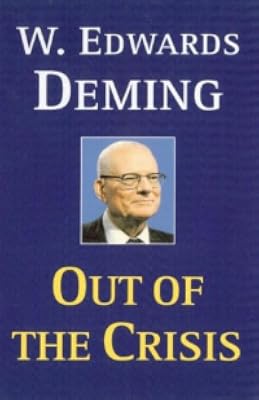
Out of the Crisis
by W. Edwards Deming
On This Page
Description
Deming's classic work on management, based on his famous 14 Points for Management. " Long-term commitment to new learning and new philosophy is required of any management that seeks transformation. The timid and the fainthearted, and the people that expect quick results, are doomed to disappointment." --from Out of the Crisis In his classic Out of the Crisis, W. Edwards Deming describes the foundations for a completely new and transformational way to lead and manage people, processes, and show more resources. Translated into twelve languages and continuously in print since its original publication, it has proved highly influential. Research shows that Deming's approach has high levels of success and sustainability. Readers today will find Deming's insights relevant, significant, and effective in business thinking and practice. This edition includes a foreword by Deming's grandson, Kevin Edwards Cahill, and Kelly Allan, business consultant and Deming expert. According to Deming, American companies require nothing less than a transformation of management style and of governmental relations with industry. In Out of the Crisis , originally published in 1982, Deming offers a theory of management based on his famous 14 Points for Management. Management's failure to plan for the future, he claims, brings about loss of market, which brings about loss of jobs. Management must be judged not only by the quarterly dividend, but by innovative plans to stay in business, protect investment, ensure future dividends, and provide more jobs through improved product and service. In simple, direct language, Deming explains the principles of management transformation and how to apply them. show lessTags
Recommendations




Member Reviews
Deming's fourteen points were famous in the 1980s when they were imported in Japan. Deming helped to lead the Japanese in an economic surge that was felt worldwide. The Japanese were outdoing the United States, especially in engineering. Deming's fourteen points were given as a way to elucidate steps to proceed in the U.S.
What strikes me is that pride in one's work is central to the whole gambit. Without the worker taking pride in her/his work, then there is nothing to be gained. This, not economic incentives, is the core of Deming's work. Do not rob the worker of his pride, or you risk causing quality of production to decline. This simple observation - of what one takes pride in - is helpful whenever I analyze how to deal with others' show more work.
Also prominent within this treatise is the idea of statistical control. When one's work reaches the bounds within the upper limit and lower limit of control, then one can work freely towards decreasing variability and increasing reliability of one's product. This, in essence, is work. This is how to improve one's work each day.
Deming's work was probably revolutionary back in his day (the 1980s). Today, however, most of his lessons have been absorbed by management of enterprises worldwide. They are commonly observed among many product-oriented companies. It is nice to read about them within their historical context. Most of his ideas are still useful in business today. show less
What strikes me is that pride in one's work is central to the whole gambit. Without the worker taking pride in her/his work, then there is nothing to be gained. This, not economic incentives, is the core of Deming's work. Do not rob the worker of his pride, or you risk causing quality of production to decline. This simple observation - of what one takes pride in - is helpful whenever I analyze how to deal with others' show more work.
Also prominent within this treatise is the idea of statistical control. When one's work reaches the bounds within the upper limit and lower limit of control, then one can work freely towards decreasing variability and increasing reliability of one's product. This, in essence, is work. This is how to improve one's work each day.
Deming's work was probably revolutionary back in his day (the 1980s). Today, however, most of his lessons have been absorbed by management of enterprises worldwide. They are commonly observed among many product-oriented companies. It is nice to read about them within their historical context. Most of his ideas are still useful in business today. show less
. Demings tells American management what they are doing wrong and what they can do fix it. That sounds like a lot of hubris, except that Deming is the guy credited with turning around the Japanese manufacturing industry after World War 2, so he knows what he's talking about. Demings emphasizes the importance of statistical process control, and how manufacturing problems are almost always attributable to the system, and not the workers. He speaks out against short-term objectives that end up being harmful in the long term (e.g. quotas, management by objective, increasing stock value in short term). If you are interested in "quality", this is a book to read.
I've seen countless references to this business classic and finally read it based on a survey of the best business books. The principals are timeless and worthy of any manager's time to read and understand. Fortunately, I also found the concepts to appear dates, in part because so many of them have been incorporated into our thinking.
Favorite quote (p. 53): "The greatest waste in America is failure to use the abilities of people."
Favorite quote (p. 53): "The greatest waste in America is failure to use the abilities of people."
The origin of the species.
I included this book in my book: The 100 Best Business Books of All Time. www.100bestbiz.com.
The origin of the species.
Ratings
Members
- Recently Added By
Author Information
31+ Works 1,106 Members
W. Edwards Deming (1900-1993) was an international consultant in management and quality. In 1987, he was awarded the National Medal of Technology and Innovation by President Ronald Reagan.
Awards and Honors
Notable Lists
Common Knowledge
- Original publication date
- 1982
- Quotations
- Who is it that darkeneth counsel by words without knowledge? Job 38:2
Classifications
Statistics
- Members
- 581
- Popularity
- 50,831
- Reviews
- 6
- Rating
- (4.15)
- Languages
- Dutch, English
- Media
- Paper, Ebook
- ISBNs
- 11
- ASINs
- 8