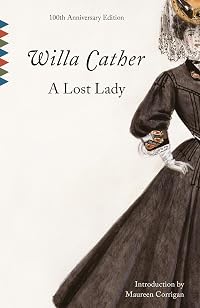
A Lost Lady
by Willa Cather 
There is 1 current discussion about this work.
On This Page
Description
To the people of Sweet Water, a fading railroad town on the Western plains, Mrs. Forrester is the resident aristocrat, at once gracious and comfortably remote. To her aging husband she is a treasure whose value increases as his powers fail. To Niel Herbert, who falls in love with her as a boy and becomes her confidant as a man, Mrs. Forrester is by turns steadfast and faithless, dazzling and pathetic. Mrs. Forrester is a woman whose charm is intertwined with a terrifying vulnerability, and show more whose inevitable decline with age is symbolic of the West itself and its fall from the idealized age of noble pioneers to the age of capitalist exploitation, and A Lost Lady is the portrait of a frontier woman who reflects the conventions of her age even as she defies them. show lessTags
Recommendations





















Member Reviews
Cather’s writing is beautiful and this short novel gives just enough of the tragic Marian Forrester to pull the reader in. She’s married to an older man who has been badly injured. The story is told from the point of view of Niel, a young man who fell in love with her. She has become little more than a caregiver for her husband and then she takes a lover. Apparently, her character partly inspired Daisy’s in The Great Gatsby. The book includes one of the most disturbing scenes of animal cruelty I’ve ever read, which almost put me off it completely. I’m glad I read it, so I could gain a deeper appreciation for Cather’s skill. It reminded me a bit of Madame Bovary and of The Angle of Repose.
59. [179981::A Lost Lady] by [[Willa Cather]]
published: 1923
format: unpaged ebook from obscure publisher (typically ~150 pages)
acquired: September
read: Nov 2-22
time reading: 3 hr 26 min, 1.5 min/page
rating: 5
I struggled and I think mostly failed to figure out how to capture this powerfully compact little book. We're still in Nebraska, "in one of those grey towns along the Burlington railroad, which are so much greyer today than they were then". But Cather's style and perspective are evolving. There is a bitterness to her writing, which is new. She is attacking the zero-principle, zero-ethics destructive evolution of American capitalism. And her prose here has what I think is a new sharpness. But she maintains her deep interest in show more character and natural surroundings. Her characters are still complex, flawed, limited and yet full and wonderfully surprising. Her lost lady, Marian Forrester, is quite magnificent, really only fallen in the eyes are our viewpoint, that of a young local orphan, Niel Herbert. Niel is raised by his uncle, a local lawyer. He gets lost in books and has a mixture of smalltown principles and scholarly inclination. Through his relationship and observation of Marian he experiences his own kind of gut-wrenching fallen innocence, but he's naive and growing up.
Cather's prose is something else here, whether showing nature as a reflection of the story they surround or capturing Marian's impact. Marian can lighten a room, disarm the serious, and she creates energy in disarray, but she is also not to be underestimated. When pressed to false cheerfulness she "burned through the common-place words like the colour in an opal." Elsewhere in some restrained passion with a visitor, the married Marian "put her hand on the sleeve of his coat; the white fingers clung to the black cloth as bits of paper cling to magnetized iron. Her touch, soft as it was, went through the man, all the feet and inches of him."
It's unfortunate how tied-up or incapable I feel at capturing what is really a terrific little book. When it was published reviews claimed it was her best book up to that point, and that's how I felt having read four of her previous five. It's an evolving author. But I do wonder how this one will hang around, and if I'll retain the same memories and impressions her earlier works have left with me. There is a cost to this compression. In all the other books of hers I've read she paces, counting on her story telling to keep you in the flow. This one, sharp, quick, doesn't have the same room for this, and there is maybe a little loss of the experience of being in the book.
Well, regardless of all that, this is a special book on the changing American ethical landscape, on both a loss of innocence and the nuance of human adaptation. Recommended.
2019
https://www.librarything.com/topic/312033#6987036 show less
published: 1923
format: unpaged ebook from obscure publisher (typically ~150 pages)
acquired: September
read: Nov 2-22
time reading: 3 hr 26 min, 1.5 min/page
rating: 5
I struggled and I think mostly failed to figure out how to capture this powerfully compact little book. We're still in Nebraska, "in one of those grey towns along the Burlington railroad, which are so much greyer today than they were then". But Cather's style and perspective are evolving. There is a bitterness to her writing, which is new. She is attacking the zero-principle, zero-ethics destructive evolution of American capitalism. And her prose here has what I think is a new sharpness. But she maintains her deep interest in show more character and natural surroundings. Her characters are still complex, flawed, limited and yet full and wonderfully surprising. Her lost lady, Marian Forrester, is quite magnificent, really only fallen in the eyes are our viewpoint, that of a young local orphan, Niel Herbert. Niel is raised by his uncle, a local lawyer. He gets lost in books and has a mixture of smalltown principles and scholarly inclination. Through his relationship and observation of Marian he experiences his own kind of gut-wrenching fallen innocence, but he's naive and growing up.
Cather's prose is something else here, whether showing nature as a reflection of the story they surround or capturing Marian's impact. Marian can lighten a room, disarm the serious, and she creates energy in disarray, but she is also not to be underestimated. When pressed to false cheerfulness she "burned through the common-place words like the colour in an opal." Elsewhere in some restrained passion with a visitor, the married Marian "put her hand on the sleeve of his coat; the white fingers clung to the black cloth as bits of paper cling to magnetized iron. Her touch, soft as it was, went through the man, all the feet and inches of him."
It's unfortunate how tied-up or incapable I feel at capturing what is really a terrific little book. When it was published reviews claimed it was her best book up to that point, and that's how I felt having read four of her previous five. It's an evolving author. But I do wonder how this one will hang around, and if I'll retain the same memories and impressions her earlier works have left with me. There is a cost to this compression. In all the other books of hers I've read she paces, counting on her story telling to keep you in the flow. This one, sharp, quick, doesn't have the same room for this, and there is maybe a little loss of the experience of being in the book.
Well, regardless of all that, this is a special book on the changing American ethical landscape, on both a loss of innocence and the nuance of human adaptation. Recommended.
2019
https://www.librarything.com/topic/312033#6987036 show less
This short novel was published in 1923, but it begins several decades earlier, in the American West. The lady of the title is Mrs. Forrester, the wife of a man who amassed considerable wealth in the railroad business, but who, in the course of the story, finds himself in what such folks might call "reduced circumstances." It's told from the point of view of a young friend of the family, who idolizes her as having all the virtues considered most fitting to a woman of her social class: beauty and charm and a certain air of purity. But, through his eyes, we also see tiny glimpses of the woman behind that exterior, someone flawed, and much more complicated, and sadder.
I'm really impressed by Willa Cather's ability to make a character like show more Marian Forrester feel so much like a real, complex person in such a surprisingly minimalist way. Everything about her is more suggested than explored, and it doesn't feel like that should work remotely as well as it does.
This is also an interesting glimpse into a small piece of American history. A history, it must be said, that invites judgment from 21st-century readers with its causal racism, its ingrained classism, and its musings on the whole Manifest Destiny thing as a lovely, idealistic dream, albeit one now giving way to a sort of degraded banality. Such things can sometimes be uncomfortable to read, but in this case I felt mostly a sort of anthropological fascination with it all. show less
I'm really impressed by Willa Cather's ability to make a character like show more Marian Forrester feel so much like a real, complex person in such a surprisingly minimalist way. Everything about her is more suggested than explored, and it doesn't feel like that should work remotely as well as it does.
This is also an interesting glimpse into a small piece of American history. A history, it must be said, that invites judgment from 21st-century readers with its causal racism, its ingrained classism, and its musings on the whole Manifest Destiny thing as a lovely, idealistic dream, albeit one now giving way to a sort of degraded banality. Such things can sometimes be uncomfortable to read, but in this case I felt mostly a sort of anthropological fascination with it all. show less
The lost lady of Willa Cather’s novella is Marian Forrester, wife to Captain Forrester who of late was instrumental in the building of the railway. She is the very breath of light and spring to many a young boy in Sweet Water. In particular, Niel Herbert falls under Mrs. Forrester’s spell as a boy when she tends him after he has fallen and broken his arm. But her charms captivate one and all, not least the Captain’s many powerful friends. Yet hers is a free spirit and, in some senses, even from the outset she is already a lost lady. However, her losses only become apparent years later after the Captain first loses his fortune and then, following a stroke, much of his mobility. His infirmity traps her in Sweet Water, preventing her show more from joining with her friends in Colorado for the winters. And that is when Niel begins to really notice her changing.
Along with a vividly painted portrait of a woman very much of her own mind, this story treads through both the beautiful meadows and the marshy backwater of the American hinterland. Early in the story we witness perhaps the most awful example of wanton cruelty I have ever encountered in a story. It is so startling that it makes it hard to even focus on what Cather is doing here. But I suppose that, since nothing much comes of that act at the time or later, it must be meant to serve as a caution on how we ought to treat of Marian’s own actions. Fate, it seems, can be as cruel as the cruelest of young boys.
Cather’s writing is never less than riveting. She seems to evoke a prairie locale with the mere wave of her hand, but it is surely the work of a great artist. Her central characters are as complex as any imaginable: full of contrary actions, missteps, magnanimity, and baseness. Almost too much for such a slight work. But gently recommended, as ever. show less
Along with a vividly painted portrait of a woman very much of her own mind, this story treads through both the beautiful meadows and the marshy backwater of the American hinterland. Early in the story we witness perhaps the most awful example of wanton cruelty I have ever encountered in a story. It is so startling that it makes it hard to even focus on what Cather is doing here. But I suppose that, since nothing much comes of that act at the time or later, it must be meant to serve as a caution on how we ought to treat of Marian’s own actions. Fate, it seems, can be as cruel as the cruelest of young boys.
Cather’s writing is never less than riveting. She seems to evoke a prairie locale with the mere wave of her hand, but it is surely the work of a great artist. Her central characters are as complex as any imaginable: full of contrary actions, missteps, magnanimity, and baseness. Almost too much for such a slight work. But gently recommended, as ever. show less
This novella is hardly more than a sketch of a character. The brilliance of Cather’s prose is demonstrated in her portrayal of Marian Forrester, the high-spirited wife of one of the great pioneers and railroad builders. There are also historical implications of Cather’s fable. These are enhanced by the enigmatic and ambiguous elements in Mrs. Forrester’s portrait. On the surface, Marian Forrester belongs to Cather’s long line of restless, magnetic, intelligent women, like Alexandra Bergson, who grows wealthy farming the virgin land in O Pioneers! (1913), Thea Kronborg, the Swedish girl who becomes a famous opera singer in The Song of the Lark (1915), and Ántonia Shimerda, the heroine of My Ántonia (1918), who survives tragedy show more and abandonment to become the mother of many children, “a rich mine of life, like the founders of early races.”
One may view A Lost Lady as a brilliant epilogue to Cather’s famous pioneer novels; however, it has a different tone, not heroic and optimistic like the Whitmanesque O Pioneers! but bittersweet and retrospective like Edith Wharton’s Age of Innocence. As one who loves Cather's beautiful writing style, I found this a touching taste from her pen. show less
One may view A Lost Lady as a brilliant epilogue to Cather’s famous pioneer novels; however, it has a different tone, not heroic and optimistic like the Whitmanesque O Pioneers! but bittersweet and retrospective like Edith Wharton’s Age of Innocence. As one who loves Cather's beautiful writing style, I found this a touching taste from her pen. show less
Captain Daniel Forrester and his younger wife, Marian, live in a prairie town with tight connections to the Burlington railway. Mrs. Forrester maintains a distant relationship with most people, but her charm and good looks still have them eating out of her hand. Early in the story, Mrs. Forrester gives a group of schoolboys permission to play on her property, and she brings them food. One of the boys, Niel, develops a crush on her and Mrs. Forrester's story is then told largely through his eyes.
Niel is a studious young man, reading classics and working to overcome his humble origins. Captain Forrester, a self-made man, counsels Niel that he need only work hard to get what he deserves in life:
All our great west has been developed from show more such dreams; the homesteader's and the prospector's and the contractor's. We dreamed the railroads across the mountains, just as I dreamed my place on the Sweet Water. (p. 55)
As Niel matures he watches the Forresters, and pines for Mrs. Forrester who of course sees him as nothing more than a nice schoolboy. Niel's illusions are shattered when Mrs. Forrester shows her own human weaknesses. Unfortunately, I failed to develop an emotional connection to these characters. The novel was improved by Cather's beautiful descriptions of the landscape:
The sky was burning with the soft p[ink and silver of a cloudless summer dawn. The heavy, bowed grasses splashed him to the knees. All over the marsh, snow-on-the-mountain, globed with dew, made cool sheets of silver, and the swamp milk-week spread its flat, raspberry-coloured clusters. There was an almost religious purity about the fresh morning air, the tender sky, the grass and flowers with the sheen of early dew upon them. There was in all living things something limpid and joyous -- like the wet, morning call of the birds, flying up through the unstained atmosphere. (p. 84)
This was a decent novel, just not one of Cather's best. show less
Niel is a studious young man, reading classics and working to overcome his humble origins. Captain Forrester, a self-made man, counsels Niel that he need only work hard to get what he deserves in life:
All our great west has been developed from show more such dreams; the homesteader's and the prospector's and the contractor's. We dreamed the railroads across the mountains, just as I dreamed my place on the Sweet Water. (p. 55)
As Niel matures he watches the Forresters, and pines for Mrs. Forrester who of course sees him as nothing more than a nice schoolboy. Niel's illusions are shattered when Mrs. Forrester shows her own human weaknesses. Unfortunately, I failed to develop an emotional connection to these characters. The novel was improved by Cather's beautiful descriptions of the landscape:
The sky was burning with the soft p[ink and silver of a cloudless summer dawn. The heavy, bowed grasses splashed him to the knees. All over the marsh, snow-on-the-mountain, globed with dew, made cool sheets of silver, and the swamp milk-week spread its flat, raspberry-coloured clusters. There was an almost religious purity about the fresh morning air, the tender sky, the grass and flowers with the sheen of early dew upon them. There was in all living things something limpid and joyous -- like the wet, morning call of the birds, flying up through the unstained atmosphere. (p. 84)
This was a decent novel, just not one of Cather's best. show less
My second read for Willa Cather reading week was A Lost Lady first published in 1923, is seen by many as her best novel. A novel about the passing of the old order, an elegy for the days of the Pioneer, it tells the story of the gradual deterioration of a woman’s reputation and values.
Thirty or forty years ago, in one of those grey towns along the Burlington railroad, which are so much greyer today than they were then, there was a house well known from Omaha to Denver for its hospitality and for a certain charm of atmosphere.
The story is told through the eyes of Niel Herbert, who as a young boy falls in love with the beautiful, elegant, almost other worldly Marian Forrester. Married to an elderly railroad pioneer, to whom she is a show more constant delight, Marian charms the community of Sweet Water where the couple live mainly during the summer months. The summer this story opens, Niel is twelve years old, he and his friends, fish, picnic and play on the land surrounding the Forrester home, Marian Forrester watching them from the house sends some newly baked biscuits out to them. Another local boy, a little older than Niel and his friends is Ivy Peters, a scornful, cruel boy, amused by Niel’s affection for the Forresters.
“He could remember the very first time he ever saw Mrs Forrester, when he was a little boy. He had been loitering in front of the Episcopal church one Sunday morning, when a low carriage drove up to the door. Ben Keezer was on the front seat, and on the back seat was a lady, alone, in a black silk dress all puffs and ruffles, and a black hat, carrying a parasol with a carved ivory handle. As the carriage stopped she lifted her dress to alight; out of a swirl of foamy white petticoats she thrust a black, shiny slipper. She stepped lightly to the ground and with a nod to the driver went into the church. The little boy followed her through the open door, saw her enter a pew and kneel. He was proud now that at the first moment he had recognised her as belonging to a different world from any he had ever known.”
Marian and Captain Forrester play host to the Captain’s friends at their comfortable home, they are a popular couple, their home a place of genial company. As a boy young Niel is bewitched by Mrs Forrester – and from the day he is carried into her home, injured, to await the local doctor, his life in Sweet Water is lived on the periphery of the Forrester home. Niel’s uncle, Judge Pommeroy is one of the Captain’s particular friends and so Niel becomes a regular and welcome guest in their home, Marian becomes fond of the boy, encouraging his visits. The Captain and his slowly declining health represent the end of the old pioneering days, as his old fashioned investments lose money and he and his wife are forced to live in their Sweet Water home all year round.
Several years later, Niel is working with his uncle, before leaving Sweet Water to train as an architect, still a regular visitor at the Forrester’s house he is introduced to Frank Ellinger and Constance Ogden. Marian wants Niel to entertain Constance who is the same age as Niel, but Constance seems more taken with Frank, a large, sociable man of about forty, who Niel feels uncomfortable around, and he notices, spends a lot of time with Mrs Forrester.
Niel’s faith in Marian Forrester is severely shaken, for him she loses a lot of the glamour she had before Frank Ellinger became a regular visitor. When the Captain returns from town with the news that they have lost most of their money, Niel struggles to reconcile Marian Forrester with a woman who will have to undertake her own household tasks. For Niel, Marian Forrester’s decline is a slow sad education into the truth of human frailties. Like Emma Bovary perhaps, Marian Forrester is not entirely unsympathetic, even in the midst of his increasing disappointment over the years Niel can’t entirely turn away from her.
“Long, long afterward, when Niel did not know whether Mrs Forrester was living or dead, if her image flashed into his mind, it came with a brightness of dark eyes, her pale triangular cheeks with long earrings, and her many-coloured laugh. When he was dull, dull and tired of everything, he used to think that if he could hear that long-lost lady laugh again he could be gay.”
Marian is a woman who has known excitement and glamour, twenty five years younger than her husband she is not quite ready to sit ageing by the fire. She looks after her husband tenderly; yet she still knows how to charm the men around her. Marian is faithless but steadfast, vulnerable yet capable of doing whatever she needs to survive. Old Pioneers like Captain Forrester eventually shuffle off to make way for the new capitalist generation represented by Ivy Peters – who has bought up land around the Forrester home, and in time manages Marian’s estate – taking unpardonable liberties in Niel’s opinion with the way he speaks to one who should be his social superior. Niel has to accept that Marian is not the idealised creature she had appeared to that small boy, and so faithful to the last Niel attempts to protect Marian from herself.
A Lost Lady is a delicately rendered novel, the writing exquisite, marking a half way point in Cather’s writing career. It is simply superb, poignant and memorable. show less
Thirty or forty years ago, in one of those grey towns along the Burlington railroad, which are so much greyer today than they were then, there was a house well known from Omaha to Denver for its hospitality and for a certain charm of atmosphere.
The story is told through the eyes of Niel Herbert, who as a young boy falls in love with the beautiful, elegant, almost other worldly Marian Forrester. Married to an elderly railroad pioneer, to whom she is a show more constant delight, Marian charms the community of Sweet Water where the couple live mainly during the summer months. The summer this story opens, Niel is twelve years old, he and his friends, fish, picnic and play on the land surrounding the Forrester home, Marian Forrester watching them from the house sends some newly baked biscuits out to them. Another local boy, a little older than Niel and his friends is Ivy Peters, a scornful, cruel boy, amused by Niel’s affection for the Forresters.
“He could remember the very first time he ever saw Mrs Forrester, when he was a little boy. He had been loitering in front of the Episcopal church one Sunday morning, when a low carriage drove up to the door. Ben Keezer was on the front seat, and on the back seat was a lady, alone, in a black silk dress all puffs and ruffles, and a black hat, carrying a parasol with a carved ivory handle. As the carriage stopped she lifted her dress to alight; out of a swirl of foamy white petticoats she thrust a black, shiny slipper. She stepped lightly to the ground and with a nod to the driver went into the church. The little boy followed her through the open door, saw her enter a pew and kneel. He was proud now that at the first moment he had recognised her as belonging to a different world from any he had ever known.”
Marian and Captain Forrester play host to the Captain’s friends at their comfortable home, they are a popular couple, their home a place of genial company. As a boy young Niel is bewitched by Mrs Forrester – and from the day he is carried into her home, injured, to await the local doctor, his life in Sweet Water is lived on the periphery of the Forrester home. Niel’s uncle, Judge Pommeroy is one of the Captain’s particular friends and so Niel becomes a regular and welcome guest in their home, Marian becomes fond of the boy, encouraging his visits. The Captain and his slowly declining health represent the end of the old pioneering days, as his old fashioned investments lose money and he and his wife are forced to live in their Sweet Water home all year round.
Several years later, Niel is working with his uncle, before leaving Sweet Water to train as an architect, still a regular visitor at the Forrester’s house he is introduced to Frank Ellinger and Constance Ogden. Marian wants Niel to entertain Constance who is the same age as Niel, but Constance seems more taken with Frank, a large, sociable man of about forty, who Niel feels uncomfortable around, and he notices, spends a lot of time with Mrs Forrester.
Niel’s faith in Marian Forrester is severely shaken, for him she loses a lot of the glamour she had before Frank Ellinger became a regular visitor. When the Captain returns from town with the news that they have lost most of their money, Niel struggles to reconcile Marian Forrester with a woman who will have to undertake her own household tasks. For Niel, Marian Forrester’s decline is a slow sad education into the truth of human frailties. Like Emma Bovary perhaps, Marian Forrester is not entirely unsympathetic, even in the midst of his increasing disappointment over the years Niel can’t entirely turn away from her.
“Long, long afterward, when Niel did not know whether Mrs Forrester was living or dead, if her image flashed into his mind, it came with a brightness of dark eyes, her pale triangular cheeks with long earrings, and her many-coloured laugh. When he was dull, dull and tired of everything, he used to think that if he could hear that long-lost lady laugh again he could be gay.”
Marian is a woman who has known excitement and glamour, twenty five years younger than her husband she is not quite ready to sit ageing by the fire. She looks after her husband tenderly; yet she still knows how to charm the men around her. Marian is faithless but steadfast, vulnerable yet capable of doing whatever she needs to survive. Old Pioneers like Captain Forrester eventually shuffle off to make way for the new capitalist generation represented by Ivy Peters – who has bought up land around the Forrester home, and in time manages Marian’s estate – taking unpardonable liberties in Niel’s opinion with the way he speaks to one who should be his social superior. Niel has to accept that Marian is not the idealised creature she had appeared to that small boy, and so faithful to the last Niel attempts to protect Marian from herself.
A Lost Lady is a delicately rendered novel, the writing exquisite, marking a half way point in Cather’s writing career. It is simply superb, poignant and memorable. show less
Members
- Recently Added By
Lists

The Guardian's 1000 Novels Everyone Must Read
1,005 works; 552 members

Novels from The Guardian's Great American Novelist Tournament
148 works; 24 members

Favourite Virago Modern Classics
183 works; 38 members
20th Century Literature
1,161 works; 55 members
Harold Bloom - The Western Canon: D. The Chaotic Age
833 works; 24 members

Books about Frontier Life and Pioneers
55 works; 7 members

Canon de la narrativa universal del s. XX (cicutadry)
499 works; 3 members

Llibres que he llegit el 2025
81 works; 2 members

School Made Us Read It
380 works; 197 members
Talk Discussions
Current Discussions
A Lost Lady by Willa Cather 1983 in George Macy devotees (November 2025)
Author Information

154+ Works 46,168 Members
Willa Siebert Cather was born in 1873 in the home of her maternal grandmother in western Virginia. Although she had been named Willela, her family always called her "Willa." Upon graduating from the University of Nebraska in 1895, Cather moved to Pittsburgh where she worked as a journalist and teacher while beginning her writing career. In 1906, show more Cather moved to New York to become a leading magazine editor at McClure's Magazine before turning to writing full-time. She continued her education, receiving her doctorate of letters from the University of Nebraska in 1917, and honorary degrees from the University of Michigan, the University of California, Columbia, Yale, and Princeton. Cather wrote poetry, short stories, essays, and novels, winning awards including the Pulitzer Prize for her novel, One of Ours, about a Nebraska farm boy during World War I. She also wrote The Professor's House, My Antonia, Death Comes for the Archbishop, and Lucy Gayheart. Some of Cather's novels were made into movies, the most well-known being A Lost Lady, starring Barbara Stanwyck. In 1961, Willa Cather was the first woman ever voted into the Nebraska Hall of Fame. She was also inducted into the Hall of Great Westerners in Oklahoma in 1974, and the National Women's Hall of Fame in Seneca, New York in 1988. Cather died on April 24, 1947, of a cerebral hemorrhage, in her Madison Avenue, New York home, where she had lived for many years. (Bowker Author Biography) show less
Willa Cather has a Legacy Library. Legacy libraries are the personal libraries of famous readers, entered by LibraryThing members from the Legacy Libraries group.
All Editions
Some Editions
Awards and Honors
Series
Belongs to Publisher Series
Work Relationships
Is contained in
Later Novels: A Lost Lady / The Professor's House / Death Comes for the Archbishop / Shadows on the Rock / Lucy Gayheart / Sapphira and the Slave Girl by Willa Cather
Willa Cather - The Library of America Set Complete in 3 Volumes (1. Early Novels & Stories; 2. Stories, Poems and Other Writings; and 3. Later Novels) by Willa Cather (indirect)
Has the adaptation
Has as a student's study guide
Common Knowledge
- Canonical title
- A Lost Lady
- Original publication date
- 1923
- People/Characters
- Marion Forrester
- Important places
- USA (American West); Nebraska, USA
- Related movies
- A Lost Lady (1924 | IMDb); A Lost Lady (1934 | IMDb)
- Epigraph
- "...Come, my coach!
Good night, ladies; good night, sweet ladies,
Good night, good night." - Dedication*
- Para Jan Hambourg
- First words
- Thirty or forty years ago, in one of those grey towns along the Burlington railroad, which are so much greyer today than they were then, there was a house well known from Omaha to Denver for its hospitality and for a certain ... (show all)charm of atmosphere.
Willa Cather was a writer whose gifts, and critical reception, were paradoxical. (Introduction) - Quotations
- The Old West had been settled by dreamers, great-hearted adventurers who were unpractical to the point of magnificence; a courteous brotherhood, strong in attack but weak in defence, who could conquer but could not hold.
- Last words
- (Click to show. Warning: May contain spoilers.)"I did!"
(Click to show. Warning: May contain spoilers.)Willa Cather shows a series of still moments, held gestures, and tells more recognisable and uncategorisable truth than most. (Introduction)
*Some information comes from Common Knowledge in other languages. Click "Edit" for more information.
Classifications
Statistics
- Members
- 1,826
- Popularity
- 11,980
- Reviews
- 46
- Rating
- (3.72)
- Languages
- 10 — Czech, Dutch, English, Estonian, French, German, Greek, Italian, Portuguese, Spanish
- Media
- Paper, Audiobook, Ebook
- ISBNs
- 88
- UPCs
- 2
- ASINs
- 46