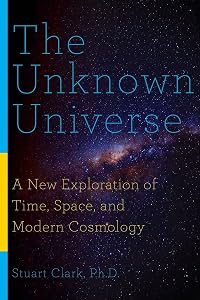
The Unknown Universe: A New Exploration of Time, Space, and Modern Cosmology
by Stuart Clark
On This Page
Description
A groundbreaking guide to the universe and how our latest deep-space discoveries are forcing us to revisit what we know--and what we don't. This is the first book to address what will be an epoch-defining scientific paradigm shift. Stuart Clark will ask if Newton's famous laws of gravity need to be rewritten; if dark matter and dark energy are just celestial phantoms? Can we ever know what happened before the Big Bang? What's at the bottom of a black hole? Are there universes beyond our own? show more Does time exist? Are the once immutable laws of physics changing? show lessTags
Recommendations






Member Reviews
Clark’s book combines a basic survey of cosmology with, in its final chapters, introductions to some of the unsolved problems. Those final chapters give a pretty good rundown of how we got ourselves into difficulties for which very jarring and disruptive ideas, like dark matter and dark energy, appear as theoretical solutions. Clark’s emphasis, rightly I think, is on the problems or mysteries to which those ideas are purported answers rather than to the sensationalism of the ideas themselves. This is in keeping with his wary attitude toward mathematical or theoretical “discoveries” for which we, at least for now, lack observational evidence.
As science books go, this is a very quick read. That’s not to say that the topics show more discussed are simple. But the treatment is quick. Clark keeps everything at a conceptual level — you won’t find equations, or much mathematical talk of any complexity at all.
Within those constraints, I think he does well. He doesn’t go deeply into topics, but he does provide the basis from which someone, even a relative novice, could explore farther, armed with a big picture understanding.
Clark has a “great scientist” way of telling the story of cosmology. I don’t think he’s committed to a “great man” theory so much as to an appealing way to tell the story. He will go from scientist to scientist — James Bradley, Hippolyte Fizeau, Michael Faraday, James Clerk Maxwell, Albert A. Michelson, Albert Einstein, . . . — telling of each one’s part in the bigger story. The trick is to weave those people into a coherent, continuous story, and I think he does that pretty well.
One thing I have to say the book lacks is any illustrations or diagrams. For example, Clark provides an interesting discussion of various historical methods for measuring the speed of light, but I found myself sketching my own diagrams to gain clarity. His explanations are relatively clear, but a diagram would help a great deal. Michelson-Morley’s method is a good example, but also Fizeau’s spinning cogwheel method — something I wasn’t familiar with at all.
One theme that Clark pursues throughout the book is that of theoretical vs. observational physics (and astronomy). He identifies Arthur Eddington’s construction of a theory of how stars produce energy, in response to James Jeans’ position that answering the question was beyond the reach of observation. Instead, as Clark says, Eddington “reverse-engineered” a solution — he built a model of what we cannot observe to explain what we can observe.
Such an approach is not entirely new. You could cast Kant’s explanation of how the solar system formed — his “nebular hypothesis” (also described by Clark) — as a similar modeling of what is beyond observation. But I think Clark’s point may be that the approach is rampant in contemporary physics and cosmology. Physicists regularly theorize about such things as dark matter, and then go to look for them. Rather than following the path of old fashioned scientific method — observe and then theorize — physicists routinely reverse the order — theorize and then observe.
In fact, that approach has had some very significant successes. The recent detection of gravitational waves confirmed their long-thought theoretical existence. Black holes were discovered mathematically long before actually being observed.
And the relationship between theorizing and observing is, in reality, much more complex. Often observations produce surprising results — for example, recent observations of the rate of the universe’s expansion. Those observations defied expectations, providing evidence that the universe’s expansion is speeding up rather than slowing down, as had been thought due to straight-forward considerations of gravity. Then the theorizing begins — what could explain the surprising results? And the theorizing posits unobserved mechanisms, or forces, e.g., dark energy. And then, in turn, we have to ask what telltale observations would support the theory, and observation kicks back in.
But there is of course a danger of severing the tie between theorizing and observing, taking theoretical derivations, like dark energy or dark matter, to be bona fide discoveries of real phenomena regardless of the lack of any actual observations. And Clark warns of that tendency in contemporary cosmology.
I’ve gone into a little more depth than I might have. I don’t want to give the impression that this is a difficult, academic book. Clark is a clear writer, and readers of a pretty wide range of previous knowledge of cosmology will get a lot out of this book. show less
As science books go, this is a very quick read. That’s not to say that the topics show more discussed are simple. But the treatment is quick. Clark keeps everything at a conceptual level — you won’t find equations, or much mathematical talk of any complexity at all.
Within those constraints, I think he does well. He doesn’t go deeply into topics, but he does provide the basis from which someone, even a relative novice, could explore farther, armed with a big picture understanding.
Clark has a “great scientist” way of telling the story of cosmology. I don’t think he’s committed to a “great man” theory so much as to an appealing way to tell the story. He will go from scientist to scientist — James Bradley, Hippolyte Fizeau, Michael Faraday, James Clerk Maxwell, Albert A. Michelson, Albert Einstein, . . . — telling of each one’s part in the bigger story. The trick is to weave those people into a coherent, continuous story, and I think he does that pretty well.
One thing I have to say the book lacks is any illustrations or diagrams. For example, Clark provides an interesting discussion of various historical methods for measuring the speed of light, but I found myself sketching my own diagrams to gain clarity. His explanations are relatively clear, but a diagram would help a great deal. Michelson-Morley’s method is a good example, but also Fizeau’s spinning cogwheel method — something I wasn’t familiar with at all.
One theme that Clark pursues throughout the book is that of theoretical vs. observational physics (and astronomy). He identifies Arthur Eddington’s construction of a theory of how stars produce energy, in response to James Jeans’ position that answering the question was beyond the reach of observation. Instead, as Clark says, Eddington “reverse-engineered” a solution — he built a model of what we cannot observe to explain what we can observe.
Such an approach is not entirely new. You could cast Kant’s explanation of how the solar system formed — his “nebular hypothesis” (also described by Clark) — as a similar modeling of what is beyond observation. But I think Clark’s point may be that the approach is rampant in contemporary physics and cosmology. Physicists regularly theorize about such things as dark matter, and then go to look for them. Rather than following the path of old fashioned scientific method — observe and then theorize — physicists routinely reverse the order — theorize and then observe.
In fact, that approach has had some very significant successes. The recent detection of gravitational waves confirmed their long-thought theoretical existence. Black holes were discovered mathematically long before actually being observed.
And the relationship between theorizing and observing is, in reality, much more complex. Often observations produce surprising results — for example, recent observations of the rate of the universe’s expansion. Those observations defied expectations, providing evidence that the universe’s expansion is speeding up rather than slowing down, as had been thought due to straight-forward considerations of gravity. Then the theorizing begins — what could explain the surprising results? And the theorizing posits unobserved mechanisms, or forces, e.g., dark energy. And then, in turn, we have to ask what telltale observations would support the theory, and observation kicks back in.
But there is of course a danger of severing the tie between theorizing and observing, taking theoretical derivations, like dark energy or dark matter, to be bona fide discoveries of real phenomena regardless of the lack of any actual observations. And Clark warns of that tendency in contemporary cosmology.
I’ve gone into a little more depth than I might have. I don’t want to give the impression that this is a difficult, academic book. Clark is a clear writer, and readers of a pretty wide range of previous knowledge of cosmology will get a lot out of this book. show less
A very nicely done survey of astronomy, physics, and cosmology, focusing largely on history and personalities, but with enough science that I'd probably have done better to read with my eyes and not my ears! As usual with the science books I choose to listen to while I walk my goofy dog, the narrator inevitably was explaining some complicated space-time-particle-curve thing at the moment my poor dog spotted a toddler (they're all really golden retriever devouring aliens, in disguise, doncha know?) and bolted in terror, dragging me in his wake, and causing me to lose track of quarks, light years, etc. Still, even allowing for the bits I got lost at, and the author really does present the “big picture” without cluttering things up show more with math and chemistry, so it truly is my dog's fault (or, possibly, mine) that I got lost at all, this is a very enjoyable look at theories of time, space, the origins and fate of the universe, and everything, from early days up to the present. show less
Most of this easy-reading book covers the same topics as scads of other cosmology popularizations, albeit in a novel order. By emphasizing doubts about things like inflation, dark matter, dark energy, the exactitude of Einstein's equivalence principle, and whether space and time (and hence spacetime) are sufficiently understood, Clark eventually arrives at the position that a paradigm shift may be in the offing.
A discursive discussion about some of the more difficult issues facing the world of astrophysics today. Looking at such a subjects as black holes, nebula formation, solar dynamics and the heat death of the universe, this isn't a starters guide to the state of astrophysics. Despite a readable style, I didn't find this, that accessible, but I would imagine that the controversies that it explores were well covered. Certainly not for the novice, it does have some good points, it's just that as someone who was looking for an introduction into the mysteries of the universe, this probably wasn't the best choice for that notion.
La casualità delle mie scelte di lettura ha fatto sì che mi capitassero due libri di cosmologia d fila. In questo caso Clark fa una trattazione molto più ampia di quella di Balbi: non che si debba o voglia fare una graduatoria, perché i due approcci sono completamente diversi. Clark scrive molto bene ed è chiara la sua volontà di raccontare quello che succede ora nella cosmologia, e d'altra parte questo è il suo lavoro di scrittore scientifico. Quindi localmente è tutto bello e comprensibile, oltre che posto in un contesto storico che fa apprezzare meglio le cose e condito da aneddoti gustosi in stile americano come l'incontro brussellese tra Einstein e Lemaître. Quando però la lettura termina, rimane un senso di vuoto, non show more dovuto alla vastità dell'universo quanto alla eterogeneità dei temi trattati. La mia sensazione è che Clark abbia ripreso quanto aveva scritto sulle riviste e l'abbia inciccito; ma non l'ha ripensato in modo unitario. Risultato? Si scoprono tante nozioni puntuali, ma l'universo resta ancora più sconosciuto. Una nota positiva: è bello leggere di come gli scienziati lavorano, facendo ipotesi sempre più indirette. Spesso noi crediamo che quello che dicono gli scienziati siano verità assolute: qui si vede che non è proprio così. Buona la traduzione di Valeria Lucia Gili. show less
May 3, 2018Italian
Ratings
Members
- Recently Added By
Lists

Science: Astronomy
62 works; 2 members

Books Read in 2017
4,249 works; 130 members
Author Information
32+ Works 770 Members
Classifications
Statistics
- Members
- 88
- Popularity
- 363,994
- Reviews
- 5
- Rating
- (3.76)
- Languages
- English, Italian
- Media
- Paper, Audiobook, Ebook
- ISBNs
- 11
- ASINs
- 3