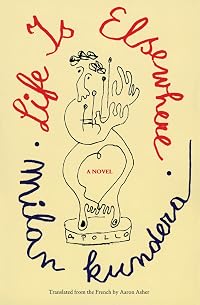
Life Is Elsewhere
by Milan Kundera
On This Page
Description
A budding poet and his adoring mother are the central characters of this intriguing early novel by Milan Kundera. He takes us through the young man's fantasies and love affairs in a characteristic tour de force, alive with wit, eroticism and ideas.Tags
Recommendations





Member Reviews
Kundera’s third novel is a hymn to lyrical poetry, revolutionary passions and youthful testosterone. “Bliss was it in that dawn to be alive / But to be young was very heaven,” and all that, although it turns out that the young Wordsworth (and Goethe) are among the few poets not to be channeled by Kundera’s young hero, Jaromil. And it isn’t hard to see why — they had the bad taste to go on to become old men.
And of course this is Kundera, so there is a heavy layer of irony going on. Youth is a time of great clumsiness, self-doubt and acne as well as of great energy, beauty and passion; lyrical poetry usually mixes the trite with the profound in its grand images; first love is often in so much of a hurry to get its rocks off show more that it picks the wrong object; revolutions (not least the Czechoslovak one of 1948) mix in a good deal of petty revenge, bureaucratic dogmatism and political pragmatism with all the youthful idealism and passion; and even the most romantic poetic gesture of all, the early grave, can have more than its fair share of bathos.
This is all very clever and often funny, but you do sometimes get the feeling that the author is taking unfair advantage of the situation to indulge his own fantasies and write in an unnecessary number of sex-scenes — particularly as none of the female characters in the book have names or more than a minimal capacity to act independently of men. Admittedly, the men don’t have names either (other than Jaromil, his dream alter-ego Xavier, and various real-life Dead Poets), but they do seem to be able to act independently, and don’t spend all their time being undressed. show less
And of course this is Kundera, so there is a heavy layer of irony going on. Youth is a time of great clumsiness, self-doubt and acne as well as of great energy, beauty and passion; lyrical poetry usually mixes the trite with the profound in its grand images; first love is often in so much of a hurry to get its rocks off show more that it picks the wrong object; revolutions (not least the Czechoslovak one of 1948) mix in a good deal of petty revenge, bureaucratic dogmatism and political pragmatism with all the youthful idealism and passion; and even the most romantic poetic gesture of all, the early grave, can have more than its fair share of bathos.
This is all very clever and often funny, but you do sometimes get the feeling that the author is taking unfair advantage of the situation to indulge his own fantasies and write in an unnecessary number of sex-scenes — particularly as none of the female characters in the book have names or more than a minimal capacity to act independently of men. Admittedly, the men don’t have names either (other than Jaromil, his dream alter-ego Xavier, and various real-life Dead Poets), but they do seem to be able to act independently, and don’t spend all their time being undressed. show less
Holy crap, this book was great. I mean, as long as you don't like pleasant books about nice people. It's vicious. And thank God, the lead character stopped reminding me of the worst things about me eventually.
Rereading Life Is Elsewhere, I had the feeling as though I was traveling back to my adolescent years when I read the book for the first time. The protagonist, Jaromil the poet, leads a life observing and reacting towards others’ views on him. In Kundera’s words, he lives in a ‘mirrored world’. Needless to say, he is unhappy, insecure and emotionally disturbed.
The tragedy is planted at the start of the novel, when Jaromil’s conception is unwelcome by his father. This is a life that is not meant to exist, a life that is always better in somewhere else. But then, ’somewhere’ is a space of non-existence. The eagerness to prove his existence makes Jaromil draw headless sketches, eavesdropping adults’ comments about him, show more writes and memorizes poems to impress men and women, and voices offensive opinions.
Women play important roles in Jaromil’s life. His relationship with his mother is complicated - it’s dependency rather than love. In fact, he relies on the women - from his mother to the first girls he dated, to the redhead girl,and finally the filmmaker - around him to reassured himself the worthiness of his existence.
Kundera is the master of the craft. The self-conscious narrator appears natural. The inclusion of Xarvier, the character in Jaromil’s dream, as his alter-ego to subtly reflect his vulnerability and frustration (that he can never achieve what he wishes but Xarvier would) is a superior plot. This is evident when the redhead girl, the only person who loves him, calls out Xarvier’s name during their intimacy; and later, Jaromil sees Xarvier makes love with the young filmmaker.
Life is always elsewhere, when you can’t grasp the meaning of life. show less
The tragedy is planted at the start of the novel, when Jaromil’s conception is unwelcome by his father. This is a life that is not meant to exist, a life that is always better in somewhere else. But then, ’somewhere’ is a space of non-existence. The eagerness to prove his existence makes Jaromil draw headless sketches, eavesdropping adults’ comments about him, show more writes and memorizes poems to impress men and women, and voices offensive opinions.
Women play important roles in Jaromil’s life. His relationship with his mother is complicated - it’s dependency rather than love. In fact, he relies on the women - from his mother to the first girls he dated, to the redhead girl,and finally the filmmaker - around him to reassured himself the worthiness of his existence.
Kundera is the master of the craft. The self-conscious narrator appears natural. The inclusion of Xarvier, the character in Jaromil’s dream, as his alter-ego to subtly reflect his vulnerability and frustration (that he can never achieve what he wishes but Xarvier would) is a superior plot. This is evident when the redhead girl, the only person who loves him, calls out Xarvier’s name during their intimacy; and later, Jaromil sees Xarvier makes love with the young filmmaker.
Life is always elsewhere, when you can’t grasp the meaning of life. show less
Like falling from one dream into another this novel takes you on a journey into the adolescence of a poet. Peeling away layers of personality the poet protagonist is revealed to be a human with all the ridiculous accouterments that attend to the artist. For those who enjoy ideas and feeling the sublime this is a great novel.
When I was in my twenties I read this. Reading this decades later, I enjoyed it much less. Full of insufferable people, now I see it more of a satire of callow young poets.
My late 20s illustrated a certain cooling of conviction. It was a grassy hill in early spring, I believe I had bought this new and found my own views on poetry and revolution echoed, Hell, anticipated by Kundera. This is a novel of resignation.
Великолепен роман. На много места видях себе си в Яромил. На много и не се видях. Имаше няколко убийствени цитата, назоваващи това, което винаги съм мислил, но никога обрисувал с думи така просто, ясно и красиво...
Members
- Recently Added By
Lists

living room bookshelf
150 works; 1 member
Author Information

53+ Works 61,355 Members
One of the foremost contemporary Czech writers, Kundera is a novelist, poet, and playwright. His play The Keeper of the Keys, produced in Czechoslovakia in 1962, has long been performed in a dozen countries. His first novel, The Joke (1967), is a biting satire on the political atmosphere in Czechoslovakia in the 1950s. It tells the story of a show more young Communist whose life is ruined because of a minor indiscretion: writing a postcard to his girlfriend in which he mocks her political fervor.The Joke has been translated into a dozen languages and was made into a film, which Kundera wrote and directed. His novel Life Is Elsewhere won the 1973 Prix de Medicis for the best foreign novel. Kundera has been living in France since 1975. His books, for a long time suppressed in his native country, are once again published.The Unbearable Lightness of Being (1984), won him international fame and was a successful English-language film. In this work Kundera moves toward more universal and philosophically tinged themes, thus transforming himself from a political dissident into a writer of international significance. (Bowker Author Biography) show less
Some Editions
Awards and Honors
Series
Belongs to Publisher Series
Work Relationships
Is contained in
Has as a student's study guide
Common Knowledge
- Canonical title
- Life Is Elsewhere
- Original title
- Život je jinde
- Original publication date
- 1973 (initial pub. in French) (initial pub. in French); 1986 (English: Kussi) (English: Kussi)
- People/Characters
- Jaromil
- First words*
- Quando la madre del poeta si domandava dove il poeta era stato concepito, si presentavano solo tre possibilità: o una sera sulla panchina di un giardino pubblico, o un pomeriggio nell'appartamento di un collega del padre del... (show all) poeta, oppure una mattina in un posticino romantico nei dintorni di Praga. Quando il padre del poeta si poneva la stessa domanda, arrivava alla conclusione che il poeta era stato concepito nell'appartamento del collega, perchè quel giorno tutto gli era andato storto.
- Last words*
- (Click to show. Warning: May contain spoilers.)No, niente fiamme. Sta per affogare nell'acqua. Guardava il proprio viso sulla superficie dell'acqua. Poi, improvvisamente, su quel viso scorse un grande terrore. e fu l'ultima cosa che vide.
- Original language*
- Tsjechisch
*Some information comes from Common Knowledge in other languages. Click "Edit" for more information.
Classifications
- Genres
- Fiction and Literature, General Fiction
- DDC/MDS
- 891.86354 — Literature & rhetoric Literatures of other languages East Indo-European and Celtic literatures West and South Slavic languages (Bulgarian, Slovene, Polish, Czech, Slovak, Serbo-Croatian, and Macedonian) Czech Czech fiction 1900–1989 Late 20th century 1945–1989
- LCC
- PG5039.21 .U6 .Z3513 — Language and Literature Slavic languages and literatures. Baltic languages. Albanian language Slavic. Baltic. Albanian Slavic Czech
- BISAC
Statistics
- Members
- 2,458
- Popularity
- 7,883
- Reviews
- 21
- Rating
- (3.84)
- Languages
- 27 — Arabic, Catalan, Czech, Danish, Dutch, English, Estonian, Finnish, French, German, Greek, Hebrew, Hungarian, Icelandic, Italian, Japanese, Lithuanian, Norwegian (Bokmål), Norwegian, Polish, Portuguese, Russian, Serbian, Croatian, Spanish, Swedish, Turkish
- Media
- Paper, Audiobook, Ebook
- ISBNs
- 88
- ASINs
- 18